From Surf Wiki (app.surf) — the open knowledge base
Asparagus
Species of flowering plant in the family Asparagaceae
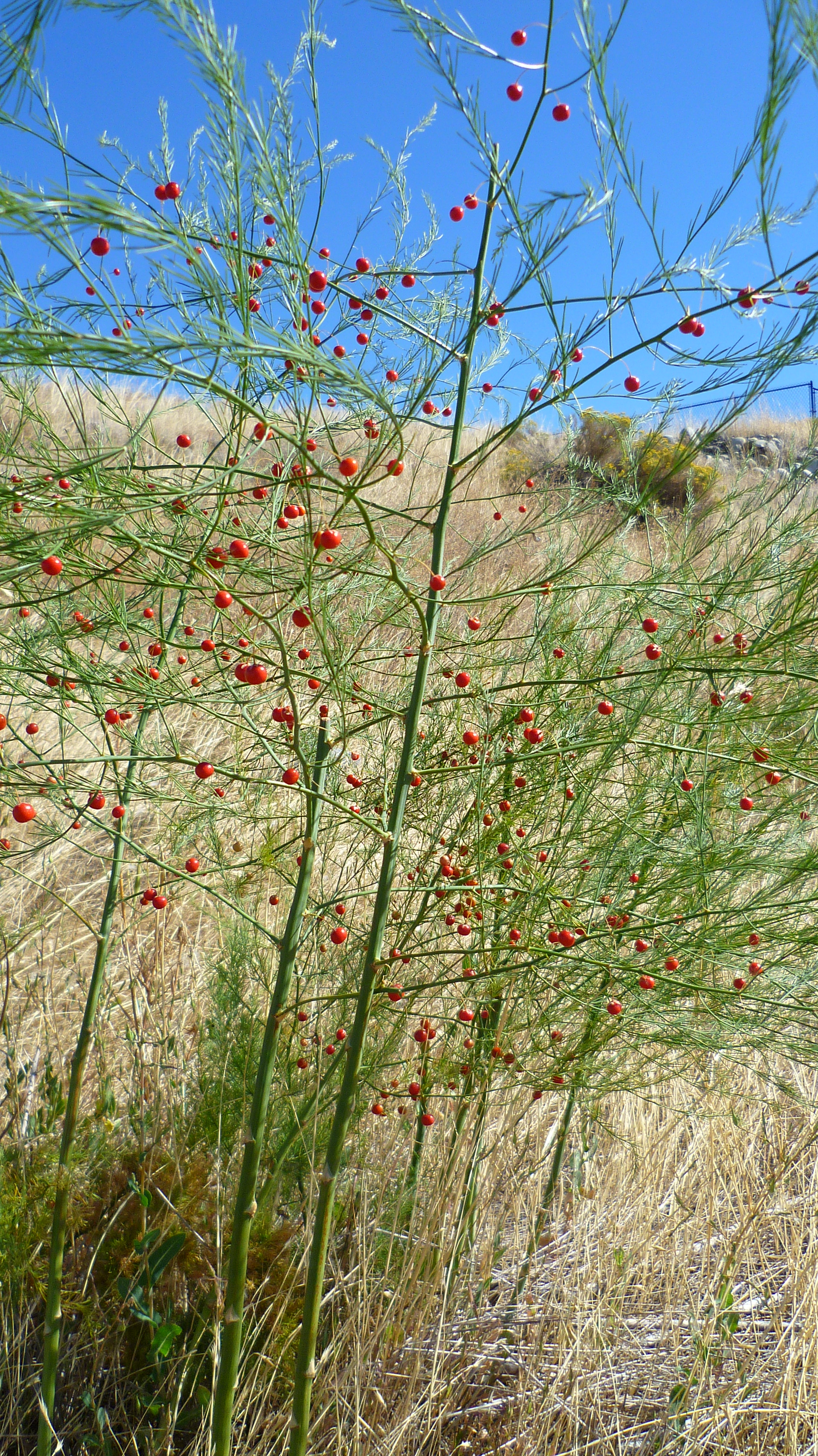
Species of flowering plant in the family Asparagaceae
|Asparagus altilis (L.) Asch. |Asparagus caspius Schult. & Schult.f. |Asparagus esculentus Salisb. |Asparagus fiori Sennen |Asparagus hedecarpus Andrews ex Baker" |Asparagus hortensis Mill. ex Baker |Asparagus littoralis Steven |Asparagus oxycarpus Steven |Asparagus paragus Gueldenst. ex Ledeb. |Asparagus polyphyllus Steven ex Ledeb. |Asparagus sativus Mill. |Asparagus setiformis Krylov |Asparagus vulgaris Gueldenst. ex Ledeb.
Asparagus (Asparagus officinalis) or garden asparagus is a perennial flowering plant species in the genus Asparagus native to Eurasia. Widely cultivated as a vegetable crop, its young shoots are used as a spring vegetable.
Description
Asparagus is an herbaceous, perennial plant growing typically to 100–150 cm tall, with stout stems with much-branched, feathery foliage. It has been known to grow as long as 3.5 m. The 'leaves' are needle-like cladodes (modified stems) in the axils of scale leaves; they are 6 – long and 1 mm broad, and clustered in fours, up to 15, together, in a rose-like shape. The root system, often referred to as a 'crown', is adventitious; the root type is fasciculated.
The flowers are bell-shaped, greenish-white to yellowish, 4.5 – long, with six tepals partially fused together at the base; they are produced singly or in clusters of two or three in the junctions of the branchlets. It is usually dioecious, with male and female flowers on separate plants, but sometimes hermaphrodite flowers are found. The fruit is a small red berry 6-10 mm in diameter, which is toxic to humans.
Asparagus grown natively to the western coasts of Europe (from northern Spain to northwest Germany, north Ireland, and Great Britain) are treated as A. officinalis subsp. prostratus (Dumort.) Corb., distinguished by its low-growing, often prostrate stems growing to only 30 – high, and shorter cladodes 2 – long. Some authors treat it as a distinct species, A. prostratus Dumort.

Etymology
The English word asparagus derives from classical Latin but the plant was once known in English as sperage, from the Medieval Latin sparagus. In the eleventh century AD the word "sparagus" appeared in an English text. See Brunning (June 2010), p. 6. – Brunning uses the term "in print", though no printing technique was used in England at the time. In the same sentence, she states that peasants often called it "sparrow grass", and further on mentions a 1667 diary in which Samuel Pepys bought a bundle of "sparrow grass" in Fenchurch Street, London. This term itself derives from the - aspáragos, a variant of - aspháragos. The Greek terms are of uncertain provenance; the former form admits the possibility of a Proto-Indo-European root meaning "to jerk, scatter," directly or via a Persian descendant meaning "twig, branch"; but the Ancient Greek word itself, meaning "gully, chasm," seems to be of Pre-Greek origin instead.
Asparagus was corrupted by folk etymology in some places to "sparrow grass"; indeed, John Walker wrote in 1791 that "Sparrowgrass is so general that asparagus has an air of stiffness and pedantry". The name 'sparrow grass' was still in common use in rural East Anglia, England well into the twentieth century.
Taxonomy
Asparagus was once classified in the lily family, as were the related Allium species onions and garlic. Genetic research currently places lilies, Allium, and asparagus in three separate families: the Liliaceae, Amaryllidaceae, and Asparagaceae, respectively. The latter two are part of the order Asparagales.
Asparagus populations grown natively to the western coasts of Europe are treated as the subspecies group of prostratus (Dumort.) Corb..
Distribution and habitat
Sources differ as to the plant's native range, but generally include most of Europe and western temperate Asia.
Cultivation
Since asparagus often originates in maritime habitats, it thrives in soils that are too saline for normal weeds to grow. Thus, a little salt was traditionally used to suppress weeds in beds intended for asparagus; this has the disadvantage that the soil cannot be used for anything else. Some regions and gardening zones are better-suited for growing asparagus than others, such as the west coast of North America and other more maritime, "Mediterranean" environments. The fertility of the soil is a large factor. "Crowns" are planted in winter, and the first shoots appear in spring; the first pickings or "thinnings" are known as sprue asparagus. Sprue has thin stems.
A breed of "early-season asparagus" that can be harvested two months earlier than usual was announced by a UK grower in early 2011. This variety does not need to lie dormant and blooms at 7 C, rather than the usual 9 C.
Purple asparagus differs from its green and white counterparts in having high sugar and low fibre levels. Purple asparagus was originally developed in Italy, near the city of Albenga and commercialized under the variety name 'Violetto d' Albenga'. Purple asparagus can also turn green while being cooked due to its sensitivity to heat.
File:Illustration Asparagus officinalis0b.jpg|German botanical illustration of asparagus File:Green Asparagus New York 11 May 2006.jpg|Green asparagus for sale in New York City File:20120511Spargelernte7.ogv|Harvest of white asparagus in Hockenheim, Germany File:Asparagus image.jpg|Cultivated asparagus bundles
Companion planting
Asparagus is said to be a useful companion plant for tomatoes, as the tomato plant repels the asparagus beetle. Asparagus may repel some harmful root nematodes that affect tomato plants.
Production
In 2023, world production of asparagus was 8.6 million tonnes, with China accounting for 87% of the total (table).
| Source: FAOSTAT |
|---|
| of the United Nations |
Uses
The genome of the species has been sequenced as a model to study the evolution of sex chromosomes in plants and dioecy.
Nutrition
Raw asparagus is 93% water, 4% carbohydrates, 2% protein, and contains negligible fat (table). In a reference amount of 100 g, raw asparagus supplies 20 calories, and is a rich source (20% or more of the Daily Value) of vitamin K (35% DV), and a moderate source (11–13% DV) of iron, and the B vitamins, thiamine, riboflavin, and folate, with no other micronutrients in significant content (table).

Culinary
Only young asparagus shoots ("spears") are commonly eaten: once the buds start to open ("ferning out"), the shoots quickly turn woody. The shape of edible spears can vary according to variety; typical shapes are long thin spears from 8mm to 24mm diameter, no longer than 22cm. The roots contain starch.
The shoots are prepared and served in a number of ways around the world, typically as an appetizer or vegetable side dish. In Asian-style cooking, asparagus is often stir-fried. Cantonese restaurants in the United States often serve asparagus stir-fried with chicken, shrimp, or beef. It may also be quickly grilled over charcoal or hardwood embers, and is also used as an ingredient in some stews and soups.
Asparagus can also be pickled and stored for several years. Some brands label shoots prepared in this way as "marinated".
Stem thickness indicates the age of the plant (and not the age of the stalk), with the thicker stems coming from older plants. Older, thicker stalks can be woody, although peeling the skin at the base removes the tough layer. Peeled asparagus will poach much faster.{{cite web |access-date=20 July 2011
Male plants tend to produce spears that are smaller and thinner, while female plants tend produce larger and thicker spears. The thickness of stalks is not an indication of their tenderness; they are thick or thin from the moment they sprout from the ground.
Green asparagus is eaten worldwide, and the availability of imports throughout the year has made it less of a delicacy than it once was. In Europe, according to one source, the "asparagus season is a highlight of the foodie calendar"; in the UK this traditionally begins on 23 April and ends on Midsummer Day. In Europe the short growing season and high demand leads to a relatively high price for local produce, although asparagus is also imported.
Only seasonally on the menu, asparagus dishes are advertised outside many restaurants, usually from late April to June. For the French style, asparagus is often boiled or steamed and served with Hollandaise sauce, white sauce, melted butter or most recently with olive oil and Parmesan cheese. Tall, narrow asparagus cooking pots allow the shoots to be steamed gently, their tips staying out of the water.
In western Himalayan regions, such as Nepal and north-western India, Ornithogalum pyrenaicum, known as "wild asparagus," is harvested as a seasonal vegetable delicacy known as kurilo or jhijhirkani.
White asparagus
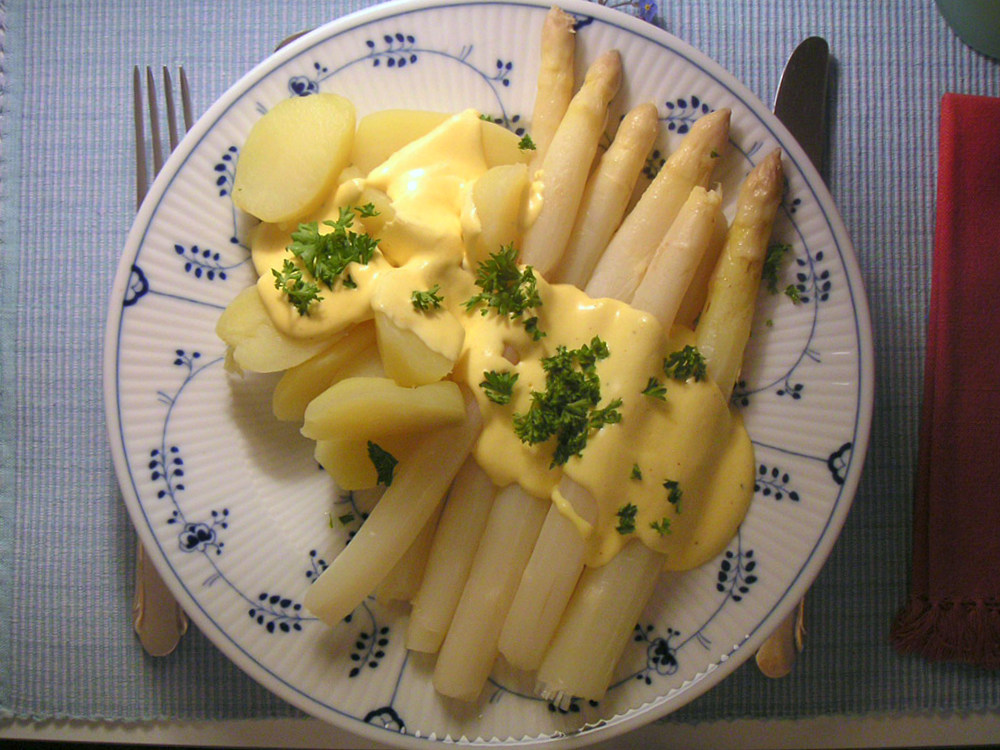
White asparagus is produced by applying a blanching technique while the asparagus shoots are growing: the shoots are covered with soil as they grow, i.e. earthed up; without exposure to sunlight, there is no photosynthesis and the shoots remain white. The locally cultivated so-called "white gold" or "edible ivory" asparagus, also referred to as "the royal vegetable", is believed to be less bitter and more tender than unblanched green. Freshness is valued, and the lower ends of white asparagus must be peeled.
During the German Spargelsaison or Spargelzeit ("asparagus season" or "asparagus time"), the asparagus season that traditionally finishes on 24 June, roadside stands and open-air markets sell about half of the country's white asparagus consumption. urine
In culture
Asparagus has been used as a vegetable owing to its distinct flavor, and in medicine due to its diuretic properties and its purported function as an aphrodisiac. It is pictured as an offering on an Egyptian frieze dating to 3000 BC. In ancient times, it was also known in Syria and in the Iberian Peninsula. Greeks and Romans ate it fresh when in season, and dried the vegetable for use in winter. Emperor Augustus coined the expression "faster than cooking asparagus" for quick action.Latin velocius quam asparagi conquantur (or celerius quam asparagi cocuntur), ascribed to Augustus by Suetonius (*The Lives of the Twelve Caesars, Book 2 *(Augustus), para. 87). See List of Latin phrases (V).
A recipe for cooking asparagus is given in one of the oldest surviving collections of recipes (Apicius's 1st century AD De re coquinaria, Book III). In the second century AD, the Greek physician Galen, highly respected within Roman society, mentioned asparagus as a beneficial herb, but as dominance of the Roman empire waned, asparagus' medicinal value drew little attention until al-Nafzawi's The Perfumed Garden.
By 1469, asparagus was cultivated in French monasteries. Asparagus appears to have been little noticed in England until 1538, and in Germany until 1542.
Asparagus was brought to North America by European settlers at least as early as 1655. Adriaen van der Donck, a Dutch immigrant to New Netherland, mentions asparagus in his description of Dutch farming practices in the New World. Asparagus was grown by British immigrants as well; in 1685, one of William Penn's advertisements for Pennsylvania included asparagus in a long list of crops that grew well in the American climate.
The points d'amour ("love tips") were served as a delicacy to Madame de Pompadour (1721–1764).
Effects on urine
The effect of eating asparagus on urine excreted afterwards has long been observed:
[Asparagus] cause a powerful and disagreeable smell in the urine, as everybody knows. :— Treatise of All Sorts of Foods, Louis Lémery, 1702
asparagus... affects the urine with a foetid smell (especially if cut when they are white) and therefore have been suspected by some physicians as not friendly to the kidneys; when they are older, and begin to ramify, they lose this quality; but then they are not so agreeable. :— "An Essay Concerning the Nature of Aliments", John Arbuthnot, 1735
A few Stems of Asparagus eaten, shall give our Urine a disagreeable Odour... :— "Letter to the Royal Academy of Brussels", Benjamin Franklin, c. 1781
Asparagus "...transforms my chamber-pot into a flask of perfume." :— Marcel Proust (1871–1922)
Asparagus contains asparagusic acid. When the vegetable is digested, a group of volatile sulfur-containing compounds is produced.

Certain compounds in asparagus are metabolized to yield ammonia and various sulfur-containing degradation products, including various thiols and thioesters, which following consumption give urine a characteristic smell. Some of the volatile organic compounds responsible for the smell are:
- methanethiol
- dimethyl sulfide
- dimethyl disulfide
- bis(methylthio)methane
- dimethyl sulfoxide
- dimethyl sulfone
Subjectively, the first two are the most pungent, while the last two (sulfur-oxidized) give a sweet aroma. A mixture of these compounds form a "reconstituted asparagus urine" odor. This was first investigated in 1891 by Marceli Nencki, who attributed the smell to methanethiol. These compounds originate in the asparagus as asparagusic acid and its derivatives, as these are the only sulfur-containing compounds unique to asparagus. As these are more present in young asparagus, this accords with the observation that the smell is more pronounced after eating young asparagus. The biological mechanism for the production of these compounds is less clear.
The onset of the asparagus urine smell is remarkably rapid while the decline is slower. The smell has been reported to be detectable 15 to 30 minutes after ingestion and subsides with a half-life of approximately four hours. Asparagus has been eaten and cultivated for at least two millennia but the association between odorous urine and asparagus consumption was not observed until the late 17th century when sulfur-rich fertilisers became common in agriculture. Small-scale studies noted that the "asparagus urine" odour was not produced by all individuals and estimates as to the proportion of the population who are excretors (reporting a noticeable asparagus urine odour after eating asparagus) has ranged from about 40% to as high as 79%. When excretors are exposed to urine of people who do not report odour in their urine after asparagus consumption, however, the characteristic asparagus urine odour is usually reported. More recent work has found that a small proportion of individuals do not produce asparagus urine, and amongst those who do, some cannot detect the odour due to a single-nucleotide polymorphism within a cluster of olfactory receptors.
Debate exists about the universality of producing the sulfurous smell, as well as the ability to detect it. Originally, this was thought to be because some people digested asparagus differently from others, so some excreted odorous urine after eating asparagus, and others did not. In the 1980s, three studies from France, China, and Israel published results showing that producing odorous urine from asparagus was a common human characteristic. The Israeli study found that from their 307 subjects, all of those who could smell "asparagus urine" could detect it in the urine of anyone who had eaten asparagus, even if the person who produced it could not detect it. A 2010 study found variations in both production of odorous urine and the ability to detect the odor, but that these were not tightly related. Most people are thought to produce the odorous compounds after eating asparagus, but the differing abilities of various individuals to detect the odor at increasing dilutions suggests a genetically determined specific sensitivity.
In 2010, the company 23andMe published a genome-wide association study on whether participants have "ever noticed a peculiar odor when [they] pee after eating asparagus". This study pinpointed a single-nucleotide polymorphism (SNP) in a cluster of olfactory genes associated with the ability to detect the odor. While this SNP did not explain all of the difference in detection between people, it provides support for the theory that genetic differences occur in olfactory receptors that lead people to be unable to smell these odorous compounds.
Celebrations
The green crop is significant enough in California's Sacramento–San Joaquin River Delta region that the city of Stockton holds a festival every year to celebrate it. Oceana County, Michigan, the self-proclaimed "asparagus capital of the world", hosts an annual festival. The Vale of Evesham in Worcestershire (another "asparagus capital") celebrates the annual British Asparagus Festival, with auctions of the best crop, an "Asparagus Run" modelled on the Beaujolais Run, and a weekend "Asparafest" music festival.
Many German cities hold an annual Spargelfest (asparagus festival) celebrating the harvest of white asparagus. Schwetzingen claims to be the "Asparagus Capital of the World".
Gallery
File:Wild-asparagus88.JPG|Wild asparagus sauteed with garlic, naam plaa, and soy sauce File:Asparagus NL.jpg|In the Netherlands and northern Germany, asparagus is often eaten with ham, boiled egg, potatoes, and a melted butter sauce. File:Crème d'asperge à la truffe.jpg|Cream of asparagus soup File:Asparagus3.JPG|Three types of asparagus are on display, with white asparagus at the back and green asparagus in the middle. The plant at the front is Ornithogalum pyrenaicum, commonly called wild asparagus, and sometimes Bath asparagus or Prussian asparagus. File:White Asparagus bacon rice.jpg|Asparagus served with bacon and rice File:Asparagus aphyllus - 2018.jpg|Wild asparagus (Asparagus aphyllus) native to the Levant File:AsparagusFernMilduraVictoriaAustralia.jpg|Asparagus in Mildura, Victoria, Australia File:SkFernlikePlant.jpg|Mature wild asparagus with seed pods in Saskatchewan, Canada
Notes
References
References
- Kell, S.P.. (2016). "''Asparagus officinalis''".
- (2025). "''Asparagus officinalis'' L.". The World Flora Consortium.
- (2004). "Plant Resources of Tropical Africa 2: Vegetables". PROTA Foundation, Wageningen; Backhuys, Leiden; CTA, Wageningen.
- (2 October 2004). "Longest asparagus". Guinness World Records.
- Diderot, D.. (2009). "The Encyclopedia of Diderot & d'Alembert".
- Garden Grow.. (n.d.). "Growing Asparagus".
- Flora Europaea.. (n.d.). "Asparagus officinalis". Royal Botanic Garden Edinburgh.
- "Asparagus prostratus (Asparagus, Wild)". ETI BioInformatics.
- "sparrowgrass".
- (1806). "A Critical Pronouncing Dictionary, and Expositor of the English Language".
- Ewart Evans, George "Ask the Fellows who Cut the Hay"
- Plants of the World Online.. (n.d.). "Asparagus officinalis L.". Royal Botanic Gardens, Kew.
- Euro+Med Plantbase Project.. "Asparagus officinalis". Botanic Garden and Botanical Museum Berlin-Dahlem.
- {{GRIN
- "Glossary – 'S'". [[BBC Food]].
- (19 March 2011). "New breed of early asparagus hits the shelves". The Daily Telegraph.
- (21 May 2014). "Asparagus: this season's hottest shades to grow". The Telegraph.
- (2010-07-20). "Asparagus".
- "Plants for a Future".
- (2025). "Asparagus production in 2023, Crops/Regions/World list/Production Quantity/Year (pick lists)". UN Food and Agriculture Organization, Corporate Statistical Database (FAOSTAT).
- (2017-11-02). "The asparagus genome sheds light on the origin and evolution of a young Y chromosome". Nature Communications.
- "Growing Asparagus in the Home Garden; Section on harvesting". Purdue University Cooperative Extension Service.
- (6 December 2016). "Product Specification: Vale of Evesham asparagus". [[Department for Environment, Food and Rural Affairs.
- (([[United States Department of the Army]])). (2009). "The Complete Guide to Edible Wild Plants". [[Skyhorse Publishing]].
- (2021-12-14). "10 Easy Asparagus Appetizers".
- "Asparagus".
- "Asparagus". University of Illinois Extension.
- Blamey, M. & Grey-Wilson, C. (1989). ''Flora of Britain and Northern Europe''. {{ISBN. 0-340-40170-2.
- [http://www.oxfordtimes.co.uk/leisure/4329516.Time_to_glory_in_asparagus_again/ ''Oxford Times'': "Time to glory in asparagus again".] {{webarchive. link. (7 September 2009)
- "Page Redirection".
- (5 August 2016). "Le Livre de cuisine: Comprenant la cuisine de ménage et la grande cuisine, 1893.". BnF collection ebooks.
- (2018). "Diversity and use of wild and non-cultivated edible plants in the Western Himalaya". Journal of Ethnobiology and Ethnomedicine.
- Creasy, Rosalind. (1999-03-15). "Edible French Garden". Tuttle Publishing.
- (20 May 2009). "Wit goud en koningin der groente: vorstelijke asperges". Infoyo (web publisher).
- Evans, Stephen. (21 April 2012). "Asparagus, royalty and the joys of seasonal eating". BBC News.
- Brunning, Pam. (June 2010). "Asparagus – Liliaceae–Asparagacease". Food & Wine.
- "Over asperge – Oudheid". Stichting Afzetbevordering Asperges.
- (1997). "The New Oxford Book of Food Plants". Oxford University Press.
- (January 1987). "New World Dutch Studies: Dutch Arts and Culture in Colonial America, 1609-1776: Proceedings of the Symposium". SUNY Press.
- Murphy, Andrew R.. (8 October 2018). "William Penn: A Life". Oxford University Press.
- (20 May 2009). "Wit goud en koningin der groente: vorstelijke asperges". Infoyo (web publisher).
- (25 April 1966). "The French Chef; Asparagus From Tip to Butt". [[WGBH Educational Foundation.
- McGee, Harold. (2004). "McGee on Food and Cooking". Hodder and Stoughton.
- Arbuthnot J. (1735). "An Essay Concerning the Nature of Aliments". J. Tonson.
- Franklin, Benjamin. (c. 1781). "Letter to the Royal Academy of Brussels".
- From the French "[...] changer mon pot de chambre en un vase de parfum", ''Du côté de chez Swann'', Gallimard, 1988.
- Stromberg, Joseph. "Why Asparagus Makes Your Urine Smell". smithsonianmag.com.
- White RH.. (1975). "Occurrence of S-methyl thioesters in urines of humans after they have eaten asparagus". Science.
- (26 July 2010). "Excretion and Perception of a Characteristic Odor in Urine after Asparagus Ingestion: a Psychophysical and Genetic Study". Chemical Senses.
- (1987). "The chemical nature of the urinary odour produced by man after asparagus ingestion". Xenobiotica.
- Mitchell S.C.. (2001). "Food idiosyncrasies: beetroot and asparagus". Drug Metabolism and Disposition.
- Nencki, Marceli. (1891). "Ueber das vorkommen von methylmercaptan im menschlichen harn nach spargelgenuss". Arch. Exp. Pathol. Pharmakol..
- (2019-04-01). "Phytochemical compounds and biological activity in Asparagus roots: a review". International Journal of Food Science and Technology.
- Somer, E.. (14 August 2000). "Eau D'Asparagus".
- "Why Your Pee Smells Funny After Eating Asparagus".
- (2016). "The proof is in the pee: Population asparagus urinary odor kinetics". PAGE: Abstracts of the Annual Meeting of the Population Approach Group in Europe.
- Mitchell, S. C.. (2001). "Food idiosyncrasies: Beetroot and asparagus". [[Drug Metabolism and Disposition]].
- (1956). "Two unifactorial characters for which man is polymorphic". [[Nature (journal).
- (1985). "You're in for a treat: Asparagus". North Carolina Medical Journal.
- (2011). "Excretion and perception of a characteristic odor in urine after asparagus ingestion: A psychophysical and genetic study". [[Chemical Senses]].
- (May 1989). "Odorous urine in man after asparagus". Br. J. Clin. Pharmacol..
- S. C. MITCHELL. (May 1989). "Asparagus and malodorous urine". Br. J. Clin. Pharmacol..
- (2010). "Excretion and Perception of a Characteristic Odor in Urine after Asparagus Ingestion: a Psychophysical and Genetic Study". Chemical Senses.
- (23 September 2005). "The scientific chef: asparagus pee". The Guardian.
- Hannah Holmes. "Why Asparagus Makes Your Pee Stink". Discover.com.
- (1980). "A polymorphism of the ability to smell urinary metabolites of asparagus". Br Med J.
- (2010). "Web-Based, Participant-Driven Studies Yield Novel Genetic Associations for Common Traits". PLOS Genet..
- "National Asparagus Festival".
- "A Visitor's Introduction to Evesham". Choosewhere.
- "About the Festival". British Asparagus Festival.
- Davis, William A.. (14 May 2008). "Buried treasure: white asparagus". The Christian Science Monitor.
This article was imported from Wikipedia and is available under the Creative Commons Attribution-ShareAlike 4.0 License. Content has been adapted to SurfDoc format. Original contributors can be found on the article history page.
Ask Mako anything about Asparagus — get instant answers, deeper analysis, and related topics.
Research with MakoFree with your Surf account
Create a free account to save articles, ask Mako questions, and organize your research.
Sign up freeThis content may have been generated or modified by AI. CloudSurf Software LLC is not responsible for the accuracy, completeness, or reliability of AI-generated content. Always verify important information from primary sources.
Report