From Surf Wiki (app.surf) — the open knowledge base
Ash-shab yurid isqat an-nizam
Political slogan used during the Arab Spring
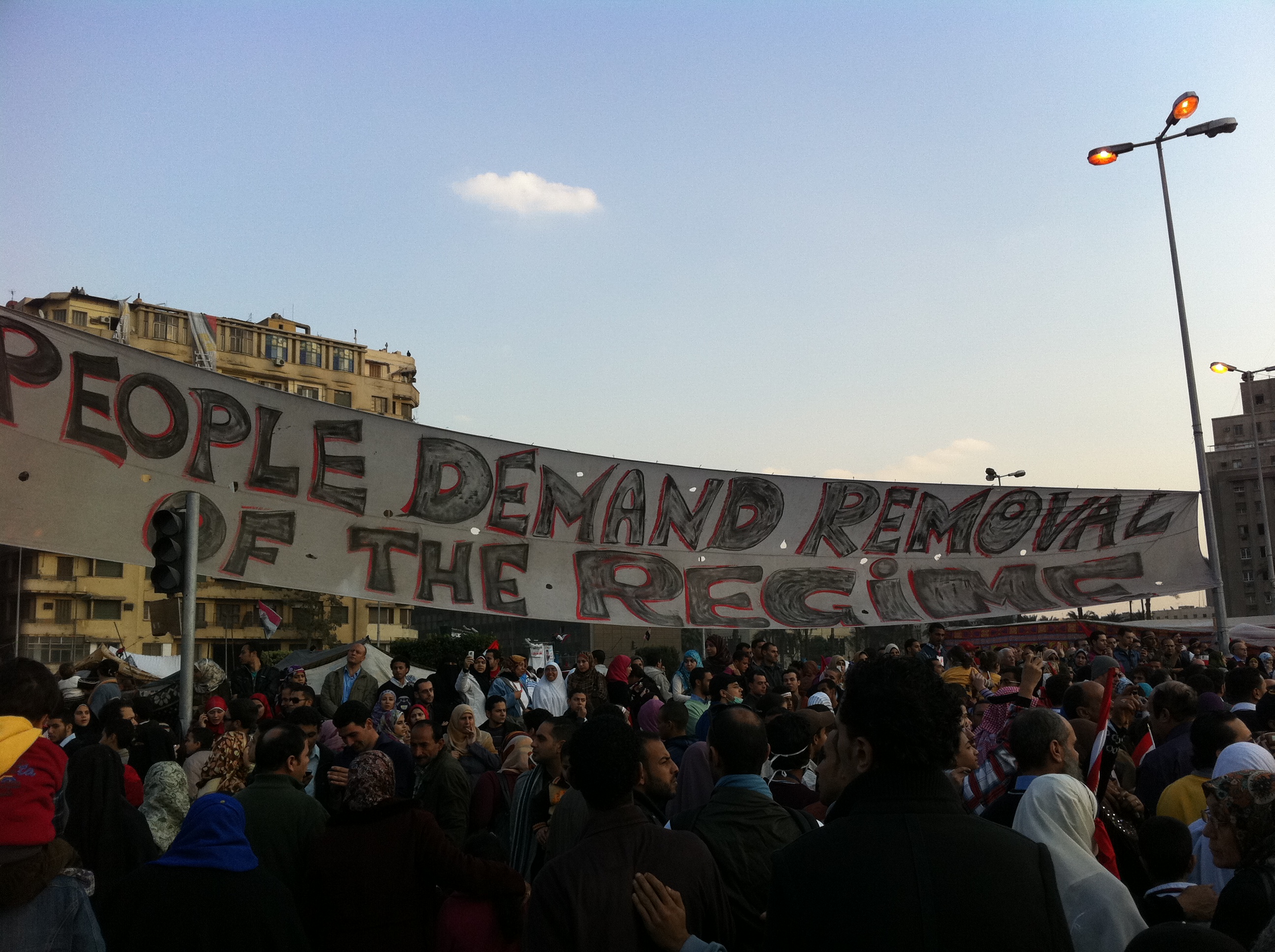
Political slogan used during the Arab Spring
ar (, ) is a political slogan associated with the Arab Spring. The slogan first emerged during the Tunisian Revolution. The chant echoed at Avenue Habib Bourguiba in Tunis for weeks. The slogan also became used frequently during the 2011 Egyptian revolution. It was the most frequent slogan, both in graffiti and in chants in rallies, during the revolution in Egypt.
The chant was raised during the uprising in Bahrain. It was frequently used in protests across Yemen. The slogan was used in rallies across Libya at the beginning of the 2011 revolt. In March 2011, a group of youths under the age of 15 were arrested in Dera'a in southern Syria, after having sprayed ejak el door ya doctor graffiti, translating to "it is your turn doctor" (referring to the regime of Bashar al-Assad, who practiced ophthalmology). Their arrests sparked the uprising and subsequent civil war in Syria. The slogan was also used frequently in Sudan throughout the protests.
In Lebanon, the slogan has been used in protests against that country's sectarian political system. In the Lebanese protests, ar ("the regime") did not refer to the sectarian political order as such, but rather the government.
Variants
Syrian Islamists have appropriated the slogan for their own purposes, altering it to ar (), as well as ar ().
In post-Mubarak Egypt, given the fact that the military government only partially met the demands of the revolutionaries, with the state of emergency remaining in place, some protesters started using a somewhat different version of the slogan: The people want to bring down the field marshal, referring to Field Marshal Mohamed Tantawi, the Chairman of the Supreme Council of the Armed Forces.
Variations of the slogan were used by counter-revolutionaries, including by Bashar al-Assad's supporters in Syria as ar (), by Gaddafists in Libya as ar (), and by King Hamad's loyalists in Bahrain as ar (), referring to the main opposition party of Bahrain, Al-Wefaq.
In Jordan, a youth group named "24 March" used the slogan ar (). However, the slogan later changed to ar in November 2012, when the government imposed a hike in the price of fuel.
In Palestine, a variation of the slogan, ar (), emerged in protests calling for the two main factions Fatah and Hamas to settle their differences.
During the 2011 Israeli social justice protests, the slogan "The people want social justice" was used, chanted in Hebrew to the same cadence as ar.
The slogan was adopted to ar () in protests in Morocco against the normalization of relations with Israel.
Context
Uriel Abulof, professor of politics at Tel-Aviv University and a senior research fellow at Princeton University, commented:
Whether Arab popular uprisings will eventually transform political systems – thus nominally qualified as real revolutions – remains to be seen. But one revolution is real and clear: the people (شعب, sha'ab) was born – a collective, rather than a collection, of individuals, a whole greater than the sum of its parts. The uprising's slogan was not simply, as one might have expected, "down with the regime." It is precisely because the demonstrates felt that the existence of such a people, let alone one in possession of agency, is far from obvious, that they added, in a resolute speech-act – an act created by speech – "the people wants."}}
Benoît Challand, teaching Middle Eastern politics at the University of Bologna, commented on the slogan in the following way:
Rashid Khalidi, the Edward Said professor of Arab studies at Columbia University and the editor of the Journal of Palestine Studies, commented in the following manner:
Gallery
File:Anti-government protest in Assi square of Hama.ogg|Anti-Assad protesters chanting the slogan in the Assi square, during the Siege of Hama on 22 July 2011 File:Anti Ali Abdullah Saleh protest in Sanaa.webm|Anti-Ali Abdullah Saleh protesters chanting the slogan in Sanaa in 2012
References
References
- (4 April 2011). "The Arab Awakening". [[Al Jazeera English]].
- Ertuna, Can. (15 February 2011). "The regime is overthrown, what now?". [[Hürriyet]].
- Beach, Alastair. (1 February 2011). "EXCLUSIVE: On the streets of Cairo". [[The Spectator]].
- Mackey, Robert. (4 February 2011). "Updates on Day 11 of Egypt Protests". [[The New York Times]].
- Shadid, Anthony. (31 January 2011). "In Crowd's Euphoria, No Clear Leadership Emerges". The New York Times.
- Safty, Adel. (28 February 2011). "18 Days That Shook Egypt". Gulf News.
- Escobar, Pepe. (2 February 2011). "The Brotherhood Factor". [[Asia Times]].
- (15 February 2011). "Bahrain Protestors Take Over Key Junction". [[Financial Times]].
- (22 February 2011). "Bahrain Unrest: Thousands join anti-government protest". BBC.
- (2011). "Sa'ada Rallies Repeat "The people want the fall of the regime"". National Yemen.
- (17 February 2011). "Yemen protesters flee armed government loyalists". [[Yahoo! News]].
- El Gharbi, Jalel. (21 February 2011). "The fall of Qaddafi's throne". [[Babelmed]].
- Sinjab, Lina. (19 March 2011). "Middle East Unrest: Silence broken in Syria". BBC.
- Fadel, Leila. (25 March 2011). "After deadly crackdown, a test of wills looms in Syria". [[The Washington Post]].
- ".:Middle East Online::Protests widen, and grow: Sudanese want to overthrow regime:.".
- Barker, Anne. (7 March 2011). "Beirut Protesters Demand End to Sectarianism". [[Australian Broadcasting Corporation]].
- Constantine, Zoe. (9 March 2011). "No sects, please, we're Lebanese, say campaigners for secular state". [[The National (Abu Dhabi).
- (2012-03-02). "What do the people want? Dissection of the Arab Spring slogan". Tabeer.
- Evan Hill. (30 June 2011). "Scorecard: Egypt's army and the revolution". [[Al-Jazeera English]].
- "حشد مليوني في قلب العاصمة دمشق يهتف بصوت واحد: الشعب يريد بشار الأسد". al-Intiqad.
- (2011-03-04). "شلقم يطالب القذافي بالرحيل وعبد الجليل يعد بنقل الانتفاضة للعاصمة ومعارك ضارية بين الثوار وقوات النظام ومقتل 50 في الزاوية".
- (22 February 2012). "Bahrain Sunnis warn government over dialogue at rally".
- Sadiki, Larbi. (29 February 2012). "En passant in Jordan: The king's dilemma". [[Al-Jazeera English]].
- (2012-11-16). "Jordan protesters call for "downfall of the regime"". Reuters.
- Abu Toameh, Khaled. (15 March 2011). "Palestinians Demand: 'We want to end the division'". [[The Jerusalem Post]].
- (10 August 2011). "Massive Protests Raise the Question: Should Israel be More European or American?".
- (2022-12-25). "محتجون بالرباط يطالبون بإسقاط التطبيع".
- (2021-05-16). "حناجر المحتجين تصدح وسط الرباط بشعارات "الشعب يريد إسقاط التطبيع"".
- (2022-12-24). "احتجاجات في 30 مدينة مغربية: "الشعب يريد إسقاط التطبيع"". [[The New Arab]].
- Abulof, Uriel. (3 October 2011). "What Is the Arab Third Estate?". Huffington Post.
- Challand, Benoit. (2 March 2011). "The Counter-Power of Civil Society in the Middle East". Deliberately Considered.
- Khalidi, Rashid. (24 February 2011). "Reflections on the revolutions in Tunisia and Egypt". The Middle East Channel.
- (2023-08-06). "Despite Hamas' crackdown, Gaza protests continue in rare defiance". [[Al-Monitor]].
This article was imported from Wikipedia and is available under the Creative Commons Attribution-ShareAlike 4.0 License. Content has been adapted to SurfDoc format. Original contributors can be found on the article history page.
Ask Mako anything about Ash-shab yurid isqat an-nizam — get instant answers, deeper analysis, and related topics.
Research with MakoFree with your Surf account
Create a free account to save articles, ask Mako questions, and organize your research.
Sign up freeThis content may have been generated or modified by AI. CloudSurf Software LLC is not responsible for the accuracy, completeness, or reliability of AI-generated content. Always verify important information from primary sources.
Report