From Surf Wiki (app.surf) — the open knowledge base
Arunachal Pradesh
State in northeast India
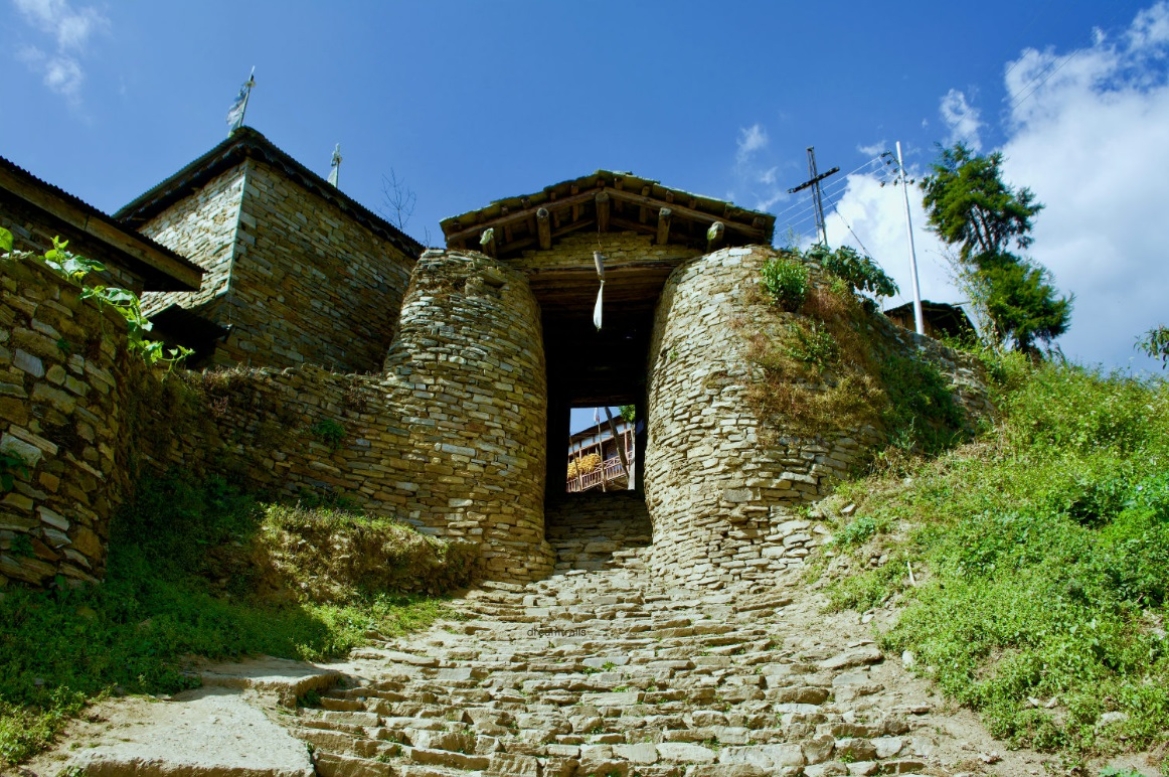
State in northeast India
| Field | Value |
|---|---|
| name | Arunachal Pradesh |
| type | State |
| image_skyline | {{Multiple image |
| border | infobox |
| total_width | 280 |
| image_style | border:1; |
| perrow | 2/2/2/2 |
| image1 | The Tawang Monastery.jpg |
| caption1 | Tawang Monastery |
| image2 | Tawang Gate.jpg |
| caption2 | Tawang Gate, Tawang |
| image3 | A wintry morning in Vijaynagar.jpg |
| caption3 | Vijaynagar |
| image4 | Golden Pagoda Namsai Arunachal Pradesh.jpg |
| caption4 | Golden Pagoda, Namsai |
| image5 | Natural beauty of Mechuka, Arunachal Pradesh 8.jpg |
| caption5 | Mechuka |
| image6 | Ziro valley of Aruncahl in summer season.jpg |
| caption6 | Ziro valley |
| image7 | Madhuri Lake.jpg |
| caption7 | Madhuri Lake |
| image8 | Sela Pass .jpg |
| caption8 | Sela Pass |
| caption9 | Golden Jubilee Stadium |
| image_seal | Arunachal Pradesh Seal.svg |
| etymology | Arunachal ('dawn-lit mountains') and Pradesh ('province or territory') |
| nickname | "Land of Rising Sun" |
| motto | Satyameva Jayate (Truth Alone Triumphs) |
| image_map | IN-AR.svg |
| coordinates | |
| region | Northeast India |
| before_was | North-East Frontier Agency |
| formation_date1 | 21 January 1972 |
| formation_date2 | formation1 |
| formation_date4 | 20 February 1987 |
| capital | Itanagar |
| largestcity | capital |
| districts | 28 |
| Governor | Kaiwalya Trivikram Parnaik |
| Chief_Minister | Pema Khandu (BJP) |
| Deputy_CM | Chowna Mein (BJP) |
| judiciary | Gauhati High Court-Itanagar Bench |
| legislature_type | Unicameral |
| assembly | Arunachal Pradesh Legislative Assembly |
| assembly_seats | 60 seats |
| rajya_sabha_seats | 1 seat |
| lok_sabha_seats | 2 seats |
| area_footnotes | |
| area_total_km2 | 83743 |
| area_rank | 14th |
| elevation_footnotes | |
| elevation_max_m | 7,090 |
| elevation_max_point | Kangto |
| elevation_min_m | 44 |
| elevation_min_point | Brahmaputra River |
| population_total | 1,383,727 |
| population_as_of | 2011 |
| population_rank | 27th |
| population_urban | 22.94% |
| population_rural | 77.06% |
| population_density | 17 |
| population_footnotes | |
| population_demonym | Arunachalis |
| 0fficial_Langs | English |
| official_script | Latin script |
| GDP_total | |
| GDP_year | 2025–26 |
| GDP_rank | 31st |
| GDP_per_capita | |
| GDP_per_capita_rank | 16th |
| HDI_year | 2023 |
| HDI | 0.722 |
| HDI_rank | 17th |
| literacy | 84.2% |
| literacy_year | 2024 |
| literacy_rank | 21st |
| sex_ratio | 997♀/1,000 ♂ |
| sexratio_year | 2021 |
| sexratio_rank | 5th |
| iso_code | IN-AR |
| registration_plate | AR |
| website | arunachalpradesh.gov.in |
| foundation_day | Arunachal Pradesh Day |
| mammal | Mithun |
| bird | Hornbill |
| fish | Golden Mahseerref |
| flower | Foxtail orchid |
| tree | Hollong |
| image_highway | SH IN-AR.png |
Arunachal Pradesh (; ) is a state in northeast India. It was known as the North-East Frontier Agency until 1972, after which it became a union territory under the name Arunachal Pradesh. It became a state on 20 February 1987. Itanagar is its capital and largest town.
It shares international borders with Bhutan in the west, Myanmar in the east, and a disputed 1,129 km border with China's Tibet Autonomous Region in the north at the McMahon Line. Arunachal Pradesh is claimed in its entirety by China as South Tibet as part of the Tibet Autonomous Region; China occupied some regions of Arunachal Pradesh in 1962 but later withdrew its forces.
As per the 2011 census, Arunachal Pradesh has a population of 1,383,727. With only 17 inhabitants per square kilometre, it is the least densely populated state in India. It is an ethnically diverse state, with predominantly Monpa people in the west, Tani people in the centre, Mishmi and Tai people in the east, and Naga people in the southeast of the state. About 23 major tribes and 100 sub-tribes live in the state, including Nocte, Adi, Nyishi, Singpho, Galo, Tagin, and Apatani. The Nyishi are the largest ethnic group in the region. The Mishmi tribe has three sub-tribes, namely Idu-Mishmi, Digaru-Mishmi, and Miju-Mishmi.
Etymology
Arunachal Pradesh means Land of the Dawn-Lit Mountains, which is the sobriquet for the state in Sanskrit. The term was coined during the formation of the state. Prior to the year 1972, it was called North-East Frontier Agency.
The People's Republic of China (PRC) does not recognize Arunachal Pradesh, and claims the land to be part of Tibet, calling it South Tibet ( pinyin: Zàngnán). In ancient Tibetan texts, eastern Arunachal Pradesh and some parts of Tibet were called Lhoyü while the residents were called Lhobha people, while Tawang district and West Kameng district in western Arunachal Pradesh were called Monyul.
History
Ancient period
Main article: Monpa people, Prince Tsangma
Very little ancient history is known about the region apart from the Northwestern corner, and the areas bordering current Assam. The Northwestern regions came under Monpa and Tibetan control.
Northwestern parts of this area came under the control of the Monpa kingdom of Monyul under Tibet which flourished between 500 BCE and 600 CE. The Monpa and Sherdukpen keep historical records of the existence of local chiefdoms in the northwest as well.
According to Tibetan chronicles, Monyul was ruled by Gongkar Gyal, descendent of an exiled Tibetan ruler named Lhase Tsangma, the brother of Tibetan king Ralpacan who arrived in Monyul in 837 A.D or earlier.
A descendant of Gongkar Gyal became the ruler of Trashiyangtse region of Bhutan and Gapde Tsan another descendant was the ruler of Khorwong valley in Thembang town (now West Kameng district, Arunachal Pradesh).
Later, the second son of Gongkar Gyal, Wongme Palde who returned to Tibet owing to the poverty in Khorwong valley came back to Monyul to become its ruler.
The Rgyal rigs text written in 1668 or 1728 contains a record of taxes collected. Taxes were paid via coins, foodstuffs, or livestock from area around present-day Kameng district and Tawang district.
The Monpas () ་known to the Chinese as Menba were responsible for trade between Assam and Tibet and held the Koriapar Dooar at Sonitpur district of Assam. The Monpa chief were subordinate to the ruler of Tawang who in turn were subordinate to the Government of Tibet or Ganden Phodrang in Lhasa. The Tibetan government at Lhasa appointed Tibetan officials called Gellongs to supervise the local Monpa chief. The Monpa chief who looked after the Duar were called Tsorgon, a position created in the 16th century.
According to historical Tibetan text the state of Arunachal Pradesh known as Lhoyu came under the control of Tubo Kingdom or Tibetan Empire in the 7th century CE.

Medieval period
Main article: Tsangyang Gyatso, Tawang Monastery

In the 17th century, the 5th Dalai Lama Ngawang Lobsang Gyatso (1617–1682), who achieved political supremacy over Tibet in 1642, imposed a tax called Khrey over Monyul and instructed the construction of fortresses in Monpa area called Dzong which served as centers for administration and tax collection.
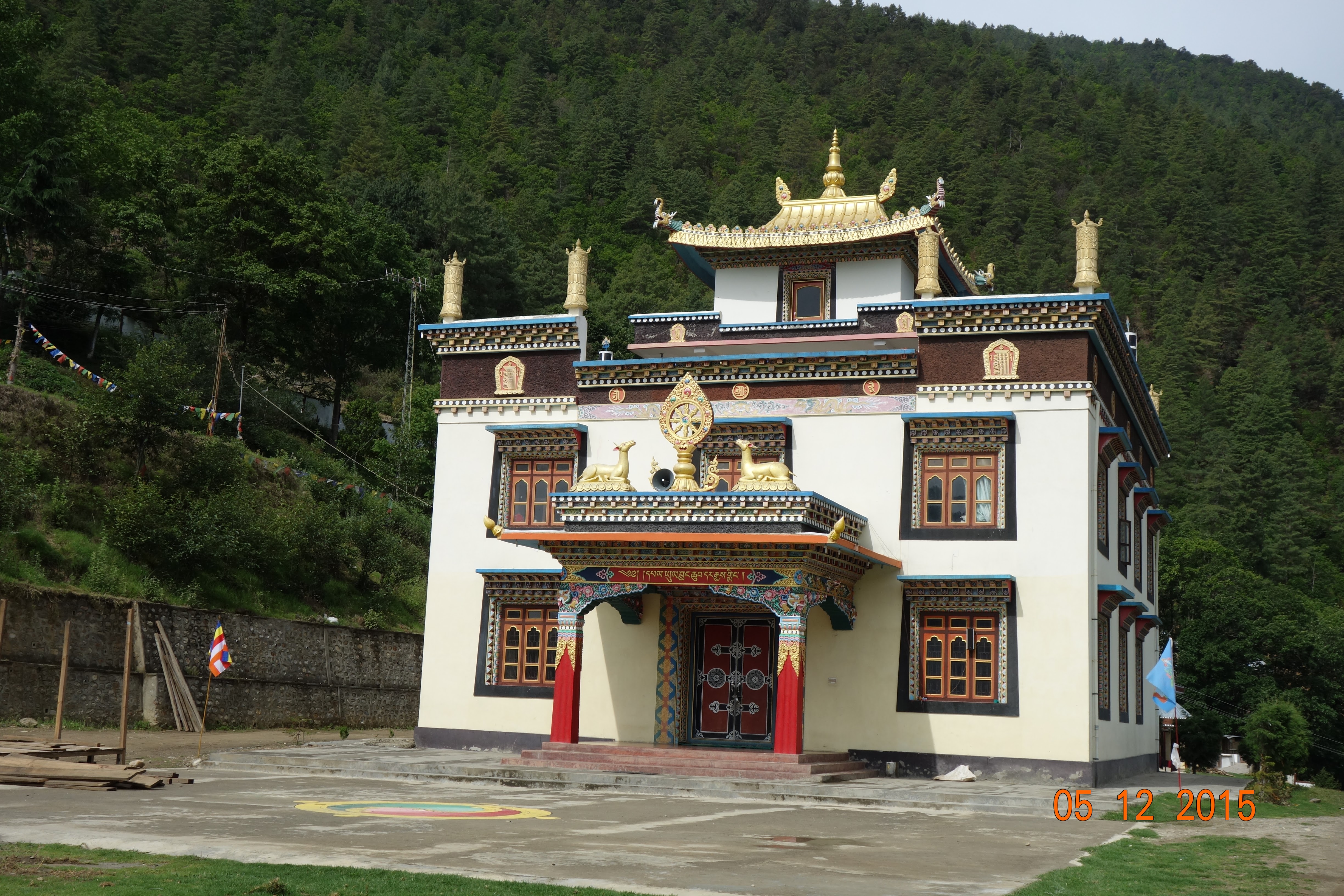
The fortressess built were Dirang Dzong, Taklung Dzong and Gyangkhar Dzong to collect tax from the Dirang Monpa, Kalaktang Monpa and Tawang Monpa respectively. The officials who collected the taxes were called Dzongpon.
The tax was carried to Tawang Monastery and then to Lhasa via Tsona city (present-day China).
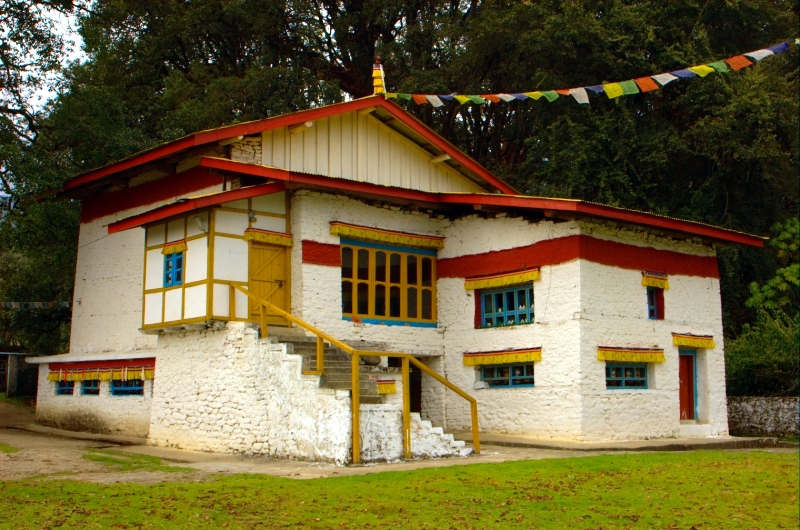
The 6th Dalai Lama Tsangyang Gyatso (1683–1706) was born in Tawang and died in Amdo (present-day China) on his way to Beijing after being kidnapped by the Mongol forces under Lha-bzang Khan, the last ruler of Khoshut Khanate on the approval of Kangxi Emperor of the Qing dynasty.
Before his death the 6th Dalai Lama instructed the construction of notable buildings like Tromzikhang in Barkhor, Lhasa.

Arunachal Pradesh falls under Kham () and Ü-Tsang () cultural region of Tibet which also includes the Brahmaputra River watershed.
The foothills and the plains, were under the control of the Chutia kings of Assam. Inner parts of the state remained independent and self-governed even though interactions with external parties did exist.
The main archaeological sites of the state include:
| Site | Dated to | Built by | ||
|---|---|---|---|---|
| Bhismaknagar Fort, Roing | ||||
| Bolung Fort, Bolung | ||||
| Dimachung-Betali, West Kameng | ||||
| Gomsi Fort, East Siang | ||||
| Rukmini Fort, Roing | ||||
| Tezu Fort, Roing | ||||
| Naksha Parbat ruins, East Kameng | ||||
| Ita Fort, Itanagar | ||||
| Buroi Fort, Papum Pare | ||||
| Malinithan Temple, Likabali | ||||
| Ita Pukhuri, Ithili | ||||
| Padum Pukhuri, Ithili | ||||
| Kampona brick tank, Idili | ||||
| Kanying brick tank, Idili | ||||
| Bolung brick canal, Bolung | ||||
| Dirang Dzong, West Kameng | ||||
| Tawang Monastery, Tawang |
British India
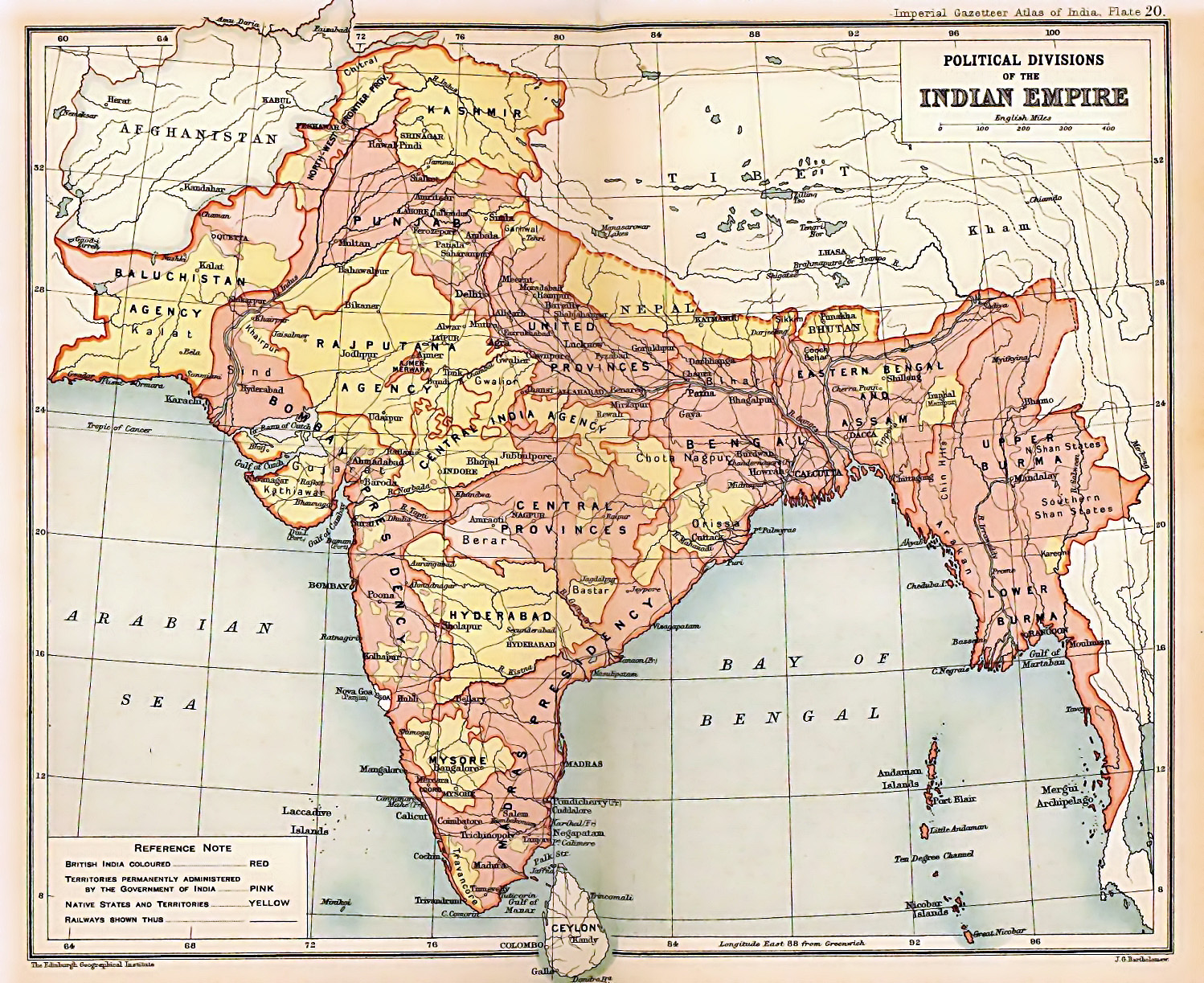

In 1912–13, the British Indian government established the North-East Frontier Tracts. It was divided into three sections, which eventually came to be called the Ballipara Frontier Tract, Lakhimpur Frontier Tract and Sadiya Frontier Tract.
The McMahon line
Main article: McMahon Line

In 1913–1914, representatives of the de facto independent state of Tibet and Britain met in India to define the borders of 'Outer Tibet' (with respect to China). British administrator Sir Henry McMahon drew the 550 mi McMahon Line as the border between British India and Tibet, placing Tawang and other areas within British India. The Tibetan and British representatives devised the Simla Accord including the McMahon Line, but the Chinese representatives did not concur. The Simla Accord denies other benefits to China unless it assents to the Accord.
The Chinese position was that Tibet was not independent from China and could not sign treaties, so the Accord was invalid, like the Anglo-Chinese (1906) and Anglo-Russian (1907) conventions. British records show that the condition for the Tibetan government to accept the new border was that China must accept the Simla Convention. As Britain was not able to get an acceptance from China, Tibetans considered the McMahon line invalid.
In the time that China did not exercise power in Tibet, the line had no serious challenges. In 1935, a Deputy Secretary in the Foreign Department, Olaf Caroe, "discovered" that the McMahon Line was not drawn on official maps. The Survey of India published a map showing the McMahon Line as the official boundary in 1937. In 1938, two decades after the Simla Conference, the British finally published the Simla Accord as a bilateral accord and the Survey of India published a detailed map showing the McMahon Line as a border of India.
In April 1938, a small British force led by Captain G. S. Lightfoot arrived in Tawang and informed the monastery that the district was now Indian territory. The Tibetan government at Lhasa protested and its authority was restored after Lightfoot's return.
In 1944, Britain established administrations in the area, from Dirang Dzong in the west to Walong in the east. Administrative control extended over the area of the Tawang tract lying south of the Sela Pass when J.P. Mills set up an Assam Rifles post at Dirang Dzong and sent the Tibetan tax-collectors packing. Tibetan protests were brushed aside. However, no steps were taken to evict Tibet from the area north of the pass which contained Tawang town. The Tawang district remained under Tibetan authority until 1951.
Sino-Indian War
Main article: Sino-Indian War
Following the conclusion of British rule, India gained independence in 1947, while the People's Republic of China (PRC) was founded in 1949. The new Chinese administration maintained the position that the McMahon Line was not valid.
In October 1947, independent Tibet wrote a note to the Government of India asking for a "return" of the territories that the British had allegedly occupied from Tibet. Among these were listed Zayul and Walong and in direction of Pemakoe, Lonag, Lopa, Mon, Bhutan, Sikkim, Darjeeling. After negotiation with the Indian government, Tibet relinquished claims on these territories.
In November 1950, the PRC was poised to take over Tibet by force, and India supported Tibet. Journalist Sudha Ramachandran argued that China claimed Tawang on behalf of Tibetans, though Tibetans did not claim Tawang as part of Tibet.
In February 1951, India sent Ralengnao Khathing of Manipur with a small escort and several hundred porters to Tawang and took control of the remainder of the Tawang tract from the Tibetans, removing the Tibetan administration.
What is now Arunachal Pradesh was established as the North-East Frontier Agency (NEFA) in 1954. Sino-Indian relations were cordial until 1960. Resurgence of the border disagreement was a factor leading to the Sino-Indian War in 1962, during which China captured most of Arunachal Pradesh, including the Tawang tract. China soon declared victory, withdrew back to the McMahon Line, and returned Indian prisoners of war in 1963.
The war resulted in the termination of barter trade with Tibet, although since 2007 the Indian government has shown signs of wanting to resume barter trade.
Renaming and statehood
Under the leadership of Indira Gandhi, The North-East Frontier Agency (NEFA) was renamed Arunachal Pradesh on 20 January 1972, and it became a union territory. Later on, Arunachal Pradesh became a state on 20 February 1987 during Rajiv Gandhi's government.
NB: K A A Raja, as Chief Commissioner to NEFA, under Assam, whose Capital used to be Shillong, later on went to become the first Lieutenant Governor to the Union Territory of Arunachal Pradesh.
Recent claims
The 14th Dalai Lama did not originally recognise India's sovereignty over Arunachal Pradesh. As late as 2003, he said that "Arunachal Pradesh was actually part of Tibet". In January 2007, the Dalai Lama said that both Britain and Tibet had recognised the McMahon Line in 1914. In 2008, he said that Arunachal Pradesh was a part of India under the agreement signed by Tibetan and British representatives. According to the Dalai Lama, "In 1962 during the India-China war, the People's Liberation Army (PLA) occupied all these areas (Arunachal Pradesh) but they announced a unilateral ceasefire and withdrew, accepting the current international boundary".
In recent years, China has occasionally asserted its claims on Tawang. India rebutted these claims and told the Chinese government that Tawang is an integral part of India. India reiterated this to China when the two prime ministers met in Thailand in October 2009. A report that the Chinese Army had briefly invaded Arunachal Pradesh in 2016 was denied by India's Minister of State for Home Affairs, Kiren Rijiju. In April 2017, China strongly objected to a visit to Tawang by the Dalai Lama, as it had to an earlier visit by the US ambassador. China had objected to the Dalai Lama's previous visits to the area.
In 2024, The New York Times reported that, according to satellite imagery, China had constructed villages along and inside of disputed territory within Arunachal Pradesh. Chinese individuals, called "border guardians", received annual subsidies to relocate to newly built villages and paid to conduct border patrols.
Insurgency
Main article: Insurgency in Arunachal Pradesh
Arunachal Pradesh has faced threats from insurgent groups, notably the National Socialist Council of Nagaland (NSCN), who are believed to have base camps in the districts of Changlang and Tirap. These groups seek to decrease the influence of Indian government in the region and merge part of Arunachal Pradesh into Nagaland.
The Indian army is present along the Tibetan border to thwart any Chinese incursion. Under the Foreigners (Protected Areas) Order 1958 (India), Inner Line Permits (ILPs) are required to enter Arunachal Pradesh through any of its checkgates on the border with Assam.
Geography
Main article: Geography of Arunachal Pradesh

Arunachal Pradesh is located between 26.28° N and 29.30° N latitude and 91.20° E and 97.30° E longitude and has an area of 83743 km2.
The highest peak in the state is Kangto, at 7060 m. Nyegi Kangsang, the main Gorichen peak, and the Eastern Gorichen peak are other tall Himalaya peaks. The state's mountain ranges, in the extreme East of India, are described as "the place where the sun rises" in historical Indian texts and named the Aruna Mountains, which inspired the name of the state. The villages of Dong (more accessible by car, and with a lookout favoured by tourists) and Vijaynagar (on the edge of Myanmar) receive the first sunlight in all of India.

Major rivers of Arunachal Pradesh include the Kameng, Subansiri, Siang (Brahmaputra), Dibang, Lohit and Noa Dihing rivers. Subsurface flows and summer snow melt contribute to the volume of water. Mountains until the Siang river are classified as the Eastern Himalayas. Those between the Siang and Noa Dihing are classified as the Mishmi Hills that may be part of the Hengduan Mountains. Mountains south of the Noa Dihing in Tirap and Longding districts are part of the Patkai Range.
Climate
The climate of Arunachal Pradesh varies with elevation. The low-altitude areas have a humid subtropical climate. High-altitude areas (3,500–5,500 m) have a subtropical highland climate and alpine climate. Arunachal Pradesh receives 2,000 to of rainfall annually, 70%–80% obtained between May and October.
Biodiversity
Arunachal Pradesh has among the highest diversity of mammals and birds in India. There are around 750 species of birds and more than 200 species of mammals in the state.

Flora
In the year 2000, Arunachal Pradesh was covered with 63,093 km2 of tree cover (77% of its land area). It harbours over 5,000 plants. At the lowest elevations, essentially at Arunachal Pradesh's border with Assam, are Brahmaputra Valley semi-evergreen forests. Much of the state, including the Himalayan foothills and the Patkai hills, are home to Eastern Himalayan broadleaf forests. Toward the northern border with Tibet, with increasing elevation, come a mixture of Eastern and Northeastern Himalayan subalpine conifer forests followed by Eastern Himalayan alpine shrub and meadows and ultimately rock and ice on the highest peaks. It supports many medicinal plants and within Ziro valley of Lower Subansiri district 158 medicinal plants are being used by its inhabitants. The mountain slopes and hills are covered with alpine, temperate, and subtropical forests of dwarf rhododendron, oak, pine, maple and fir. The state has Mouling and Namdapha national parks.
Fauna
The major animal species are tiger, leopard, snow leopard, Asian elephant, sambar deer, chital deer, barking deer, sloth bear, mithun (Bos frontalis), gaur, dhole, giant squirrel, marbled cat, leopard cat. A new subspecies of hoolock gibbon has been described from the state which has been named as the Mishmi Hills hoolock gibbon (H. h. mishmiensis). Three new giant flying squirrels were also described from the state during the last one and half-decade. These were, Mechuka giant flying squirrel, Mishmi Hills giant flying squirrel, and Mebo giant flying squirrel.
Administration
Districts
Main article: Districts of Arunachal Pradesh
Arunachal Pradesh comprises three divisions, namely, Central, East and West, each headed by a divisional commissioner and twenty-eight districts, each administered by a deputy commissioner. West Siang is the largest district by area and Tawang is the smallest district. Papum is the largest district by population and Diwang Valley is the smallest.
| Division | West | Central | East |
|---|---|---|---|
| Headquarters | Yazali | Basar | Namsai |
| Districts |
Major towns
Below are the major towns in Arunachal Pradesh.
Municipal corporation
- Itanagar Municipal Corporation
Municipal councils
- Pasighat Municipal council
Municipal committees
- Deomali
- Aalo
- Seppa
- Tezu
- Daporijo
- Namsai
- Ziro
- Roing
- Tawang
- Khonsa
- Bomdila
- Pasighat
Towns
- Jairampur
- Deomali
- Aalo
- Yingkiong
- Changlang
- Miao
- Basar
- Dirang
- Anini
- Koloriang
- Rupa
- Boleng
- Hawai
- Sagalee
- Yupia
- Doimukh
- Gumto
- Longding
- Pangin
- Likabali
- Malinithan
- Bhalukpong
- Nampong
- Hayuliang
- Palin
- Jamin
- Bhismaknagar
- Akshiganga
- Mechukha
- Pasighat
- Ziro
- Raga
Demographics
Main article: Demographics of Arunachal Pradesh

| 1961 | 336,558 | 1971 | 467,511 | 1981 | 631,839 | 1991 | 864,558 | 2001 | 1,097,968 | 2011 | 1,383,727
As per the 2011 Census, Arunachal Pradesh has 12 Scheduled Tribes, comprising 68.79% of its population. The state can be roughly divided into a set of semi-distinct cultural spheres, on the basis of tribal identity, language, religion and material culture: the Tibetic-speaking Monpa area bordering Bhutan in the west, the Tani area in the centre of the state, the Mishmi area to the east of the Tani area, the Tai/Singpho/Tangsa area bordering Myanmar, and the Naga area to the south, which also borders Myanmar. In between there are transition zones, such as the Aka/Hruso/Miji/Sherdukpen area, between the Tibetan Buddhist tribes and the animist Tani hill tribes. In addition, there are isolated peoples scattered throughout the state, such as the Sulung.

Within each of these cultural spheres, one finds populations of related tribes speaking related languages and sharing similar traditions. In the Tibetic area, one finds large numbers of Monpa tribespeople, with several subtribes speaking closely related but mutually incomprehensible languages, and also large numbers of Tibetan refugees. Within the Tani area, major tribes include the Nyishi. Apatani also live among the Nyishi, but are distinct. In the north one find the Tagin People. In the centre, one finds predominantly Galo people, with the major sub-groups of Karka, Lodu, Bogum, Lare and Pugo among others, extending to the Ramo and Pailibo areas (which are close in many ways to Galo). In the east, one finds the Adi with many subtribes including Padam, Pasi, Minyong and Bokar, among others. Milang, while also falling within the general Adi sphere, are in many ways quite distinct. Moving east, the Idu, Miju and Digaru make up the Mishmi cultural-linguistic area.
Moving southeast, the Tai Khamti are linguistically distinct from their neighbours and culturally distinct from the majority of other Arunachalese tribes. They follow the Theravada sect of Buddhism. They also exhibit considerable convergence with the Singpho and Tangsa Naga tribes of the same area, all of which are also found in Burma. They are one of the most recent people group migrated to Arunachal region from Burma. The Nocte Naga and Wancho Naga are another two major ethnic tribes. Both the tribes exhibit very much cultural similarities. Finally, the Deori tribe is also a major community in the state, with their own distinctive identity. They are the descendants of the priestly class of Chutia people who were allowed to continue their livelihood after the defeat of the Chutias. Deoris are one of the only Arunachal tribes in the historical records – which shows they are among the first ethnic groups to inhabit the Himalayas of the districts of Dibang Valley and Lohit, before the arrival of many other tribes in the region between 1600 and 1900.
Religion
Main article: Religion in Arunachal Pradesh, Hinduism in Arunachal Pradesh

According to the 2011 Indian Census, 418,732 (30.26%) are Christians, 401,876 (29.04%) are Hindus, 162,815 (11.77%) Buddhists, 27,045 (1.95%) Muslims, 3,287 (0.24%) Sikhs, 771 (0.06%) Jains and 362,553 (26.20%) are adherents of various tribals belief including Donyi-Polo. However, the religious landscape of Arunachal Pradesh is diverse with no single religious group representing the majority of the population, although it is one of the few Indian states where Christianity has the most followers. A relatively large percentage of Arunachal's population are nature worshippers (indigenous religions), and follow their own distinct traditional institutions like the Nyedar Namlo by the Nyishi, the Rangfrah by the Tangsa & Nocte, Medar Nelo by the Apatani, the Kargu Gamgi by the Galo and Donyi-Polo Dere by the Adi under the umbrella of the indigenous religion the Donyi-Polo. A small number of Arunachali people have traditionally identified as Hindus, although the number may grow as animist traditions are absorbed into Hinduism. Tibetan Buddhism predominates in the districts of Tawang, West Kameng, and isolated regions adjacent to Tibet. Theravada Buddhism is practised by groups living near the Myanmar border. Around 30% of the population are Christians.
Buddhism arrived in Arunachal Pradesh in 8th century CE from Tibet.
In 1971, the percentage of Christians in the state was 0.79%. This increased to 10.3% by 1991 and by 2011 it had crossed 25%.
Languages
The speakers of major languages of the state according to the 2011 census are Nyishi (20.74%), Adi (17.35%, includes Adi and Gallong), Nepali (6.89%), Tagin (4.54%), Bhotia (4.51%), Wancho (4.23%), Assamese (3.9%), Bangla (3.65%), Hindi (3.45%), Chakma (3.40%), Apatani (3.21%), Mishmi (3.04%), Tangsa (2.64%), Nocte (2.19%), Bhojpuri (2.04%) and Sadri (1.03%).
The vast majority of Arunachal Pradesh speaks Tani languages of the Tibeto-Burman language family. Tani people are indigenous to central Arunachal Pradesh, including (moving from west to east) the Nyishi, the Apatani, the Tagin, the Galo, the Bokar, the Adi, the Padam, the Pasi, and the Minyong. The Tani languages are noticeably characterised by an overall relative uniformity, suggesting relatively recent origin and dispersal within their present-day area of concentration. Most of the Tani languages are mutually intelligible with at least one other Tani language, meaning that the area constitutes a dialect chain, as was once found in much of Europe; only Apatani and Milang stand out as relatively unusual in the Tani context. Tani languages are among the better-studied languages of the region.
To the east of the Tani area lie three virtually undescribed and highly endangered languages of the "Mishmi" group of Tibeto-Burman: Idu, Digaru and Mishmi people. A number of speakers of these languages are also found in Tibet. The relationships of these languages, both among one another and to other area languages, are as yet uncertain. Further south, one finds the Singpho (Kachin) language, which is primarily spoken by large populations in Myanmar's Kachin State, and the Nocte and Wancho languages, which show affiliations to certain Naga languages spoken to the south in modern-day Nagaland.
To the west and north of the Tani area are found at least one and possibly as many as four Bodic languages, including Dakpa and Tshangla language; within modern-day India, these languages go by the cognate but, in usage, distinct designations Monpa and Memba. Most speakers of these languages or closely related Bodic languages are found in neighbouring Bhutan and Tibet, and Monpa and Memba populations remain closely adjacent to these border regions.
Between the Bodic and Tani areas lie many almost completely undescribed and unclassified languages, which, speculatively considered Tibeto-Burman, exhibit many unique structural and lexical properties that probably reflect both a long history in the region and a complex history of language contact with neighbouring populations. Among them are Sherdukpen, Bugun, Hruso, Koro, Miji, Bangru and Puroik/Sulung. The high linguistic significance these languages is belied by the extreme paucity of documentation and description of them, even in view of their highly endangered status. Puroik, in particular, is perhaps one of the most culturally and linguistically unique and significant populations in all of Asia from proto-historical and anthropological-linguistic perspectives, and yet virtually no information of any real reliability regarding their culture or language can be found in print.
Finally, other than the Bodic and Tani groups, there are also certain migratory languages that are largely spoken by migratory and central government employees serving in the state in different departments and institutions in modern-day Arunachal Pradesh. They are classified as Non-Tribal as per the provisions of the Constitution of India.
Outside of Tibeto-Burman, one finds in Arunachal Pradesh a single representative of the Tai family, spoken by Tai Khamti, which is closely affiliated to the Shan language of Myanmar's Shan State. Seemingly, Khampti is a recent arrival in Arunachal Pradesh whose presence dates to 18th or early 19th-century migrations from northern Myanmar.
In addition to English, various Indo-Aryan languages Assamese, Bengali, Nepali and especially Hindi are making strong inroads into Arunachal Pradesh. Primarily as a result of the primary education system—in which classes are generally taught by Hindi-speaking migrant teachers from Bihar and other Hindi-speaking parts of northern India, a large and growing section of the population now speaks a semi-creolised variety of Hindi as a mother tongue. Hindi acts as a lingua franca for most of the people in the state. Despite, or perhaps because of, the linguistic diversity of the region, English is the only official language recognised in the state.
Education
Literacy has risen in official figures to 66.95% in 2011 from 54.74% in 2001. The literate population is said to number 789,943. The number of literate males is 454,532 (73.69%) and the number of literate females is 335,411 (59.57%).
Economy
The chart below displays the trend of the gross state domestic product of Arunachal Pradesh at market prices by the Ministry of Statistics and Programme Implementation with figures in billions of Indian Rupees.
| Year | Gross Domestic Product (Billion ₹) | |
|---|---|---|
| 1980 | ||
| 1985 | ||
| 1990 | ||
| 1995 | ||
| 2000 | ||
| 2005 | ||
| 2010 | ||
| 2015 |
Arunachal Pradesh's gross state domestic product was estimated at US$706 million at current prices in 2004 and US$1.75 billion at current prices in 2012. Agriculture primarily drives the economy. Jhum, the local term used for shifting cultivation is being widely practised among the tribal groups, though owing to the gradual growth of other sources of income in the recent years, it is not being practised as prominently as it was earlier. Arunachal Pradesh has close to 61,000 km2 of forests, and forest products are the next most significant sector of the economy. Among the crops grown here are rice, maize, millet, wheat, pulses, sugarcane, ginger, and oilseeds. Arunachal is also ideal for horticulture and fruit orchards. Its major industries are rice mills, fruit preservation and processing units, and handloom handicrafts. Sawmills and plywood trades are prohibited under law. There are many saw mills in the state. A significant portion of India's unexplored hydroelectric capacity is attributed to Arunachal Pradesh. In 2008, the Arunachal Pradesh government entered into several memoranda of understanding with multiple companies, outlining around 42 hydroelectric projects intended to generate over 27,000 MW of electricity. Construction of the Upper Siang Hydroelectric Project, which is expected to generate between 10,000 and 12,000 MW, began in April 2009.
Transport
Air
Itanagar Airport, a greenfield project serving Itanagar, was constructed at Holongi at a cost of 6.5 billion. In 2022, IndiGo began direct flights to Itanagar from Mumbai and Kolkata. Alliance Air operates flights to the state flying from Kolkata via Guwahati to Pasighat Airport. This route commenced in May 2018 under the Government's Regional Connectivity Scheme UDAN following the completion of a passenger terminal at Pasighat Airport in 2017. State-owned Daporijo Airport, Ziro Airport, Along Airport, and Tezu Airport are small and not in operation, but the government has proposed to develop them. Before the state was connected by roads, these airstrips were used to distribute food.
Roads


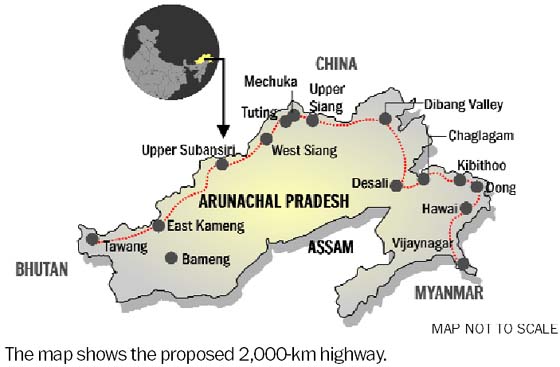
The main highway of Arunachal Pradesh is the Trans-Arunachal Highway, National Highway 13 (1293 km; formerly NH-229 and NH-52). It originates in Tawang and spans most of the width of Arunachal Pradesh, then crosses south into Assam and ends at Wakro. The project was announced by then Prime Minister Manmohan Singh in 2008 for completion by 2015–16, but only became operational in 2018.
NH-15 through Assam follows the southern border of Arunachal Pradesh. Access to central Arunachal Pradesh has been facilitated by the Bogibeel Bridge, an earthquake-resistant rail and road bridge over the Brahmaputra River in Assam, opened for public use on 25 December 2018 by Prime Minister Narendra Modi. A spur highway numbered NH-415 services Itanagar.
State-owned Arunachal Pradesh State Transport Services (APSTS) runs daily bus service from Itanagar to most district headquarters including Tezpur, Guwahati in Assam, Shillong in Meghalaya, and Dimapur in Nagaland.
, every village is connected by road, thanks to funding provided by the central government. Every small town has its own bus station with daily bus service. Connections to Assam have increased commerce.
In 2014, two additional east–west highways were proposed: an Industrial Corridor Highway in the lower foothills, and a Frontier Highway along the McMahon Line. The proposed alignment of the Frontier Highway has been published.
Railway
Arunachal Pradesh got its first railway line in late 2013 with the opening of the new link line from Harmuti on the main Rangpara North–Murkongselak railway line to Naharlagun in Arunachal Pradesh. The construction of the 33-kilometre broad-gauge railway line was completed in 2012, and the link became operational after the gauge conversion of the main line from Assam. The state capital Itanagar was added to the Indian railway map on 12 April 2014 via the newly built 20-kilometre Harmuti-Naharlagun railway line, when a train from Dekargaon in Assam reached Naharlagun railway station, 10 kilometres from the centre of Itanagar, a total distance of 181 kilometres.
On 20 February 2015, the first through train was run from New Delhi to Naharlagun, flagged off from the capital by the Indian prime minister, Narendra Modi. India plans to eventually extend the railway to Tawang, near the border with China.
Education
Main article: Education in Arunachal Pradesh
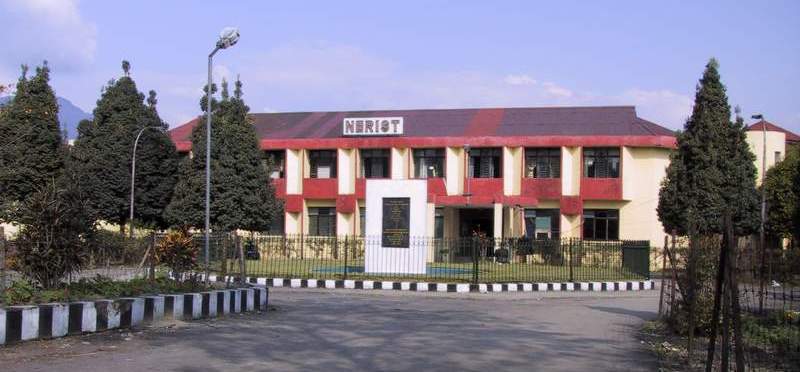
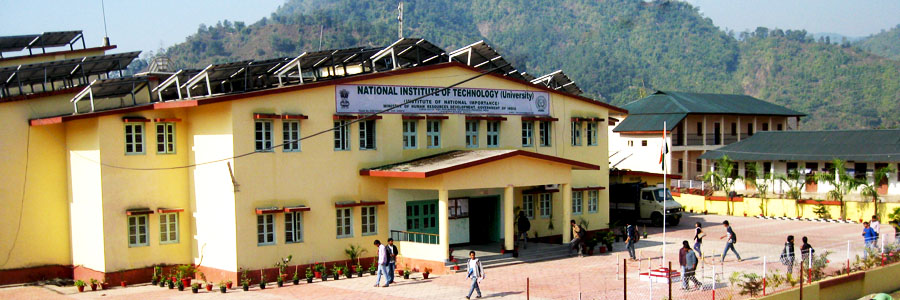
The state government is expanding the relatively underdeveloped education system with the assistance of NGOs like Vivekananda Kendra, leading to a sharp improvement in the state's literacy rate. The main universities are the Rajiv Gandhi University (formerly known as Arunachal University), under which come 36 institutions offering regular undergraduate courses as well as teacher education and health sciences and nursing degrees, both under governmental and private managements, Indira Gandhi Technological and Medical Sciences University and Himalayan University as well. The first college, Jawaharlal Nehru College, Pasighat, was established in 1964. The First Technical University is Established in 2014 namely North East Frontier Technical University (NEFTU). In Aalo, West Siang District by The Automobile Society India, New Delhi. There is also a deemed university, the North Eastern Regional Institute of Science and Technology as well as the National Institute of Technology, Arunachal Pradesh, established on 18 August 2010, is located in Yupia (headquarter of Itanagar). NERIST plays an important role in technical and management higher education. The directorate of technical education conducts examinations yearly so that students who qualify can continue on to higher studies in other states.

Of the above institutions, only the following institutions are accredited by NAAC (National Assessment and Accreditation Council), in the order of their grade: Jawaharlal Nehru College, Pasighat (Grade A), St Claret College, Ziro (Grade A), Indira Gandhi Govt. College, Tezu (Grade B++), Rajiv Gandhi University (Grade B), National Institute of Technology, Arunachal Pradesh (Grade B), Dera Natung Government College, Itanagar (Grade B), Govt. College, Bomdila (Grade B), Donyi Polo Govt. College, Kamki (Grade B), and Rang Frah Govt. College, Changeling (Grade C).
Wangcha Rajkumar Government College, Deomali is the only college in the southeastern part of Arunachal Pradesh. It caters to the students from Tirap, Changlang and Longding districts.
There are also trust institutes, like Pali Vidyapith, run by Buddhists. They teach Pali and Khamti scripts in addition to typical education subjects. Khamti is the only tribe in Arunachal Pradesh that has its own script. Libraries of scriptures are in a number of places in Lohit district, the largest one being in Chowkham.
The state has two polytechnic institutes: Rajiv Gandhi Government Polytechnic in Itanagar established in 2002 and Tomi Polytechnic College in Basar established in 2006. There are two law colleges, namely, the private-owned Arunachal Law Academy at Itanagar and the government-owned Jarbom Gamlin Government Law College at Jote, Itanagar. The College of Horticulture and Forestry is affiliated to the Central Agricultural University, Imphal.
Politics
Arunachal Pradesh suffered political crisis between April 2016 and December 2016. The Indian National Congress Chief Minister Nabam Tuki replaced Jarbom Gamlin as the Chief Minister of Arunachal Pradesh on 1 November 2011 and continued until January 2016. After a political crisis in 2016, President's rule was imposed ending his tenure as the chief minister. In February 2016, Kalikho Pul became the Chief Minister when 14 disqualified MLAs were reinstated by the Supreme Court. On 13 July 2016, the Supreme Court quashed the Arunachal Pradesh Governor J.P. Rajkhowa's order to advance the Assembly session from 14 January 2016 to 16 December 2015, which resulted in President's rule in Arunachal Pradesh. As a result, Nabam Tuki was reinstated as the Chief Minister of Arunachal Pradesh on 13 July 2016. But hours before floor test, he resigned as the chief minister on 16 July 2016. He was succeeded by Pema Khandu as the INC Chief Minister who later joined PPA in September 2016 along with majority of MLAs. Pema Khandu further joined BJP in December 2016 along with majority of MLAs. Arunachal Pradesh becomes second northeast Indian state to achieve ODF status. During 2017, 2021, and 2023, China compiled a list of name alterations for multiple locations in Arunachal Pradesh, in both Chinese and Tibetan languages. China asserts these areas as belonging to "Southern Tibet" and being integral parts of China. The proposed changes encompassed 11 alterations, covering geographical landmarks like mountain summits and rivers, as well as residential zones.
On 28 August 2023, China further provoked India when the PRC's Ministry of Natural Resources released its new 'standard map' in which Arunachal Pradesh was depicted as a part of PRC. Other internationally disputed lands and waters were also depicted as PRC territory on their new map.
State symbols
Geographical indication
Arunachal Pradesh Khaw Tai (Khamti Rice) was awarded the Geographical Indication (GI) status tag from the Geographical Indications Registry, under the Union Government of India, on 3 October 2023 and is valid until 12 December 2031.
Namsai Organic Spices and Agricultural Producer Company Limited from Lohit, proposed the GI registration of Arunachal Pradesh Khaw Tai (Khamti Rice). After filing the application in December 2021, the rice was granted the GI tag in 2023 by the Geographical Indication Registry in Chennai, making the name "Arunachal Pradesh Khaw Tai (Khamti Rice)" exclusive to the rice grown in the region. It thus became the first rice variety from Arunachal Pradesh and the 3rd type of goods from Arunachal Pradesh to earn the GI tag. The GI tag protects the rice from illegal selling and marketing, and gives it legal protection and a unique identity.
Notes
References
Bibliography
- {{cite book|last1=Mizuno|first1=Kazuharu|last2=Tenpa|first2=Lobsang|title=Himalayan Nature and Tibetan Buddhist Culture in Arunachal Pradesh, India: A Study of Monpa|year=2015|publisher=Springer
References
- [http://arunachalpradesh.nic.in/govt.htm Government] {{webarchive. link. (7 October 2016)
- "Arunachal Pradesh: Physiography, At a glance". ENVIS Centre on Himalayan Ecology.
- (26 June 2018). "4 Reasons Why Arunachal Pradesh is a Natural Wonderland".
- "Primary Census Abstract Data Tables (India & States/UTs – District Level)". Office of the Registrar General and Census Commissioner of India.
- "Report of the Commissioner for linguistic minorities: 47th report (July 2008 to June 2010)". Commissioner for Linguistic Minorities, Ministry of Minority Affairs, [[Government of India]].
- "Ministry of Development of North Eastern Region, North East India".
- "WORKING IN HINDI LANGUAGE".
- "India: Subnational HDI".
- (23 September 2024). "Annual Report, Periodic Labour Force Survey (PLFS) (July 2023 – June 2024)". National Sample Survey Office, Ministry of Statistics and Programme Implementation, Government of India.
- "Sex ratio of State and Union Territories of India as per National Health survey (2019–2021)".
- "Arunachal Pradesh". [[Oxford University Press]].
- (12 June 2017). "'We Wake Up at 4 am': Arunachal Pradesh CM Pema Khandu Wants Separate Time Zone". Outlook.
- (23 September 2020). "Arunachal Residents Write To PM On Road Project, Quote National Security". NDTV.
- Saaliq, Sheikh. (21 October 2024). "India says it reached a pact with China on military patrols along their disputed border". AP News.
- (17 January 2022). "China returns Indian citizen at disputed border". [[Reuters]].
- (14 September 2008). "Strong Borders, Secure Nation". Princeton University Press.
- Sarmah, Minakshi. (2021). "Is China's Territorial Claim On Arunachal Pradesh Justifiable?". World Affairs: The Journal of International Issues.
- (2020). "Tawang, Monpas and Tibetan Buddhism in Transition". [[Springer Nature]].
- (2016). "Open War: State-Making's Dress Rehearsal". Cambridge University Press.
- Sharma, Usha. (2005). "Discovery of North-East India". Mittal Publications.
- (10 September 2020). "India launches villages programme in Arunachal, ignores angry China". Reuters.
- "Official Web Page of Government of Arunachal Pradesh".
- {{harvcol. Mizuno. Tenpa. 2015
- {{harvcol. Mizuno. Tenpa. 2015
- {{harvcol. Mizuno. Tenpa. 2015
- {{harvcol. Mizuno. Tenpa. 2015
- {{harvcol. Eilmer. 2014
- {{harvcol. Das. 1998
- Xiaoming Zhang. (2004). "China's Tibet". 五洲传播出版社.
- {{harvcol. Mizuno. Tenpa. 2015
- [[Claude Arpi]], The Pure Crystal Mountain Pilgrimage of Tsari, ''1962: The McMahon Line Saga''.
- Baruah, Swarnalata. (2004). "Chutia Jaatir Buranji". Banalata Publications.
- "Tourism | District Lower Dibang Valley, Government of Arunachal Pradesh. | India".
- "Indian Archeology-1996-97".
- "Chattopadhyay, S., ''History and archaeology of Arunachal Pradesh'', p. 71".
- Borah, D.K.''Archaeological ruins of Naksabat'', p.32
- "Ita Fort | Itanagar Capital Complex".
- Barua, Rai K. L.. (27 January 1933). "Early history of Kamarupa".
- Thakur, A.K.. (2004). "Pre-Historic Archaeological Remains of Arunachal Pradesh and People's Perception: An Overview". Proceedings of the Indian History Congress.
- "District Handbook of Lower Dibang District".
- "Chattopadhyay, S. "History and Archeology of Arunachal Pradesh Chapter3: Archeological remains", p.76.".
- "Notes on ancient temples and other remains in the vicinity of Sadiya by Major S.F.Hannay".
- "Simla Convention". Tibetjustice.org.
- Shakya, Tsering. (1999). "The Dragon in the Land of Snows: A History of Modern Tibet Since 1947". Columbia University Press.
- Lamb, Alastair, ''The McMahon line: a study in the relations between India, China and Tibet, 1904 to 1914'', London, 1966, p529
- Ray, Jayanta Kumar. (2007). "Aspects of India's International relations, 1700 to 2000: South Asia and the World".
- Ray, Jayanta Kumar. (2007). "Aspects of India's International Relations, 1700 to 2000: South Asia and the World". Pearson Education India.
- {{harvnb. Maxwell. 1972
- {{harvp. Lamb, ''The McMahon Line'', Vol. 2. 1966
- Ramachandran, Sudha. (27 June 2008). "China toys with India's border". South Asia.
- {{harvnb. Maxwell. 1972
- [https://timesofindia.indiatimes.com/city/guwahati/Manipur-remembers-man-who-won-Tawang/articleshow/45859646.cms Manipur remembers man who won Tawang], The Times of India, 13 January 2014.
- Maxwell, Neville. (1970). "India's China War". Pantheon.
- A.G. Noorani, "{{usurped. [https://web.archive.org/web/20050326174852/http://www.hinduonnet.com/fline/fl2017/stories/20030829001604900.htm Perseverance in peace process]", ''India's National Magazine'', 29 August 2003.
- Manoj Joshi, "Line of Defence", ''Times of India'', 21 October 2000
- "PM to visit Arunachal in mid-Feb".
- "History {{!}} DISTRICT UPPER SIANG {{!}} India".
- (15 March 2017). "KAA Raja brought democracy: C T Mein".
- (4 June 2008). "Tawang is part of India: Dalai Lama". The Times of India.
- (4 June 2008). "Tawang is part of India: Dalai Lama". TNN.
- "Dalai Lama's visit to Arunachal nostalgic: Top aide" [[Hindustan Times]] dated Dharamsala, 8 November 2009
- (28 September 2016). "Kiren Rijiju: News of Chinese incursion in Arunachal Pradesh incorrect: MoS Rijiju".
- (15 April 2017). "Dalai Lama in Tawang: What next". Tribuneindia News Service.
- "Thousands flock to see Dalai Lama in Indian state.".
- (10 August 2024). "China's Great Wall of Villages". [[The New York Times]].
- (12 August 2003). "Apang rules out Chakma compromise". Telegraphindia.com.
- (1 June 2004). "Rainfall distribution over the Arunachal Pradesh Himalayas". Weather.
- Choudhury, A. U.. (2006). "A pocket guide to the birds of Arunachal Pradesh. Gibbon Books & The Rhino Foundation for Nature in North East India".
- Choudhury, A. U.. (2003). "The mammals of Arunachal Pradesh". Regency Publications.
- Mittermeier, Russell A.. (2004). "Hotspots revisited.". Cemex.
- (1 January 2017). "The last frontiers of wilderness: Tracking loss of intact forest landscapes from 2000 to 2013". Science Advances.
- "Protected Areas". Department of Forests & Environment, Govt. of Arunachal Pradesh.
- (15 November 2013). "High-Resolution Global Maps of 21st-Century Forest Cover Change". Science.
- "Official Web Page of Government of Arunachal Pradesh".
- (2005). "Ethnomedicinal botany of the Apatani in the Eastern Himalayan region of India". J Ethnobiol Ethnomed.
- (1968). "A revised survey of the forest types of India(1968).".
- "Flora and Fauna". Department of Forests & Environment, Govt. of Arunachal Pradesh.
- Choudhury, A. U.. (2013). "Description of a new subspecies of hoolock gibbon ''Hoolock hoolock'' from North East India". The Newsletter & Journal of the Rhino Foundation for Nat. In NE India.
- Choudhury, A. U.. (2007). "A new flying squirrel of the genus Petaurista Link from Arunachal Pradesh in north-east India.". The Newsletter & Journal of the Rhino Foundation NE India.
- Choudhury, A. U.. (2009). "One more new species of giant flying squirrel of the genus Petaurista Link, 1795 from Arunachal Pradesh in north-east India". The Newsletter & Journal of the Rhino Foundation NE India.
- Choudhury, A. U.. (2013). "Description of a new species of giant flying squirrel of the genus Petaurista Link, 1795 from Siang basin, Arunachal Pradesh in North East India". The Newsletter & Journal of the Rhino Foundation for Nat. In NE India.
- "Arunachal Pradesh Districts".
- "Administrative jurisdiction of divisions and districts". Government of Arunachal Pradesh.
- "A – 2 DECADAL VARIATION IN POPULATION SINCE 1901". Office of the Registrar General and Census Commissioner of India.
- "Census Population". Ministry of Finance India.
- "Population and decadal change by residence: 2011 (PERSONS)". Office of the Registrar General & Census Commissioner, India.
- "Population by religion community – 2011". The Registrar General & Census Commissioner, India.
- "C-1 Appendix – 2011 Details Of Religious Community Shown Under 'other Religions And Persuasions' In Main Table C-1".
- (19 November 2017). "How churches in Arunachal Pradesh are facing resistance over conversion of tribals". The Economic Times.
- "Census of India: C-1 Population By Religious Community".
- "Theravada Buddhist Monasteries of Arunachal Pradesh: A Study of Art and Visual Culture"%2C%20settled%20in).
- (8 March 2017). "Christian population on the rise in Arunachal Pradesh, Manipur". Hindustan Times.
- "Census of India Website: Office of the Registrar General & Census Commissioner, India".
- "C-17: Population by bilingualism and trilingualism, Arunachal Pradesh - 2011". Office of the Registrar General & Census Commissioner, India.
- (22 August 2014). "How Hindi became the language of choice in Arunachal Pradesh".
- "Census of India: Provisional Population Tables – Census 2011". Censusindia.gov.in.
- [http://www.thisismyindia.com/arunachal-pradesh/arunachal-pradesh-economy.html Arunachal Pradesh Economy] {{webarchive. link. (8 May 2016 , ''This Is My India'')
- "Economy of Arunachal Pradesh".
- (17 February 2008). "Massive dam plans for Arunachal". Indiatogether.org.
- "India pre-empts Chinese design in Arunachal". The New Indian Express.
- (28 July 2012). "PMO ends tussle between AAI and Arunachal". [[The Hindu]].
- (28 November 2022). "IndiGo commences operations from Donyi Polo Airport, Itanagar".
- (22 May 2018). "Arunachal's first commercial flight lands at Pasighat airport".
- (13 August 2014). "Govt considering setting up of 3 greenfield airports in NE". [[Business Line.
- (25 December 2016). "Itanagar-Dimapur bus service flagged off".
- "Night coach bus services introduced".
- "PSTS".
- "Official Page of NRC Yak, Dirang..".
- (16 October 2014). "Top officials to meet to expedite road building along China border". [[The Times of India]].
- (20 September 2014). "Narendra Modi government to provide funds for restoration of damaged highways". dnaindia.
- "Indian Government Plans Highway Along Disputed China Border". thediplomat.com.
- "Govt planning road along McMohan line in Arunachal Pradesh: Kiren Rijiju". Live Mint.
- "Archived copy".
- (8 April 2014). "Arunachal Pradesh Capital Itanagar Put on India's Railway Map". indiatimes.com.
- "Arunachal Pradesh now on railway map, train reaches Naharlagun, a town near capital Itanagar". timesofindia-economictimes.
- (20 February 2015). "Modi to flag off first train from Arunachal to Delhi". The Times of India.
- "Quality higher education". [[The Economic Times]].
- "NIT Arunachal Pradesh, Govt. of India".
- "WANGCHA RAJKUMAR GOVT.COLLEGE".
- (3 January 2018). "Arunachal becomes 2nd NE state to achieve ODF status". [[The Times of India]].
- (4 April 2023). "Arunachal Pradesh: India rejects China's attempt to rename disputed places". BBC News.
- ''Himalayan Times'', "China Provokes India, includes Arunachal Pradesh, Aksai Chin in new 'standard map' ", p.3, 30 August 2023. ''Asian News International'', Beijing, 29 August 2023.
- "Arunachal Pradesh Symbols".
- (3 March 2024). "18 lesser-known GI-certified products of Arunachal Pradesh". The Times of India.
This article was imported from Wikipedia and is available under the Creative Commons Attribution-ShareAlike 4.0 License. Content has been adapted to SurfDoc format. Original contributors can be found on the article history page.
Ask Mako anything about Arunachal Pradesh — get instant answers, deeper analysis, and related topics.
Research with MakoFree with your Surf account
Create a free account to save articles, ask Mako questions, and organize your research.
Sign up freeThis content may have been generated or modified by AI. CloudSurf Software LLC is not responsible for the accuracy, completeness, or reliability of AI-generated content. Always verify important information from primary sources.
Report