From Surf Wiki (app.surf) — the open knowledge base
Arthroplasty
Surgery to repair or replace joints
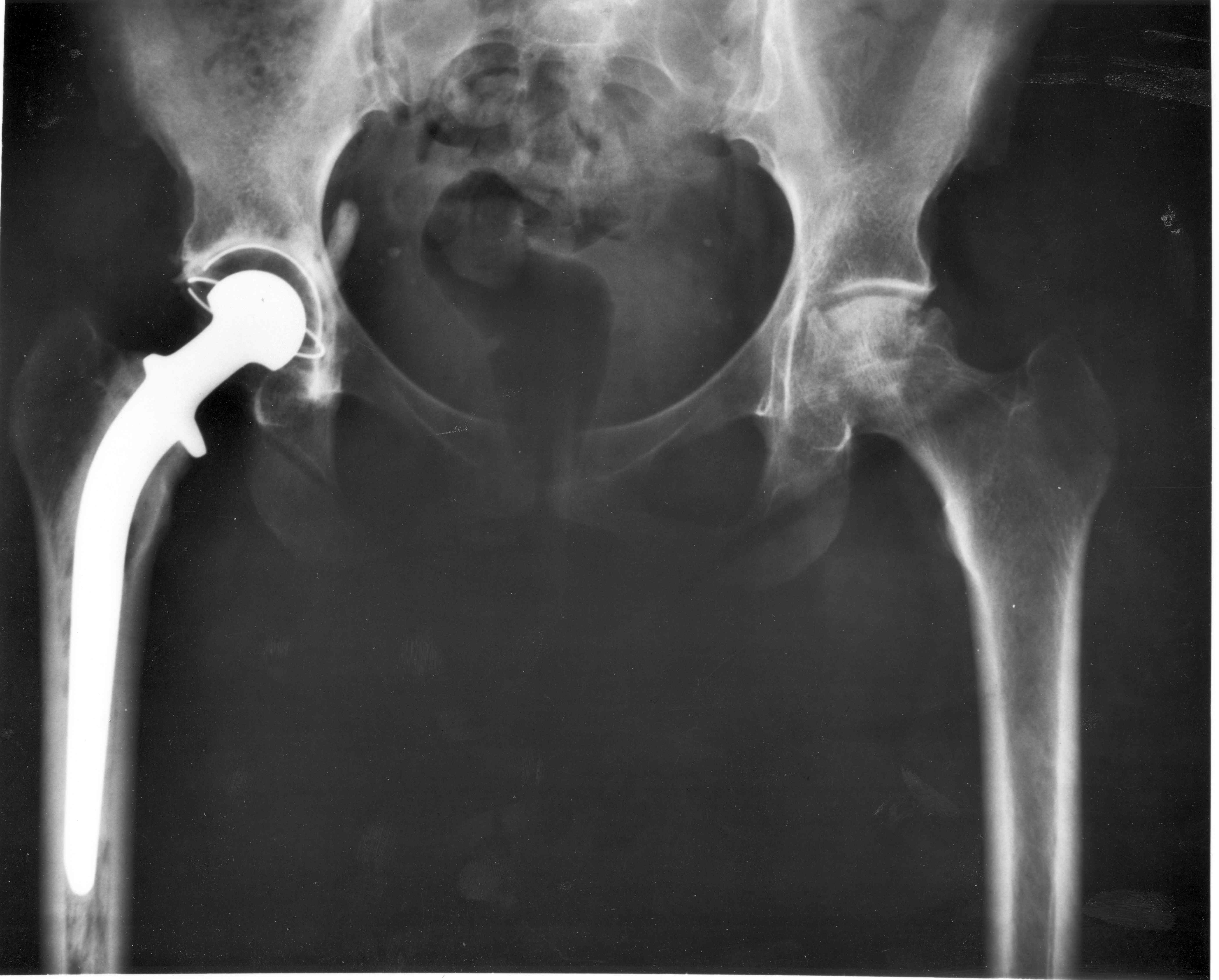
Surgery to repair or replace joints
| Field | Value | |
|---|---|---|
| Name | Arthroplasty | |
| Image | ||
| Caption | ||
| ICD10 | ||
| ICD9 | ||
| MeshID | D019643 | |
| OPS301 | ||
| OtherCodes | ||
| Speciality | orthopedics |
Name = Arthroplasty | Image = | Caption = | ICD10 = | ICD9 = | MeshID = D019643 | OPS301 = | OtherCodes = | HCPCSlevel2 = Arthroplasty (literally "[re-]forming of joint") is an orthopedic surgical procedure where the articular surface of a musculoskeletal joint is replaced, remodeled, or realigned by osteotomy or some other procedure. It is an elective procedure that is done to relieve pain and restore function to the joint after damage by arthritis or some other type of trauma.
Types

Main article: Joint replacement
For the last 45 years, the most successful and common form of arthroplasty is the surgical replacement of arthritic or destructive or necrotic joint or joint surface with a prosthesis. For example, a hip joint that is affected by osteoarthritis may be replaced entirely (total hip arthroplasty) with a prosthetic hip. This would involve replacing both the acetabulum (hip socket) and the head and neck of the femur. The purpose of this procedure is to relieve pain, to restore range of motion and to improve walking ability, thus leading to the improvement of muscle strength.
Non-prosthesis
Other types of arthroplasty
- Interpositional arthroplasty, previously a popular form of arthroplasty, with interposition of some other tissue like skin, muscle or tendon to keep inflammatory surfaces apart.
- Excisional or resection(al) arthroplasty in which joint surface and bone is removed. The remaining ends are attached, or left to give time for scar tissue to fill in the gap. One variant of is the Stainsby procedure which consists of excision of part of a proximal phalanx in a metatarsophalangeal joint, reduction of the plantar plate and kirschner wire fixation of the metacarpal bone to the remaining phalanx.
- Resurfacing arthroplasty, where one or both bone surfaces are trimmed and replaced with a smooth metal covering.
- Mold arthroplasty,
- Silicone replacement arthroplasty
- Osteotomy to restore or modify joint congruity.
Complications and improvements
Arthroplasty presents various and continuous challenges to the engineer and surgeon. The prosthesis selected must be nontoxic yet resistant, compatible and durable. Meeting all these criteria usually means that the prosthesis will not last 10–20 years. 75% of artificial knees will last 20 years and 90% will last 10 years.
In recent years the technology has been improved with a porous-coated prosthesis which allows for stronger bonding to the body, but even more notable improvements have derived from the recent explosion in computer-assisted design and manufacturing (CAD/CAM). Using X-rays and other scans of the patient as well as modern 3D printing, personally tailored prostheses are a reality for more and more individuals.
Indications
- osteoarthritis (OA)
- rheumatoid arthritis (RA)
- avascular necrosis (AVN) or osteonecrosis (ON)
- congenital dislocation of the hip joint (CDH) Hip dysplasia (human)
- acetabular dysplasia (shallow hip socket)
- frozen shoulder, loose shoulder
- traumatized and malaligned joint
- joint stiffness
Complications
- Blood clots or deep vein thrombosis
- Infection
- Bleeding
- Periprosthetic fracture
- Loosening
- Mechanical wear
- Failure
References
fr:Arthroplastie hr:Artroplastika ro:Artroplastie sr:Artroplastika
References
- (2015). "Surgical Management of the Forefoot in Patients with Rheumatoid Arthritis - A Review Article". The Open Orthopaedics Journal.
- Jared R. H. Foran. "Hip Resurfacing". [[American Academy of Orthopaedic Surgeons]].
- Saladin, Kenneth S. New York: McGraw Hill, 2012. Print. Pgs 307-208.
- NIH 3D Print Exchange. A Collection of Biomedical 3D Printable Files and 3D Printing Resources Supported by the National Institutes of Health (NIH). U.S National Library of Medicine. U.S. National Library of Medicine, n.d. Web. 22 Nov. 2016.
This article was imported from Wikipedia and is available under the Creative Commons Attribution-ShareAlike 4.0 License. Content has been adapted to SurfDoc format. Original contributors can be found on the article history page.
Ask Mako anything about Arthroplasty — get instant answers, deeper analysis, and related topics.
Research with MakoFree with your Surf account
Create a free account to save articles, ask Mako questions, and organize your research.
Sign up freeThis content may have been generated or modified by AI. CloudSurf Software LLC is not responsible for the accuracy, completeness, or reliability of AI-generated content. Always verify important information from primary sources.
Report