From Surf Wiki (app.surf) — the open knowledge base
Artemisia absinthium
Species of plant

Species of plant
- Absinthium bipedale Gilib., not validly published
- Absinthium majus Geoffr.
- Absinthium majus Garsault, not validly published
- Absinthium officinale Lam.
- Absinthium officinale Brot.
- Absinthium vulgare (L.) Lam.
- Artemisia absinthia St.-Lag.
- Artemisia arborescens var. cupaniana Chiov.
- Artemisia arborescens f. rehan (Chiov.) Chiov.
- Artemisia baldaccii Degen
- Artemisia doonense Royle
- Artemisia inodora Mill.
- Artemisia kulbadica Boiss. & Buhse
- Artemisia pendula Salisb.
- Artemisia rehan Chiov.
- Artemisia rhaetica Brügger
Artemisia absinthium, otherwise known as common wormwood, is a species of Artemisia native to North Africa and temperate regions of Eurasia, and widely naturalized in Canada and the northern United States. It is grown as an ornamental plant and is used as an ingredient in the spirit absinthe and some other alcoholic beverages.
Etymology
Wormwood's relative mugwort was traditionally used as a remedy for a variety of complaints, especially those of a gynaecological nature, and so the wormwood genus bears the name of the Greek goddess of childbirth, Artemis. The specific name derives from apsínthion, the Greek term for the plant.
"Wormwood" itself is an alteration of Old English wermod, which is of obscure origin. The German cognate Wermut is the source of the term vermouth, used in French and English to describe a kind of wine traditionally flavoured with wormwood.
Description
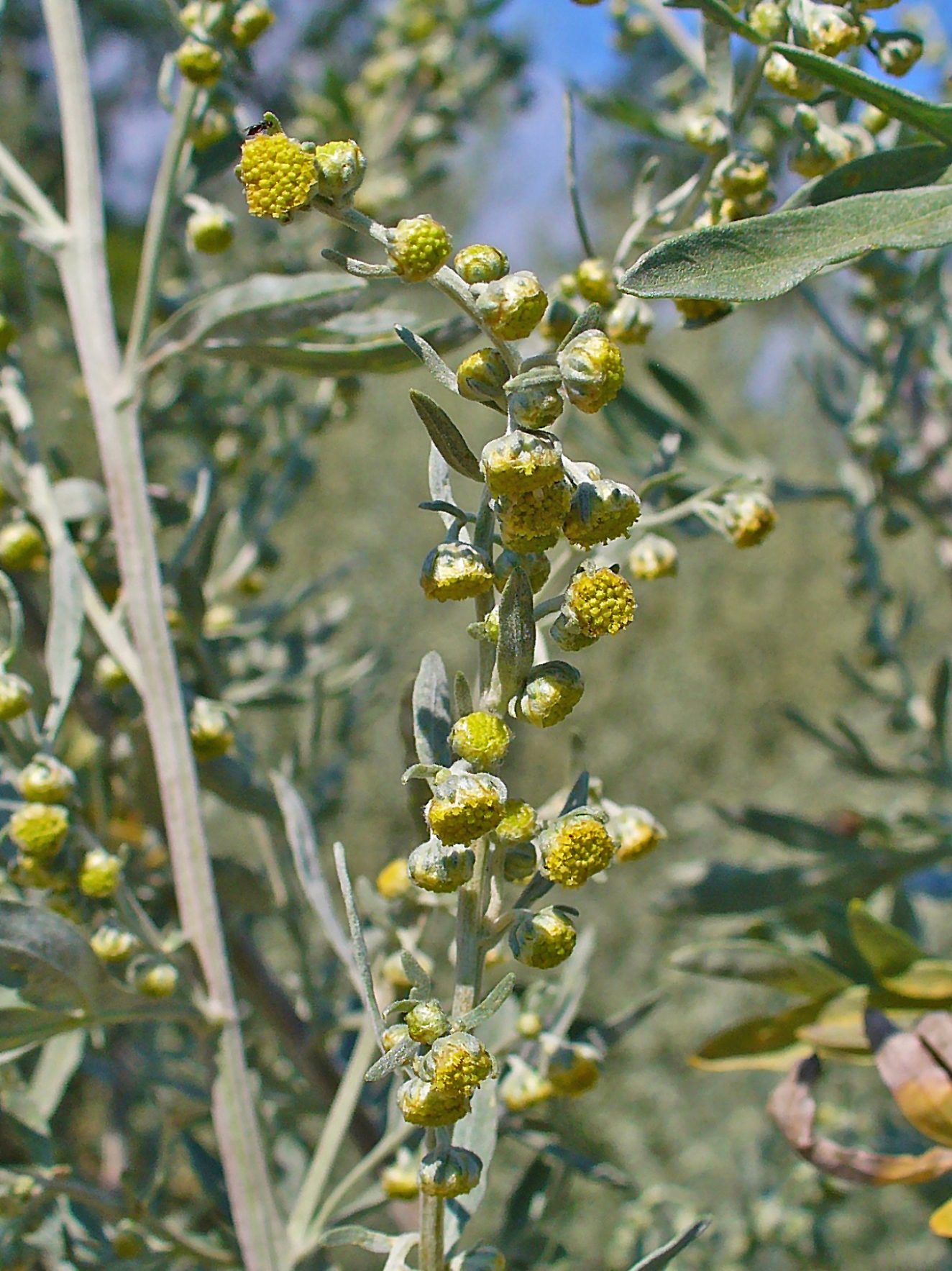
A. absinthium is a herbaceous perennial plant with fibrous roots. The stems are straight, growing to 0.8 - (and rarely over 1.5 m) tall, grooved, branched, and silvery-green with a strong odor.
Leaves are spirally arranged, greenish-grey colored above, white below, covered with silky silvery-white trichomes, and bearing minute oil-producing glands. The basal leaves are up to 250 mm long, bi- to tripinnate with long petioles, with the cauline leaves (those on the stem) smaller, 50 - long, less divided, and with short petioles. The uppermost leaves can be both simple and sessile (without a petiole).
Flowers are pale yellow, tubular, and clustered in spherical bent-down heads (capitula), which are in turn clustered in leafy and branched panicles. Flowering occurs from early summer to early autumn; pollination is anemophilous. The fruit is a small achene. Seed dispersal occurs by gravity.
A. absinthium grows naturally on uncultivated arid ground, on rocky slopes, and at the edge of footpaths and fields. Although once relatively common, it is becoming increasingly rare in Britain, where it has recently been suggested to be an archaeophyte rather than a true native.
Cultivation
The plant can easily be cultivated in dry soil. It should be planted under bright exposure in fertile, midweight soil. It prefers soil rich in nitrogen, and can be propagated by ripened cuttings taken in spring or autumn in temperate climates, or by seeds in nursery beds. Growing the plant with others tends to stunt their growth; accordingly, it is not considered to be a good companion plant. A. absinthium also self-seeds generously. It is naturalised in some areas away from its native range, including much of North America and the Kashmir Valley of India.
This plant, and its cultivars "Lambrook Mist" have gained the Royal Horticultural Society's Award of Garden Merit. These two short cultivars are very similar and more silver than typical British absinthium material and probably derive from southern Europe. "Lambrook Silver" is the earliest of these cultivars, having been selected in the late 1950s by Margery Fish, who developed the garden at East Lambrook Manor. "Lambrook Mist" was selected about 30 years later by Andrew Norton, a subsequent owner of the garden. Both gained their Awards of Garden Merit during the RHS Artemisia Trial 1991–3.
Cultivar "Silver Ghost" is a taller, silver plant, which flowers much later (August–September) than typical absinthium (June–July) in Britain, and so holds its silver appearance for longer. This and a more feathery-leaved cultivar "Persian Lace" were selected by National Collection Holder John Twibell in the 1990s.
Constituents
Wormwood herb contains bitter substances from the group of sesquiterpene lactones; absinthin, at 0.20 to 0.28%, is the main component of these bitter substances. Essential oils make up 0.2 to 0.8% and contain (-) - thujone, (+) - isothujone, thujyl alcohol and its esters, chamazulene and other mono- and sesquiterpenes. In Bailen et al 2013 and Gonzalez-Coloma et al 2013 the Gonzalez-Coloma group discovered a chemotype that does not produce β-thujone but does contain terpenoids not seen elsewhere.
Uses
Artemisia absinthium is claimed to have antifungal, neuroprotective, insecticidal, antimicrobial, anthelmintic, acaricidal, antimalarial, antidepressant, and hepatoprotective properties.
It is an ingredient in the spirit absinthe, and is used for flavouring in some other spirits and wines, including bitters, bäsk, vermouth, and pelinkovac. As a folk medicine, it is claimed to counteract poor appetite and to treat various diseases such as Crohn's disease and IgA nephropathy.
Wormwood was traditionally relatively common as a bittering spice in farmhouse brewing in Denmark, and to some extent Estonia. In 18th-century England, wormwood was sometimes used instead of hops in beer. According to Nicholas Culpeper, a stinking breath can be cured by "drinking a glass of Wormwood beer every morning".
Historical sources describe the use of Artemisia absinthium as an anthelmintic and antiprotozoal remedy, with modern studies reporting antibacterial, antifungal, and antibiofilm activity of its extracts. Wormwood-based alcoholic preparations, including absinthe, were also prescribed as prophylaxis during the 19th-century French conquest of Algeria.
Wormwood clippings and cuttings are added to chicken nesting boxes to repel lice, mites, and fleas. Bailen et al. 2013 and Gonzalez-Coloma et al. 2013 find the unique terpenoids of the Gonzalez-Coloma chemotype make this strain especially promising for insect control. a company named EcoflorAgro is investing heavily into increasing the planted area of this strain, hoping to commercialize it to a degree attempted but never achieved due to unreliable supply for other botanical insecticides before.
Toxicity
Most chemotypes of A. absinthium contain (−)-α- and/or (+)-β-thujone, though some do not. (−)-α-Thujone by itself is a GABA receptor antagonist that can cause convulsions when administered in large amounts to animals and humans. However, there is only one case of documented toxicity of wormwood, in which a 31-year-old man drank 10 mL of steam-distilled pure volatile oil of wormwood, wrongly believing it was absinthe liqueur. Medicinal extracts of wormwood have not been shown to cause seizure or other adverse effects at usual doses. Thujones have not been shown to be the cause of excessive doses' toxicity for any kind of wormwood extracts, including absinthe.
Cultural history
In the apocalyptic Book of Revelation ending the Bible, the star named "Wormwood" falls to earth and turns a third of its waters bitter. Similarly where the Biblical Hebrew word לענה (la'anah) appears in the Hebrew Bible, it is generally translated into English as "wormwood". The word occurs nine times in the Hebrew Bible, seven times with the implication of bitterness and twice as a proper noun, in the Greek translation apsinthos, naming the physical meteor in its orbit, in Revelation 8:11. The English rendering "wormwood" additionally refers to the dark green oil produced by the plant, which was used to kill intestinal worms.
The Ukrainian city Chernobyl, notable for its catastrophic nuclear disaster in 1986, is named from one of the Ukrainian names for common wormwood: (or more commonly полин звичайний uk, 'common artemisia'). The name is inherited from or , a compound of + , the parts related to and било uk, 'stalk', which may also refer to A. vulgaris.
Lucretius, reflecting on life in the Roman Republic before 50 BCE, stated in his poem De rerum natura that, "Physicians, when they wish to treat children with a nasty dose of wormwood, first smear the rim of the cup with a sweet coat of yellow honey. The children, too young as yet for foresight, are lured by the sweetness at their lips into swallowing the bitter draught. So they are tricked but not trapped, for the treatment resorts them to health."
Nicholas Culpeper insisted that wormwood was the key to understanding his 1651 book The English Physitian. Richard Mabey describes Culpeper's entry on this bitter-tasting plant as "stream-of-consciousness" and "unlike anything else in the herbal", and states that it reads "like the ramblings of a drunk". Culpeper biographer Benjamin Woolley suggests the piece may be an allegory about bitterness, as Culpeper had spent his life fighting the Establishment, and had been imprisoned and seriously wounded in battle as a result.
William Shakespeare referred to wormwood in Romeo and Juliet: Act 1, Scene 3. Juliet's childhood nurse said, "For I had then laid wormwood to my dug" meaning that the nurse had weaned Juliet, then aged three, by using the bitter taste of wormwood on her nipple. He also referred to wormwood in Hamlet: Act 3, Scene 2. Hamlet said, "That's wormwood" in response to the Player Queen expressing distaste for remarriage.
John Locke, in his 1689 book titled An Essay Concerning Human Understanding, used wormwood as an example of bitterness, writing, "For a child knows as certainly before it can speak the difference between the ideas of sweet and bitter (i.e. that sweet is not bitter), as it knows afterwards (when it comes to speak) that wormwood and sugarplums are not the same thing."
Edwin Arlington Robinson relates in a poem how Cliff Klingenhagen gave a guest a glass of wine while drinking a glass of wormwood himself. He concludes, "I have spent / Long time a-wondering when I shall be / As happy as Cliff Klingenhagen is."
References
References
- Christian Rätsch. (2005). "The Encyclopedia of Psychoactive Plants: Ethnopharmacology and Its Applications". Inner Traditions/Bear.
- "''Artemisia absinthium'' L. — The Plant List".
- "''Artemisia absinthium'' [Assenzio vero] - Flora Italiana".
- "''Artemisia absinthium'' in Flora of North America @ efloras.org".
- {{cite OED. artemisia
- {{cite OED. absinthium
- {{OEtymD. wormwood
- {{OEtymD. vermouth
- Archeophytes in Britain CD Preston, DA Pearman and A R Hall Botanical J of Linnean Society 2004 145 257-294
- Shafi et al., 2012
- "''Artemisia absinthium'' 'Lambrook Mist' AGM". APPS.RHS.org.uk.
- "''Artemisia absinthium'' 'Lambrook Silver' AGM". APPS.RHS.org.uk.
- John Twibell, National Collection of Artemisia
- Wichtl, Max, ed. (1984). Teedrogen. Ein Handbuch für Apotheker und Ärzte. Wissenschaftliche Verlagsgesellschaft, Stuttgart, {{ISBN. 3-8047-0792-0, pp. 363–365
- [[European Medicines Agency]], Committee on Herbal Medicinal Products (HMPC) (30 May 2017). [https://www.ema.europa.eu/en/documents/herbal-report/final-assessment-report-artemisia-absinthium-l-herba-revision-1_en.pdf Assessment report on ''Artemisia absinthium'' L., herba, final], London, p. 4
- Isman, Murray B.. (2020-01-07). "Botanical Insecticides in the Twenty-First Century—Fulfilling Their Promise?". [[Annual Reviews (publisher).
- (2020). "Bioactive Compounds, Pharmacological Actions, and Pharmacokinetics of Wormwood (Artemisia absinthium)". Antibiotics.
- European Scientific Cooperative on Phytotherapy (2009) "Absinthii herba (wormwood)" In: ESCOP Monographs: The Scientific Foundation for Herbal Medicinal Products, 2nd ed, Thieme.
- (2012). "The artemisia L. Genus: A review of bioactive essential oils". Molecules (Basel, Switzerland).
- (2015). "Botanical Drugs as an Emerging Strategy in Inflammatory Bowel Disease: A Review". Mediators of Inflammation.
- (2010). "Wormwood (Artemisia absinthium) for poorly responsive early-stage IgA nephropathy: A pilot uncontrolled trial". American Journal of Kidney Diseases.
- Garshol, Lars Marius. (2020). "Historical Brewing Techniques: The Lost Art of Farmhouse Brewing". Brewers Publications.
- Hartley, Dorothy. (1985). "Food in England". Futura Publications.
- Culpeper, Nicholas. (1801). "The English Physician Enlarged". London: J. Scatcherd etc..
- (2025-12-15). "The Historical Role of Wormwood and Absinthe in Infectious Diseases: A Narrative Review and Future Perspectives". Sci.
- (23 March 2018). "Gardening Australia Series 29 Episode 09".
- (2016). "Sources of variability of wormwood (''Artemisia absinthium'' L) essential oil". J. Appl. Res. Med. Aromatic Plants.
- (1999). "Essential oil of ''Artemisia absinthium'' L from the Spanish Pyrenees". J. Essential Oil Res..
- (April 2000). "Absinthe and gamma-aminobutyric acid receptors". Proc. Natl. Acad. Sci. U.S.A..
- (1997). "Poison on line – acute renal failure caused by oil of wormwood purchased through the internet". N. Engl. J. Med..
- (2000). "Retrospective analysis of the safety of bitter herbs with an emphasis on ''Artemisia absinthium'' L (wormwood)". J. Naturopathic Med..
- (2007). "Systematic misinformation about thujone in pre-ban absinthe". Deutsche Lebensmittel-Rundschau.
- (12 April 2007). "Wormwood". Old Dominion University.
- "Revelation 8 Interlinear Bible".
- Danker, Frederick W. (2000). "ἀψίνθιον". University of Chicago Press.
- Etymology from O. S. Melnychuk, ed. (1982–2012), ''Etymolohichnyi slovnyk ukraïnsʹkoï movy'' (Etymological dictionary of the Ukrainian language) v 7, Kyiv: Naukova Dumka.
- Lucretius. (1951). "On the nature of the universe". Penguin Classics.
- Richard Mabey. (2010). "Weeds. The Story of Outlaw Plants". Profile Books Ltd..
- "An Essay Concerning Humane Understanding, Volume 1 MDCXC, Based on the 2nd Edition, Books 1 and 2".
This article was imported from Wikipedia and is available under the Creative Commons Attribution-ShareAlike 4.0 License. Content has been adapted to SurfDoc format. Original contributors can be found on the article history page.
Ask Mako anything about Artemisia absinthium — get instant answers, deeper analysis, and related topics.
Research with MakoFree with your Surf account
Create a free account to save articles, ask Mako questions, and organize your research.
Sign up freeThis content may have been generated or modified by AI. CloudSurf Software LLC is not responsible for the accuracy, completeness, or reliability of AI-generated content. Always verify important information from primary sources.
Report