From Surf Wiki (app.surf) — the open knowledge base
Arnold Horween
American football player and coach (1898–1985)

American football player and coach (1898–1985)
| Field | Value | ||
|---|---|---|---|
| name | Arnold Horween | ||
| image | Arnold and Ralph Horween.jpeg | ||
| caption | Arnold Horween (right) with his brother Ralph (left) as members of the Harvard Crimson football team, circa 1919. | ||
| birth_date | |||
| birth_place | Chicago, Illinois, U.S. | ||
| death_date | |||
| death_place | Chicago, Illinois, U.S. | ||
| position1 | Fullback, halfback, quarterback | ||
| height_ft | 5 | ||
| height_in | 11.5 | ||
| weight_lb | 206 | ||
| college | Harvard | ||
| high_school | Francis W. Parker | ||
| coaching_years1 | 1923–1924 | ||
| coaching_team1 | Chicago Cardinals | ||
| coaching_years2 | 1926–1930 | ||
| coaching_team2 | Harvard | ||
| playing_years1 | 1921 | ||
| playing_team1 | Racine Cardinals | ||
| playing_years2 | 1921–1924 | ||
| playing_team2 | Chicago Cardinals | ||
| CoachPFR | HorwAr0 | ||
| module | {{Infobox military person | embed=yes | |
| allegiance | United States United States | ||
| branch | [[File:United States Department of the Navy Seal.svg | 20px | United States Navy seal]] U.S. Navy |
| serviceyears | 1917–19 | ||
| rank | [[File:US-O2 insignia.svg | 8px]] Lieutenant | |
| battles | World War I |
- National champion (1919)
- Rose Bowl champion (1920)
- 2× First-team All-American (1919, 1920)
- First Jewish Harvard football captain
Arnold Horween (originally Arnold Horwitz; also known as A. McMahon; July 7, 1898 – August 5, 1985) was an American football player and coach. He played and coached both collegiately for Harvard University and professionally in the National Football League (NFL).
Horween played left halfback, right halfback, fullback, and center for the unbeaten Harvard Crimson football teams of 1919, which won the 1920 Rose Bowl, and 1920. He was voted an All-American.
Horween also played four seasons in the NFL, as a fullback, halfback, and blocking back (quarterback) for the Racine Cardinals and the Chicago Cardinals. He was a player-coach for the Cardinals. Later, he was Harvard's head football coach, from 1925 to 1930.
His brother Ralph Horween was also an All-American football player for Harvard, and also played and coached in the NFL for the Cardinals. They were the last Jewish brothers to play in the NFL until Geoff Schwartz and Mitchell Schwartz, in the 2000s. After retiring from football, Horween and his brother inherited and ran the family leather tannery business, Horween Leather Company.
Early and personal life
Horween's parents, Isidore and Rose (Rabinoff), immigrated to Chicago from Ukraine in the Russian Empire in 1892. During his youth the family changed its name to Horween from its original name, which was either Horwitz or Horowitz.
Horween was Jewish, and was born in Chicago, Illinois. He was the brother of Ralph Horween, who was two years older. They were the last Jewish brothers to play in the NFL until offensive tackles Geoff Schwartz and Mitchell Schwartz in the 2000s.
He played high school football at center and fullback for four years at Francis W. Parker School. He was captain of the football team in his senior year.
Horween was 5 ft, and weighed 206 lb. In 1928, he married Marion Eisendrath, daughter of leather tycoon William Eisendrath.
NFL career
Horween played fullback, tailback, and blocking back (quarterback) in the National Football League for four years, in 32 games, for the Racine Cardinals (in the American Professional Football Association, the predecessor to the NFL) in 1921 and the Chicago Cardinals (as the Cardinals changed their name) from 1922 to 1924. He was a player–coach for the Cardinals from 1923 to 1924.
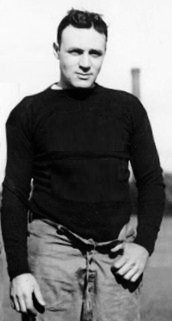
In 1922–23, Horween appeared in all 11 games and scored 4 rushing touchdowns as the Cardinals were 8–3–0. In 1923–24, the team was 8–4–0. On October 7, 1923, he and his brother both scored in the same game, as he kicked two extra points and his brother ran for a touchdown as the Cardinals beat the Rochester Jeffersons 60–0 at Normal Park in Chicago. On November 12, 1922, he made a long pass to Paddy Driscoll for the game's only touchdown, in a 7–0 victory over the Akron Pros. On December 2, 1923, he kicked a 35 yd field goal and his brother ran for a touchdown as the Cardinals beat the Oorang Indians, 22–19.
His brother Ralph Horween also played for the Chicago Cardinals. Horween and his brother played for the Cardinals under the alias McMahon (he played as A. McMahon) to protect their family's social status. He kept that name until 1923.
Coaching career at Harvard
Horween returned to Harvard as the school's head football coach from 1925 to 1930, compiling a record of 21–17–3. The New York Sun reported: The boys are for him unreservedly. It is no, secret, however, that Horween's appointment didn't please the Beacon Street–Park Avenue element among the grads. The clique that supported the old regime would prefer to see a Cabot or a Wendell, we use the names as symbols, in the saddle...
Charlie Devens, who later played baseball for the New York Yankees, played football under Horween at Harvard. He recalled that anti-Semitic posters aimed at Coach Horween were displayed at a game in Ann Arbor, Michigan.
Horween married Marion Eisendrath in November 1928. The couple had a long engagement, as they had agreed to postpone the wedding until the Harvard football team defeated Yale. The requisite victory took place on Saturday, November 24, and the wedding on the following Thursday. He resigned following the 1930 season.
Horween Leather Company
After retiring from football, Horween returned to Chicago in 1930, and he and his brother inherited the family leather tannery business, Horween Leather Company, which had been founded by their father in Chicago in 1905. He operated the business, a successful company that supplied (and still supplies) the leather for Wilson's NFL official football, from 1949 to 1984.
In 1945, he coached the football team of his former high school, Francis Parker.
In 1952, he was vice president of the Chicago Symphony Orchestra. He also served as a trustee of the Chicago Symphony, and on the Harvard University board of overseers.
Head coaching record
College
References
References
- Raphael, Sven. (March 21, 2012). "Horween Leather Company Chicago". Gentleman's Gazette.
- (1933). "Who's who in American Jewry". Jewish Biographical Bureau.
- (1961). "The Sentinel's history of Chicago Jewry, 1911–1961". Sentinel Publishing Co. Chicago.
- Charles H. Joseph. (1926). "18M". The Jewish Criterion.
- "Ralph Horween". profootballresearchers.org.
- Stanley Bernard Frank. (1936). "The Jew in sports". The Miles Publishing Company.
- Gerald R. Gems. (2000). "For Pride, Profit, and Patriarchy: Football and the Incorporation of American Cultural Values". Scarecrow Press.
- Michael Oriard. (2004). "King Football: Sport and Spectacle in the Golden Age of Radio and Newsreels, Movies and Magazines, the Weekly & the Daily Press". Univ of North Carolina Press.
- (1965). "Encyclopedia of Jews in Sports". Bloch Pub. Co..
- Gregg Rosenthal. (June 19, 2012). "Schwartzes first Jewish brothers in NFL since 1923".
- Barnathan, Lee. (May 2, 2012). "Browns pick Schwartz in NFL draft". Jewish Journal.
- (September 25, 1919). "Arnold Horween Elected". Harvard Alumni Bulletin.
- (January 3, 1920). "Harvard Wins from Oregon 7 to 6". Our Paper – Massachusetts Reformatory (Concord, Mass.).
- John Maxymuk. (2012). "NFL Head Coaches: A Biographical Dictionary, 1920–2011". McFarland.
- (November 30, 1928). "Miss Eisendrath Bride of Horween". Boston Globe.
- Frederick Sumner Mead. (1921). "Harvard's Military Record in the World War". Harvard Alumni Association.
- Steven A. Riess. (1998). "Sports and the American Jew". Syracuse University Press.
- Murray Greenberg. (2008). "Passing Game: Benny Friedman and the Transformation of Football". PublicAffairs.
- Jack Cavanaugh. (2010). "The Gipper: George Gipp, Knute Rockne, and the Dramatic Rise of Notre Dame Football". Skyhorse Publishing.
- (1950). "Co-operation". Boston Elevated Railway Company, Metropolitan Transit Authority.
- (March 3, 2013). "Horween, Arnold". Jews In Sports @ Virtual Museum.
- Donald Grant Herring. (1919). "Football; Princeton 10, Harvard 10".
- Mark F. Bernstein. (2001). "Football: The Ivy League Origins of an American Obsession". University of Pennsylvania Press.
- (1997). "The New York Times Biographical Service". New York Times & Arno Press.
- (August 4, 1996). "A League First: Former Player Turns 100". New York Times.
- (1997). "x".
- Richard Goldstein. (May 29, 1997). "Ralph Horween, 100, the Oldest Ex-N.F.L. Player". New York Times.
- Wechsler, Bob. (2008). "Day by Day in Jewish Sports History". KTAV Publishing House.
- Kevin Carroll. (2007). "Dr. Eddie Anderson, Hall of Fame College Football Coach: A Biography". McFarland.
- Dick Johnson. (2002). "Yankees Century: 100 Years of New York Yankees Baseball". Houghton Mifflin Harcourt.
- (November 26, 1928). "Horween May Quit Harvard Coaching Job; Holds Confab with Bingham; Arnold to Marry on Thursday". The Pittsburgh Press.
- (August 7, 1985). "Ex-Harvard Grid Coach Dies at 87". The Lewiston Journal.
- (May 28, 1997). "Ralph Horween". Chicago Tribune.
- (March 21, 2012). "Horween Leather Company". Gentleman's Gazette.
- "About « Horween Leather Company". Horween.com.
- (May 27, 1997). "Deaths; Ralph Horween". Toledo Blade.
- Barbara Rolek. (October 27, 2003). "Horween's leather bound by tradition". Chicago Tribune.
- (1952). "Chicago Symphony Orchestra; Program notes".
This article was imported from Wikipedia and is available under the Creative Commons Attribution-ShareAlike 4.0 License. Content has been adapted to SurfDoc format. Original contributors can be found on the article history page.
Ask Mako anything about Arnold Horween — get instant answers, deeper analysis, and related topics.
Research with MakoFree with your Surf account
Create a free account to save articles, ask Mako questions, and organize your research.
Sign up freeThis content may have been generated or modified by AI. CloudSurf Software LLC is not responsible for the accuracy, completeness, or reliability of AI-generated content. Always verify important information from primary sources.
Report