From Surf Wiki (app.surf) — the open knowledge base
Armoire (Augustus Pugin)
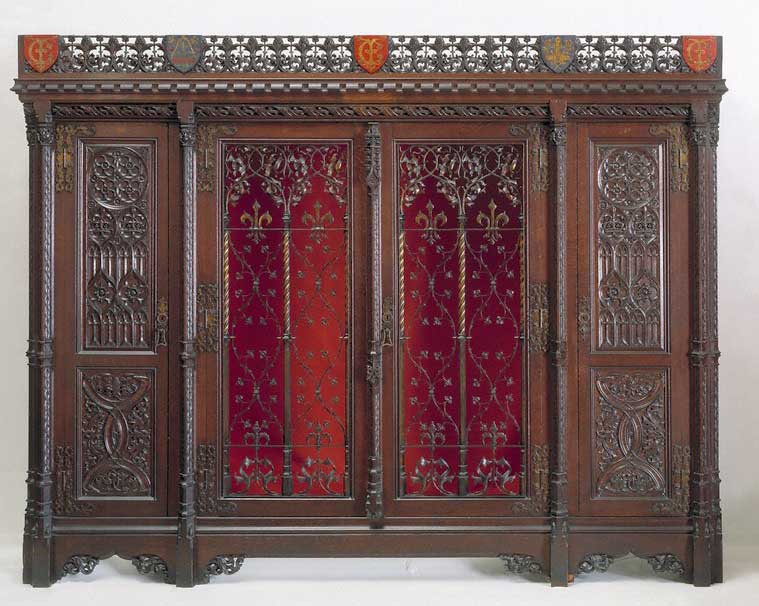
This ''''''Armoire'''''', displayed at the Great Exhibition of 1851, was designed by Augustus Pugin (1812–52) and made by frequent collaborator John Gregory Crace (1809-1889).
History and description
The cabinet was the grandest piece in the group of furniture designed by Pugin and made by Crace for the Medieval Court in the Great Exhibition of 1851. As Crace was a judge for Class XXVI (furniture) and the cabinet was exhibited in his name, it was not eligible for a medal.
The shields along the top and the carved decorative motifs were drawn from medieval sources. The motifs include Crace's initials, a plummet (carpenter's tool) as an emblem of his honesty, and a compass to indicate his ability to keep within his estimates. Many designers of the Victorian period were inspired by the art of the Middle Ages, but Pugin was probably the greatest and most ardent exponent of the Gothic Revival style.
A prolific designer, best remembered for his decoration of the Houses of Parliament, Pugin exhausted himself and died the year after this cupboard was made, aged only forty. The Victoria and Albert Museum bought the cupboard directly from the 1851 Exhibition, making it one of its earliest acquisitions.
Bibliography
This article was imported from Wikipedia and is available under the Creative Commons Attribution-ShareAlike 4.0 License. Content has been adapted to SurfDoc format. Original contributors can be found on the article history page.
Ask Mako anything about Armoire (Augustus Pugin) — get instant answers, deeper analysis, and related topics.
Research with MakoFree with your Surf account
Create a free account to save articles, ask Mako questions, and organize your research.
Sign up freeThis content may have been generated or modified by AI. CloudSurf Software LLC is not responsible for the accuracy, completeness, or reliability of AI-generated content. Always verify important information from primary sources.
Report