From Surf Wiki (app.surf) — the open knowledge base
Armeniac Theme
Medieval province of the Byzantine Empire
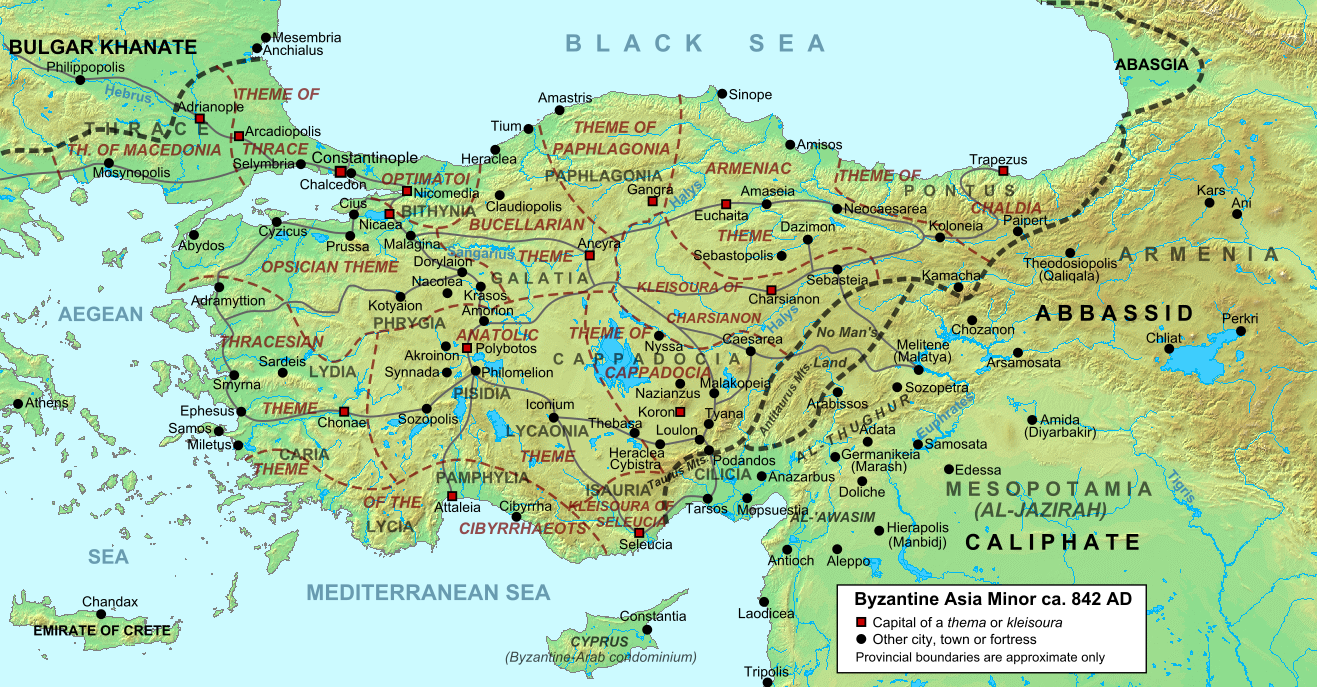
Medieval province of the Byzantine Empire
| Field | Value |
|---|---|
| native_name | Άρμενιακόν, θέμα Άρμενιάκων, Άρμενιακόν θέμα |
| conventional_long_name | Theme of the Armeniacs |
| common_name | Armeniac Theme |
| subdivision | Theme |
| nation | the Byzantine Empire |
| era | Middle Ages |
| capital | Amaseia |
| image_map | Asia Minor ca 780 AD.svg |
| image_map_caption | The Byzantine themes of Asia Minor in circa 780, after the split of the Opsikion |
| life_span | 640s/660s–c. 1073 |
| year_start | 640s/660s |
| year_end | c. 1073 |
| event_end | Fall to Frankish mercenaries and then Seljuks. |
| today | Turkey |
The Armeniac Theme (, Armeniakon [thema]), more properly the Theme of the Armeniacs (Greek: θέμα Ἀρμενιακῶν, thema Armeniakōn), was a Byzantine theme (a military-civilian province) located in northeastern Asia Minor (modern Turkey).
History
The Armeniac Theme was one of the four original themes, established sometime in the mid-7th century out of the territory of Lesser Armenia (also known as "Armenia Minor"). Although the mention of a "George, tourmarchēs of the Armeniacs" in 629, during the Persian campaigns of Emperor Heraclius (r. 610–641), may suggest the existence of the theme at such an early date, the first unambiguous reference to it in literary sources occurs during the revolt of its general, Saborios, in 667/668. It is next mentioned on a seal of 717/718. Together with the other themes, it was created from the remnants of one of the field armies of the old East Roman army following the disastrous defeats suffered during the first wave of the Muslim conquests, a process probably complete by the late 640s. Thus, the army of the magister militum per Armeniae (the "Armeniacs") was withdrawn and settled in the areas of Pontus, Paphlagonia and Cappadocia, giving its name to the region.
The theme's capital was at Amaseia, and it was governed by a stratēgos, who ranked, together with the stratēgoi of the Anatolic and Thracesian themes, in the first tier of stratēgoi, drawing an annual salary of 40 gold pounds. In the 9th century, it fielded some 9,000 men and encompassed 17 fortresses. Its size and strategic importance on the Byzantine Empire's north-eastern frontier with the Muslims made its governor a powerful figure, and the theme's forces participated in several revolts in the 8th century. Consequently, in the 9th century it was broken up: the smaller provinces of Charsianon and Cappadocia were formed, first as kleisourai and later as full themes, along the border in the south and east, while in circa 819, the coastal themes of Paphlagonia and Chaldia were split off, followed later by the area of Koloneia (first under a doux, by 863 under a full strategos), leaving a rump Armeniac theme encompassing the western Pontus.
The theme remained in Byzantine hands until the late 11th century. In 1073, however, following the disastrous Battle of Manzikert, Frankish mercenaries under Roussel de Bailleul seized control and governed the region, until Byzantine authority was restored by future emperor Alexios Komnenos in 1075. Shortly after, the region was overrun by the Seljuk Turks, with only a few coastal forts holding out. The Komnenian emperors managed to recover the coastal regions for the Empire, but the Armeniac theme was not restored.
References
Sources
References
- {{harvnb. Haldon. 1999
- {{harvnb. ODB
- {{harvnb. Ragia. 2009. McGeer. Nesbitt. Oikonomides. 2001
- {{harvnb. Haldon. 1997
- {{harvnb. Haldon. 1999
- {{harvnb. ODB. Treadgold. 1995
- {{harvnb. Haldon. 1999
This article was imported from Wikipedia and is available under the Creative Commons Attribution-ShareAlike 4.0 License. Content has been adapted to SurfDoc format. Original contributors can be found on the article history page.
Ask Mako anything about Armeniac Theme — get instant answers, deeper analysis, and related topics.
Research with MakoFree with your Surf account
Create a free account to save articles, ask Mako questions, and organize your research.
Sign up freeThis content may have been generated or modified by AI. CloudSurf Software LLC is not responsible for the accuracy, completeness, or reliability of AI-generated content. Always verify important information from primary sources.
Report