From Surf Wiki (app.surf) — the open knowledge base
Armed Forces of Bolivia
Combined military forces of Bolivia

Combined military forces of Bolivia
| Field | Value |
|---|---|
| name | Armed Forces of Bolivia |
| native_name | Fuerzas Armadas de Bolivia |
| image | Flag of Bolivia (military).svg |
| motto | Subordinacion y Constancia, ¡Viva Bolivia! (Subordination and Steadfastness. Long Live Bolivia!) |
| founded | |
| branches | |
| website | |
| commander-in-chief | Rodrigo Paz (President of Bolivia) |
| commander-in-chief_title | Captain General of the Armed Forces |
| minister | Raúl Salinas |
| minister_title | Minister of Defense |
| commander | César Moisés Vallejos Rocha |
| commander_title | Commander in Chief of the Armed Forces |
| age | 18 |
| active | 40.000 to 70.000 (est.) |
| reserve | 40.000 (est.) |
| amount | $659.2 million (2017) |
| percent_GDP | 1.76% (2017) |
| history | History of Bolivia |
| ranks | Military ranks of Bolivia |
| commander-in-chief = Rodrigo Paz (President of Bolivia) | commander-in-chief_title = Captain General of the Armed Forces Argentina Austria Brazil China Mexico Peru Russia Israel (historical) Turkey United States European Union France Switzerland United Kingdom
The Bolivian Armed Forces (Spanish: Fuerzas Armadas de Bolivia) are the military of Bolivia. The Armed Forces of Bolivia are responsible for the defence, both of external and internal, of Bolivia and they are constituted by Bolivian Army, the Bolivian Air Force and the Bolivian Navy. All these institutions are under the Ministry of Defence of Bolivia.
In addition to the Bolivian Army, the Bolivian Air Force and the Bolivian Navy, the Bolivian National Police, although dependent on the Ministry of Government in times of peace, is part of the reserves of the Armed Forces according to the Organic Law of the Armed Forces of this nation, together with other reserve bodies such as the SAR-FAB emergency and rescue units.
Figures on the size and composition of the armed forces of Bolivia vary considerably, with rare official data available. It is estimated, however, that the three main forces (army, navy and air force) add up to a total of between 40,000 to 70,000 troops, while the Bolivian police would be around 40,000 troops.
High Command of the Armed Forces of Bolivia
The roles and tenure of the High Command are described in the Organic Law of the Armed Forces (LOFA) which states that the hierarchy is subordinate to and appointed by the President of Bolivia with the Minister of Defense acting as an intermediary between the President and the Armed Forces. Article 172 of the 2009 Constitution states that amongst the President's duties are "To designate and substitute the Commander in Chief of the Armed Forces and the Commanders of the Army, the Air Force and the Navy."
The current positions, appointed by interim president Jeanine Áñez Chávez on 13 Nov 2019 are as follows:
- Commander in Chief of the Armed Forces: Gen. Carlos Orellana Centellas
- Military Chief of Staff: Pablo Arturo Guerra Camacho
- Commander of the Army: Gen. Iván Patricio Inchauste
- Commander of the Air Force: Ciro Orlando Álvarez Guzmán
- Commander of the Navy: Rear Admiral Moisés Orlando Mejía Heredia
Article 100 of the LOFA also states that these positions, and several others such as Chief of Police and Head of the Presidential, may be held "only once during the military career and for a time no greater than two years". This results in a fairly high turnover in the Bolivian High Command with continued service being prohibited by law. The last changes in High Command, under the previous President Evo Morales, occurred on 24 Dec 2018, 11 Dec 2017, 29 Dec 2016, 30 Dec 2015, 18 Dec 2014, 13 Dec 2013 and 3 Dec 2012.
Attempts to increase the maximum length of service for members of the High Command (and other positions) were made, unsuccessfully, under the Morales administration who wished to increase it to between 3 and 5 years.
Commander in Chief of the Armed Forces
| No. | Portrait | Name | ||||
|---|---|---|---|---|---|---|
| (birth–death) | Term of office | Defence branch | Ref. | Took office | Left office | Time in office |
| General | ||||||
| Víctor Guzmán Bruno | 14 August 1991 | 20 August 1992 | ||||
| General | ||||||
| Oscar Vargas Lorenzetti | 20 August 1992 | 15 December 1994 | ||||
| General | ||||||
| Reynaldo Cáceres Quiroga | 15 December 1994 | 1 November 1996 | ||||
| General | ||||||
| Hernán Aguilera Bianchi | 1 November 1996 | 14 November 1998 | ||||
| Admiral | ||||||
| Jorge Zabala Ossio | 14 November 1998 | 24 November 2000 | ||||
| General | ||||||
| Alvin Anaya Kippes | 24 November 2000 | 8 August 2002 | ||||
| Divisional general | ||||||
| Roberto Claros Flores | ||||||
| Acting | 8 August 2002 | 24 November 2003 | ||||
| Admiral | ||||||
| **** | 24 November 2003 | 14 June 2005 | ||||
| Admiral | ||||||
| Marco Antonio Justiniano Escalante | 14 June 2005 | 24 January 2006 | ||||
| Admiral | ||||||
| José Luis Cabás Villegas | ||||||
| Acting | 5 January 2009 | 24 January 2010 | ||||
| General | ||||||
| Carlos Ramiro de La Fuente Bloch | 24 January 2010 | 22 March 2011 | ||||
| Admiral | ||||||
| Armando Pacheco Gutiérrez | 22 March 2011 | 5 January 2012 | ||||
| General | ||||||
| Tito Roger Gandarillas | 5 January 2012 | 3 December 2012 | ||||
| General | ||||||
| Edwin de la Fuente | 3 December 2012 | 14 December 2013 | ||||
| Admiral | ||||||
| Víctor Baldivieso Haché | 14 December 2013 | 22 December 2014 | ||||
| General | ||||||
| Omar Jaime Salinas Ortuño | 22 December 2014 | 30 December 2015 | ||||
| General | ||||||
| Juan Gonzalo Durán Flores | 30 December 2015 | 29 December 2016 | ||||
| General | ||||||
| Luis Orlando Ariñez Bazán | 29 December 2016 | 11 December 2017 | ||||
| Admiral | ||||||
| Yamil Octavio Borda Sosa | 11 December 2017 | 24 November 2018 | ||||
| [[File:Kaliman niega que se hubiese gestado un golpe de Estado contra Evo Morales (cropped).jpg | 50px]] | General | ||||
| Williams Kaliman | ||||||
| (born 1963) | 24 November 2018 | 13 November 2019 | ||||
| General | ||||||
| Carlos Orellana Centellas | 13 November 2019 | Incumbent |
Army
Main article: Bolivian Army
The Bolivian Army (Ejército de Bolivia, EB) is the land branch of the armed forces of Bolivia. Together with the Bolivia army and air force Bolivia, is responsible for protecting Bolivia of internal, external threats and ensure the independence of this country. The Bolivian Army has around 55,500 men. There are six military regions (regiones militares—RMs) in the army. The Army is organized into ten divisions. The Army maintains a small fleet of utility aircraft, primarily to support headquarters.
Combat units directly under the Army general command
- 1st Infantry Regiment Colorados (Presidential Guard), contains two 2 battalions: BI-201 and BI-202
- BATCOM-251,
- Gen. maintenance cen. no. 1
- Transport batt. no. 1.
- 1st National parks Security Regiment
Special forces command
The Special Forces command controls the following units:
- 12th Ranger Regt. "MANCHEGO", Montero
- 16th Infantry Regt. JORDAN, Riberalta (Special Forces)
- 18th Parachute Infantry Regiment VICTORIA "Army Special Troops Training Center", Cochabamba
- 24th Ranger Regiment (Mountain) MÉNDEZ ARCOS, Challapata
Army aviation command
Army aviation company 291 (La Paz), army aviation company 292 (Santa Cruz)
- 291st Cavalry Group (La Paz)
Regional
The Bolivian Army has six military regions (regiones militares—RMs) covering the various Departments of Bolivia:
- RM 1, La Paz, most of La Paz Department: 1st Army Division, 297th MPB C.L.Saavedra (Military Police battalion), BE-296 CNL R.C.Zabalegui (ecological batt.), BE-297 (ecolog. batt.), BATLOG-1 (Logistics btn.), army aviation company 291 C.L.Cordoba, Mili. hospital no. 1, Military Police School, Army Equestrian Center, Military College of Bolivia "COL Gustavo Villaroel Lopez", Army School of Intelligence, Army Engineers School MCAL Antonio Jose de Sucre, Army Signals and Communications School, Army Armor School, Army 1st Engineering Regiment CPN Felipe Ochoa "Army Engineering and Maintenance Center", Bolivian Army Military School of Music "LTCOL Antonio Patino", 2nd Armored Cavalry Regiment "Tarapaca"
- RM 2, Potosí, covering the departments of Oruro and Potosi: 2nd and 10th ADs, 24th RR M.Arcos (ranger regt.), ADA-202 (a.a. group), Army Mountain School
- RM 3, Tarija, consisting of Tarija Department and eastern Chuquisaca and southern Santa Cruz:3rd and 4th AD
- RM 4, Sucre, covering the departments of Cochabamba and northern Chuquisaca: 7th Army Division, 272nd MP Btn., BATLOG-2 (long.Batt), mili.hospital no2, Army Arsensals Cochabamba, Army Command and Staff College MSHL Antonio de Santa Cruz, Army NCO School "SGT M. Paredez", Army Artillery School, 18th PIR "Victoria" (Army Special Troops Training Center), Army NCOs and Warrant Officers Advance Studies Institute, Army Arms Applications School, 1LT Edmundo Andrade Military High School
- RM 5, Cobija, encompassing the Pando Department and parts of La Paz and Beni departments: 6th AD, 16th IR Jordan (special forces), Army Jungle Operations School
- RM 6, Santa Cruz, covering most of Santa Cruz Department: 5th and 8th ADs, BMP-273 R.Amezaga (Military Police), BE-298 (ecological batt.), 12th RR Manchego (ranger), BATLOG-3 (logist. batt.), 292 army aviation company, Bolivian Condores school (special forces), 6th IR
Army divisions
The army is organized into ten territorial divisions plus a mechanized division, each of which, with the exception of Viacha, occupy a region generally corresponding to the administrative departments, with some overlapping. These and their respective divisional headquarters and constituent units are:
- 1st Mechanized Division, Viacha (La Paz Department): 1st Field Artillery Regiment "Camacho", 6th Air Defense Artillery Regiment, 23rd IR (Mechanized Infantry Training), 4th IR Tarapaca (Mech.) 5th ACR, 2nd ACR (Training), 1st Armor Regiment
- 1st AD, Viacha (La Paz Department): 8th IR Ayacucho, RI 30 Murillo (mountain), RA 2 Bolivar, Bat.Ing. 2 G.F.Roman.
- 2nd AD, Oruro: 21st IR Illimani (Mountain), RI 22 Mejillones, 25th RI (Mountain) Tocopilla, RC 8 Braun, 1st Artillery Regt. Camacho, Bat.Ing. 7 Sajama.
- 3rd AD, Villamontes (Tarija Department): 5th IR Campero, RI 20 Padilla, RC 3 Aroma, RA 3 Pisagua, Bat.Ing. 1 Chorolque.
- 4th AD, Camiri (Santa Cruz Department):, 6th Infantry Regiment Campos, RI 11 Boqueron, 1st Cavalry Regt. "E. Avaroa", RA 4 Bullian
- 5th AD, Roboré (Santa Cruz Department): RI 13 Montes, RI 14 Florida, RI 15 Junin, RC 6 Castrillo, RA 5 Vergara
- 6th AD, Trinidad: RI 17 Indepedencia, RI 29 Echevarria, RI 31 Rios, RI 32 Murguia, 2nd Cavalry Regt. Ballivan, 8th AR Mendez(reserve), Bat.Ing. 6 Riosinho.
- 7th Army Division, Cochabamba (the largest):, 2nd Infantry Regiment "Marshal Antonio Jose de Sucre", 18th Parachute Infantry Regiment "Victoria" (Army Special Troops Training Center), RI 26 R.Barrientos (mech.) 29th PIR "CPT V.Ustariz" (airborne), RA 7 Tumusia, Bat.Ing.5 T.N.Ovando
- 8th AD, Santa Cruz: RI 7 Marzana, RI 10 Warnes (mech.), RC 10 G.M.J.M. Mercado, RA 9 Mitre (reserve), Bat.Ing. 3 Pando.
- 9th AD (Reserve), Rurrenabaque: the Division has been reduced to reserve status and its component units have been divided up between DE-1 and DE-6
- 10th AD, Tupiz: 3rd IR "Juan Jose Perez", RI 4 Loa, RI 27 Antofagasta, 7th ACR Chichas (Armored Cavalry), RA 12 Ayohuma (reserve)
RI: infantry regiment RC: cavalry regiment RA: artillery regiment Bat.Ing.: battalion engineer
Army organized has ten divisions controlling the following units:

- eight cavalry regiments, included two mechanized regiments
- twenty-three infantry regiments included two airborne and two mountain
- one recce. mechanized regiments and one armored regiments
- two ranger regiments
- one special forces regiments
- six and three reserve artillery regiments
- one artillery and antiaircraft group
- one artillery and antiaircraft Regiment
- three military police battalions
- three ecological battalions
- two army aviation companies
- six engineer battalions
- Plus logistical and instructional support commands
- Presidential Guard (Colorado) infantry battalion under direct control of the army headquarters in La Paz's Miraflores district
The Army maintains a small fleet of utility aircraft, primarily to support headquarters.
Equipment of the Army
Main article: List of equipment of the Bolivian Armed Forces
Land equipment


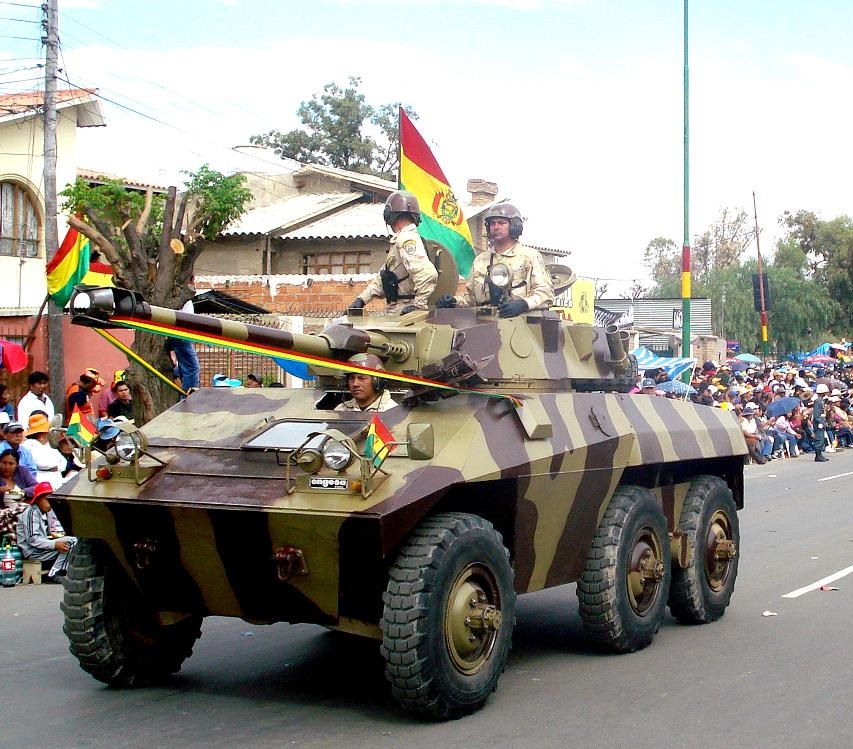
| Bolivian army equipment |
|---|
| Tanks |
| Reconnaissance vehicles |
| Armoured Personnel Carriers |
| Artillery pieces and mortar |
| Transport |
| Small Arms |
Air equipment
Main article: Bolivian Army
Uniforms

Army officers, NCOs, and enlisted personnel generally wear gray or, for tropical areas, gray-green service uniforms. Army fatigue uniforms are olive green, and combat uniforms are of US woodland pattern camouflage. The standard headgear for enlisted personnel is the beret bearing the national colors of red, yellow and green. Paratroops (paracaidistas) were distinguished by black berets, and Special Forces by green berets.
Air Force
Main article: Bolivian Air Force

The Bolivian air force (Fuerza Aérea Boliviana, FAB) is the air branch of the armed forces of Bolivia. The Bolivian Air Force has nine air bases, located at La Paz, Cochabamba, Santa Cruz, Puerto Suárez, Tarija, Villamontes, Cobija, Riberalta, and Roboré.
Major commands included the following:
- General Command Systems Department in La Paz, equipped with sophisticated computers. In March 1989, FAB took a major step toward modernizing its force by inaugurating the

- Group of Security and Defense of Air Installations (Grupo de Seguridad y Defensa de Instalaciones Aéreas—GSDIA); and GADA-91, GADA-92, GADA-93 and GADA-94.
- Four air brigades with thirteen subordinate air groups.
- First Air Brigade (El Alto):
- Hunting air group 31 "G.J.Market": Fighter squadron 311, Executive squadron 310
- Transport air group 71 "Gen.W.A.Rojas" (Military airlift TAM):Air squadron 710, Air squadron 711, Air squadron 712
- Aerophotogrammetry National Service (NSS)
- Bolivian Air Transport-TAB
- Task Force "Black devils"
- Group air defence artillery GADA-91
- Second Air Brigade (Cochabamba):
- Hunting air group 34 "P.R.Cuevas": Aerotactico squadron 340, Link training squadron 341
- Group air search and rescue 51: Squadron helicopter 511
- Group air defence artillery GADA-92
- Third Air Brigade (Santa Cruz):
- Hunting Air Group 32 "B.B.Rioja": squadron 321, squadron 320, squadron 327 (maintenance)
- COLMILAV Training squadrons: primary squadron, basic squadron, squadron "NN" (prob.navigation)
- Air group air reconnaissance and exploration 82(air base Puerto Suárez): 831 squadron
- Air group 61 "Gen.L.G.Pereiera (air base Puerto Suárez): squadron 610
- Task force "Red Devils" (air base The Trompillo-Robore)
- Group air defence artillery GADA-93
- Fourth Air Brigade:
- Group air reconnaissance and exploration 82 "Cap.A.V.Peralta" (air base Tarija): squadron 821
- Air Group 63 "Tcnl.E.L.Rivera" (air base Villamontes): squadron 630
- Group air defence artillery GADA-94
- First Air Brigade (El Alto):
Units under direct control of the general command of the FAB
::*Tactical air group 62 (air base Riberalta): squadron 620 ::*Air group 64: squadron (air base Cobija) 640 ::*Transport air group 72 (air base Trinidad) : squadron 720
Navy
Main article: Bolivian Navy
The Bolivian Naval Force (Fuerza Naval Boliviana in Spanish), formerly Bolivian Navy (Armada Boliviana) is a naval force about 5,000 strong in 2008. Although Bolivia has been landlocked since the War of the Pacific in 1879, Bolivia established a River and Lake Force (Fuerza Fluvial y Lacustre) in January 1963 under the Ministry of National Defense. It consisted of four boats supplied from the United States and 1,800 personnel recruited largely from the army. Bolivia's naval force was renamed the Bolivian Naval Force (Fuerza Naval Boliviana) in January 1966, but it also has been called the Bolivian Navy (Armada Boliviana). It became a separate branch of the armed forces in 1963. Bolivia has large rivers that are tributaries to the Amazon which are patrolled to prevent smuggling and drug trafficking. There is also a Bolivian Naval presence on Lake Titicaca, the highest navigable lake in the world, across which runs along the Peruvian frontier.

Districts
The Navy is organized into ten naval districts, with flotilla headquarters in Guaqui, Guayaramerín, Puerto Suárez, Riberalta, and San Pedro de Tiquina, and bases in Puerto Busch, Puerto Horquilla, Puerto Villarroel, Trinidad, and Rurrenabaque.
Naval vessels include several dozen boats, dozen or more of which are for riverine patrol, including the piranias, and riders, which are powerful river boats. In addition, Bolivia has several seagoing vessels, including the Santa Cruz de la Sierra (PR-51), and several flagged ships that sail with the permission of the "Capitanias Navales" Naval Registration Office. The Libertador Simón Bolívar, a ship acquired from Venezuela, use to navigate from its home port in Rosario, Argentina on the River Paraná. In 1993, the Navy was formally renamed the Naval Force (Fuerza Naval) and moved with the Bolivian Army under a single military authority.
Most of the officers are often educated in the Naval Academy where they graduate with a BS in Military and Naval Science, diploma accredited by the Military University and then they do other studies at the bachelor's degree and master's level. Argentina has their Naval Military Group in Bolivia advising at the highest level in naval strategy and tactics. Many Bolivian officers practice ocean sailing in Argentinean big naval ships. The Bolivian Navy has several Special Forces units to address both internal and external conflicts.

- DN1 Primer Distrito Naval "BENI"- DN1 First Naval District "BENI"
- DN2 Segundo Distrito Naval- "MAMORE"- DN2 Second Naval District "MAMORA"
- DN3 Tercer Distrito Naval "MADERA" -DN3 Third Naval District "Madera"
- DN4 Cuarto Distrito Naval "TITICACA" -DN4 Fourth Naval District Titicaca
- DN5 Quinto Distrito Naval "SANTA CRUZ DE LA SIERRA" -DN5 Fifth Naval District "SANTA CRUZ DE LA SIERRA"
- DN6 Sexto Distrito Naval "COBIJA" -Sixth Naval District DN6 "COBIJA"
- The Naval Service Areas:
- AN 1 "COCHABAMBA" – Naval Area 1 "Cochabamba"
- AN 2 "SANTA CRUZ" – Naval Area 2 "SANTA CRUZ"
- AN 3 "BERMEJO" – Naval Area 3 "Bermejo"
- AN 4 "LA PAZ" – Naval Area 4 "La Paz"
- And the special units:
- Fuerza de Tarea "Diablos Azules"- Task Force "Blue Devils"
- Servicio de Inteligencia Naval – SINDA Naval Intelligence Service – SINDA
- Grupo de Reacción Inmediata GRIN -Immediate Response Group GRIN
- El Centro de Instrucción de Buceo en Altura- High Altitude Diving Training Center
- Command Training Center Amphibians
Marine corps

The Marine component of the FNB originated with the creation of the Marine Battalion Almirante Grau in the early 1980s. This unit of 600 men is based on Tiquina naval base on Lake Titicaca. Later changes name to Marine Battalion Independence, based in Chua (Not to be confused with the Independence RI17 EB).At present this battalion maintains a similar number of troops including premilitares. Staff of this unit is part of Task Force Blue Devils or are stationed in various naval bases. There are currently seven infantry battalions which are distributed as follows:
- Primer Distrito Naval "BENI"- First Naval District "BENI"
- Batallón de Infantería de Marina I "Bagué"- 1st Marine Battalion "Bagué"
- Segundo Distrito Naval "MAMORE"- Second Naval District "MAMORA"
- Batallón de Infantería de Marina II "Tocopilla"- 2nd Marine Battalion "Tocopilla"
- Tercer Distrito Naval "MADERA"- Third Naval District "MADERA"
- Batallón de Infantería de Marina III "Mejillones"- Marine Battalion III "Mejillones"
- Cuarto Distrito Naval "TITICACA"- Fourth Naval District Titicaca
- Batallón de Infantería de Marina IV "Alianza " -Marine Infantry Battalion IV "Alliance"
- Batallón de Infantería de Marina Mecanizada VI "Independencia"- Marine Infantry Battalion Mechanized VI "Independence"
- Quinto Distrito Naval "SANTA CRUZ DE LA SIERRA"- Fifth Naval District "SANTA CRUZ DE LA SIERRA"
- Batallón de Infantería de Marina V "Calama"- Marine Battalion V Calama
- Sexto Distrito Naval "COBIJA"- Sixth Naval District "COBIJA"
- Batallón de Infantería de Marina VII "Columna Porvenir"- Marine Battalion VII "Columna Porvenir"
Naval Military Police
This specialty is essentially similar to its counterpart in the Army, carrying out operations such as Important Persons Protection (IPP) Physical Security (SEF) or Patrol Facility (PAT), with additions such as signals or naval protocol. There Naval detachments of PM in all district headquarters or FNB Naval Area. But only have the following units at the Battalion:
- AN 4 " La Paz "- AN 4 "La Paz"
- Batallón de Policía Militar Naval N° 1- 1st Naval Military Police Battalion
- AN 1 "COCHABAMBA"- AN 1 "Cochabamba"
- Batallón de Policia Militar Naval N° 2 "Carcaje"- 2nd Naval Military Police Battalion "Quiver"
- AN 2 "SANTA CRUZ"- AN 2 "SANTA CRUZ"
- Batallón de Policía Militar Naval N° 3 -Naval Military Police Battalion No. 3
- Cuarto Distrito Naval "TITICACA"- Fourth Naval District Titicaca
- Batallón de Policía Militar Naval N° 4- Naval Military Police Battalion No. 4
Equipment
Boats
The Bolivian Navy has a total of 173 vessels, mostly stationed on Lake Titicaca:
- PATROL:
- 1 Class PR-51
- 6 class boats Cap. Bretel Bretel
- 4 patrol boats lake
- 32 Boston Whaler
- UNITS SALVAGE:
- 8 Piranha assault boats Mk.1
- 3 Boats hospitals
- 2 Transport of hydrocarbons
- 2 Tanker Ships
- 1 Transport
- 1 Ship "Naval School"
Naval aviation
Main article: Bolivian Navy
Conscription
Since 1904 military service has been compulsory for all fit males between the ages of eighteen and forty-nine. In practice, however, budgetary limitations strictly limited the number of eligible men conscripted, and those traditionally tended to be mostly Indians. Beginning in 1967, conscripts were legally held on active duty for up to two years, but funds seldom permitted even a full year's service. Noncommissioned officers (NCOs) and warrant officers, all of whom were volunteers, generally were drawn from mixed-blood cholos (those of Spanish and Indian descent). In the late 1980s, the service obligation was one year, and conscripts had to be at least nineteen years of age. The FF.AA. commander reported in early 1989 that the largest percentage of conscripts came from the middle class. One explanation for this change could have been the flocking of youths to the lucrative coca paste-making business. Military authorities in the Cochabamba area in particular began to experience growing difficulty in enlisting volunteers in the mid-1980s. Consequently, the military reportedly was resorting to pressganging eighteen-year-olds off the city streets to fill their annual quotas.
Training installations
Training installations include the Garras International Antinarcotics Training School (Escuela Garras del Valor) is a military training facility located in Bolivia, which trains military and law enforcement personnel from Bolivia and other Latin American countries in counternarcotics, intelligence, and counterinsurgency techniques.
References
- ORBAT del Ejercito de Bolivia – Order of battle and list of equipment used by the military of Bolivia.
- CIA World Factbook (2000)
References
- "Ley Orgánica de las FFAA".
- "CIA World Facts".
- "Bolivia-Military Spendings".
- "Bolivian Defence Spending Increases".
- (13 November 2019). "Evo y los militares, una relación con altibajos que tuvo un abrupto fin". La Nación.
- "Página Siete".
- (25 March 2020). "El Deber".
- "Bolivia (Plurinational State of)'s Constitution of 2009".
- Corz, Carlos. (13 November 2019). "Áñez posesiona al Alto Mando de las FFAA; les dice que el país los necesita para mantener la paz".
- (14 December 2013). "Nuevo mando militar será posesionado hoy".
- Montero, Baldwin. "Gobierno y FFAA reafirman su cohesión en jura del nuevo Alto Mando Militar".
- Valdés, Kattya. (20 December 2018). "Presidente anuncia para el lunes 24 cambio del Alto Mando en las FFAA y la Policía".
- Baldwin, Montero. "Nuevo Alto Mando de las FFAA asume compromiso de apoyo a la agenda 2025".
- (30 December 2015). "Posesionan al nuevo Alto Mando de las FFAA; una mujer es jefa del Estado Mayor".
- (18 December 2014). "Morales posesiona a nuevo alto mando militar de las FFAA".
- (3 December 2012). "Morales posesiona a nuevo Alto Mando Militar".
- Farfán, Williams. "FFAA define que Comandante en Jefe ocupe el cargo tres años".
- (22 October 2015). "Bolivia: Decreto Presidencial Nº 22888, 14 de agosto de 1991".
- (22 October 2015). "Bolivia: Decreto Presidencial Nº 23240, 20 de julio de 1992".
- (4 June 2019). "Bolivia: Decreto Presidencial Nº 23910, 15 de diciembre de 1994".
- (22 October 2015). "Bolivia: Decreto Presidencial Nº 24401, 1 de noviembre de 1996".
- (22 November 2000). "FFAA: Presidente relevará al Alto Mando Militar". noticiasfides.com.
- (22 October 2015). "Bolivia: Decreto Presidencial Nº 25992, 24 de noviembre de 2000".
- (27 June 2022). "Bolivia: Decreto Presidencial Nº 26757, 8 de agosto de 2002".
- (22 October 2015). "Bolivia: Decreto Presidencial Nº 27257, 24 de noviembre de 2003".
- (27 June 2022). "Bolivia: Decreto Presidencial Nº 28202, 14 de junio de 2005".
- (27 June 2022). "Bolivia: Decreto Presidencial Nº 29880, 5 de enero de 2009".
- (5 January 2009). "Presidente boliviano renueva cúpula militar". reuters.com.
- (4 June 2019). "Bolivia: Decreto Presidencial Nº 408, 24 de enero de 2010".
- (22 October 2015). "Bolivia: Decreto Presidencial Nº 825, 22 de marzo de 2011".
- (5 January 2012). "Gral. Tito Roger Gandarillas nuevo Comandante en Jefe de las FF.AA.". impresa.lapatria.bo.
- (3 December 2012). "Presidente releva al Alto Mando Militar y posesiona al general Edwin de la Fuente como comandante de las FFAA". la-razon.com.
- (14 December 2013). "El presidente de Bolivia nombra nuevos jefes de las Fuerzas Armadas". AméricaEconomía.
- (22 December 2014). "Bolivia renueva el Alto Mando de sus Fuerzas Armadas". infodefensa.com.
- (30 December 2015). "Gonzalo Durán, nuevo comandante de las FFAA". eldeber.com.bo.
- (29 December 2016). "Morales posesiona al nuevo Alto Mando Militar con ruptura de la secuencia de mando". paginasiete.bo.
- (11 December 2017). "Almirante Yamil Borda Sosa es Comandante en Jefe de FFAA". eldiario.net.
- (24 December 2018). "El general Williams Kaliman Romero asume como comandante en jefe de las FFAA".
- (13 November 2019). "El Gral. Carlos Orellana es el nuevo comandante en jefe de las FFAA de Bolivia". fmbolivia.com.bo/.
- "ORBAT del Ejercito de Bolivia".
- (27 August 2008). "Bolivia's landlocked sailors pine for the high seas".
- Chantelle, Bacigalupo. (22 March 2019). "Every year on 'Día Del Mar,' Bolivia celebrates the coastline they lost".
- (26 May 2005). "United States promotes rule of law, transparency in the Americas.". Embassy of the United States: Montevideo.
- (May 2001). "Andean Counterdrug Initiative: International Narcotics and Law Enforcement: FY 2002 Budget Justification". U.S. Dept. of State (official website).
- Ledebur, Kathryn. (4 September 2008). "New York Times Misleads Readers on Drug War in Bolivia". Media Accuracy on Latin America.
This article was imported from Wikipedia and is available under the Creative Commons Attribution-ShareAlike 4.0 License. Content has been adapted to SurfDoc format. Original contributors can be found on the article history page.
Ask Mako anything about Armed Forces of Bolivia — get instant answers, deeper analysis, and related topics.
Research with MakoFree with your Surf account
Create a free account to save articles, ask Mako questions, and organize your research.
Sign up freeThis content may have been generated or modified by AI. CloudSurf Software LLC is not responsible for the accuracy, completeness, or reliability of AI-generated content. Always verify important information from primary sources.
Report