From Surf Wiki (app.surf) — the open knowledge base
Archway tube station
London Underground station

London Underground station
| Field | Value |
|---|---|
| name | Archway |
| symbol | underground |
| manager | London Underground |
| locale | Archway |
| borough | London Borough of Islington |
| platforms | 2 |
| fare_zone | 2 |
| fare_zone_1 | 3 |
| image_name | Archway station main entrance.JPG |
| imagesize | x265px |
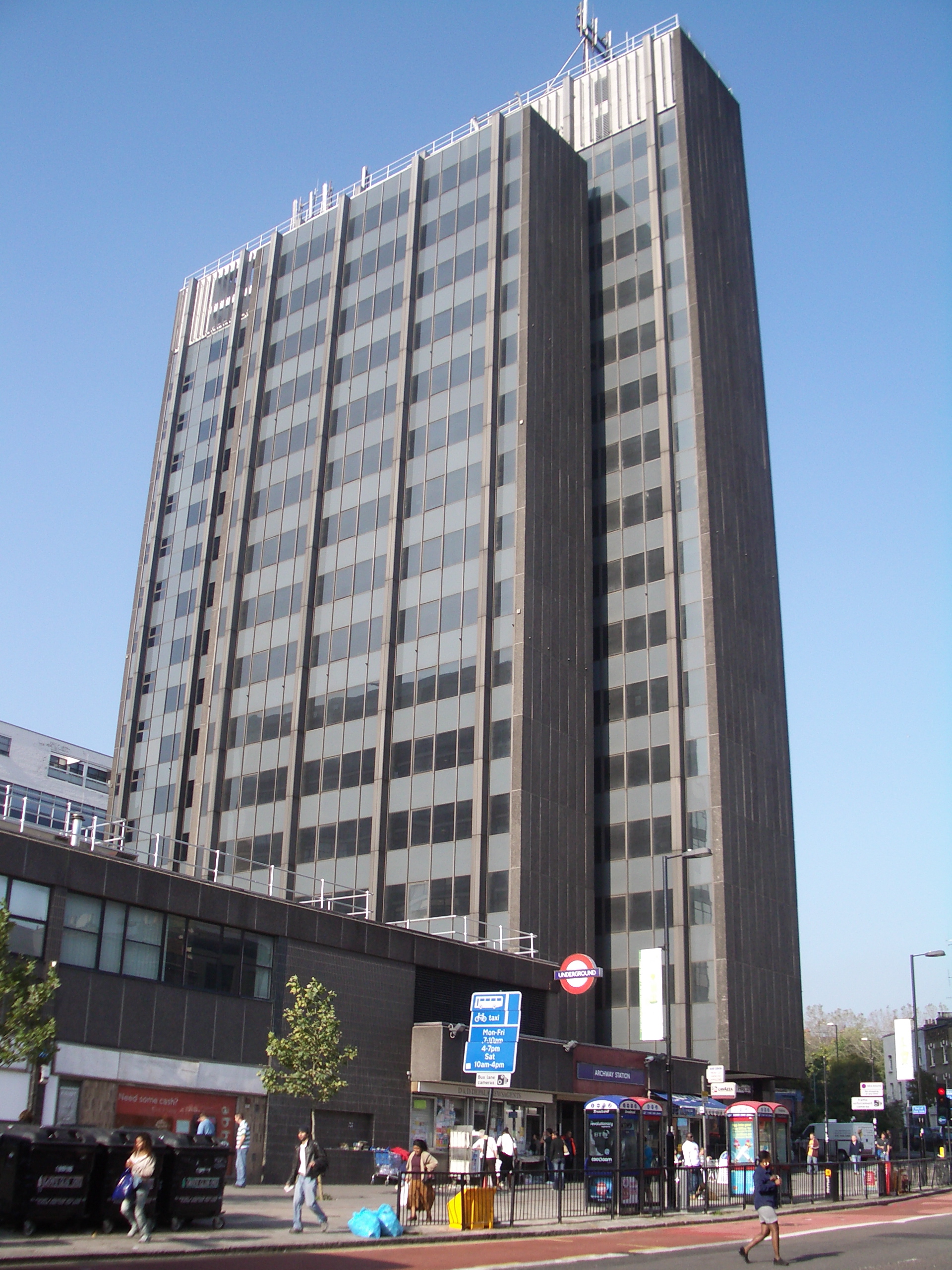
| caption | Main entrance on Junction Road |
| coordinates | |
| original | Charing Cross, Euston and Hampstead Railway |
| years1 | 22 June 1907 |
| years2 | 11 June 1939 |
| years3 | 3 July 1939 |
| years4 | 19 January 1941 |
| years5 | December 1947 |
| events1 | Opened as Highgate; terminus of line |
| events2 | Renamed Archway (Highgate) |
| events3 | Line extended to East Finchley |
| events4 | Renamed Highgate (Archway) |
| events5 | Renamed Archway |
| railcode | ACY |
| tubeexits03 | 6.41 |
| tubeexits04 | 6.757 |
| tubeexits05 | 6.40 |
| tubeexits06 | 6.844 |
| tubeexits07 | 7.74 |
| tubeexits08 | 8.24 |
| tubeexits09 | 8.04-- |
| interchange | Upper Holloway |
| interchange_note |
Archway is a London Underground station. It is located at the intersection of Holloway Road, Highgate Hill, Junction Road and Archway Road in Archway, North London, directly underneath the Vantage Point building. The station is on the High Barnet branch of the Northern line, between Highgate and Tufnell Park stations. It is in both London fare zone 2 and zone 3.
Location
When constructed, the area was simply the northern end of Holloway Road and had no specific name but, in the hope of attracting patronage, the terminus was originally named Highgate after the village up the hill. At the time of the station's construction the first cable tramway in Europe operated non-stop up Highgate Hill to the village from outside the Archway Tavern, and this name was also considered for the station. The main station entrance now lies beneath Archway Tower (now renamed Vantage Point) on Junction Road while the side entrance is on Highgate Hill.
History
The Leslie Green designed station opened on 22 June 1907, under the name Highgate faced in Green's standard ox-blood glazed brick. It was opened as one of the northern terminals of what was then the Charing Cross, Euston & Hampstead Railway (CCE&HR).
The station was renamed Archway (Highgate) on 11 June 1939 The station was renamed Highgate (Archway) on 19 January 1941, before becoming just Archway in December 1947 with the Highgate name being reassigned to the new station constructed beneath the London and North Eastern Railway (LNER) high-level station of the same name.
On 2 June 2006, a train derailed while entering the reversing siding at the station.
In 2007 plans to add step-free access to the station were consulted on and a Transport and Works Act Order was granted. These plans were subsequently shelved by incoming mayor Boris Johnson.
Design
In 1930 the station was upgraded with escalators to replace the original lifts and the secondary entrance was replaced with a modern design by Charles Holden, virtually identical to the one he built at the same time at Hammersmith. Holden's station was replaced in the 1970s.
The platform walls once featured the distinctive and elegantly simple tiling schemes used by Holden on the underground stations constructed at this time. Cream tiles were used throughout with the station name band formed of letter shaped tiles inset into a background of cream tiles incised to accept the lettering. Similar tiling schemes can be seen at the neighbouring Highgate station, as well as at Bethnal Green and the stations on the tunnelled section of the Hainault branch of the Central line (for example Gants Hill). All were built in the late 1930s/early 1940s. The tiles at Archway were replaced several years ago during retiling works.
, the station has escalators descending to the platforms.
An unusual feature for a Northern line station is that both platforms are long enough to accommodate nine car trains instead of the usual seven. This was an early attempt to solve overcrowding on the line. For many years after Archway opened the last two cars of each train were reserved exclusively for passengers travelling between Archway and Tottenham Court Road. At all other stations the last two cars remained in the running tunnel at each stop so that passengers using them had an uninterrupted journey. At Tottenham Court Road, the train stopped beyond the station such that the first two cars entered the running tunnel beyond the station allowing the passengers in the rear seven cars to embark or disembark. A consequence of this arrangement was: that the front two cars could not be used by passengers intending to disembark at Tottenham Court Road from either direction. The rear two cars ran empty south of Tottenham Court Road (Archway being the northern terminus at the time).
Following the success of this nine car arrangement, nine car operation was implemented between Kennington and Edgware, but with only a limited number of stations being accessible from the rear two cars. These were Kennington to Leicester Square inclusive and Golders Green to Colindale inclusive. Nine car trains did not stop at Mornington Crescent but this was because, at this time, all Edgeware trains did not stop there. Stations south of Tottenham Court Road operated with two cars in running tunnel. However, north of Hampstead, the stations were converted for nine car platforms as the stations are not in tunnel. The service was eventually extended to Edgware, but site constraints meant that only seven and a half cars could be accommodated on platform 1 only so either Edgware was a non nine car station or passengers were allowed to disembark via the communicating doors.
All nine car operation was suspended on 6 September 1939 when the line was split into wo sections for the installation of flood gates just after World War II was declared. It was never reinstated.
Crossover and siding

When the original section of the Northern Line from Charing Cross to Golders Green and Archway (then Highgate) was opened in 1907, the terminus at Archway was provided with a scissors crossover just south of the station and the running lines beyond the north end of the platforms continued as separate dead-end sidings. When the line was extended to Highgate and East Finchley in 1939, the 'northbound' siding was extended as the northbound road while the 'southbound' siding was retained as a dead-end siding, extended at the north end with the new southbound line from Highgate joining it just before the southbound platform and a new connection from the northbound line to the siding, thus turning the old 'southbound' siding into a central reversing siding. The crossover south of the station was subsequently converted to a single trailing crossover but was decommissioned on 15 October 1967, when Archway was converted to programme-machine control from Cobourg Street. The signal box closed on 25 June 1961 when Archway became remote-controlled.
The enlarged crossover tunnel remains although cable runs extend down its centre between the two tracks for most of its length. The layout of the platforms and the underground passenger areas still reflect the station's former role as a terminus.
Services
Archway station is on the High Barnet branch of the Northern line between Highgate to the north and Tufnell Park to the south. Trains generally operate between Morden or Battersea Power Station to High Barnet or Mill Hill East via the Charing Cross or the Bank branch.
Connections
- London Buses routes 4, 17, 41, 43, 134, 143, 210, 234, 263, 390, C11, W5 and night routes N20, N41 and N263 serve the station.
- London Underground maps and maps in London Overground trains show the station as 450m from Upper Holloway station on the Gospel Oak to Barking line. Interchange within twenty minutes is allowed between the two stations.
References
- "Station Codes". Transport for London.
- {{citation London station interchange January 2016
- {{cite map/Standard Tube Map
- Taylor, Sheila. (2001). "The Moving Metropolis". Calmann and King.
- Rose, Douglas. (December 2007). "The London Underground: A Diagrammatic History". Capital Transport.
- Butt, R.V.J.. (1995). "The Directory of Railway Stations". Patrick Stephens Ltd.
- "Underground Journeys: Highgate". [[Royal Institute of British Architects]].
- Feather, Clive. "Northern line". Clive's Underground Line Guides.
- (11 September 2007). "100 Years of the Hampstead Tube".
- (10 December 2014). "Derailment at Archway".
- (7 September 2007). "Archway station exhibition".
- (29 July 2013). "Transport and Works Act 1992 Orders".
- Feather, Clive. "Vertical Transport". Clive's Underground Line Guides.
- "Tube Facts – Tube Stations with steps".
- Northern, Driver's Eye View:Video 125 DEVD 027
- "Nine Cars on the Northern".
- Ragga, John. "Archway". London Underground Technical – Northern Line Disused Features.
- "Northern line timetable: From Archway Underground Station to Highgate Underground Station".
- "Northern line timetable: From Archway Underground Station to Tufnell Park Underground Station".
- (4 February 2023). "Buses from Archway".
- {{citation London station interchange January 2016/
This article was imported from Wikipedia and is available under the Creative Commons Attribution-ShareAlike 4.0 License. Content has been adapted to SurfDoc format. Original contributors can be found on the article history page.
Ask Mako anything about Archway tube station — get instant answers, deeper analysis, and related topics.
Research with MakoFree with your Surf account
Create a free account to save articles, ask Mako questions, and organize your research.
Sign up freeThis content may have been generated or modified by AI. CloudSurf Software LLC is not responsible for the accuracy, completeness, or reliability of AI-generated content. Always verify important information from primary sources.
Report