From Surf Wiki (app.surf) — the open knowledge base
Archduke Franz Ferdinand of Austria
Austrian archduke (1863–1914)

Austrian archduke (1863–1914)
| Field | Value | |
|---|---|---|
| name | Archduke Franz Ferdinand | |
| title | Archduke of Austria-Este, Royal Prince of Hungary and Bohemia | |
| image | Ferdinand Schmutzer - Franz Ferdinand von Österreich-Este, um 1914 (cropped).jpg | |
| caption | Franz Ferdinand | |
| birth_date | ||
| birth_place | Graz, Austrian Empire | |
| death_date | ||
| death_place | Sarajevo, Austria-Hungary | |
| death_cause | Assassination by gunshot | |
| burial_place | Artstetten Castle | |
| spouse | ||
| spouse-type | Spouse | |
| consort | ||
| issue | {{Plainlist | |
| issue-type | Issue | |
| full name | Franz Ferdinand Karl Ludwig Joseph Maria | |
| Francis Ferdinand Charles Louis Joseph | ||
| house | Habsburg-Lorraine | |
| father | Archduke Karl Ludwig of Austria | |
| mother | Princess Maria Annunziata of Bourbon-Two Sicilies | |
| signature | Archduke Franz Ferdinand of Austria Signature.svg | |
| burial_date | 4 July 1914 |
| suc-type = | reg-type = | spouse-type = Spouse
- Princess Sophie of Hohenberg
- Maximilian, Duke of Hohenberg
- Prince Ernst of Hohenberg}} | issue-link = | issue-pipe = | issue-type = Issue Francis Ferdinand Charles Louis Joseph | house-type =
Archduke Franz Ferdinand Carl Ludwig Joseph Maria of Austria (Francis Ferdinand, 18 December 1863 – 28 June 1914) was the heir presumptive to the throne of Austria-Hungary. His assassination in Sarajevo was the most immediate cause of World War I.
Franz Ferdinand was the eldest son of Archduke Karl Ludwig of Austria, the younger brother of Emperor Franz Joseph I of Austria. Following the death of Crown Prince Rudolf in 1889 and the death of Karl Ludwig in 1896, Franz Ferdinand became the heir presumptive to the Austro-Hungarian throne. His courtship of Sophie Chotek, a lady-in-waiting, caused conflict within the imperial household, and their morganatic marriage in 1900 was only allowed after he renounced his descendants' rights to the throne. Franz Ferdinand held significant influence over the military, and in 1913 he was appointed inspector general of the Austro-Hungarian armed forces.
On 28 June 1914, Franz Ferdinand and his wife were assassinated in Sarajevo by the 19-year-old Gavrilo Princip, a member of Young Bosnia. Franz Ferdinand's assassination led to the July Crisis and precipitated Austria-Hungary's declaration of war against Serbia, which in turn triggered a series of events that eventually ledfour weeks after his deathto Austria-Hungary's allies and Serbia's allies declaring war on each other, starting World War I.
Biography
Early life
Franz Ferdinand was born in Graz, then part of the Austrian Empire, the eldest son of Archduke Karl Ludwig of Austria (the younger brother of Franz Joseph and Maximilian) and of his second wife, Princess Maria Annunziata of Bourbon-Two Sicilies. In 1875, when he was eleven years old, his cousin Francis V, Duke of Modena, died, naming Franz Ferdinand his heir on condition that he add the name "Este" to his own. This inheritance made Franz Ferdinand one of the wealthiest men in Austria.
Heir presumptive
In 1889, Franz Ferdinand's life changed dramatically. His cousin Crown Prince Rudolf committed suicide at his hunting lodge in Mayerling. This left Franz Ferdinand's father, Karl Ludwig, first in line to the throne. When Karl Ludwig died of typhoid fever in 1896,
Despite this burden, he found time for travel and personal pursuits, such as his circumnavigation of the world between 1892 and 1893. After visiting India he spent time hunting kangaroos and emus in Australia in 1893, then travelled on to Nouméa, New Hebrides, Solomon Islands, New Guinea, Sarawak, Hong Kong and Japan. After sailing across the Pacific on the RMS Empress of China from Yokohama to Vancouver he crossed the United States, arriving at the World's Columbian Exposition 1893 on the Chicago, Burlington, and Quincy Railroad on a private Pullman car named Mascotte, and staying at the Lexington Hotel, before continuing through to New York and returning to Europe.
Franz Ferdinand had a fondness for trophy hunting that was excessive even by the standards of European nobility in his day. In his diaries he kept track of 272,511 game kills, 5,000 of which were deer. About 100,000 trophies were on exhibit at his Bohemian castle at Konopiště which he also stuffed with various antiquities, his other great passion.
Military career
Franz Ferdinand, like most males in the ruling Habsburg line, entered the Austro-Hungarian Army at a young age. He was frequently and rapidly promoted, given the rank of lieutenant at age fourteen, captain at twenty-two, colonel at twenty-seven, and major general at thirty-one. While never receiving formal staff training, he was considered eligible for command and at one point briefly led the primarily Hungarian 9th Hussar Regiment. In 1898 he was given a commission "at the special disposition of His Majesty" to make inquiries into all aspects of the military services and military agencies were commanded to share their papers with him.
He also held honorary ranks in the Austro-Hungarian Navy, and received the rank of admiral at the close of the Austro-Hungarian naval maneuvers in September 1902.
Franz Ferdinand exerted influence on the armed forces even when he did not hold a specific command through a military chancery that produced and received documents and papers on military affairs. This was headed by and eventually employed a staff of sixteen. His authority was reinforced in 1907 when he secured the retirement of the Emperor's confidant Friedrich von Beck-Rzikowsky as Chief of the General Staff. Beck's successor, Franz Conrad von Hötzendorf, was personally selected by Franz Ferdinand.
Franz in 1913, as heir-presumptive to the elderly emperor, had been appointed inspector general of all the armed forces of Austria-Hungary (Generalinspektor der gesamten bewaffneten Macht), a position superior to that previously held by Archduke Albrecht and including presumed command in wartime.
Marriage and family
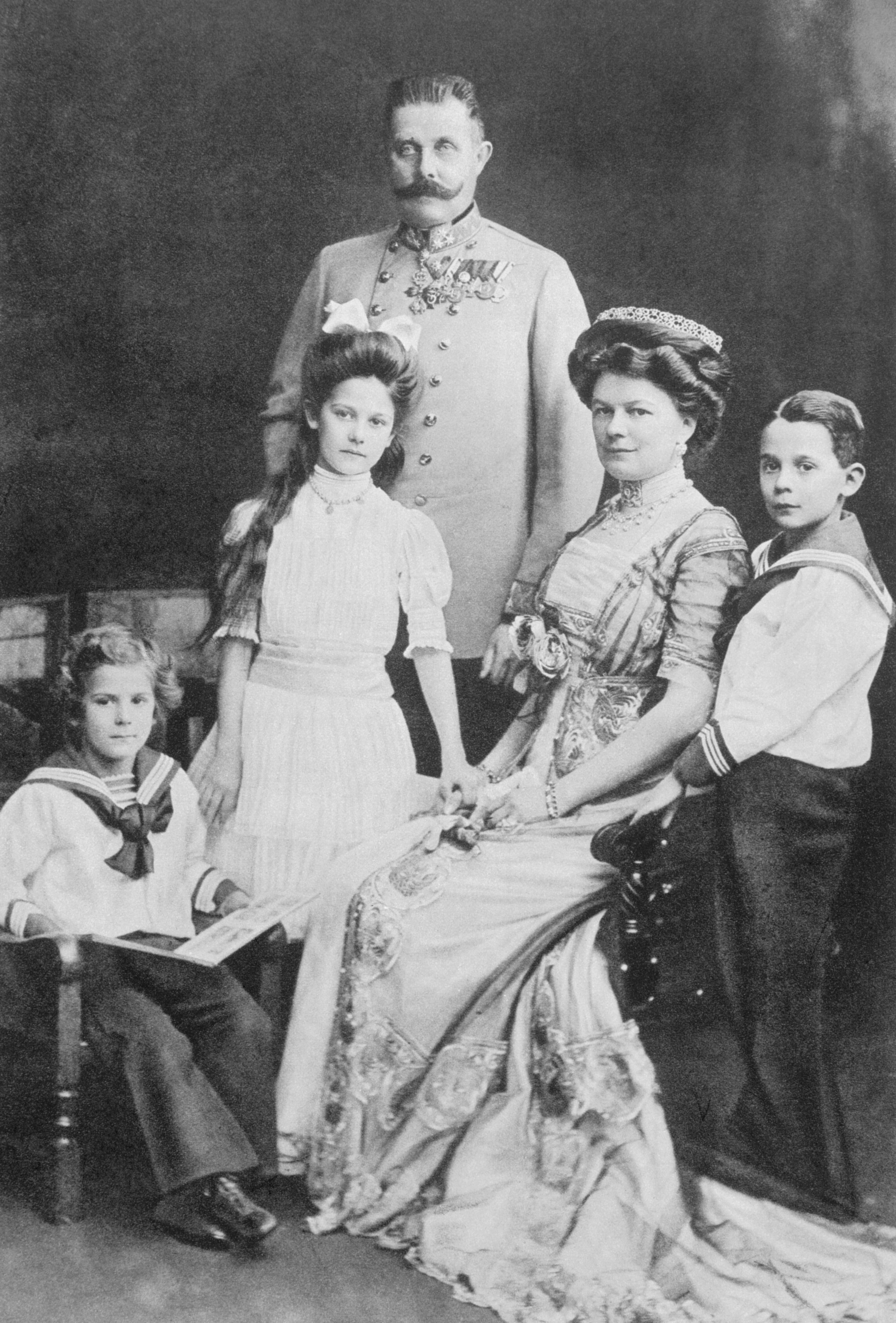
In 1894, Franz Ferdinand met Countess Sophie Chotek, a lady-in-waiting to Archduchess Isabella, wife of Archduke Friedrich, Duke of Teschen. Franz began to visit Archduke Friedrich's villa in Pressburg (now Bratislava), and in turn Sophie wrote to Franz Ferdinand during his convalescence from tuberculosis on the island of Lošinj in the Adriatic. They kept their relationship a secret, until it was discovered by Isabella.
To be eligible to marry a member of the imperial House of Habsburg, one had to be a member of one of the reigning or formerly reigning dynasties of Europe. The Choteks were not one of these families. Deeply in love, Franz Ferdinand refused to consider marrying anyone else. Finally, in 1899, Emperor Franz Joseph agreed to permit Franz Ferdinand to marry Sophie, provided that the marriage would be morganatic and that their descendants would not have succession rights to the throne. Sophie would not share her husband's rank, title, precedence, or privileges, nor would she normally appear in public beside him. She would not be allowed to ride in the royal carriage or sit in the royal box in theaters.
The wedding took place on 1 July 1900, at Reichstadt (now Zákupy) in Bohemia; Franz Joseph did not attend the ceremony, nor did Franz Ferdinand's brothers or any other archduke. The only members of the imperial family present were Franz Ferdinand's stepmother, Princess Maria Theresa of Braganza, and her two daughters. Upon the marriage, Sophie was given the title "Princess of Hohenberg" (Fürstin von Hohenberg) with the style "Her Serene Highness" (Ihre Durchlaucht). In 1909, she was given the more senior title "Duchess of Hohenberg" (Herzogin von Hohenberg) with the style "Her Highness" (Ihre Hoheit). This raised her status considerably, but she was still required to yield precedence at court to all the archduchesses. Whenever a function required the couple to assemble with the other members of the imperial family, Sophie had to stand far down the line, separated from her husband.
Franz Ferdinand's children were:
- Princess Sophie of Hohenberg (1901–1990), married Count Friedrich von Nostitz-Rieneck (1891–1973)
- Maximilian, Duke of Hohenberg (1902–1962), married Countess Elisabeth von Waldburg zu Wolfegg und Waldsee (1904–1993)
- Prince Ernst of Hohenberg (1904–1954), married Marie-Therese Wood (1910–1985)
- Stillborn son (1908), buried in Artstetten Castle, near his parents
Franz Ferdinand and Sophie visited England in the autumn of 1913, spending a week with George V and Queen Mary at Windsor Castle before going to stay for another week with the Duke of Portland at Welbeck Abbey, Nottinghamshire, where they arrived on 22 November. He attended a service at the local Catholic church in Worksop. Franz Ferdinand and the Duke of Portland went game shooting on the Welbeck estate when, according to Portland's memoirs, Men, Women and Things:
Assassination
Main article: Assassination of Archduke Franz Ferdinand

|[[File:FranzFerdinand uniform.jpg|thumb|upright|left|Franz Ferdinand's blood-stained uniform]]
.jpg)
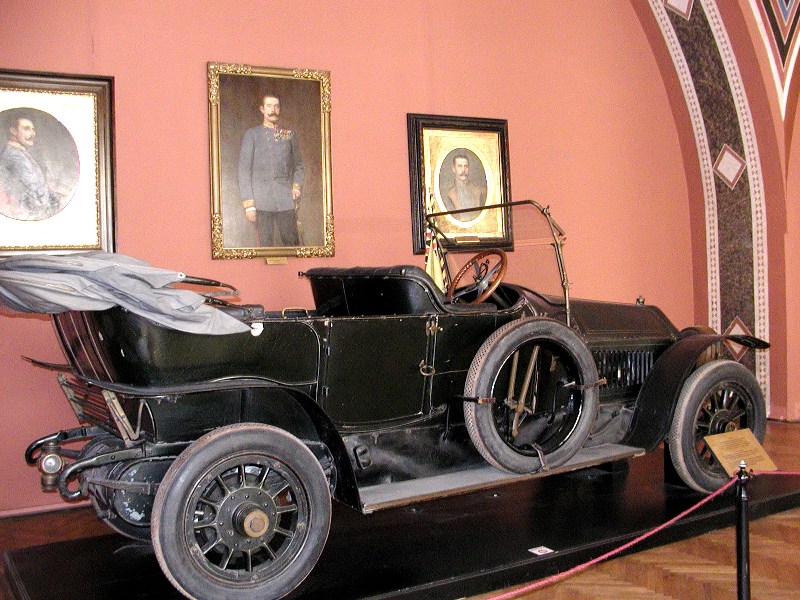
On Sunday, 28 June 1914, at about 10:45 am, Franz Ferdinand and his wife were assassinated in Sarajevo, the capital of the Austro-Hungarian province of Bosnia and Herzegovina. The perpetrator was 19-year-old Gavrilo Princip, a member of Young Bosnia and one of a group of assassins organized and armed by the Black Hand.
Earlier in the day, the couple had been attacked by Nedeljko Čabrinović, also a Young Bosnia conspirator, who had thrown a grenade at their car. However, the bomb detonated behind them, injuring the occupants in the following car. On arriving at the Governor's residence, Franz asked "So you welcome your guests with bombs!"
After a short rest at the Governor's residence, the royal couple insisted on seeing all those who had been injured by the bomb at the local hospital. However, no one told the drivers that the itinerary had been changed. When the error was discovered, the drivers had to turn around. As the cars backed down the street and onto a side street, the line of cars stalled. At this time, Princip was sitting at a cafe across the street. He instantly seized his opportunity and walked across the street and shot the royal couple. He first shot Sophie in the abdomen and then shot Franz Ferdinand in the neck. Franz leaned over his crying wife. He was still alive when witnesses arrived to render aid. His dying words to Sophie were, "Don't die darling, live for our children." Princip's weapon was the pocket-sized FN Model 1910 pistol chambered for the .380 ACP cartridge provided him by Serbian Army Military Intelligence Lieutenant-Colonel and Black Hand leader Dragutin Dimitrijević. Franz Ferdinand's aides attempted to undo his coat but realized they needed scissors to cut it open: the outer lapel had been sewn to the inner front of the jacket for a smoother fit to improve his appearance to the public. Whether or not as a result of this obstacle, his wound could not be attended to in time to save him, and he died within minutes. Sophie also died en route to the hospital.
A detailed account of the shooting can be found in Sarajevo by Joachim Remak:
One bullet pierced Franz Ferdinand's neck while the other pierced Sophie's abdomen. ... As the car was reversing (to go back to the Governor's residence because the entourage thought the Imperial couple were unhurt) a thin streak of blood shot from the Archduke's mouth onto Count Harrach's right cheek (he was standing on the car's running board). Harrach drew out a handkerchief to still the gushing blood. The Duchess, seeing this, called: "For Heaven's sake! What happened to you?" and sank from her seat, her face falling between her husband's knees.
Harrach and Potoriek ... thought she had fainted ... only her husband seemed to have an instinct for what was happening. Turning to his wife despite the bullet in his neck, Franz Ferdinand pleaded: "Sopherl! Sopherl! Sterbe nicht! Bleibe am Leben für unsere Kinder! – Sophie dear! Don't die! Stay alive for our children!" Having said this, he seemed to sag down himself. His plumed hat ... fell off; many of its green feathers were found all over the car floor. Count Harrach seized the Archduke by the uniform collar to hold him up. He asked "Leiden Eure Kaiserliche Hoheit sehr? – Is Your Imperial Highness suffering very badly?" "Es ist nichts. – It is nothing." said the Archduke in a weak but audible voice. He seemed to be losing consciousness during his last few minutes, but, his voice growing steadily weaker, he repeated the phrase perhaps six or seven times more.
A rattle began to issue from his throat, which subsided as the car drew in front of the Konak bersibin (Town Hall). Despite several doctors' efforts, the Archduke died shortly after being carried into the building while his beloved wife was almost certainly dead from internal bleeding before the motorcade reached the Konak.
The assassinations, along with the arms race, nationalism, imperialism, militarism of Imperial Germany and the alliance system all contributed to the origins of World War I, which began a month after Franz Ferdinand's death, with Austria-Hungary's declaration of war against Serbia. The assassination of Franz Ferdinand is considered the most immediate cause of World War I.

After his death, Archduke Karl became the heir presumptive of Austria-Hungary. Franz Ferdinand was buried with his wife Sophie in Artstetten Castle, Austria.
Character
The German historian Michael Freund described Franz Ferdinand as "a man of uninspired energy, dark in appearance and emotion, who radiated an aura of strangeness and cast a shadow of violence and recklessness ... a true personality amidst the amiable inanity that characterized Austrian society at this time." As his sometime admirer Karl Kraus put it, "he was not one who would greet you ... he felt no compulsion to reach out for the unexplored region which the Viennese call their heart." His relations with Emperor Franz Joseph were tense; the emperor's personal servant recalled in his memoirs that "thunder and lightning always raged when they had their discussions." The commentaries and orders which the heir to the throne wrote as margin notes to the documents of the Imperial central commission for architectural conservation (where he was Protector) reveal what can be described as "choleric conservatism". The Italian historian Leo Valiani provided the following description.
After the assassination of Franz Ferdinand and Sophie in 1914, Marie Valerie, the daughter of Emperor Franz Joseph, observed that her father had placed more trust in the newly designated heir, his grandnephew Archduke Charles. The emperor confessed to his daughter about the assassination, stating: "For me, it is a relief from a great worry."
Political views
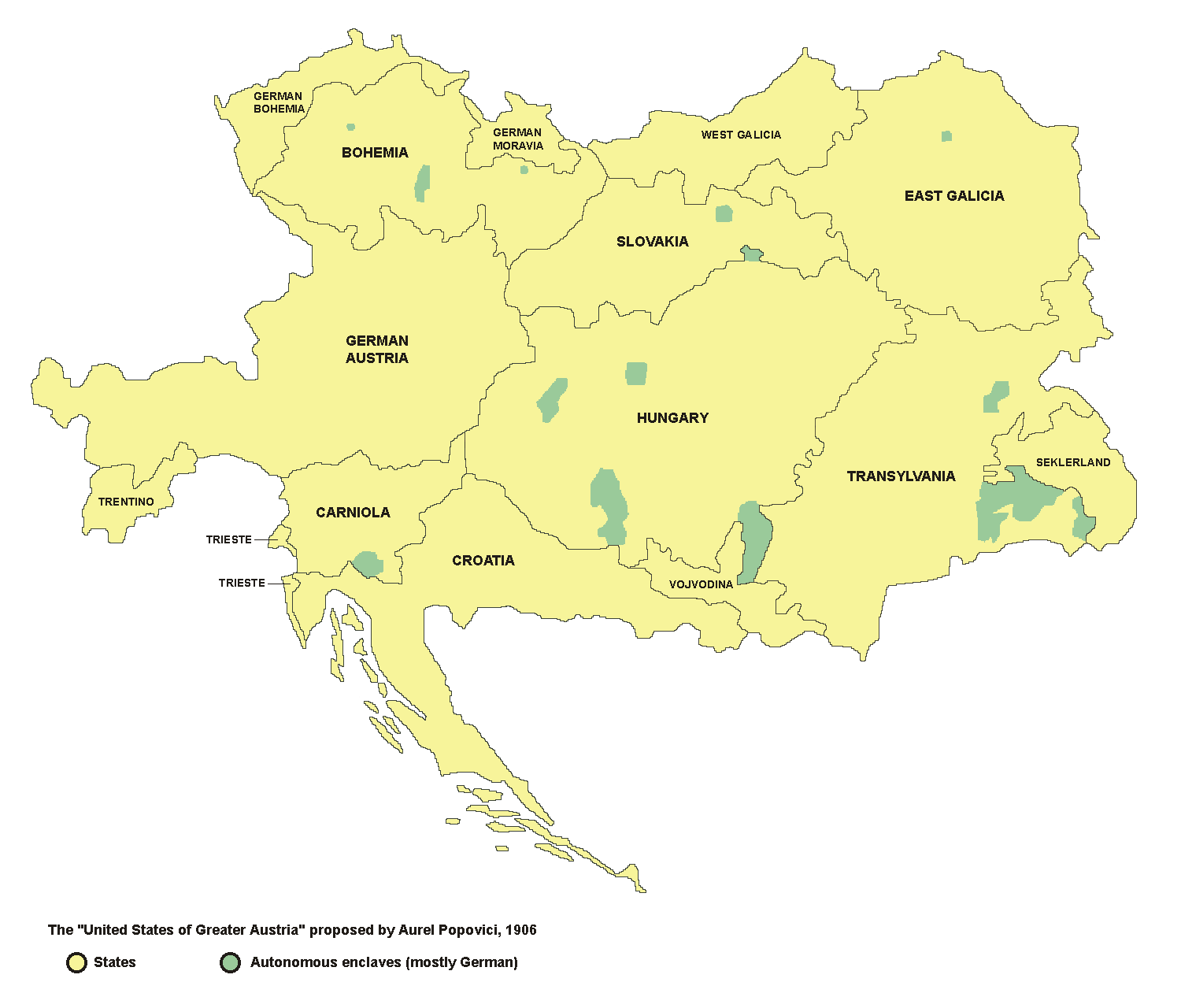
"The three cornerstones of Ferdinand's political conviction were clericalism, anti-democratic views, and anti-Hungarianism," and the basis of his worldview was that "politics is a matter only for the ruler, while the people, the masses have to obey." Franz Ferdinand often complained that in Hungary, the glorification of revolutionary hero Lajos Kossuth, the decline of the monarchical principle, and the dominance of the Freemasons and the Jewish people was prevalent. Historians have disagreed on how to characterize the political philosophies of Franz Ferdinand, some attributing generally liberal views on the empire's nationalities while others have emphasized his dynastic centralism, Catholic conservatism, and tendency to clash with other leaders.
He advocated granting greater autonomy to ethnic groups within the Empire and addressing their grievances, especially the Czechs in Bohemia and the south Slavic peoples in Croatia and Bosnia, who had been left out of the Austro-Hungarian Compromise of 1867.
He also advocated a cautious approach towards Serbia – repeatedly locking horns with Franz Conrad von Hötzendorf, Vienna's hard-line Chief of the Austro-Hungarian General Staff, warning that harsh treatment of Serbia would bring Austria-Hungary into open conflict with Russia, to the ruin of both empires.
He was disappointed when Austria-Hungary failed to act as a great power, such as during the Boxer Rebellion in 1900. Other nations, including, in his description, "dwarf states like Belgium and Portugal", had soldiers stationed in China, but Austria-Hungary did not. However, Austria-Hungary did participate in the Eight-Nation Alliance to suppress the Boxers, and sent soldiers as part of the "international relief force".
Franz Ferdinand was a prominent and influential supporter of the Austro-Hungarian Navy in a time when sea power was not a priority in Austrian foreign policy and the Navy was relatively little known or supported by the public. After his assassination in 1914, the Navy honoured Franz Ferdinand and his wife with a lying in state aboard SMS Viribus Unitis.
Commemorations

Memorial for archduke Franz Ferdinand of Austria was erected at the bridgehead of Latin Bridge, Sarajevo on the 28th of June, 1917. [[File:Franzferdinand40hel1917.jpg|thumb|upright|right|alt=The bluish-tinted stamp shows Sophia, duchess of Hohenberg on the left, and Franz Ferdinand on the right. The stamp is titled "Militärpost" ("Military Mail") at the top, and the date of the couple's deaths at the bottom.|Commemorative postage stamp (Austria-Hungary)]] Archduke Franz Ferdinand and his Castle of Artstetten were selected as a main motif for the Austrian 10 euro The Castle of Artstetten commemorative coin, minted on 13 October 2004. The reverse shows the entrance to the crypt of the Hohenberg family. There are two portraits below, showing Archduke Franz Ferdinand and his wife Sophie, Duchess of Hohenberg.
Titles, styles, honours and arms
Titles and styles
- 18 December 1863 – 20 November 1875: His Imperial and Royal Highness Archduke and Prince Franz Ferdinand of Austria, Royal Prince of Hungary, Bohemia and Croatia
- 20 November 1875 – 28 June 1914: His Imperial and Royal Highness Franz Ferdinand, Archduke of Austria-Este
Honours and awards
Domestic
- Knight of the Golden Fleece, 1878
- Grand Cross of the Royal Hungarian Order of St. Stephen, 1893
- Military Merit Cross, in Diamonds
- Silver Military Merit Medal on Red Ribbon
- Long Service Cross for Officers, 2nd Class
- 1898 Jubilee Medal for the Armed Forces
- 1908 Military Jubilee Cross
- Sea Voyage Medal 1892-1893
Foreign
- Anhalt Anhalt: Grand Cross of the Order of Albert the Bear
- Baden: Knight of the House Order of Fidelity, 1908
- Kingdom of Bavaria:
- Knight of St. Hubert, 1895
- Commemorative Medal for the 70th Anniversary of Military Service of Prince Regent Luitpold
- Belgium: Grand Cordon of the Order of Leopold
- Kingdom of Bulgaria: Knight of Saints Cyril and Methodius, with Collar
- Denmark: Knight of the Elephant, 12 May 1908
- Saxe-Coburg and Gotha Saxe-Altenburg Saxe-Meiningen Ernestine duchies: Grand Cross of the Saxe-Ernestine House Order
- Kingdom of Italy: Knight of the Annunciation, 22 January 1891
- Tuscany Tuscan Grand Ducal family: Grand Cross of St. Joseph
- Two Sicilies Two Sicilian Royal family: Grand Cross of St. Ferdinand and Merit
- Flag of the Vatican City (2 by 3).svg Holy See:
- Knight of the Supreme Order of Christ
- Grand Cross of the Holy Sepulchre of Jerusalem
- Sovereign Military Order of Malta Military Order of Malta: Bailiff Grand Cross of Honour and Devotion
- Empire of Japan: Grand Cordon of the Order of the Chrysanthemum, 27 July 1893
- Johor Johor: First Class of the Royal Family Order of Johor, 1893
- Principality of Montenegro: Grand Cross of the Order of Prince Danilo I
- Flagge Großherzogtümer Mecklenburg.svg Mecklenburg: Grand Cross of the Wendish Crown, with Crown in Ore
- Oldenburg: Grand Cross of the Order of Duke Peter Friedrich Ludwig, with Crown in Gold
- Kingdom of Portugal: Grand Cross of the Sash of the Two Orders
- Kingdom of Prussia:
- Knight of the Black Eagle, with Collar
- Grand Commander of the Royal House Order of Hohenzollern, with Collar
- Military Merit Cross
- Kingdom of Romania:
- Grand Cross of the Order of Carol I
- Grand Cross of the Star of Romania
- Saxe-Weimar-Eisenach: Grand Cross of the White Falcon, 1892
- Kingdom of Württemberg:
- Grand Cross of the Württemberg Crown, 1889
- Golden Jubilee Medal
- Kingdom of Saxony: Knight of the Rue Crown, 1886
- Kingdom of Serbia: Grand Cross of the White Eagle
- Thailand Siam: Knight of the Order of the Royal House of Chakri, 1 June 1902
- Spain: Grand Cross of the Order of Charles III, with Collar, 5 May 1906
- Sweden Norway Sweden-Norway: Knight of the Seraphim, 19 September 1890
- Russian Empire:
- Knight of St. Andrew, 1891
- Knight of St. Alexander Nevsky
- Knight of the White Eagle
- Knight of St. Anna, 1st Class
- Knight of St. Stanislaus, 1st Class
- United Kingdom of Great Britain and Ireland:
- Honorary Grand Cross of the Bath (civil), 19 February 1901
- Stranger Knight Companion of the Garter, 15 July 1902
- Commemorative Medal for the Diamond Jubilee of Queen Victoria
- Silver Commemorative Medal for the Coronation of King Edward VII
| [[File:Coat of Arms of Archduke Franz Ferdinand of Austria.svg | 185px]] | |
|---|---|---|
| Armorial achievement of Franz Ferdinand, Archduke of Austria-Este | [[File:Imperial Monogram of Archduke Franz Ferdinand of Austria.svg | 78px]] |
| Imperial Monogram |
Footnotes
References
References
- Albertini, Luigi. (1953). "Origins of the War of 1914". Oxford University Press.
- "PROBLEMS CONFRONTING FRANCIS JOSEPH'S SUCCESSOR; Although Pan-Slavism Is Not a Serious Menace to the Dual Monarchy, Austria-Hungary, There Are Other Complex Questions Which the Present Emperor's Heir, Archduke Francis Ferdinand, of Whom Little Is Known, Will Have to Face.". [[New York Times]].
- Brook-Shepherd, Gordon. (1987). "Royal Sunset: The European Dynasties and the Great War". Doubleday.
- Marshall, S. L. A.. (2001). "World War I". Mariner Books.
- Keegan, John. (2000). "The First World War". Vintage.
- Johnson, Lonnie. (1989). "Introducing Austria: A Short History". Ariadne Press.
- "One of Europe's most powerful and wealthy men was an Okanagan tourist in 1893".
- (2023-10-10). "Franz Ferdinand, archduke of Austria-Este {{!}} Biography, Assassination, Facts, & World War I {{!}} Britannica".
- (23 May 1893). "The Archduke Franz Ferdinand". The Argus.
- (15 April 1893). "Distinguished Visitors". Australian Town and Country Journal.
- [http://austrian-mint.at/images/content/pdfs/Download/Ausstellung/Katalog_Land_in_Sicht_D.pdf Katalog ''Land in Sicht!: Österreich auf weiter Fahrt''] {{webarchive. link. (28 May 2008 (Catalogue ''Land Ahoy!: Austria on the Seven Seas'') (in [[Portable Document Format). PDF]] and in [[German language]]) p. 8. Exhibition by the Austrian Mint, 17 August – 3 February 2006. ''Münze Österreich'' (Austrian Mint). Accessed 22 May 2009.
- (7 October 1893). "Will See the Fair". The Champaign County News {{!}} Champaign County, Illinois.
- (9 October 1893). "Lexington Hotel, Michigan Boulevard and 22nd Street". The Chicago Tribune {{!}} Chicago, Illinois.
- Wladimir Aichelburg, ''Erzherzog Franz Ferdinand von Österreich-Este und Artstetten'', Vienna: Lehner, 2000, {{ISBN. 978-3-901749-18-6, p. 31 {{in lang. de: {{Lang. de. "Tatsächlich war Franz Ferdinand ein außergewöhnlich leidenschaftlicher Jäger" – "It is a fact that Franz Ferdinand was an unusually passionate hunter."
- (27 June 2014). "8 things you didn't know about Franz Ferdinand". PBS.
- [[Michael Hainisch]], ed. Friedrich Weissensteiner, ''75 Jahre aus bewegter Zeit: Lebenserinnerungen eines österreichischen Staatsmannes'', Veröffentlichungen der Kommission für neuere Geschichte Österreichs 64, Vienna: Böhlau, 1978, {{ISBN. 978-3-205-08565-2, p. 367 {{in lang. de: ''"Konopischt ... das einst dem Erzherzoge Franz Ferdinand gehört hatte. Das Schloß ist voller Jagdtrophäen"'' - "Konopiště ... which once belonged to Archduke Franz Ferdinand. The castle is full of hunting trophies."
- Neil Wilson and Mark Baker, ''Prague: City Guide'', Lonely Planet City Guide, 9th ed. Footscray, Victoria / Oakland, California / London: Lonely Planet, 2010, {{ISBN
- Thomas Veszelits, ''Prag'', HB-Bildatlas 248, Ostfildern: HB, 2003, {{ISBN. 978-3-616-06152-8, p. 106. {{in lang. de: ''"Jagdtrophäen, Waffen aus drei Jahrhunderten und Kunstschätze füllten die Räume"'' – "Hunting trophies, weapons dating to three centuries, and art treasures filled the rooms."
- Rothenburg, G.. (1976). "The Army of Francis Joseph". Purdue University Press.
- (5 September 1902). "Court News".
- Radziwill, Catherine. (1916). "The Austrian Court From Within". Cassel and Company, LTD.
- Meyer, G. J.. (2007). "A World Undone: The Story of the Great War 1914 to 1918". Bantam Dell.
- Schwarz, Otto. ''Hinter den Fassaden der Ringstrasse: Geschichte, Menschen, Geheimnisse''. Amalthea, Vienna, 2007, {{ISBN. 978-3-85002-589-8, p. 26 {{in lang. de
- link. (21 August 2011 , Artstetten Castle.)
- Watson, Greig. "Could Franz Ferdinand Welbeck gun accident have halted WWI?". BBC News.
- Beyer, Rick, ''The Greatest Stories Never Told'', Harper Collins, {{ISBN. 978-0-06-001401-8. pp. 146–147
- Remak, Joachim. (1959). "Sarajevo: The Story of a Political Murder". Criterion.
- John McCannon. ''AP World History''. Copyright 2010, 2008, Barron's Educational Series, Inc. page 9.
- (2014-06-27). "Profile: Archduke Franz Ferdinand". ABC News.
- Freund, Michael: Deutsche Geschichte. Die Große Bertelsmann Lexikon-Bibliothek, Bd. 7. C. Bertelsmann Verlag, 1961. p.901
- ''Die Fackel''. Issue 10 July 1914
- Ketterl, Eugen. ''Der alte Kaiser wie nur einer ihn sah''. Cissy Klastersky (ed.), Gerold & Co., Vienna 1929
- Brückler, Theodor: ''Franz Ferdinand als Denkmalpfleger''. Die "Kunstakten" der Militärkanzlei im Österreichischen Staatsarchiv. Böhlau Verlag, Vienna 2009. {{ISBN. 978-3-205-78306-0
- Valiani, Leo, ''The End of Austria-Hungary'', Alfred A. Knopf, New York (1973) pp. 9–10 [translation of: ''La Dissoluzione dell'Austria-Ungheria'', Casa Editrice Il Saggiatore, Milano (1966) pp. 19–20]
- Palmer, Alan. (1994). "Twilight of the Habsburgs: the Life and Times of Emperor Francis Joseph". Atlantic Monthly Press.
- Quote of historian László Gulyás (2019): The Assassination of Franz Ferdinand : The Archduke Who Despised Hungarians Url: [https://web.archive.org/web/20201216121124/https://hungarytoday.hu/the-assassination-of-franz-ferdinand-the-archduke-who-despised-hungarians/]
- (1994). "History of Transylvania". Akadémiai Kiadó.
- [http://www.austriancoins.com/10e.html Austrian 10-Euro Coins]. Austriancoins.com (9 October 2002). Retrieved on 2013-08-16.
- "Kaiser Joseph II. harmonische Wahlkapitulation mit allen den vorhergehenden Wahlkapitulationen der vorigen Kaiser und Könige".
- ''[http://alex.onb.ac.at/cgi-content/alex?aid=shb&datum=1914&page=22&size=45 Hof- und Staatshandbuch der Österreichisch-Ungarischen Monarchie]'' (1914), Genealogy p. 2
- Boettger, T. F.. "Chevaliers de la Toisón d'Or - Knights of the Golden Fleece".
- "A Szent István Rend tagjai".
- ''Hof- und Staats-Handbuch des Großherzogtum Baden'' (1910), "Großherzogliche Orden" [https://digital.blb-karlsruhe.de/blbihd/periodical/pageview/1881289 p. 41]
- ''Hof- und Staats-Handbuch des Königreichs Bayern'' (1906), "Königliche-Orden" [https://archive.org/details/bub_gb_nTedipoxoGcC/page/n39 p. 9]
- Jørgen Pedersen. (2009). "Riddere af Elefantordenen, 1559–2009". Syddansk Universitetsforlag.
- 刑部芳則. (2017). "明治時代の勲章外交儀礼". 明治聖徳記念学会紀要.
- "Johor di Persada Global – Portal Kesultanan Johor". Johor Royal Council.
- ''Staatshandbuch für das Großherzogtum Sachsen / Sachsen-Weimar-Eisenach'' (1900), "Großherzogliche Hausorden" [https://zs.thulb.uni-jena.de/rsc/viewer/jportal_derivate_00185861/Staatshandbuch_Film_Nr_16_0245.tif p. 17] {{Webarchive. link. (6 September 2020)
- ''[https://archive.org/details/bub_gb_Pc5CAAAAYAAJ/page/n63 Hof- und Staats-Handbuch des Königreich Württemberg]'' (1907), "Königliche Orden" p. 28
- Sachsen. (1901). "Staatshandbuch für den Königreich Sachsen: 1901". Heinrich.
- (1 June 1902). "ส่งเครื่องราชอิสริยาภรณ์ไปพระราชทาน". [[Royal Thai Government Gazette]].
- (1914). "Guía Oficial de España".
- (1905). "Sveriges statskalender".
- (1906). "The knights of England; a complete record from the earliest time to the present day of the knights of all the orders of chivalry in England, Scotland, and Ireland, and of knights bachelors". Printed and published for the Central chancery of the orders of knighthood, Sherratt and Hughes.
- {{London Gazette. (15 July 1902)
This article was imported from Wikipedia and is available under the Creative Commons Attribution-ShareAlike 4.0 License. Content has been adapted to SurfDoc format. Original contributors can be found on the article history page.
Ask Mako anything about Archduke Franz Ferdinand of Austria — get instant answers, deeper analysis, and related topics.
Research with MakoFree with your Surf account
Create a free account to save articles, ask Mako questions, and organize your research.
Sign up freeThis content may have been generated or modified by AI. CloudSurf Software LLC is not responsible for the accuracy, completeness, or reliability of AI-generated content. Always verify important information from primary sources.
Report