From Surf Wiki (app.surf) — the open knowledge base
Arbelas
Type of Roman gladiator
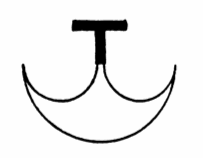
Type of Roman gladiator
The arbelas (plural arbelai) was a type of ancient Roman gladiator. The word is a hapax legomenon, occurring only in the Oneirocritica of Artemidorus, a Greek work on dream interpretation that discusses the symbolism of various gladiator types. It may be related to the Greek word arbelos (ἄρβηλος), a cobbler's semicircular blade used to cut leather similar to an ulu.
A few reliefs show gladiators armed with a curved blade fighting each other; it has been argued that these (possibly also fighting retiarii, the net-fighters) are arbelai;
Artemidorus lists the arbelas among gladiators who might appear in dreams advising a man about what sort of woman he is to marry. Both the dimachaerus, who fought with two curved blades, and the "so-called" arbelas signify that the woman will either be a poisoner, malicious, or ugly.
References
References
- Duncan, Anne. (2006). "Performance and Identity in the Classical World". Cambridge University Press.
- Fagan, Garret G.. (2011). "The Lure of the Arena: Social Psychology and the Crowd at the Roman Games". Cambridge University Press.
- Carter, Michael. (January 2012). "Artemidorus and the Arbelas Gladiator". Zeitschrift für Papyrologie und Epigraphik.
- Carter, Michael. (January 2012). "Gladiatorial Combat with 'Sharp' Weapons (τοι̑ϛ ὀξέσι σιδήροιϛ)". Zeitschrift für Papyrologie und Epigraphik.
This article was imported from Wikipedia and is available under the Creative Commons Attribution-ShareAlike 4.0 License. Content has been adapted to SurfDoc format. Original contributors can be found on the article history page.
Ask Mako anything about Arbelas — get instant answers, deeper analysis, and related topics.
Research with MakoFree with your Surf account
Create a free account to save articles, ask Mako questions, and organize your research.
Sign up freeThis content may have been generated or modified by AI. CloudSurf Software LLC is not responsible for the accuracy, completeness, or reliability of AI-generated content. Always verify important information from primary sources.
Report