From Surf Wiki (app.surf) — the open knowledge base
Arapahoe County, Colorado
County in Colorado, United States
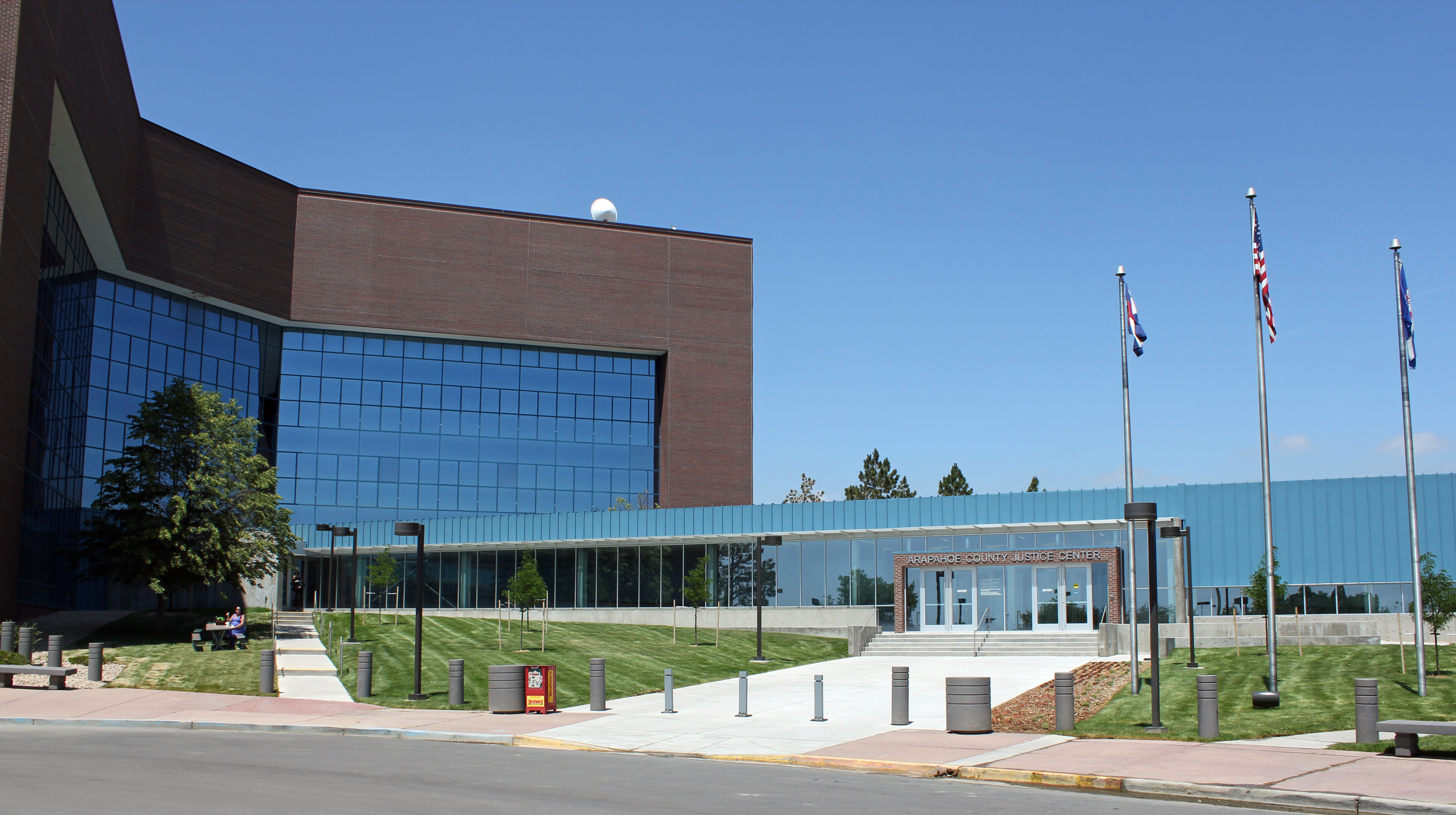
County in Colorado, United States
| Field | Value |
|---|---|
| county | Arapahoe County |
| state | Colorado |
| image_flag | File:Flag of Arapahoe County, Colorado.svg |
| logo | Logo of Arapahoe County, Colorado.png |
| founded date | November 1 |
| founded year | 1861 |
| coordinates | |
| seat wl | Littleton |
| largest city wl | Aurora |
| area_total_sq_mi | 805 |
| area_land_sq_mi | 798 |
| area_water_sq_mi | 7.3 |
| area percentage | 0.9% |
| census yr | 2020 |
| pop | 655070 (3rd) |
| pop_est_as_of | 2024 |
| population_est | 666918 |
| density_sq_mi | auto |
| density_km2 | 317 |
| time zone | Mountain |
| web | www.arapahoegov.com/ |
| named for | The Arapaho Nation |
| ex image | Little Dry Creek.JPG |
| ex image cap | Little Dry Creek in Englewood |
| district | 1st |
| district2 | 4th |
| district3 | 6th |
Arapahoe County ( ) is a county located in the U.S. state of Colorado. As of the 2020 census, its population was 655,070, making it the third-most populous county in Colorado. The county seat is Littleton, and the most populous city is Aurora. The county was named for the Arapaho Native American tribe, who once lived in the region. Arapahoe County is part of the Denver-Aurora-Lakewood metropolitan statistical area. Arapahoe County calls itself "Colorado's First County", since its origins antedate the Pike's Peak Gold Rush.
History
On August 25, 1855, the Kansas Territorial Legislature created a huge Arapahoe County to govern the entire western portion of the Territory of Kansas. The county was named for the Arapaho Nation, who lived in the region.
In July 1858, gold was discovered along the South Platte River in Arapahoe County (in present-day Englewood). This discovery precipitated the Pike's Peak Gold Rush. Many residents of the mining region felt disconnected from the remote territorial governments of Kansas and Nebraska, so they voted to form their own Territory of Jefferson on October 24, 1859. The following month, the Jefferson Territorial Legislature organized 12 counties for the new territory, including a smaller Arapahoe County. Denver City served as the county seat of Arapahoe County.
The Jefferson Territory never received federal sanction, and when the State of Kansas was admitted to the Union on January 29, 1861, the mining regions temporarily reverted to unorganized territory. On February 28, 1861, Congress passed an act organizing the Territory of Colorado, using present-day borders. On November 1, 1861, the Colorado Territorial Assembly organized the 17 original counties of Colorado, including a new Arapahoe County. Arapahoe County originally stretched from the line of present-day Sheridan Boulevard 160 mi east to the Kansas border, and from the line of present-day County Line Road 30 mi north to the 40th parallel north (168th Avenue). Denver City served as the county seat of Arapahoe County until 1902.
In 1901, the Colorado General Assembly voted to split Arapahoe County into three parts - a new consolidated City and County of Denver, a new Adams County, and the remainder of the Arapahoe County to be renamed South Arapahoe County. A ruling by the Colorado Supreme Court, subsequent legislation, and a referendum delayed the reorganization until November 15, 1902. Governor James Bradley Orman designated Littleton as the temporary county seat of South Arapahoe County. On April 11, 1903, the Colorado General Assembly changed the name of South Arapahoe County back to Arapahoe County. On November 8, 1904, Arapahoe County voters chose Littleton over Englewood by a vote of 1310 to 829 to be the permanent county seat.
Geography
According to the U.S. Census Bureau, the county has a total area of 805 sqmi, of which 798 sqmi are land and 7.3 sqmi (0.9%) are covered by water. The county measures 72 mi east-west and 4 to north-south.
Two exclaves of Arapahoe County are entirely surrounded by the City and County of Denver, the City of Glendale, and the Holly Hills neighborhood, a census-designated place.
Adjacent counties
- City and County of Denver – northwest and exclaves
- Adams County – north
- Washington County – east
- Lincoln County – southeast
- Elbert County – south
- Douglas County – southwest
- Jefferson County – west
Major highways
State park
- Cherry Creek State Park
Historic trails
- Smoky Hill Trail
- South Platte Trail
Recreation trails
- Highline Canal National Recreation Trail
- Platte River Greenway National Recreation Trail
Demographics
|align-fn=center 1790-1960 1900-1990 1990-2000 2010-2020
2020 census
As of the 2020 census, the county had a population of 655,070. Of the residents, 23.4% were under the age of 18 and 13.8% were 65 years of age or older; the median age was 36.6 years. For every 100 females there were 98.6 males, and for every 100 females age 18 and over there were 96.6 males. 97.9% of residents lived in urban areas and 2.1% lived in rural areas.
The racial makeup of the county was 60.5% White, 10.8% Black or African American, 1.0% American Indian and Alaska Native, 6.5% Asian, 0.3% Native Hawaiian and Pacific Islander, 8.3% from some other race, and 12.6% from two or more races. Hispanic or Latino residents of any race comprised 20.7% of the population.
There were 250,206 households in the county, of which 32.5% had children under the age of 18 living with them and 26.0% had a female householder with no spouse or partner present. About 26.4% of all households were made up of individuals and 9.0% had someone living alone who was 65 years of age or older.
There were 262,493 housing units, of which 4.7% were vacant. Among occupied housing units, 62.5% were owner-occupied and 37.5% were renter-occupied. The homeowner vacancy rate was 0.9% and the rental vacancy rate was 7.3%.
2000 census
As of the census of 2000, 487,967 people, 190,909 households, and 125,809 families were residing in the county. The population density was 608 /mi2. The 196,835 housing units averaged 245 /mi2. The racial makeup of the county was 79.93% White, 7.67% African American, 0.66% Native American, 3.95% Asian, 0.12% Pacific Islander, 4.51% from other races, and 3.16% from two or more races. Hispanics or Latinos of any race made up 11.81% of the population.
Of the 190,909 households, 34.90% had children under the age of 18 living with them, 51.20% were married couples living together, 10.60% had a female householder with no husband present, and 34.10% were not families. About 27.00% of all households were made up of individuals, and 5.90% had someone living alone who was 65 years of age or older. The average household size was 2.53, and the average family size was 3.11.
In the county, the age distribution was 26.70% under 18, 8.60% from 18 to 24, 33.10% from 25 to 44, 23.00% from 45 to 64, and 8.60% who were 65 or older. The median age was 34 years. For every 100 females, there were 97.10 males. For every 100 females age 18 and over, there were 94.20 males.
The median income for a household was $53,570, and for a family was $63,875. Males had a median income of $41,601 versus $31,612 for females. The per capita income for the county was $28,147. About 4.20% of families and 5.80% of the population were below the poverty line, including 7.00% of those under age 18 and 5.10% of those age 65 or over.
Education
K-12 Education
Arapahoe County is home to nine public school districts: Aurora, Bennett, Byers, Cherry Creek, Deer Trail, Englewood, Littleton, Sheridan, and Strasburg.
There are also several private schools throughout the county, including St. Mary's Academy in Cherry Hills Village, Regis Jesuit High School in Aurora, and Kent Denver School in Englewood.
Higher Education
Arapahoe County is home to two large community colleges: Arapahoe Community College in Littleton, and the Community College of Aurora. The county is also home to the University of Colorado Anschutz Medical Campus and the Denver South campus of Colorado Technical University, both located in Aurora.
Politics
Arapahoe County was once a classic bastion of suburban conservatism. In the 1924 Colorado gubernatorial election, Republican Clarence Morley, who was openly affiliated with the Ku Klux Klan, won over 66% of the vote in Arapahoe County, a higher percentage than he received in any other county in Colorado. In addition, the county for many years was represented in congress by Republican Tom Tancredo, a hardcore conservative known for his controversial anti-immigration, anti-Catholic, and nativist political beliefs.
As the Denver Metro Area grew in the 1960s and beyond, Arapahoe County became the most Republican county in the state outside of Colorado Springs. However, heavy urbanization, demographic changes and population increases - such as the rapid diversification of Aurora's population and younger professionals in the southern suburbs - have caused the county to become much more competitive since the 1990s. It swung from a 22-point win for George H. W. Bush in 1988 to only a three-point win in 1992. By the turn of the millennium, it had become more of a suburban swing county. In 2008, the county swung over dramatically to support Barack Obama, who became the first Democrat to carry it since 1964, and only the second since 1936. It swung from a four-point win for George W. Bush in 2004 to a 13-point win for Obama in 2008. It voted for Obama by a similar margin in 2012, and provided much of Hillary Clinton's statewide margin in 2016 as Donald Trump failed to win even 40 percent of the vote in one of the worst showings for a Republican in the county's history, with the Democrats carrying the former Tech Center area Republican strongholds of Centennial and Littleton. In the 2020 election, Joe Biden turned in the strongest showing for a Democrat in over a century, becoming the first Democrat to win over 60% of the vote since 1916. Biden carried Aurora by lopsided margins and the traditionally Republican southern parts of the county by nearly 20 points: as a reflection of changing demographics and voter coalitions, Arapahoe is now the strongest suburban county for the Democrats in the Denver metro area while Republicans have gained ground in traditionally-democratic Adams County.
Federal Representation
The bulk of the population and political strength of Arapahoe County is located in Colorado's 6th congressional district, Tancredo's former district, centered in Aurora and represented by Jason Crow. The more rural eastern parts of the county are located in the 4th District represented by Lauren Boebert while the Denver enclave portions such as Glendale and Holly Hills are in the Denver-based 1st District represented by Diana DeGette.
Communities
Cities
- Aurora (most; also extends into Adams County and Douglas County)
- Centennial
- Cherry Hills Village
- Englewood
- Glendale (exclave completely surrounded by the city of Denver)
- Greenwood Village
- Littleton (most; also extends into Douglas County and Jefferson County)
- Sheridan
Towns
- Bennett (part; also extends into Adams County)
- Bow Mar (part; also extends into Jefferson County)
- Columbine Valley
- Deer Trail
- Foxfield
Census-designated places
- Aetna Estates
- Brick Center
- Byers
- Cherry Creek
- Columbine (part; also extends into Jefferson County)
- Comanche Creek
- Dove Valley
- Four Square Mile
- Holly Hills (exclave located within the city of Denver)
- Inverness
- Peoria
- Strasburg (part; also extends into Adams County)
- Watkins (part; also extends into Adams County)
Former census-designated places
- Castlewood (now part of Centennial)
- Southglenn (now part of Centennial)
References
References
- "U.S. Census Bureau QuickFacts". [[U.S. Census Bureau]].
- "Find a County". National Association of Counties.
- Gannett, Henry. (1905). "The Origin of Certain Place Names in the United States". U.S. Government Printing Office.
- (February 28, 1861). "An Act to provide a temporary Government for the Territory of Colorado". [[Thirty-sixth United States Congress]].
- (February 12, 2011). "US Gazetteer files: 2010, 2000, and 1990". [[United States Census Bureau]].
- "County Population Totals and Components of Change: 2020-2024". United States Census Bureau.
- "U.S. Decennial Census". United States Census Bureau.
- "Historical Census Browser". University of Virginia Library.
- "Population of Counties by Decennial Census: 1900 to 1990". United States Census Bureau.
- "Census 2000 PHC-T-4. Ranking Tables for Counties: 1990 and 2000". United States Census Bureau.
- (2023). "2020 Decennial Census Demographic and Housing Characteristics (DHC)".
- (2021). "2020 Decennial Census Demographic Profile (DP1)".
- (2021). "2020 Decennial Census Redistricting Data (Public Law 94-171)".
- Geography Division. (December 17, 2020). "2020 CENSUS - SCHOOL DISTRICT REFERENCE MAP: Arapahoe County, CO". [[U.S. Census Bureau]].
- "Search for Private Schools Colorado Arapahoe County". [[National Center for Education Statistics]].
- "Our Campaigns - CO Governor Race - Nov 04, 1924".
- Post, Anne C. Mulkern {{!}} The Denver. (April 17, 2008). "Tancredo slams pope on immigration".
- Rosa, Erin. (August 8, 2006). "Tancredo Vs. Catholics?".
- (March 13, 2020). "LEFT TURN: Aurora, area suburbs veering left politically". Associated Press.
- (February 2, 2021). "2020 Elections Map". New York Times.
- "Dave Leip's Atlas of U.S. Presidential Elections".
- There were 1,344 votes for the leading "other" candidate, [[Progressive Party (United States, 1912). Progressive]] [[Theodore Roosevelt]], followed by 267 votes for Socialist [[Eugene Debs]], 40 votes for [[Prohibition Party. Prohibition]] candidate [[Eugene Chafin]], and 1 vote for [[Socialist Labor Party of America. Socialist Labor]] candidate [[Arthur E. Reimer]].
This article was imported from Wikipedia and is available under the Creative Commons Attribution-ShareAlike 4.0 License. Content has been adapted to SurfDoc format. Original contributors can be found on the article history page.
Ask Mako anything about Arapahoe County, Colorado — get instant answers, deeper analysis, and related topics.
Research with MakoFree with your Surf account
Create a free account to save articles, ask Mako questions, and organize your research.
Sign up freeThis content may have been generated or modified by AI. CloudSurf Software LLC is not responsible for the accuracy, completeness, or reliability of AI-generated content. Always verify important information from primary sources.
Report