From Surf Wiki (app.surf) — the open knowledge base
Arab Christians
none
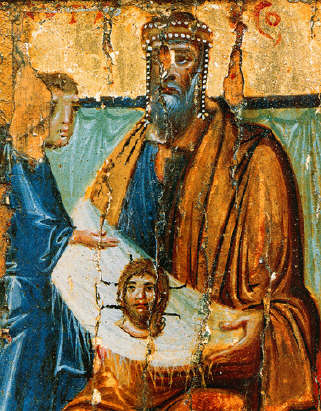
none
| Field | Value |
|---|---|
| image | Orthodox_Easter_in_As-Suwayda.jpg |
| image_caption | Greek Orthodox Easter in Suwayda, Syria |
| population | 10–15+ million |
| region1 | Lebanon |
| pop1 | 1,150,000–1,200,000 |
| region2 | Jordan |
| pop2 | 250,000–400,000 |
| region3 | Syria |
| pop3 | 300,000 (Number was around 1,200,000-1,500,000 pre-Syrian civil war) |
| region4 | Israel |
| pop4 | 133,130 |
| region5 | Sudan |
| pop5 | 100,000 |
| excluding 500,000 Copts | |
| region6 | Iraq |
| pop6 | 50,000 |
| region7 | Palestine |
| pop7 | 50,000 |
| excluding disputed territories | |
| region8 | Algeria |
| pop8 | 45,000–380,000 |
| region9 | Morocco |
| pop9 | 40,000–150,000 |
| region10 | Tunisia |
| pop10 | 23,500 |
| region11 | Turkey |
| pop11 | 18,000 |
| region12 | Egypt |
| pop12 | 10,000–350,000 |
| excluding 6–11 | |
| million Copts<ref name | "pewforum.org" |
| region13 | Libya |
| pop13 | 1,500 |
| region14 | Bahrain |
| pop14 | 1,000 |
| region15 | Yemen |
| pop15 | 400 |
| region16 | Kuwait |
| pop16 | 259–400 |
| langs | Arabic |
| Liturgical: Coptic, Koine Greek, Latin, Classical Syriac, Classical Arabic | |
| rels | Greek Orthodox Church |
| Catholic Church | |
| Oriental Orthodox Church | |
| Nestorianism | |
| Protestantism | |
| Restorationism | |
| related_groups | {{hlist |
| Saint Thomas Christians}}<ref name | "genetic" |
| native_name | ﺍﻟْﻤَﺴِﻴﺤِﻴُّﻮﻥ ﺍﻟْﻌَﺮَﺏ |
| native_name_lang | ar |
excluding 500,000 Copts excluding disputed territories excluding 6–11 million Copts Liturgical: Coptic, Koine Greek, Latin, Classical Syriac, Classical Arabic Catholic Church Oriental Orthodox Church Nestorianism Protestantism Restorationism |Rūm (Antiochian Greek Christians) |Maronites |Copts |Chaldean Catholics |Assyrians |Armenians |Latin Levantines |Saint Thomas Christians}} Arab Christians () are the Arabs who adhere to Christianity. The number of Arab Christians who live in the Middle East was estimated in 2012 to be between 10 and 15 million, although most predominant in Lebanon. Arab Christian communities can be found throughout the Arab world, but are concentrated in the Eastern Mediterranean region of the Levant and Egypt, with smaller communities present throughout the Arabian Peninsula and North Africa.
The history of Arab Christians begins with the history of Christianity in pre-Islamic Arabia, which coincides with the history of Eastern Christianity and the history of the Arabic language. Arab Christian communities either result from pre-existing Christian communities adopting the Arabic language, or from pre-existing Arabic-speaking communities adopting Christianity. The jurisdictions of three of the five patriarchates of the Pentarchy primarily became Arabic-speaking after the early Muslim conquests – the Church of Alexandria, the Church of Antioch and the Church of Jerusalem – and over time many of their adherents adopted the Arabic language and culture. Separately, a number of early Arab kingdoms and tribes adopted Christianity, including the Nabataeans, Lakhmids, Salihids, Tanukhids, Ibadis of al-Hira, and the Ghassanids.
In modern times, Arab Christians have played important roles in the Nahda movement, and they have significantly influenced and contributed to the fields of literature, politics, business, philosophy, music, theatre and cinema, medicine, and science. Today Arab Christians still play important roles in the Arab world, and are relatively wealthy, well educated, and politically moderate. Emigrants from Arab Christian communities also make up a significant proportion of the Middle Eastern diaspora, with sizable population concentrations across the Americas, most notably in Brazil, Argentina, Venezuela, Colombia, and the US. However those emigrants to the Americas, especially from the first wave of emigration, have often not passed the Arabic language to their descendants, having integrated into the majority-Christian communities to which they emigrated.
The concept of an Arab Christian identity remains contentious, with some Arabic-speaking Christian groups in the Middle East, such as Assyrians, Armenians, Greeks and others, rejecting an Arab identity. Individuals from Egypt's Coptic Christian community and Lebanon's Maronite community sometimes assume a non-Arab identity.
History
The history of Arab Christians coincides with the history of Christianity and the history of the Arabic language; Arab Christian communities result either from pre-existing Christian communities adopting the Arabic language, or from pre-existing Arabic-speaking communities adopting Christianity. Arab Christians include the indigenous Christian communities of Western Asia who became majority Arabic-speaking after the consequent seventh-century Muslim conquests in the Fertile Crescent. The Christian Arab presence predates the early Muslim conquests, and there were many Arab tribes that converted to Christianity, beginning in the 1st century.
The interests of the Arabs before the 9th century A.D. were focused primarily on the recording and translating of pre-Islamic poetry. The early Arab Christians recorded Syriac hymns, Arabic poetry, ecclesiastical melodies, proverbs, and ḥikam (rules of governance). They did not otherwise record religion, which gave way to conflicting accounts and sparse evidence for specific practices over several centuries.
From classical antiquity to modern times, Arab Christians have played important roles contributing to the culture of the Mashriq, in particular those in the Levant, Egypt and Iraq.
Pre-Islamic period
The New Testament has a biblical account of Arab conversion to Christianity recorded in the Book of Acts. When Saint Peter preaches to the people of Jerusalem, they ask,And how hear we every man in our own tongue, wherein we were born? [...] Arabians, we do hear them speak in our tongues the wonderful works of God. (Acts 2:8, 11 KJV)The first mention of Christianity in Arabia occurs in the New Testament as the Apostle Paul references his journey to Arabia following his conversion (Galatians 1: 15–17). Later, Eusebius discusses a bishop named Beryllus in the see of Bostra, the site of a synod c. 240 AD and two Councils of Arabia. The New Testament signals an early entry of Christianity among the Arabs; in addition to what was narrated by al-Tabari, Abu al-Fida, al-Maqrizi, Ibn Khaldun and al-Masoudi, the disciples of Christ (including Matthew, Bartholomew and Thaddeus) were the ones who went to Arabia as preachers of the religion. Sozomen of Gaza said that the Arabs converted to Christianity through the efforts of priests and monks who spread to Arab regions, and the strength of Christianity increased with the conversion of the major tribes. The religion was organised in many dioceses controlled by bishops and archbishops. The Arab bishops were divided into types: urban bishops residing in cities, and “tent bishops” who resided in tents and moved with their tribes from one place to another. The number of Arab bishops among the Nabataeans alone reached forty according to Ibn Durayd. The first Arab bishop of the Arabs, Saint Moses, spent many years in the 4th century as a hermit between Syria and Egypt. His piety impressed Mawiyya, Arab warrior-queen of the Tanukhids, and she made his consecration as a bishop over her people a condition to any truce with Rome. {{Multiple image The Jordan Valley and the Balqa was under Arab Christian rule by the second century AD. The Nabataeans, natives of the southern Levant, also converted to Christianity in the Late Roman Period. In Palmyra and near al-Qaryatayn there are Christian monuments and the remains of churches and inscriptions that indicate the spread of the religion into Syria proper. The administration of Jordan under Roman rule was given to the Quda'a tribe. This tribe had embraced Christianity according to Ya'qubi, and were later succeeded by the Christian Salihids and Ghassanid Kingdom. There are poetic verses by the pre-Islamic poet al-Nabigha in which he praises the kings of Ghassan, congratulating them on Palm Sunday. Bordering Syria, the Sinai was administratively affiliated with the Egyptian Church based in Alexandria. There are documents from the late third century of Dionysius, Pope of Alexandria, in which he mentions his Arab Christian subjects in the Sinai and the persecution they faced during the days of the pagan Roman emperor Diocletian. Later, forty martyrs fell in 309 in Mount Sinai during a raid by pagan Arabs on their hermitages. The monks fortified their new monasteries, and the most fortified is still in use today, Saint Catherine's Monastery, built by the commission of Roman emperor Justinian in 565. It has hosted a number of Church bishops and theologians, Ghassanid and Lakhmid kings, and pre-Islamic poets.
_and_over_4,000_with_him_(Menologion_of_Basil_II).jpg)
The southern Arabian city of Najran was made famous by the religious persecution of Christians by one of the kings of Yemen, Dhu Nuwas, who was an enthusiastic convert to Judaism. The leader of the Arabs of Najran during the period, al-Ḥārith, was canonized by the Catholic Church as Arethas. Aretas was the leader of the Christians of Najran in the early 6th century and was executed during the massacre of Christians by the king in 523. Ibn Khaldun, Ibn Hisham and Yaqut al-Hamawi mentioned that Najran was entirely Christian when Dhu al-Nawas converted to Judaism, and that the people of Najran refused to convert to his faith, so he massacred them. The victims were mentioned by Ibn Ishaq and named in the Quran as the "People of the Ditch". The Byzantine emperor Justin I was enraged and encouraged Kaleb of Axum to occupy Yemen and eliminate the Jewish king. Dhu al-Nawas was later deposed and killed, prompting Kaleb to appoint a native Christian Himyarite, Sumyafa Ashwa, as his viceroy. The Aksumites thus conquered Himyar and their rule lasted until 575. The Abyssinians spread Christianity and their rulers built an extravagant building in honor of the Martyrs of Najran. It was known by its contemporaries for its beauty, adorned with ornaments, jewels, and prominent archways. Arabs called it the “Kaaba of Najran”. The Yemenis later rebelled against the Abyssinians and demanded independence. History records Christian influence from Ethiopia to Arab lands in pre-Islamic times, and some Ethiopian Christians may have lived in Mecca.
.jpg)
Yemen had an important share in ancient Christianity. In the second century, the Greek theologian Pantaenus left Alexandria and headed towards Yemen as a missionary after his conversion. Historians such as Rufinus and Orosius mentioned that Matthew the Apostle was the missionary of Yemen and Abyssinia. A special relationship developed between the people of Yemen and the Syrian Church, as inferred by the works of Ephrem the Syrian, the biography of Simeon Stylites, and the historian Philostorgius, who said that some villages and settlements established in Yemen were Syriac-speaking. The famous Al-Qalis Church in Sana'a was built to serve aderents and to attract pilgrims travelling to the Kaaba of Mecca and Ghamdan Palace. On the organizational level, the Archbishop of Yemen held the title "Catholicos" which follows the "Patriarch*"* in rank. The spread of Christianity amongst Arabs reached Upper Mesopotamia, where Banu Bakr and Banu Mudar lived, both famous for their staunch Christian beliefs and for honoring Sergius the Military Saint. Ibn Khallikan mentioned that all the Yemeni Arabs in Iraq converted to Christianity, including Taym al-Lat, Kalb, Lakhm and Tanukh, and many had moved towards Bahrain by the fourth century.
In Medina there was a Christian sect that was rejected by the official church and considered heretical. They deified the Virgin Mary and gave her offerings. This sect was mentioned by a number of historians, including Epiphanius and Ibn Taymiyya, who called them "The Marians" (Al-Maryamiyyun). Likewise, al-Zamakhshari and al-Baydawi referred to this sect in their interpretation of the Qur’an. Another sect called "The Davidians" (Al-Dāwudiyyūn) were known for their exaggerations in honoring King David. Some contemporary historians classified it as a Judeo-Christian heresy. In Mecca, the Banu Jurhum embraced Christianity at the hands of their sixth king, Abd al-Masih ibn Baqia, and supervised the service of the Haram for a period of time. Banu Azd and Banu Khuza’a became Christians with them according to Abu al-Faraj al-Isfahani. The earliest indications of Christianity in Mecca is the Christian cemetery outside the Medina towards the well of 'Anbasa, confirmed by al-Maqdisi, as well as the conversion to Christianity by some members of the Quraysh.
Islamic era

.jpg)
Following the fall of large portions of former Byzantine and Sasanian provinces to the Arab armies, a large indigenous Christian population of varying ethnicities came under Arab Muslim dominance. Historically, a number of minority Christian sects were persecuted as heretic under Byzantine rule (such as non-Chalcedonians). The Islamic conquests set forth two processes affecting these Christian communities: the process of Arabization, causing them gradually to adopt Arabic as a spoken, literary, and liturgical language (often alongside their ancestral tongues), and the much slower, yet persistent process of Islamization. As Muslim army commanders expanded their empire and attacked countries in Asia, North Africa and southern Europe, they would offer three conditions to their enemies: convert to Islam, pay jizya (tax) every year, or face war to death. Those who refused war and refused to convert were deemed to have agreed to pay jizya.
As "People of the Book", Islamic law accorded Christians the right to practice their religion (including having Christian law used for rulings, settlements or sentences in court). In contrast to Muslims, who paid the zakat, they paid the jizya capitation tax. The jizya was not levied on slaves, women, children, monks, the old, the sick, hermits, or the very poor. In return, non-Muslim citizens were permitted to practice their faith, to enjoy a measure of communal autonomy, to be entitled to Muslim state's protection from outside aggression, to be exempted from military service, and to be exempted from the zakat. Like Arab Muslims, Arab Christians refer to God as "Allah". As with the Christians of Malta, this practice is distinguished from the Islamic use of the word "Allah" which refers to the personal name of God in that faith. The use of the term Allah in Arab churches predates Islam.
During the Islamic Golden Age, Christians contributed to the Islamic civilization in various fields, and the institution known as the House of Wisdom employed Christian scholars to translate works into Arabic and to develop new knowledge.
Modern and contemporary era
Arab Christians have always been the go-between the Islamic world and the Christian West due to their shared religious affinity. The Greek Orthodox share Orthodox ties with Russia and Greece; whilst Melkites and Maronites share Catholic bonds with Italy, Vatican and France. Scholars and intellectuals agree Christians in the Arab world have made significant contributions to Arab civilization since the introduction of Islam, and they have had a notable impact contributing the culture of the Mashriq. Many Arab Christians today are physicians, entertainers, philosophers, government officials and people of literature.
Role in the Nahda
The Nahda (meaning "the Awakening" or "the Renaissance") was a cultural renaissance of the Arabs in the late 19th and early 20th centuries. It began in the wake of the exit of Muhammad Ali of Egypt from the Levant in 1840. Beirut, Cairo, Damascus and Aleppo were the main centers of the renaissance and this led to the establishment of schools, universities, theater and printing presses. This awakening led to the emergence of a politically active movement known as the "association" that was accompanied by the birth of Arab nationalism and the demand for reformation in the Ottoman Empire. This led to the calling of the establishment of modern states based on Europe. It was during this stage that the first compound of the Arabic language was introduced along with the printing of it in letters, and later the movement influenced the fields of music, sculpture, history, humanities, economics and human rights.
This cultural renaissance during the late Ottoman rule was a quantum leap for Arabs in the post-industrial revolution, and is not limited to the individual fields of cultural renaissance in the nineteenth century, as the Nahda only extended to include the spectrum of society and the fields as a whole. Christian colleges (accepting of all faiths) like Saint Joseph University, American University of Beirut (Syrian Protestant College until 1920) and Al-Hikma University in Baghdad amongst others played a prominent role in the development of Arab culture. It is agreed amongst historians the importance the roles played by the Arab Christians in this renaissance, and their role in the prosperity through participation in the diaspora. Given this role in politics and culture, Ottoman ministers began to include them in their governments. In the economic sphere, a number of Christian families like the Greek Orthodox Sursock family became prominent. Thus, the Nahda led the Muslims and Christians to a cultural renaissance and national general despotism. This solidified Arab Christians as one of the pillars of the region and not a minority on the fringes.
The Lebanese writer and scholar Butrus al-Bustani is considered to have been the first Syrian nationalist. Syrian writers include scholar Francis Marrash. The tradition of women's literary salons and societies in the Arab world was revived during the Nahda by Maryana Marrash.
Notable academics in the modern era include the Syrian philologist Ibrahim al-Yaziji (1847–1906), whose Bible translations were among the first in the modern Arabic language, and Anastase-Marie al-Karmali (1866–1947), Iraqi Catholic priest and Discalced Carmelite friar best known for his contributions to Arabic lexicology, lexicography and philology. File:Nasif al-Yaziji.jpg|Nasif al-Yaziji (1800–1871), Lebanese author, poet and key figure of the Nahda File:Butrus al-Bustani.jpg|Butrus al-Bustani (1819–1883), Lebanese writer scholar, lexicographer, periodical editor, translator File:Francis Marrash.jpg|Francis Marrash (June 1836 – 1874), Syrian scholar, publicist, writer and poet File:Khalil Khuri (Tarajim mashahir al-Sharq fi al-qarn al-tasi' 'ashar, 1922, vol. 2, p. 122).jpg|Khalil al-Khuri (Oct 1836 – 1907), Lebanese newspaper owner and writer File:Ibrahim Al-Yazigi.jpg|Ibrahim al-Yaziji (1847–1906), Lebanese intellectual File:Photograph of Maryana Marrash2.jpg|Maryana Marrash (1848–1919), Syrian writer and poet, the reviver of women's literary salons and the first Syrian woman to publish a collection of poetry File:Qestaki al-Homsi.jpg|Qustaki al-Himsi (1858–1941), Syrian intellectual who was the founder of modern Arabic literary criticism File:Jurji Zaydan.jpg|Jurji Zaydan (1861–1914), Lebanese novelist and journalist File:Anastase-Marie al-Karmali portrait.jpg|Anastase-Marie al-Karmali (1866–1947), Iraqi Catholic priest and Discalced Carmelite friar, lexicologist, lexicographer and philologist of the Arabic language file:Abd al-Masih al-Antaki - 1907.jpg|Abd al-Masih al-Antaki (1874–1923), Syrian intellectual, journalist and political activist File:Khalil Beidas.jpg|Khalil Beidas (1874–1949), Palestinian scholar, translator, educator and novelist File:May ziade.jpg|May Ziadeh (1886–1941), Lebanese-Palestinian poet and pioneer of Oriental feminism File:Mary Ajami.jpg|Mary Ajami (1888–1965), Syrian writer who launched the first women's newspaper in the Arab world
Religious persecution
The Massacre of Aleppo of 1850, often referred to simply as The Events, was a riot perpetrated by Muslim residents of Aleppo, largely from the eastern quarters of the city, against Christian residents, largely located in the northern suburbs of the predominantly Christian neighbourhood Judayde (Jdeideh) and Salibeh. The Events are considered by historians to be particularly important in Aleppian history, for they represent the first time disturbances pitted Muslims against Christians in the region. The patriarch of the Syriac Catholic Church, Peter VII Jarweh, was fatally wounded in the attacks and died a year later. 20–70 people died from rioting and 5,000 died as a result of bombardment.
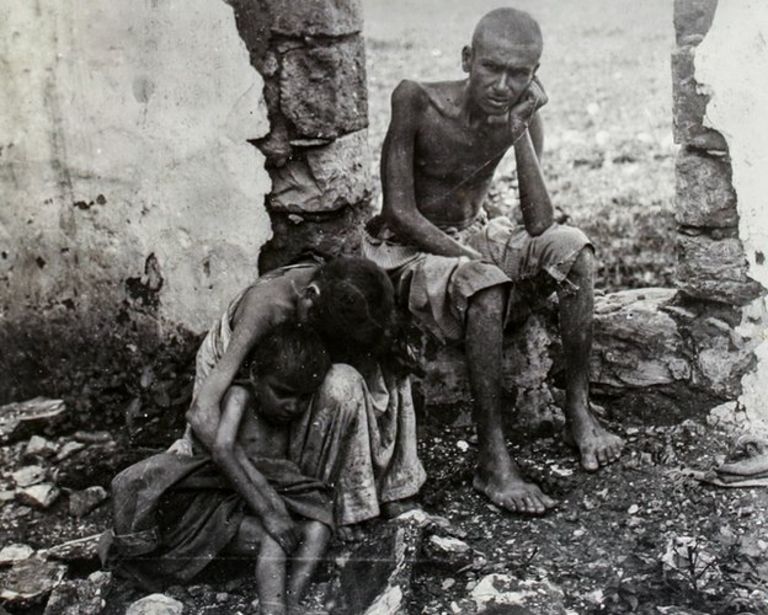
The 1860 civil conflict in Mount Lebanon and Damascus was a civil conflict and later massacre during Ottoman rule, started by skirmishes occurring between the Maronites and the Druze of Mount Lebanon. Following decisive victories and massacres against Christians, the conflict spilled over into other parts of Ottoman Syria, particularly the city Damascus, where over ten thousand Christian residents of various denominations were killed by Druze and Muslim militiamen. With the connivance of the military authorities and Turkish soldiers, Druze and allied paramilitary groups organised pogroms in Damascus which lasted three days (9–11 July). By the war's end, around 20,000 Christians had been killed, and many villages and churches were destroyed. The Christian quarter of old Damascus was destroyed and houses were plundered. Historian Mikhail Mishaqa's memoir of the massacre is valuable to historians, as it is the only account written by a survivor of a mob attack. Emir Abdelkader al-Jazairi, the exiled Algerian Muslim military leader, ordered his sons and soldiers to protect and shelter Damascene Christians from impending interpersonal violence that was spreading throughout the city, thereby saving thousands, preserving this ancient community from complete devastation.
Melkite Greek Catholic and Maronite Christians suffered negligence from the Ottoman authorities and a naval blockade from France and Britain, resulting in the Great Famine of Mount Lebanon (1915–1918) during World War I, which ran in conjunction with the Armenian genocide, the Assyrian genocide and the Greek genocide. The Mount Lebanon famine caused the highest fatality rate by population during World War I. Around 200,000 people starved to death when the population of Mount Lebanon was estimated to be 400,000 people. The Lebanese diaspora in Egypt funded the shipping of food supplies to Mount Lebanon, sent via the Syrian Island town of Arwad. On 26 May 1916, Lebanese-American writer Kahlil Gibran wrote a letter to Mary Haskell that read:
Politics (20th century – present)
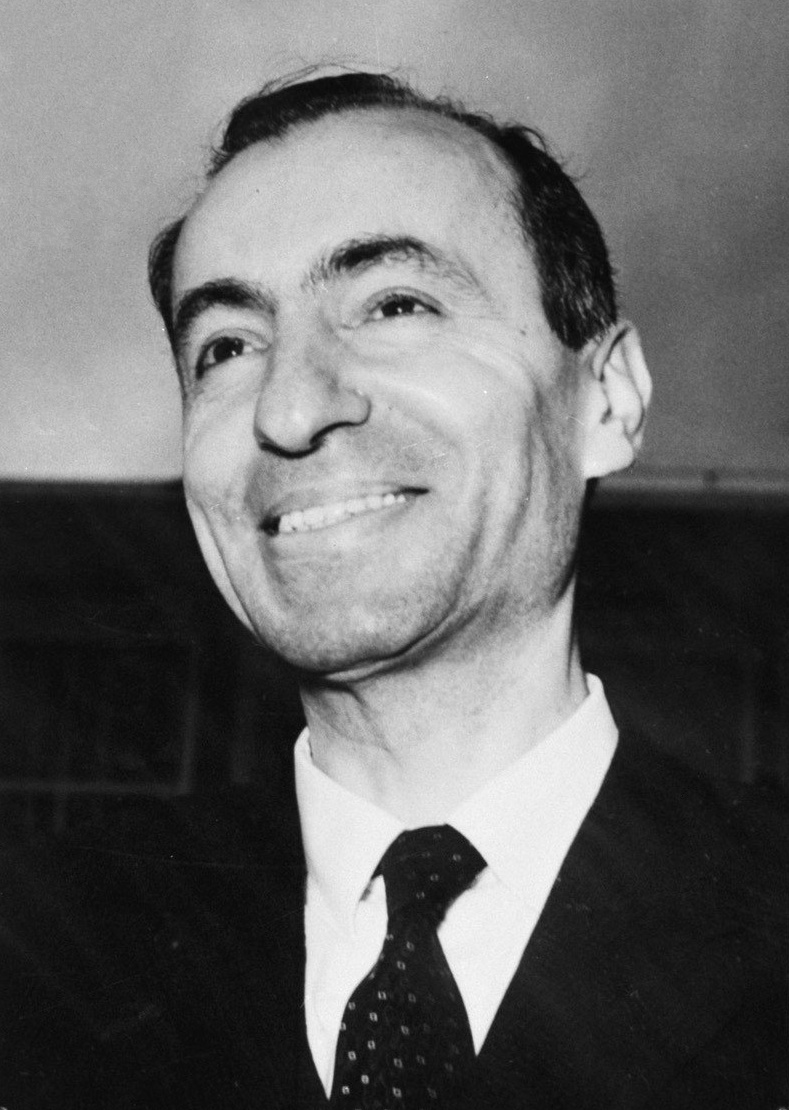

Arab Christians had been among the first Arab nationalists. As early as 1877, the Maronite leader Youssef Bey Karam had proposed to Emir Abdelkader the separation of the Arabic-speaking provinces from the Ottoman Empire using the terms al-gins al-'arabi ("Arab race") and gaba'il al-arabiya ("Arab tribes"). In the early 20th century, many prominent Arab nationalists were Christians, like the Syrian intellectual Constantin Zureiq, Ba'athism proponent Michel Aflaq, and Jurji Zaydan, who was reputed to be the first Arab nationalist. Khalil al-Sakakini, a prominent Palestinian Jerusalemite, was Arab Orthodox, as was George Antonius, Lebanese author of The Arab Awakening. Grégoire Haddad, known as the "Red Bishop of Beirut", founded the "Lebanese Social Movement" with Shiite Imam Musa al-Sadr in 1960, and promoted in the following years Islamic-Christian dialogue. The first Syrian nationalists were also Christian. Although Lebanese, Antoun Saadeh was the founder behind the Syrian Social Nationalist Party. Sa'adeh rejected Pan-Arabism and argued instead for the creation of a "United Syrian Nation" or "Natural Syria". George Habash, founder of the Popular Front for the Liberation of Palestine was Arab Orthodox, and so was Wadie Haddad, the leader of the PFLP's armed wing. Influential Palestinian Christians such as Tawfik Toubi, Daud Turki, Emile Touma and Emile Habibi became leaders of the Israeli and Palestinian communist party. Nayif Hawatmeh is the founder and leader of the Democratic Front for the Liberation of Palestine, and Kamal Nasser and Hanan Ashrawi were members of the PLO Executive Committee.
Regional conflicts
During the 1948 Arab–Israeli War, a number of Palestinian Greek Orthodox and Melkite communities were ethnically cleansed and driven out of their towns, including al-Bassa, Ramla, Lod, Safed, Kafr Bir'im, Iqrit, Tarbikha, Eilabun and Haifa. Many Christian towns or neighborhoods were ethnically cleansed and destroyed during the period between 1948 and 1953. All the Christian residents of Safed, Beisan, Tiberias were removed, and a big percentage displaced in Haifa, Jaffa, Lydda and Ramleh. Arab Christian Constantin Zureiq was the first to coin the term "Nakba" in reference to the 1948 Palestinian exodus.
In 1975, the Lebanese Civil War occurred between two broad camps, the mainly Christian 'rightist' Lebanese Front consisting of Maronites and Melkites, and the mainly Muslim and Arab nationalist 'leftist' National Movement, supported by the Druze, Greek Orthodox and the Palestinian community. The war was characterized by the kidnap, rape and massacre of those caught in the wrong place as each side eliminated 'enemy' enclaves – mainly Christian or Muslim low-income areas. In Lebanon, Maronites and Melkites looked to France and the Mediterranean world, whereas most Muslims and Greek Orthodox Christians looked to the Arab hinterland as their political lodestar. In 1982 Israel invaded Lebanon with the aim of destroying the PLO, which it besieged in West Beirut. Israel was later obliged to withdraw as a result of multiple guerrilla attacks by the Lebanese National Resistance Front and increasing hostility across all forces in Lebanon to their presence.
With the events of the Arab Spring, the Syrian Arab Christian community was heavily hit in line with other Christian communities of Syria, being victimized by the war and specifically targeted as a minority by Jihadist forces. Many Christians, including Arab Christians, were displaced or fled Syria over the course of the Syrian Civil War. When the conflict in Syria began, it was reported that Christians were cautious and avoided taking sides, but that due to the increased violence and ISIL's growth, Arab Christians showed support for Assad, fearing that if Assad was overthrown, they would be targeted. Christians supported the Assad regime based on the fear that the end of the current government could lead to instability. The Carnegie Middle East Center stated that the majority of Christians were more in support of the regime because they feared a chaotic situation or to be under the control of the Islamist Western and Turkish backed armed groups.
Academia
Arab Christians throughout history have been noted for their impact on academia and literature. Arabic-speaking Christian scholars wrote extensive theological and philosophical works and treatises in Arabic in which they not only responded to the polemics of their Muslim adversaries, but also provided systematic apologetic discussions of the Christian faith and practice. There are many New Testament translations or portions into regional colloquial forms of Arabic. In the 20th century, the noted Palestinian physician and ethnographer Tawfiq Canaan's academic work serves as valuable resources to researchers of Palestinian history. Jordanian historian Suleiman Mousa was the only author to write about Lawrence of Arabia and show the Arab perspective. Mousa noted that there were many books written to praise Lawrence, and all of them exaggerated his part in the Arab Revolt and failed to do justice to the Arabs themselves. Syrian writer Hanna Mina has been described in Literature from the "Axis of Evil" as the country's most prominent.
Media
Christians developed Arabic-speaking Christian media, including various newspapers, radio stations, and television networks such as Télé Lumière, Aghapy TV, CTV, and SAT-7, which is a Christian broadcasting network that was founded in 1995; it targets primarily Arab Christians in North Africa and the Middle East. These media networks produce dozens of Arabic-language Christian films, musical works, as well as radio and television programs.
Syro-Lebanese Melkite Saleem Takla and his brother Beshara founded the Al-Ahram newspaper in 1875 in Alexandria; now the most widely circulated Egyptian daily newspaper. Similarly, Lebanese Protestant Faris Nimr co-founded Al Muqattam in 1888, a leading Cairo-based newspaper in circulation until 1954. In Palestine, Najib Nassar's newspaper Al-Karmil was the first anti-Zionist weekly newspaper. It appeared in Haifa in 1908 and was shut down by the British in the 1940s. Likewise, the Arab Orthodox El-Issa family from Jaffa founded the Falastin newspaper in 1911. The paper was Palestine's most consistent critic of the early Zionist movement. In Lebanon, the influential Greek Orthodox Tueni family founded the An-Nahar newspaper in 1933, also one of the leading newspapers today. Shireen Abu Akleh worked as a reporter for the Arabic-language channel Al Jazeera for 25 years.
Popular Lebanese singer Fairuz has over 150 million records sold worldwide, making her the highest selling Middle-Eastern artist of all time. Other Lebanese singers include Majida El Roumi, legendary folk veteran Wadih El Safi, and "Queen of Arab pop" Nancy Ajram. Syrian notables include George Wassouf and Nassif Zeytoun. Palestinians include Lina Makhul, Fadee Andrawos, and Israeli singer Mira Awad.
Arab diaspora
Millions of people are descended from Arab Christians and they live outside the Middle East, in the Arab diaspora. They mainly reside in the Americas, but many people of Arab Christian descent also reside in Europe, Africa and Oceania. Among them, one million Palestinian Christians live in the Palestinian diaspora and 6–7 million Brazilians are estimated to have Lebanese ancestry. Mass Arab immigration started in the 1890s as Lebanese and Syrian people fled from the political and economic instability which was caused by the collapse of the Ottoman Empire. These early immigrants were known as Syro-Lebanese, Lebanese and Palestinians, or Turks. According to the United States census, there were at least 3.5 million Arabs living in the United States in the year 2000, with around 40% of them originating from Lebanon. The majority of them are members of the Christian faith, making up 63% of the overall Arab American population.
Historical events that caused the mass-emigration of Arab Christians include: the 1860 civil conflict in Mount Lebanon and Damascus, the 1915–1918 Great Famine of Mount Lebanon, the 1948 Palestinian expulsion and flight, the 1956–57 exodus and expulsions from Egypt, the Lebanese civil war, and the Iraq war.
Role in the Mahjar
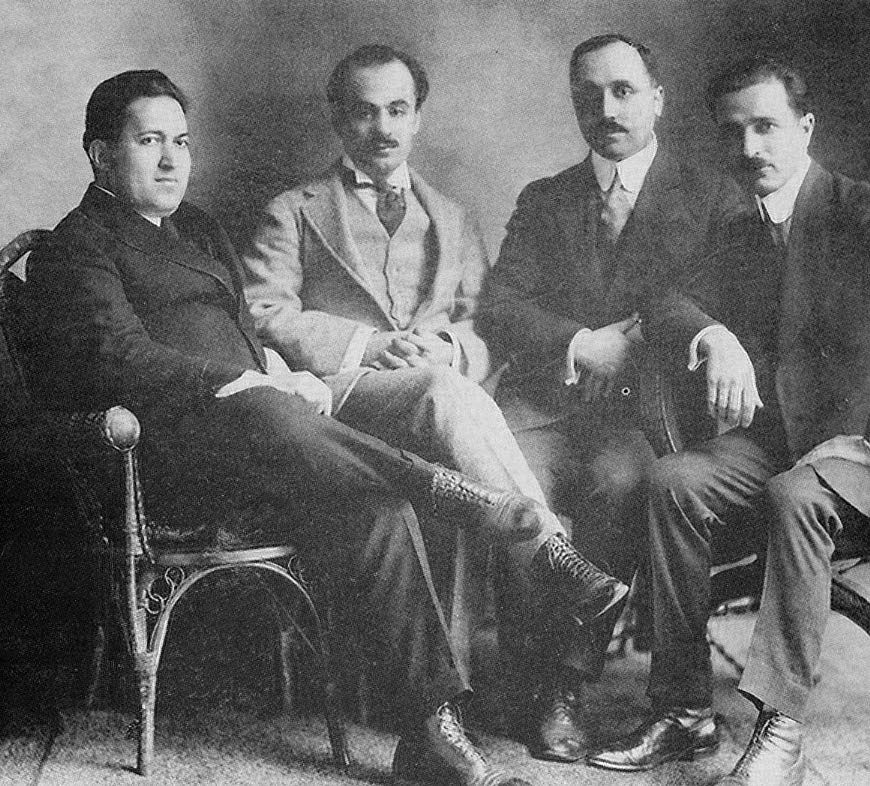
The Mahjar (one of its more literal meanings being "the Arab diaspora") was a literary movement that succeeded the Nahda movement. It was started by Christian Arabic-speaking writers who had emigrated to America from Lebanon, Syria and Palestine at the turn of the 20th century. The writers of the Mahjar movement were stimulated by their personal encounter with the Western world and participated in the renewal of Arabic literature, hence their proponents referred to as writers of the "late Nahda".
The Pen League was the first Arabic-language literary society in North America, formed initially by Syrians Nasib Arida and Abd al-Masih Haddad. Members of the Pen League included: Kahlil Gibran, Elia Abu Madi, Mikhail Naimy, and Ameen Rihani. Eight out of the ten members were Greek Orthodox and two were Maronite Christians. The league dissolved following Gibran's death in 1931 and Mikhail Naimy's return to Lebanon in 1932. Naimy was made famous internationally for his spiritual writings, most notably The Book of Mirdad.
Notable Arab Christians
Notable diaspora figures include Swiss businessman of Lebanese Greek Orthodox descent Nicolas Hayek, and Mexican business magnate of Maronite descent, Carlos Slim. From 2010 to 2013, Slim was ranked as the richest person in the world by the Forbes magazine. Figures in entertainment include actors Omar Sharif (Melkite-born), Jamie Farr, Salma Hayek, Tony Shalhoub, Vince Vaughn, Danny Thomas, Oscar award winner F. Murray Abraham and film director Youssef Chahine. Figures in academics include plant biologist Joanne Chory, scholar Nassim Nicholas Taleb, cardiac and vascular surgeon Michael DeBakey, inventor of the iPod and co-inventor of the iPhone Tony Fadell, mathematician Michael Atiyah, professor Charles Elachi, intellectual Edward Said, and Nobel Prize winner in Chemistry Elias James Corey and Nobel Prize winner in Physiology or Medicine Peter Medawar. Other notables include White House reporter Helen Thomas, activist and presidential candidate Ralph Nader, judge Rosemary Barkett, and US governor and academic administrator Mitch Daniels.
Identity
Denominations
Arab Christians mainly belong to the Greek Orthodox Church of Jerusalem, Greek Orthodox Church of Antioch, Melkite Greek Catholic Church, Maronite Church, and Oriental Orthodox Churches, though some are also members of other churches, including the Catholic Latin Church and Protestant Churches, such as the Lutheran, Anglican, and Reformed traditions. Some memberships are mixed, not by co-identification, but by including two or more members of multiple ethnicities (Arab and otherwise).
| Denomination | Communion | Members | Membership primarily subscribes to Arab identity? | Alternative identities claimed | Headquarters | Liturgical language | Area | |||||||||||||||||||||
|---|---|---|---|---|---|---|---|---|---|---|---|---|---|---|---|---|---|---|---|---|---|---|---|---|---|---|---|---|
| [[File:Coptic_cross.svg | center | 100x100px]] | Coptic Orthodox Church | Oriental Orthodox | 10 million | Mixed | Coptic, including Pharaonism | Ancient: Alexandria | title=BBC – Religions – Christianity: Coptic Orthodox Church | url=https://www.bbc.co.uk/religion/religions/christianity/subdivisions/coptic_1.shtml | access-date=28 March 2021 | website=www.bbc.co.uk | language=en-GB | archive-date=28 February 2021 | archive-url=https://web.archive.org/web/20210228230208/https://www.bbc.co.uk/religion/religions/christianity/subdivisions/coptic_1.shtml | url-status=live}} | ||||||||||||
| [[File:Coat_of_Arms_of_the_Maronite_Patriarchate.svg | center | 107x107px]] | Maronite Catholic Church | Catholic | 3.5 million | Mixed | Maronite, Phoenician and Aramean | Ancient: Antioch | Arabic, Syriac | |||||||||||||||||||
| [[File:Coat_of_arms_of_the_Greek_Orthodox_Patriarchate_of_Antioch_and_All_the_East.svg | center | 151x151px]] | Greek Orthodox Church of Antioch | Eastern Orthodox | 2.5 million | last1=Stiffler | first1=Matthew W. | title=AUTHENTIC ARABS, AUTHENTIC CHRISTIANS: ANTIOCHIAN ORTHODOX AND THE MOBILIZATION OF CULTURAL IDENTITY | date=2010 | publisher=The University of Michigan | url=https://deepblue.lib.umich.edu/bitstream/handle/2027.42/77904/mattws_1.pdf?sequence=1 | access-date=27 March 2021 | archive-date=28 April 2021 | archive-url=https://web.archive.org/web/20210428074140/https://deepblue.lib.umich.edu/bitstream/handle/2027.42/77904/mattws_1.pdf?sequence=1 | url-status=live }} | Greek and Byzantine**** | Ancient: Antioch | Arabic, Greek | ||||||||||
| [[File:Patriarchal_Emblem_of_Syriac_Orthodox_Church.svg | center | 110x110px]] | Syriac Orthodox Church | Oriental Orthodox | 1.7 million | No | Assyrian and Aramean | Ancient: Antioch | title=Syrian Orthodox Patriarchate of Antioch | url=https://syriacpatriarchate.org/ | access-date=28 March 2021 | website=Syrian Orthodox Patriarchate of Antioch | language=en-US | archive-date=11 April 2021 | archive-url=https://web.archive.org/web/20210411130028/https://syriacpatriarchate.org/ | url-status=live}} | ||||||||||||
| [[File:Patriarch_Youssef_Absi_coat_of_arms.svg | center | 129x129px]] | Melkite Greek Catholic Church | Catholic | last=Roberson | first=Ronald G. | title=The Eastern Catholic Churches 2017 | url=http://www.cnewa.org/source-images/Roberson-eastcath-statistics/eastcatholic-stat17.pdf | url-status=dead | archive-url=https://web.archive.org/web/20181024215818/http://www.cnewa.org/source-images/Roberson-eastcath-statistics/eastcatholic-stat17.pdf | archive-date=24 October 2018 | access-date=28 September 2019 | work=Eastern Catholic Churches Statistics | publisher=Catholic Near East Welfare Association}} | last=Al-Tamimi | first=Aymenn Jawad | title=Identity Among Middle East Christians | url=https://www.meforum.org/3145/middle-east-christians-identity | access-date=27 March 2021 | website=Middle East Forum | date=5 January 2012 | language=en | archive-date=27 February 2021 | archive-url=https://web.archive.org/web/20210227161011/https://www.meforum.org/3145/middle-east-christians-identity | url-status=live}}''' | Greek and Byzantine**** | Ancient: Antioch | Arabic, Greek |
| Chaldean Catholic Church | Catholic | 0.6 million | title=Chaldeans | url=https://minorityrights.org/minorities/chaldeans/ | access-date=1 April 2021 | website=Minority Rights Group | date=19 June 2015 | language=en-GB | archive-date=2 May 2021 | archive-url=https://web.archive.org/web/20210502105409/https://minorityrights.org/minorities/chaldeans/ | url-status=live}} | Chaldean, Assyrian, Arab | Ancient: Seleucia-Ctesiphon | Syriac, Arabic | ||||||||||||||
| Greek Orthodox Church of Alexandria | Eastern Orthodox | 0.5 – 2.9 million | url=https://journals.openedition.org/ema/3810 | title=Social relations between the Christian communities of Alexandria: Re-examining social boundaries in times of decline | journal=Égypte/Monde arabe | year=2018 | doi=10.4000/ema.3810 | last1=Kårtveit | first1=Bård | volume=17 | issue=17 | pages=97–117 | hdl=10852/72712 | s2cid=158605674 | hdl-access=free | access-date=27 March 2021 | archive-date=28 April 2021 | archive-url=https://web.archive.org/web/20210428074139/https://journals.openedition.org/ema/3810 | url-status=live}}''' | Greek and Byzantine**** | Ancient: Alexandria | Arabic, Greek | ||||||
| Assyrian Church of the East | Church of the East | 0.5 million | No | Nestorian, Assyrian and Aramean | Ancient: Seleucia-Ctesiphon | Syriac | ||||||||||||||||||||||
| [[File:Coat_of_arms_of_Ignatius_Moses_I_Daoud.svg | center | 114x114px]] | Syriac Catholic Church | Catholic | 0.2 million | title=Syriac Catholic Church identity – Chwiliwch Google | url=https://www.google.com/search?q=Syriac+Catholic+Church+identity | access-date=1 April 2021 | website=www.google.com}}''' | Assyrian**** or Aramean | Ancient: Antioch | Syriac | ||||||||||||||||
| Coptic Catholic Church | Catholic | 0.2 million | date=9 April 2017 | title=Who are Egypt's Coptic Christians and why are they persecuted? | url=https://www.abc.net.au/news/2017-04-10/who-are-egypts-copts/8429634 | access-date=27 March 2021 | website=abc.net.au | language=en-AU | archive-date=1 July 2021 | archive-url=https://web.archive.org/web/20210701045014/https://www.abc.net.au/news/2017-04-10/who-are-egypts-copts/8429634 | url-status=live}}''' | Coptic, including Pharaonism | Ancient: Alexandria | Coptic, Arabic | ||||||||||||||
| [[File:Jeruzalémský_patriarchát.jpg | center | 122x122px]] | Greek Orthodox Church of Jerusalem | Eastern Orthodox | 0.2 million | last=Vatikiotis | first=P. J. | date=1994 | title=The Greek Orthodox Patriarchate of Jerusalem between Hellenism and Arabism | url=https://www.jstor.org/stable/4283681 | journal=Middle Eastern Studies | volume=30 | issue=4 | pages=916–929 | doi=10.1080/00263209408701029 | jstor=4283681 | issn=0026-3206 | access-date=27 March 2021 | archive-date=28 April 2021 | archive-url=https://web.archive.org/web/20210428074139/https://www.jstor.org/stable/4283681 | url-status=live | url-access=subscription}}''' | Arab**** | Ancient: Jerusalem | Arabic, Greek | |||
| Ancient Church of the East | Church of the East | 0.1 million | No | Nestorian, Assyrian | Ancient: Seleucia-Ctesiphon | Syriac |
Self-identification

The issue of self-identification arises regarding specific Christian communities across the Arab world. A significant proportion of Maronites claim descent from the Phoenicians, whilst a significant proportion of Copts claim that they descend from the Ancient Egyptians.
Arab
Main article: Arab Orthodox Movement}}{{See also, Arab nationalism, Martyrs' Day (Lebanon and Syria)}}The designation "Greek" in the [[Greek Orthodox Church]] and Melkite Greek Catholic Church refers to the use of [[Koine Greek]] in [[liturgy]], used today alongside Arabic. As a result, the Greek dominated clergy was commonplace serving the Arabic speaking Christians, the majority who couldn't speak Greek. Some viewed Greek rule as cultural imperialism and demanded emancipation from Greek control, as well as the abolishment of the centralized structure of the institution via Arab inclusion in decision-making processes.{{Cite book, thumb, [[Djemal Pasha]] publicly executed Arab nationalists–many Christian–who espoused anti-Ottoman views in Syria and Lebanon ([[Ottoman Syria]]), [left]]The struggle for the Arabization of the [[Eastern Orthodox Church]] against the Greek clerical hegemony in Palestine led Orthodox Christian intellectuals to rebel against the Church's Greek dominated hierarchy. The rebellion was divided between those who sought a common Ottoman cause against European intrusions and those who identified with Arab nationalism against pan-Turkic (Ottoman) nationalism.{{Cite web](left-the-struggle-for-the-arabization-of-the-eastern-orthodox-church-against-the-greek-clerical-hegemony-in-palestine-led-orthodox-christian-intellectuals-to-rebel-against-the-church-s-greek-dominated-hierarchy-the-rebellion-was-divided-between-those-who-sought-a-common-ottoman-cause-against-european-intrusions-and-those-who-identified-with-arab-nationalism-against-pan-turkic-ottoman-nationalism-ref-cite-web), [Yousef]] and [[Issa El-Issa]] (founders of ''Falastin''). The cousins were among the first to elucidate the Arab struggle against the Greek clerical hegemony of the [Greek Orthodox Church of Jerusalem, [Church of Jerusalem]]. Both Sakakini and El-Issa argued that the Palestinian and the Syrian ([Greek Orthodox Church of Antioch, [Antiochian]]) community constituted an oppressed majority, controlled and manipulated by a minority Greek clergy.{{Cite web](antiochian-community-constituted-an-oppressed-majority-controlled-and-manipulated-by-a-minority-greek-clergy-ref-cite-web)
There have been numerous disputes between the Arab and the Greek leadership of the church in Jerusalem from the Mandate onwards. Jordan encouraged the Greeks to open the Brotherhood to Arab members of the community between 1948 and 1967 when the West Bank was under Jordanian rule. Land and political disputes have been common since 1967, with the Greek priests portrayed as collaborators with Israel. Land disputes include the sale of St. John's property in the Christian quarter, the transfer of fifty dunams near Mar Elias Monastery, and the sale of two hotels and twenty-seven stores on Omar Bin Al-Khattab square near the Church of the Holy Sepulchre. A dispute between the Palestinian Authority and the Greek Patriarch Irenaios led to the Patriarch being dismissed and demoted because of accusations of a real estate deal with Israel. It was later ruled uncanonical by Patriarch Bartholomew.
Rūm
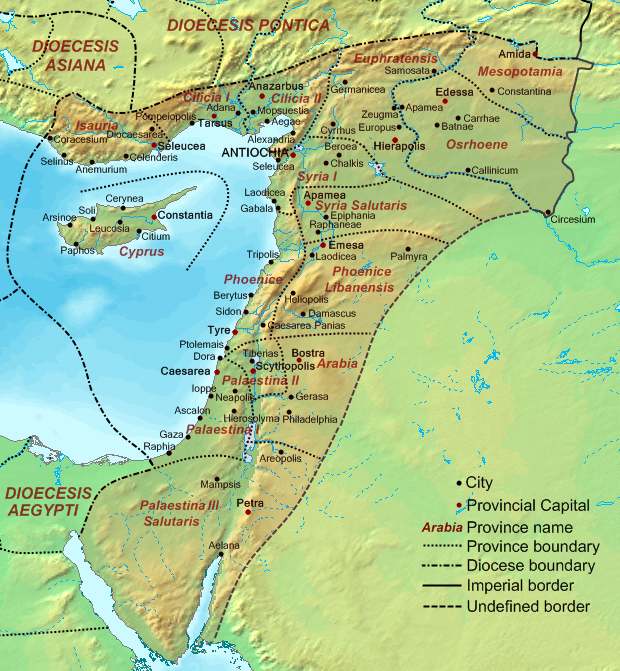
The homeland of the Antiochian Greek Christians, known as the Diocese of the East, was one of the major commercial, agricultural, religious, and intellectual areas of the Roman Empire, and its strategic location facing the Persian Sassanid Empire gave it exceptional military importance. They are either members of the Greek Orthodox Church of Antioch or the Melkite Greek Catholic Church, and they have ancient roots in the Levant; more specifically, the territories of Syria, Lebanon, Jordan and Hatay, which includes the city of Antakya (ancient Antioch). Antiochian Greeks constitute a multi-national group of people and thus construct their identity in relation to specific historical moments. Analyzing cultural identity as a conscious construction is more helpful than a simple labelling of ethnicity, thus the identity is assumed to accentuate the separate origin unique to the Christian Rūm (literally "Eastern Romans") of the Levant. Some members of the community also call themselves Melkite, which means "monarchists" or "supporters of the emperor" (a reference to their past allegiance to Macedonian and Roman imperial rule) although in the modern era, that term tends to be more commonly used by followers of the Melkite Greek Catholic Church.
The Orthodox Christian congregation was included in an ethno-religious community, Rum Millet ("Roman nation"), during the Ottoman Empire. Its name was derived from the former Eastern Roman (Byzantine) subjects of the Ottoman Empire, but all Orthodox Greeks, Bulgarians, Albanians, Aromanians, Megleno-Romanians and Serbs, as well as Georgians and Middle Eastern Christians, were considered part of the same millet in spite of their differences in ethnicity and language. Belonging to this Orthodox commonwealth became more important to the common people than their ethnic origins.
Chaldean
The former Patriarch of the Chaldean Church, Emmanuel III Delly, made the following comment in a 2006 interview:"Any Chaldean who calls himself an Assyrian is a traitor and any Assyrian who calls himself Chaldean is a traitor."The Chaldean Church, which had been part of the Nestorian Church, or Church of the East, until 1552–3, began in earnest to distance itself from the Nestorians who were now seen as the 'uncouth Assyrians'. During this period, many Chaldeans began identifying themselves solely by their religious community, and later as Iraqis, Iraqi Christians, or Arab Christians, rather than with the Assyrian community as a whole. The first split for the two groups came in 431, when they broke away from what was to become the Catholic Church over a theological dispute. The reverberation of religious animosity between these communities still continues today, a testament to the machinations of power politics in the nation-building of the Middle East. The Iraqi Chaldeans positioned themselves deliberately as a religious group within the Arab Iraqi nation. The Arab identity of the state was not only acceptable to them, but was even staunchly endorsed. The Arab nationalism they supported did not discriminate according to religion and was therefore also acceptable to them. Today, due to both forced and accepted Arabization, many Chaldeans identify themselves situationally as Arabs.
The Assyrians form the majority of Christians in Iraq, northeast Syria, south-east Turkey and north-west Iran. They are specifically defined as non-Arab indigenous ethnic group, including by the governments of Iraq, Lebanon, Iran, Syria, Israel, and Turkey.
Culture
_-_A_bag_pipe_orchestra_from_Bethlehem_playing_in_the_streets_of_the_city.jpg)
Christianity in the Middle East represents a large part of the region's diverse culture mosaic. The region includes the oldest Christian monuments in addition to the liturgy and hymns that have spread since the second century AD throughout the region. Translations of the Bible into Arabic are known from the early Christian churches in the Levant, Egypt, Mesopotamia, Malta, the Maghreb, and Al-Andalus. Christians produced hundreds of manuscripts containing portions of the Bible in Arabic. Christian Arabs celebrate various holy days, including the Feast of the Cross, Eid il-Burbara, Christmas, the Feast of St. George, and the Feast of the Prophet Elijah. In Christian traditions, Sergius and Bacchus are considered the patron saints of Arabs.
There are no major cultural differences between Christian Arabs and the general Arab environment. Some differences arise from religious differences, for example, customs and traditions related to marriage or burial. Also, in social events in which the participants are Christians, alcoholic beverages are often served (apart from those denominations that encourage teetotalism), unlike what is prevalent in most Arab societies because Islamic law forbids strong drink. Christian cuisine is similar to other Middle Eastern cuisines; unlike in Jewish cuisine and Islamic cuisines in the region, pork is allowed among Arab Christians, though it is not widely consumed. Male circumcision is near-universal among Christian Arabs, and they practice it shortly after birth as part of a rite of passage, though the practice of circumcision was dropped in the New Testament, meaning that the mainstream Churches do not oblige their followers to do so. In some Eastern Christian denominations, such as Coptic Christianity, male circumcision is an established practice, and require that their male members undergo circumcision shortly after birth as part of a rite of passage.
Demographics
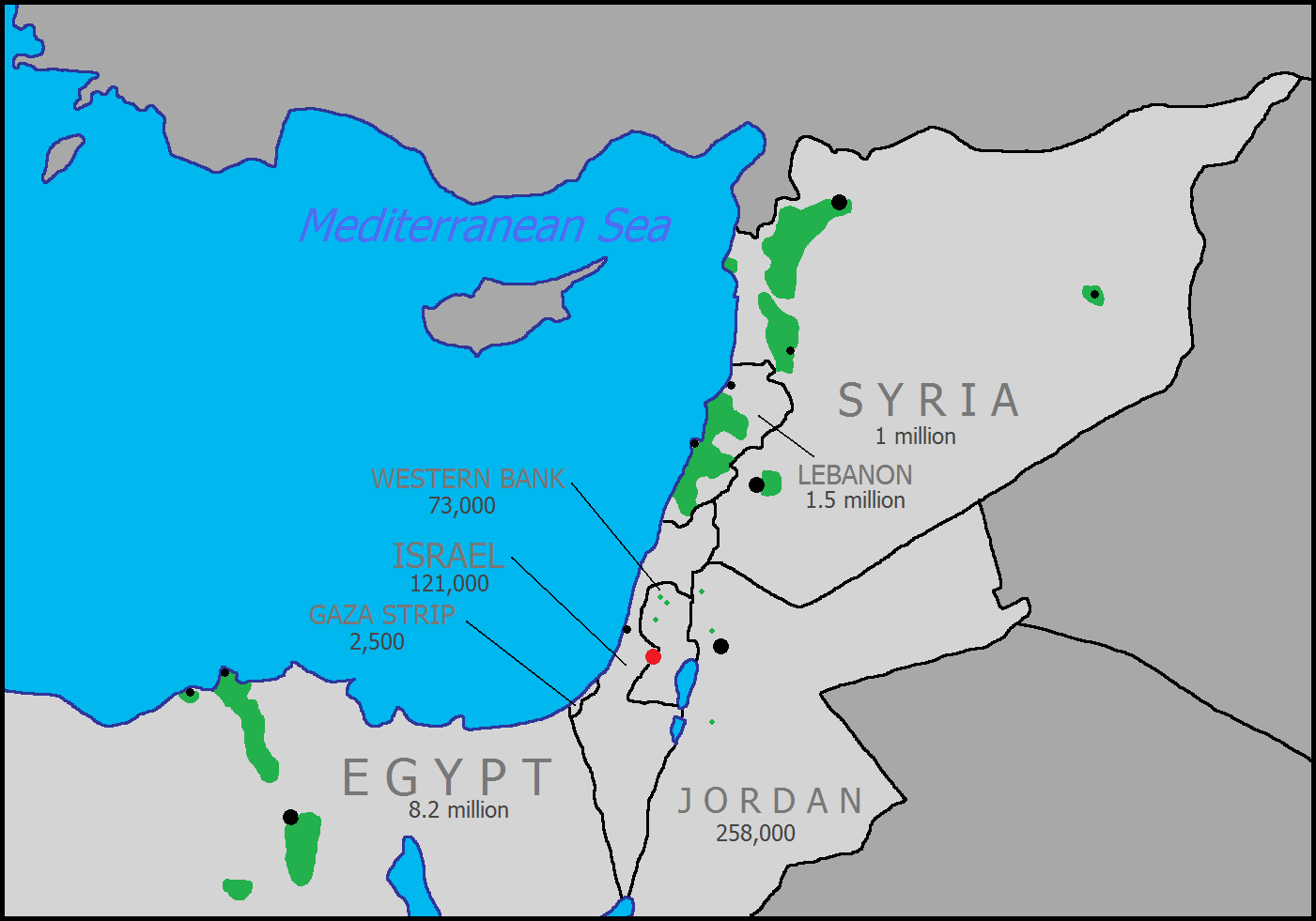
Arab Christian communities can be found throughout the Arab world.
Algeria
Main article: Christianity in Algeria

Christianity came to Algeria in the Roman era, and declined after the arrival of Islam in the 7th century. A notable Berber Christian of Algeria was Saint Augustine and his mother Saint Monica, important saints in Christianity. Prior to independence from France in 1962, Algeria was home to 1.4 million pieds-noirs (ethnic Europeans who were mostly Catholic). Arguably, many more Maghrebi Christians live in France than in North Africa, due to the exodus of the pieds-noirs in the 1960s.
In 2009, the percentage of Christians in Algeria was less than 2%. In this same survey, the United Nations counted 100,000 Catholics and 45,000 Protestants in the country. A 2015 study estimates 380,000 Muslims converted to Christianity in Algeria. Conversions have been most common in the region of Kabylie. Charles de Foucauld was renowned for his missions in Algeria among Muslims, including Arabs.
Bahrain
Main article: Christianity in Bahrain
Native Christians who hold Bahraini citizenship number approximately 1,000. The majority of Christians are originally from Iraq, Palestine and Jordan, with a small minority having lived in Bahrain for many centuries; the majority have been living as Bahraini citizens for less than a century. There are also smaller numbers of native Christians who originally hail from Lebanon, Syria, and India. The majority of Christian Bahraini citizens tend to be Orthodox Christians, with the largest church by membership being the Greek Orthodox Church. They enjoy many equal religious and social freedoms. Bahrain has Christian members in the Bahraini government.
Egypt
Main article: Christianity in Egypt

Since antiquity, there has always been a Levantine presence in Egypt, however they started becoming a distinctive minority in Egypt around the early 18th century. The Syro-Lebanese Christians of Egypt were highly influenced by European culture and established churches, printing houses and businesses across Egypt. Their aggregate wealth was reckoned at one and a half billion francs, 10% of the Egyptian GDP at the end of the 20th century. They took advantage of the Egyptian constitution that established the juridical equality of all citizens and granted the Syro-Lebanese Christians the fullness of civil rights, prior to the Nasser reforms.
Iraq
Main article: Christianity in Iraq

The Arab Christian community in Iraq is relatively small, and further dwindled due to the Iraq War to just several hundred thousand. Most Arab Christians in Iraq belong traditionally to Greek Orthodox and Catholic Churches and are concentrated in major cities such as Baghdad, Basra and Mosul. The vast majority of the remaining 450,000 to 900,000 Christians in Iraq are Assyrians.
Significant persecution of Iraqi Christians in Mosul and other areas held by ISIS occurred from 2014 onwards, with Christian houses identified as "N" for "Nasrani" (Christian).
Israel
Main article: Christianity in Israel
In December 2009, 122,000 Arab Christians lived in Israel, as Arab citizens of Israel, out of a total of 151,700 Christian citizens. According to the Central Bureau of Statistics, on the eve of Christmas 2013, there were approximately 161,000 Christians in Israel, about 2 percent of the general population in Israel. 80% of the Christians are Arab with smaller Christian communities of ethnic Russians, Ukrainians, Greeks, Armenians, and Assyrians. As of 2014 the Melkite Greek Catholic Church was the largest Christian community in Israel, where about 60% of Israeli Christians belonged to the Melkite Greek Catholic Church, while around 30% of Israeli Christians belonged to the Greek Orthodox Church of Jerusalem. The Christian communities in Israel run numerous schools, colleges, hospitals, clinics, orphanages, homes for the elderly, dormitories, family and youth centers, hotels, and guesthouses.[[File:PikiWiki Israel 67507 st. georgs church in lod.jpg|thumb|Christians worshipping the Divine Liturgy [[Church of Saint George and Mosque of Al-Khadr|St George Church]] in the city of [[Lod]]|left]]The city of Nazareth has the largest Arab Christian community in Israel, followed by the cities of Haifa, Jerusalem and Shefa-Amr. The Christian Arab communities in Nazareth and Haifa tend to be wealthier and better educated than Arabs elsewhere in Israel. Christians live in a number of other towns in Galilee either singly or mixed with Muslims and Druze, such as Abu Snan, Arraba, Bi'ina, Daliyat al-Karmel, Deir Hanna, Eilabun, Hurfeish, I'billin, Isfiya, Jadeidi-Makr, Jish, Kafr Kanna, Kafr Yasif, Kisra-Sumei, Maghar, Mazra'a, Muqeible, Peki'in, Rameh, Ras al-Ein, Reineh, Sakhnin, Shefa-Amr, Tur'an, Yafa an-Naseriyye and others have a presence of Arab Christian communities too as do other mixed cities, especially Jerusalem and Tel Aviv-Jaffa, Ramleh, Lod, Acre, Nof HaGalil, and Ma'alot Tarshiha. It is reported that all the inhabitants of Fassuta and Mi'ilya are Melkite Christians.[[File:Arab-Christian wedding.jpg|thumb|Arab Christian wedding in [[Galilee]]]] Arab Christians are one of the most educated groups in Israel. Maariv has described the Christian Arab sectors as "the most successful in the education system". Statistically, Christian Arabs in Israel have the highest rates of educational attainment among all religious communities. According to a data by Israel Central Bureau of Statistics in 2010, 63% of Israeli Christian Arabs have had college or postgraduate education, the highest of any religious and ethno-religious group. Christian Arabs also have one of the highest rates of success in the matriculation examinations per capita, (73.9%) in 2016 both in comparison to Muslims, Druze, Jews and all students in the Israeli education system as a group. Arab Christians were also the vanguard in terms of eligibility for higher education. They have attained a bachelor's degree and academic degree more than Jewish, Muslims and Druze per capita. The rate of students studying in the field of medicine was also higher among the Christian Arab students, compared with all the students from other sectors. Despite the fact that Arab Christians only represent 2.1% of the total Israeli population, in 2014 they accounted for 17.0% of the country's university students, and for 14.4% of its college students. Socio-economically, Arab Christians are closer to the Jewish population than to the Muslim population. They have the lowest incidence of poverty and the lowest percentage of unemployment which is 4.9% compared to 6.5% among Jewish men and women. They have also the highest median household income among Arab citizens of Israel and second highest median household income among the Israeli ethno-religious groups. According to study the majority of Christians in Israel (68.2 per cent) are employed in the service sector, i.e. banks, insurance companies, schools, tourism, hospitals etc. Among Arab Christians in Israel, some emphasize pan-Arabism, whilst a small minority enlists in the Israel Defense Forces.
Jordan
Main article: Christianity in Jordan

Jordan contains some of the oldest Christian communities in the world, their presence dating back to the first century AD. Today, Christians make up about 4% of the population, down from 20% in 1930. This is due to high immigration rates of Muslims into Jordan, higher emigration rates of Christians to the west and higher birth rates for Muslims. Christians in Jordan are exceptionally well integrated in the Jordanian society and enjoy a high level of freedom. Christians are allotted nine out of a total of 130 seats in the Parliament of Jordan, and also hold important ministerial portfolios, ambassadorial appointments, and positions of high military rank. All Christian religious ceremonies are publicly celebrated in Jordan.
Jordanian Arab Christians (some have Palestinian roots since 1948) number around 221,000, according to a 2014 estimate by the Orthodox Church. The study excluded minority Christian groups and the thousands of western, Iraqi and Syrian Christians residing in Jordan. Another estimate suggests the Orthodox number 125–300,000, Catholics at 114,000 and Protestants at 30,000 for a total 270–450,000. Most native Christians in Jordan identify themselves as Arab, though there are also significant Assyrian and Armenian populations in the country. There has also been an influx of Christian refugees escaping Daesh, mainly from Mosul, Iraq, numbering about 7000 and 20,000 from Syria. King Abdullah II of Jordan has made firm statements about Arab Christians:"Let me say once again: Arab Christians are an integral part of my region's past, present, and future."
Kuwait
Main article: Christianity in Kuwait
Kuwait's native Christian population exists, though is essentially small. There are between 259 and 400 Christian Kuwaiti citizens. Christian Kuwaitis can be divided into two groups. The first group includes the earliest Kuwaiti Christians, who originated from Iraq and Turkey. They have assimilated into Kuwaiti society, like their Muslim counterparts, and tend to speak Arabic with a Kuwaiti dialect; their food and culture are also predominantly Kuwaiti. They makeup roughly a quarter of Kuwait's Christian population. The rest (roughly three-quarters) of Christian Kuwaitis make up the second group. They are more recent arrivals in the 1950s and 1960s, mostly Kuwaitis of Palestinian ancestry who were forced out of Palestine after 1948. There are also smaller numbers who originally hail from Syria and Lebanon. This second group is not as assimilated as the first group, as their food, culture, and Arabic dialect still retain a Levant feel. However, they are just as patriotic as the former group, and tend to be proud of their adopted homeland, with many serving in the army, police, civil, and foreign service. Most of Kuwait's citizen Christians belong to 12 large families, with the Shammas (from Turkey) and the Shuhaibar (from Palestine) families being some of the more prominent ones.
Lebanon
Main article: Christianity in Lebanon

Lebanon holds the largest number of Christians in the Arab world proportionally and falls just behind Egypt in absolute numbers. About 350,000-450,000 of Christians in Lebanon are Orthodox and Melkites, while the most dominant group are Maronites with about 1 million population, whose Arab identity is contentiously disputed. Lebanese Christians are the only Christians in the Middle East with a sizable political role in the country. In accordance with the National Pact, the President of Lebanon must be a Maronite Christian, the Deputy Speaker of the Parliament and Deputy Prime Minister a Greek Orthodox Christian and Melkites and Protestants have nine reserved seats in the Parliament of Lebanon. The Maronites and the Druze founded modern Lebanon in the early eighteenth century, through the ruling and social system known as the "Maronite-Druze dualism" in Mount Lebanon Mutasarrifate.
Christians constituted 60% of the population of Lebanon in 1932. The exact number of Christians in modern Lebanon is uncertain because no official census has been made in Lebanon since 1932. Lebanese Christians belong mostly to the Maronite and Greek Orthodox Churches, with sizable minorities belonging to the Melkite Greek Catholic Church and Armenian Apostolic Church. The community of Armenians in Lebanon is politically and demographically significant.
Libya
Morocco
Main article: Christianity in Morocco
Christianity in Morocco appeared during the Roman times, when it was practiced by Christian Berbers in Roman Mauretania Tingitana, although it disappeared after the Islamic conquests. Morocco was home to half a million Christian Europeans (mostly of Spanish and French ancestry) prior to Moroccan independence. The U.S. State Department estimates the number of Arab and Berber Christians in Morocco as more than 40,000. Pew-Templeton estimates the number of Moroccan Christians at 20,000. The number of the Moroccans who converted to Christianity (most of them secret worshippers) are estimated between 8,000 and 50,000.
Oman
Main article: Christianity in Oman
Palestine
Main article: Christianity in Palestine

Most of the Palestinian Christians claim descent from the first Christian converts, Arameans, Ghassanid Arabs and Greeks who settled in the region. Between 36,000 and 50,000 Christians live in Palestine, most of whom belong to the Orthodox (Including Greek, Syriac and Armenian Orthodox), Catholic (Roman and Melchite) churches and Evangelical communities. The majority of Palestinian Christians live in the Bethlehem and Ramallah areas with a less number in other places. In 2007, just before the Hamas takeover of Gaza, there were 3,200 Christians living in the Gaza Strip. Half the Christian community in Gaza fled to the West Bank and abroad after the Hamas take-over in 2007. However, Palestinian Christians in Gaza face restrictions on their freedom of movement by the Israeli blockade, which has been cited as one of the reasons contributing to their dwindling numbers.[[File:Christians from Gaza.jpg|alt=|thumb|Christians from [[Gaza Strip|Gaza]]]] Many Palestinian Christians hold high-ranking positions in Palestinian society, particularly at the political and social levels. They manage the high ranking schools, universities, cultural centers and hospitals, however, Christian communities in the Palestinian Authority and the Gaza Strip have greatly dwindled over the last two decades. The causes of the Palestinian Christian exodus are widely debated and it started since the Ottoman times. Reuters reports that many Palestinian Christians emigrate in pursuit of better living standards. The Vatican saw the Israeli occupation and the general conflict in the Holy Land as the principal reasons for the Christian exodus from the territories. The decline of the Christian community in Palestine follows the trend of Christian emigration from the Muslim-dominated Middle East. Some churches have attempted to ameliorate the rate of emigration of young Christians by building subsidized housing for them and expanding efforts at job training.
Saudi Arabia
Main article: Christianity in Saudi Arabia}}[[Jubail Church]] is a 4th-century church building near [[Jubail]].{{Cite book, [crypto-Christians]]. Some [[Arabian tribes]], such as [[Banu Taghlib]] and [[Banu Tamim]], followed Christianity.{{Cite web](crypto-christians-some-arabian-tribes-such-as-banu-taghlib-and-banu-tamim-followed-christianity-ref-cite-web)
Today, Saudi Arabia's Arab Christian population consists mostly of Lebanese and Syrians living in diaspora.
Sudan
There were approximately 1.1 million Catholics in Sudan, about 3.2 percent of the total population. Sudan forms one ecclesiastical province, consisting of one archdiocese (the Archdiocese of Khartoum) and one suffragan diocese (the Diocese of El Obeid). The vast majority of Sudan's Catholics ended up in South Sudan after the partition.
Syria
Main article: Christianity in Syria
The Arab Christians of Syria are predominantly Rūm-Orthodox and Melkite-Catholic, with some Roman-Catholics. Non-Arab Syrian Christians include Assyrians (also known as Chaldeans or Syriacs), Greeks and Armenians. Assyrian refugees fled to Syria after the massacres in Turkey and Iraq during World War I, also known as Sayfo in Syriac-Aramaic, and later after the events in Iraq in 2003. Due to the Syrian civil war, a large number of Christians fled the country to Lebanon, Jordan, and Europe. However, a significant portion of the population still resides in Syria, with some being internally displaced. Many Arab Christian militias fought in the Syrian civil war, including the Khabur Guards and the pro-Assad Guardians of the Dawn. Western Aramaic is spoken by Christian and Muslim Arameans (or Syriacs) alike in remote villages in the Qalamoun mountains, including Maaloula, Jubb'adin and Bakh'a.
.jpeg)
The largest Christian denomination in Syria is the Greek-Orthodox Church, primarily consisting of Arab Christians, followed by the Syriac-Orthodox Church, whose followers often identify as Assyrian or Syriac. The combined population of Syria and Lebanon in 1910 was estimated at 30% in a population of 3.5 million. According to the 1960 census in Syria which recorded just over 4.5 million inhabitants, Christians formed just under 15% of the population (or 675,000). Since 1960 the population of Syria has increased five-fold, but the Christian population only 3.5 times. Due to political reasons, no newer census has been taken since. Most recent estimates prior to the Syrian civil war suggested that overall Christians were about 10% of the overall population of Syrian 23 million citizens, due to having lower birth rates and higher emigration rates than their Muslim compatriots.
Although religious freedom is allowed in the Syrian Arab Republic, all citizens of Syria including Christians, are subject to the Shari'a-based personal status laws regulating child custody, inheritance, and adoption. For example, in the case of divorce, a woman loses the right to custody of her sons when they reach the age of thirteen and her daughters when they reach the age of fifteen, regardless of religion. Since the fall of the Assad regime, the situation has deteriorated further, with Christians facing increased persecution by armed Islamist groups and constitutional changes affecting their rights.
Tunisia
Main article: Christianity in Tunisia

Christianity came in Tunisia during Roman rule. However, after the arrival of Islam, the population of Christians decreased in the country. Prior to Tunisian independence, Tunisia was home to 255,000 Christian Europeans (mostly of Italian and Maltese ancestry). The International Religious Freedom Report of 2007 reported that the Christian community numbered 50,000 people, 20,000 of whom were Catholics. In the Annuario Pontificio of 2018, the number of Catholics is estimated to have risen to 30,700. However, the number of Tunisian Christians is estimated to be around 23,500.
The Catholic Church in Tunisia operates 12 churches, nine schools and several libraries throughout the country. In addition to holding religious services, the Catholic Church opened a monastery, freely organized cultural activities, and performed charitable work throughout Tunisia. According to church leaders, there are 2,000 practicing Protestant Christians, most of them are Tunisians who converted to Christianity. There is also a small community of Jehovah's Witnesses numbering around 50, only half of which identify as Arab.
Turkey
Main article: Christianity in Turkey

Today, there are between 120,000 and 320,000 people of various Christian denominations in Turkey. Antiochian Greek Christians (or Melkites) who mostly live in Hatay Province, are one of the Arabic-speaking communities in Turkey and number approximately 18,000. They are often Rūm-Orthodox, but are sometimes known as "Arab Christians" due to their culture and heritage. Antioch, the capital of Hatay Province, is also the historical center of both the Greek Orthodox Church and Syriac Orthodox Church. Turkey is also home to several non-Arab native minorities, such as Armenians (around 70,000), Greeks (or Hellenes) (around 5,000) and Assyrians in the southeast (around 25,000). The village of Tokaçlı in Altınözü District has an entirely Arab Christian population and is one of the few Christian villages in Turkey.
Yemen
Main article: Christianity in Yemen}}Christianity was a widespread religion on the territory of contemporary Yemen as early as the sixth century, before the arrival of [[Islam in Yemen]].{{Cite web, [Yemeni Civil War]].{{Cite web](yemeni-civil-war-ref-cite-web)
Notes
References
Bibliography
- Seth J. Frantzman, The Strength and the Weakness: The Arab Christians in Mandatory Palestine and the 1948 War, unpublished M.A thesis at The Hebrew University of Jerusalem.
- Itamar Katz and Ruth Kark, 'The Greek Orthodox Patriarchate of Jerusalem and its congregation: dissent over real estate' in The International Journal of Middle East Studies, Vol. 37, 2005.
References
- (2012). "Christians in the Middle East – Past, Present and Future". Transformation: An International Journal of Holistic Mission Studies.
- (22 February 2014). "Minority Rights Group International : Lebanon : Lebanon Overview".
- "Abouna.org : الأب د. حنا كلداني: نسبة الأردنيين المسيحيين المقيمين 3.68% - انفوجرافيك".
- (18 November 2022). "Report: Number of Christians in Syria Dropped from 1.5 Million to 300,000".).
- al-Salem, Majd. (22 June 2023). "Emigration empties Qamishli of its Christian people". Enab Baladi.
- Teague, Ellen. (6 February 2025). "Syrian Christians face 'new era full of mysteries', says archbishop". The Tablet Publishing Company.
- Taheri, Mandy. (2025-03-10). "Hundreds of minorities, including Christians, killed in Syria—Reports".
- (23 April 2013). "Syria's beleaguered Christians". BBC News.
- "CBS data on Christian population in Israel (2016)". Cbs.gov.il.
- (9 October 2019). "Sudan's Copts See Hope in Appointment of First Christian".
excluding 1,500,000 [[Assyrian people. Assyrians]]see #Chaldeans, #Assyrians below- Chehata, Hanan. (22 March 2016). "The plight and flight of Palestinian Christians". Middle East Monitor.
- (2015). "Believers in Christ from a Muslim Background: A Global Census". Interdisciplinary Journal of Research on Religion.
- (23 March 2015). "'House-Churches' and Silent Masses —The Converted Christians of Morocco Are Praying in Secret". Vice.
- "Morocco: No more hiding for Christians".
- "Tunisia – Open Doors USA – Open Doors USA".
- Bundeszentrale für politische Bildung. (12 June 2008). "Christen in der islamischen Welt".
- (9 May 2009). "Christians of the Middle East – Country by Country Facts and Figures on Christians of the Middle East". Middleeast.about.com.
- (8 November 2017). "Orthodox Christianity in the 21st Century". Pew Research Center's Religion & Public Life Project.
- "BBC – Religions – Christianity: Coptic Orthodox Church".
- "Believers in Christ from a Muslim Background: A Global Census".
- "Bahraini Census 2010 - تعداد السكــان العام للبحريــن 2010".
- (2015). "Believers in Christ from a Muslim Background: a global census". IJRR.
- "التقارير الإحصائية".
- (2011). "Influences of history, geography, and religion on genetic structure: the Maronites in Lebanon". European Journal of Human Genetics.
- [[Syrians#CITEREFHaberGauguierYouhannaPatterson2013. Haber et al. 2013]]. Quote:1-"We show that religious affiliation had a strong impact on the genomes of the Levantines. In particular, conversion of the region's populations to Islam appears to have introduced major rearrangements in populations' relations through admixture with culturally similar but geographically remote populations, leading to genetic similarities between remarkably distant populations like Jordanians, Moroccans, and Yemenis. Conversely, other populations, like '''Christians and Druze, became genetically isolated in the new cultural environment.''' We reconstructed the genetic structure of the Levantines and found that a pre-Islamic expansion Levant was more genetically similar to Europeans than to Middle Easterners."
2-"The predominantly Muslim populations of Syrians, Palestinians and Jordanians cluster on branches with other Muslim populations as distant as Morocco and Yemen."
3-Lebanese Christians and all Druze cluster together, and Lebanese Muslims are extended towards Syrians, Palestinians, and Jordanians, which are close to Saudis and Bedouins." - Ellis, K.C.. (2018). "Secular Nationalism and Citizenship in Muslim Countries: Arab Christians in the Levant". Springer International Publishing.
- Pacini, Andrea. (1998). "Christian Communities in the Arab Middle East: The Challenge of the Future". Clarendon Press.
- C. Ellis, Kail. (2004). "Nostra Aetate, Non-Christian Religions, and Interfaith Relations". Springer Nature.
- Hourani, Albert. (1983). "Arabic Thought in the Liberal Age, 1798–1939". Cambridge University Press.
- Prioreschi, Plinio. (1 January 2001). "A History of Medicine: Byzantine and Islamic medicine". Horatius Press.
- Ira M. Lapidus, ''Islamic Societies to the Nineteenth Century: A Global History'', (Cambridge University Press, 2012), 200.
- Curtis, Michael. (2017). "Jews, Antisemitism, and the Middle East". Routledge.
- "Demographics". Arab American Institute.
- Khalil, Magdy. "Reactions in the Egyptian Press To a Lecture Delivered by a Coptic Bishop in Hudson Institute".
- (12 June 2010). "Phoenician or Arab? A never-ending debate in Lebanon". Independent.
- ''Cambridge history of Christianity'', pp.197
- Khoury, George. (22 January 1997). "The Origins of Middle Eastern Arab Christianity". melkite.com.
- النصرانية وآدابها، مرجع سابق، ص.161
- النصرانية وآدابها بين عرب الجاهلية، الأب لويس شيخو، المطبعة الكاثوليكية، بيروت 1922، ص.332
- Parry, Ken. (1999). "The Blackwell Dictionary of Eastern Christianity". Blackwell Publishing.
- النصرانية وآدابها، مرجع سابق، ص.24
- النصرانية وآدابها، مرجع سابق، ص.41
- النصرانية وآدابها، مرجع سابق، ص.26
- Ball, 2001, pp. 100-101.
- Jensen, 1996, pp. 73-75.
- النصرانية وآدابها، مرجع سابق، ص.104
- النصرانية وآدابها، مرجع سابق، ص.105
- Al-Masudi “[[Murūj al-dhahab wa-maʻādin al-jawhar. Murūj al-dhahab]]”
- النصرانية وآدابها، مرجع سابق، ص.30
- Shahîd, Irfan. (1989). "Byzantium and the Arabs in the Fifth Century". Dumbarton Oaks.
- النصرانية وآدابها، مرجع سابق، ص.40
- النصرانية وآدابها، مرجع سابق، ص.49
- (1913). "The Catholic Encyclopedia: An International Work of Reference on the Constitution, Doctrine, Discipline, and History of the Catholic Church". Catholic Encyclopedia Incorporated.
- النصرانية وآدابها، مرجع سابق، ص.60
- Al-ʻAsalī, Khālid Sālih. (July 1968). "South Arabia in the 5th and 6th centuries C.E. with reference to relations with Central Arabia". University of St Andrews.
- النصرانية وآدابها، مرجع سابق، ص.64
- النصرانية وآدابها، مرجع سابق، ص.65
- Stated in the book “''The Genealogy of the Arabs''” by Salama bin Muslim
- Philip K. Hitti, History of the Arabs, 6th ed. (Macmillan and St. Martin's Press, 1967), pp. 78–84 (on the Ghassanids and Lakhmids) and pp. 87–108 (on Yemen and the Hijaz).
- Such as [[Al-Tarikh al-Kabir. the History]] of Al-Masoudi and the biography of the Messenger by [[Ibn Hisham]]
- النصرانية وآدابها، مرجع سابق، ص.53
- النصرانية وآدابها، مرجع سابق، ص.56
- النصرانية وآدابها، مرجع سابق، ص.59
- النصرانية وآدابها، مرجع سابق، ص.78
- النصرانية وآدابها، مرجع سابق، ص.98
- سيّما ما ورد في [[Al-Ma'idah. سورة المائدة]]: ﴿وَاتخِذُونِي وَأمِي إلَهَيْنْ﴾ ، النصرانية وآدابها، مرجع سابق، ص.113
- المسيحية العربية وتطوراتها، مرجع سابق، ص.85
- النصرانية وآدابها، مرجع سابق، ص.116
- النصرانية وآدابها، مرجع سابق، ص.117
- النصرانية وآدابها، مرجع سابق، ص.120
- Grmek, Mirko D.; Fantini, Bernardino (1998). Western Medical Thought from Antiquity to the Middle Ages. Harvard University Press. p. 145.:"Hunayn ibn Ishaq was able to satisfy their needs. Of Christian Arab descent, he had spent many years of his life in Byzantine territory, in pursuit of his studies, most probably in Constantinople."
- (15 March 2014). "The Orthodox Church in the Arab World, 700–1700: An Anthology of Sources". Cornell University Press.
- Sabet, Amr (2006), ''The American Journal of Islamic Social Sciences'' 24:4, Oxford; page 99–100
- Khadduri, Majid (2010). ''War and Peace in the Law of Islam'', Johns Hopkins University Press; pages 162–224; {{ISBN. 978-1-58477-695-6
- Ali, Abdullah Yusuf (1991). The Holy Quran. Medina: King Fahd Holy Qur-an Printing Complex.
- [[John Esposito. John Louis Esposito]], ''Islam the Straight Path'', Oxford University Press, 15 January 1998, p. 34.
- Lewis (1984), pp. 10, 20
- George, Timothy. (2002). "Is the Father of Jesus the God of Muhammad?: understanding the differences between Christianity and Islam". Zondervan.
- (1977). "The Cambridge history of Islam". University Press.
- Willis Barnstone, Marvin Meyer ''The Gnostic Bible: Revised and Expanded Edition'' Shambhala Publications 2009 {{ISBN. 978-0-8348-2414-0 page 531
- Hill, Donald. ''Islamic Science and Engineering''. 1993. Edinburgh Univ. Press. {{ISBN. 0-7486-0455-3, p.4
- Rémi Brague, [http://www.christiansofiraq.com/assyriancontributionstotheislamiccivilization.htm Assyrians contributions to the Islamic civilization] {{Webarchive. link. (2013-09-27)
- Brague, Rémi. (2009). "The Legend of the Middle Ages: Philosophical Explorations of Medieval Christianity, Judaism, and Islam". University of Chicago Press.
- (15 June 2009). "Pope to Arab Christians: Keep the Faith". HuffPost.
- Radai, Itamar. (2008). "The collapse of the Palestinian-Arab middle class in 1948: The case of Qatamon". Middle Eastern Studies.
- Gran, Peter. (January 2002). "Tahtawi in Paris". Al-Ahram Weekly Online.
- Boueiz Kanaan, Claude. "Lebanon 1860–1960: A Century of Myth and Politics". la University of Michigan.
- Lattouf, 2004, p. 70
- Teague, Michael. (2010). "The New Christian Question". Al Jadid Magazine.
- محطات مارونية من تاريخ لبنان، مرجع سابق، ص.185
- Moubayed, Sami M.. (2006). "Steel & Silk: Men and Women who Shaped Syria 1900–2000". Cune Press.
- (1851). "The Reformed Presbyterian and Covenanter".
- Lutsky, Vladimir Borisovich. (1969). "Modern History of the Arab Countries". Progress Publishers.
- "Maalouf (2003)".
- Priestley, Herbert Ingram. (1938). "France Overseas: A Study Of Modern Imperialism, 1938". Octagon Books.
- "Commander of the Faithful: The Life and Times of Emir Abd el-Kader, A Story of True Jihad {{!}} Middle East Policy Council".
- (14 April 2015). "Lebanon's dark days of hunger: The Great Famine of 1915–18". The National.
- (26 November 2014). "Six unexpected WW1 battlegrounds". BBC.
- (18 April 2015). "Le centenaire de la Grande famine au Liban : pour ne jamais oublier".
- (22 April 2018). "The Syrian Social Nationalist Party's (SSNP) Expansion in Syria – By Jesse McDonald".
- Buzpinar, Ş. Tufan. (1996). "Opposition to the Ottoman Caliphate in the Early Years of Abdülhamid II: 1877-1882". Brill.
- Steppat, Fritz. (1969). "Eine Bewegung unter den Notabeln Syriens 1877-1878: Neues Licht auf die Entstehung des Arabischen Nationalismus". Deutsche Morgenländische Gesellschaft; F. Steiner Verlag.
- (2003). "War and Peace in Sudan: A Tale of Two Countries". Routledge.
- Aflaq, Michel. (1977). "Choice of Texts from the Baʻth Party Founder's Thought". Unity Freedom Socialism.
- (1973). "Asian and African Studies". Jerusalem Academic Press.
- Segev, Tom. (2000). "One Palestine, complete : Jews and Arabs under the Mandate". New York : Metropolitan Books.
- Antonius, George. (1939). "The Arab awakening : the story of the Arab national movement". J.B. Lippincott.
- "Lebanon: Hizbullah, a progressive Islamic party? – Interview with Joseph Alagha".
- (2014-01-14). "Three Decades of Peace Education around the World: An Anthology". Routledge.
- (17 May 2006). "About".
- "Ludington Daily News – Google News Archive Search".
- Bardi, Ariel Sophia. (2016). "The "Architectural Cleansing" of Palestine". American Anthropologist.
- (2003). "War and Peace in Sudan: A Tale of Two Countries". Routledge.
- "World Directory of Minorities and Indigenous Peoples – Lebanon".
- (25 September 2019). "A Church at War: Clergy & Politics in Wartime Lebanon (1975–82)".
- "World Directory of Minorities and Indigenous Peoples – Lebanon".
- "Syria: The situation of Christians, including whether Christians are perceived to be loyal to President Assad; treatment of Christians by the regime and the opposition forces, including incidents of violence against them; state protection (2013 – July 2015)".
- Sherlock, Ruth. "How The Free Syrian Army Became A Largely Criminal Enterprise".
- "British intelligence suggests al-Nusra start cooperating with West – diplomatic source".
- (2006). "The Cambridge History of Christianity: Volume 5, Eastern Christianity". Cambridge University Press.
- McHugo, John. (2013). "A Concise History of the Arabs". New Press.
- C. Ellis, Kail. (2004). "Nostra Aetate, Non-Christian Religions, and Interfaith Relations". Springer Nature.
- al-Jallad & Martin F. J. Baasten. (2017). "Arabic in Context: Celebrating 400 Years of Arabic in Leiden University". Studies in Semitic Languages and Linguistics, Volume: 89.
- Nashef, 2002, p. 13.
- Suleiman Mousa: Simplified Biography in English, by Yazan Suheil Mousa
- "Renowned Syrian Novelist Hanna Mina Dies at 94".
- Braude, Joseph. (2017). "Broadcasting Change: Arabic Media as a Catalyst for Liberalism". Rowman & Littlefield.
- Merrill, A. Fisher, John Calhoun, Harold. "The world's great dailies: profiles of fifty newspapers". la University of Michigan.
- Regan, Bernard. (30 October 2018). "The Balfour Declaration: Empire, the Mandate and Resistance in Palestine". Verso Books.
- (8 June 2012). "Veteran Lebanese journalist Ghassan Tueni dies". BBC News.
- "Mapping Digital Media: Lebanon".
- (21 November 2016). "Eight reasons why Fairouz is the greatest Arab diva of all time".
- "Arab Christian celebrities attacked for celebrating Easter by extremist trolls!".
- (14 December 2020). "Canaanite Lydia".
- Starr, Stephen. (2012). "Revolt in Syria: Eye-witness to the Uprising". Hurst.
- الجهنى, على بن مناور بن ردة. (2020). "الخطاب الدينى الواجب اليوم". مجلة البحث العلمي الاسلامي.
- "Fadi Andraos biography".
- eliefares. (24 March 2013). "Lebanese Lina Makhoul Wins The Voice Israel".
- (23 September 2015). "Lebanese Republic".
- Oualalou, Lamia. (1 July 2017). "Being Arab in Latin America".
- "Arab Americans - Demographics". [[Arab American Institute]].
- (2006). "Arab Americans: Demographics". Arab American Institute.
- "Syro-Lebanese Migration (1880–Present): "Push" and "Pull" Factors".
- "Emigration and Power A Study of Sects in Lebanon, 1860–2010".
- Fahrenthold, Stacy. (2014). "Making Nations, in the Mahjar: Syrian and Lebanese Long-distance Nationalisms in New York City, São Paulo, and Buenos Aires, 1913–1929". Northeastern University.
- (22 December 2016). "Arabic Thought beyond the Liberal Age: Towards an Intellectual History of the Nahda". Cambridge University Press.
- (2002). "A community of many worlds : Arab Americans in New York City". New York : Museum of the City of New York; Syracuse : Syracuse University Press.
- Moreh, Shmuel. (1 January 1976). "Modern Arabic Poetry: 1800–1970; the Development of Its Forms and Themes Under the Influence of Western Literature". Brill Archive.
- Starkey, Paul. (2006). "Modern Arabic literature". [[Edinburgh University Press]].
- Estevez, Dolia. (19 November 2013). "Mexican Billionaire Carlos Slim Is Quietly Transferring Assets To His Children". Forbes.
- Cadwalladr, Carole. (24 November 2012). "Nassim Taleb: my rules for life". [[The Guardian]].
- "Michael E. DeBakey, M.D.".
- Dilger, Daniel Eran. (May 11, 2017). "iPod-Father Tony Fadell speaks at Computer History Museum's iPhone 360".
- "ATIYAH, Sir Michael (Francis)".
- [http://nobelprize.org/chemistry/laureates/1990/corey-autobio.html Elias James Corey – Autobiography] {{webarchive. link. (6 July 2008. nobelprize.org)
- (12 April 1984). "Sir Peter Medawar". [[New Scientist]].
- Manuel, Diana E.. (2002). "Van Nostrand's Scientific Encyclopedia". [[John Wiley & Sons]].
- "Florida Supreme Court Historical Society – 2014 – Judge Rosemary Barkett".
- (18 March 2013). "Arab Christians in British Mandate Palestine: Communalism and Nationalism, 1917-1948". Edinburgh University Press.
- "Coptic Christianity in Egypt".
- Matt Rehbein. (10 April 2017). "Who are Egypt's Coptic Christians?".
- (2009). "The A to Z of the Coptic Church". Scarecrow Press.
- (2017). "Christianity and Monasticism in Northern Egypt: Beni Suef, Giza, Cairo, and the Nile Delta". Oxford University Press.
- "BBC – Religions – Christianity: Coptic Orthodox Church".
- "Aspects of Christian-Muslim Relations in Contemporary Lebanon".
- (2017-07-27). "Living Descendants of Biblical Canaanites Identified Via DNA".
- Svetlova, Ksenia. (12 October 2012). "Maronite Christians Seek To Revive Aramaic Language". The Forward.
- "البطريركية المارونية – بكركي".
- (12 May 2016). "Maronite liturgy draws from Eastern and Western traditions".
- (15 March 2010). "Maronite Church".
- "X. János lett az új, ortodox antiókiai pátriárka".
- (2010). "AUTHENTIC ARABS, AUTHENTIC CHRISTIANS: ANTIOCHIAN ORTHODOX AND THE MOBILIZATION OF CULTURAL IDENTITY". The University of Michigan.
- Oueis, Hadeel. (3 April 2022). "The Levantine Greeks: The Hellenic Republic should Recognize its Forgotten Greeks in Syria and other countries". Hellas Journal.
- Demeter, Daniel. (16 July 2014). "Damascus – al-Mariyamiyeh Church دمشق – كنيسة المريمية".
- "Greek Orthodox Patriarchate of Antioch and All the East".
- "CNEWA – The Syrian Orthodox Church".
- (January 1961). "Syrian Orthodox Patriarchate of Antioch and All the East – World Council of Churches".
- "The SYRIAN ORTHODOX CHURCH OF ANTIOCH".
- "Syriac Orthodox Church of Antioch {{!}} Encyclopedia.com".
- [https://core.ac.uk/download/pdf/56704913.pdf Donabed & Mako 2009], p. 90.
- (27 August 2017). "Holy Qurobo – St. George Patriarchal Cathedral – Damascus".
- "Syrian Orthodox Patriarchate of Antioch".
- Roberson, Ronald G.. "The Eastern Catholic Churches 2017". Catholic Near East Welfare Association.
- Al-Tamimi, Aymenn Jawad. (5 January 2012). "Identity Among Middle East Christians".
- "Aspects of Christian-Muslim Relations in Contemporary Lebanon".
- "Cathédrale patriarchale Notre-Dame de la Dormition".
- "Melkite Parish – Melkite UK".
- "Melkite :: Splash".
- (19 June 2015). "Chaldeans".
- "Chaldean Church of Mary Mother of Sorrows".
- (15 March 2010). "Chaldean Catholic Church".
- "البطريركية الكلدانية".
- (January 1948). "Greek Orthodox Patriarchate of Alexandria and All Africa — World Council of Churches".
- "President Lauds Orthodox faith on 100 Years {{!}} Uganda Media Centre".
- (2018). "Social relations between the Christian communities of Alexandria: Re-examining social boundaries in times of decline". Égypte/Monde arabe.
- "-- [ Greek Orthodox ] --".
- (January 1948). "Greek Orthodox Patriarchate of Alexandria and All Africa".
- [http://www.cnewa.org/source-images/Roberson-eastcath-statistics/eastcatholic-stat17.pdf The Eastern Catholic Churches 2017]{{Webarchive. link. (24 October 2018 Retrieved December 2010. Information sourced from 'Annuario Pontificio' 2017 edition.)
- "Holy Apostolic Catholic Assyrian Church of the East".
- "Syriac Catholic Church identity – Chwiliwch Google".
- "Diana Darke, Syria. Bradt Travel Guides, 2006. S. 91. The Christian quarter: Syrian Catholic Cathedral of Mar Paulus".
- "Syriac Catholic Patriarchate Official Website".
- (9 April 2017). "Who are Egypt's Coptic Christians and why are they persecuted?".
- "Palestinian Christians in the Holy Land".
- Vatikiotis, P. J.. (1994). "The Greek Orthodox Patriarchate of Jerusalem between Hellenism and Arabism". Middle Eastern Studies.
- "Church of the Holy Sepulchre".
- "CATHOLIC ENCYCLOPEDIA: Holy Sepulchre".
- "Αρχική".
- Baumer, Christoph. (28 April 2006). "The Church of the East: An Illustrated History of Assyrian Christianity". Bloomsbury Academic.
- (18 September 2011). "Phoenician or Arab? A never-ending debate in Lebanon".
- Papastathis, Konstantinos. (26 February 2020). "Arabic vs. Greek: the Linguistic Aspect of the Jerusalem Orthodox Church Controversy in Late Ottoman Times and the British Mandate". Brill.
- "Issa al Issa's Unorthodox Orthodoxy:Banned in Jerusalem, Permitted in Jaffa".
- "Issa al Issa's Unorthodox Orthodoxy: Banned in Jerusalem, Permitted in Jaffa".
- (2005). "The Greek Orthodox Patriarchate of Jerusalem and Its Congregation: Dissent over Real Estate". International Journal of Middle East Studies.
- "Greek Patriarch rift: no end in sight yet".
- (16 June 2005). "Orthodox leader demoted to monk".
- (1991). "[[Oxford Dictionary of Byzantium]]". Oxford University Press.
- "(Appadurai 1996, 13)". (Appadurai 1996, 13).
- Meyendorff, John. (1989). "Imperial Unity and Christian Divisions: The Church, 450–680 AD". St. Vladimir's Seminary Press.
- "Segaert 2008, p. 36.".
- Hanoosh, Yasmeen. (2016). "Minority Identities Before and After Iraq: The Making of the Modern Assyrian and Chaldean Appellations". The Arab Studies Journal.
- Kulish, Nicholas. (13 March 2001). "Ancient Split of Assyrians and Chaldeans Leads to Modern-Day Battle Over Census". Wall Street Journal.
- Donabed, Sargon. (1 December 2012). "Rethinking Nationalism and an Appellative Conundrum: Historiography and Politics in Iraq". National Identities.
- [http://conference.osu.eu/globalization/publ/08-bohac.pdf "Assyrians are an ethnically, linguistically and religiously distinct minority in the Middle Eastern region."] {{Webarchive. link. (13 August 2011 (PDF))
- Jenkins, Philip. (2020). "Handbook of Christianity in the Middle East". Rowman & Littlefield.
- (2011). "The World's Christians: Who they are, Where they are, and How they got there". John Wiley & Sons.
- Griffith, Sidney H.. (2015). "The Bible in Arabic: The Scriptures of the "People of the Book" in the Language of Islam". Princeton University Press.
- Shahîd, Irfan. (1995). "Byzantium and the Arabs in the Sixth Century". Dumbarton Oaks.
- Al Khatib, Jamal M.. (2016). "Arab American Children with Disabilities: Considerations for Teachers and Service Providers". Routledge.
- (2012). "Textbook for Transcultural Health Care: A Population Approach: Cultural Competence Concepts in Nursing Care". Springer Nature.
- (2011). "On Faith, Rationality, and the Other in the Late Middle Ages:: A Study of Nicholas of Cusa's Manuductive Approach to Islam". Wipf and Stock Publishers.
- (2017). "A History of Muslims, Christians, and Jews in the Middle East". Cambridge University Press.
- Pitts-Taylor, Victoria. (2008). "Cultural Encyclopedia of the Body [2 volumes]". ABC-CLIO.
- Gruenbaum, Ellen. (2015). "The Female Circumcision Controversy: An Anthropological Perspective". University of Pennsylvania Press.
- N. Stearns, Peter. (2008). "The Oxford Encyclopedia of the Modern World". [[Oxford University Press]].
- Pitts-Taylor, Victoria. (2008). "Cultural Encyclopedia of the Body [2 volumes]". ABC-CLIO.
- S. Ellwood, Robert. (2008). "The Encyclopedia of World Religions". [[Infobase Publishing]].
- Cook, Bernard A.. (2001). "Europe since 1945: an encyclopedia". Garland.
- "Believers in Christ from a Muslim Background: A Global Census | Duane A Miller Botero - Academia.edu". academia.edu.
- (2015). "Believers in Christ from a Muslim Background: A Global Census". Interdisciplinary Journal of Research on Religion.
- *{{in lang. link. (18 October 2017)
- "2010 Census Results".
- Cole, Ethan. (8 July 2008). "Egypt's Christian-Muslim Gap Growing Bigger". [[The Christian Post]].
- "Migratory flows (16th–19th century) – Syro-Lebanese migration towards Egypt (18th to early 20th century) – Marwan Abi Fadel".
- Ahmed, Hussam Eldin. "From Nahda to exile: a story of the Shawam in Egypt in the early twentieth century".
- "The World Factbook".
- (20 October 2014). "Symbol of ISIS hate becomes rallying cry for Christians".
- "Statistical Abstract of Israel 2010".
- (25 December 2012). "CBS report: Christian population in Israel growing". The Jerusalem Post.
- Adelman, Jonathan. (28 August 2015). "The Christians of Israel: A Remarkable Group".
- (1 May 2014). "The Christian communities in Israel".
- McGahern, Una. (2011). "Palestinian Christians in Israel: State Attitudes Towards Non-Muslims in a Jewish State". Routledge.
- (29 December 2019). "Christmas 2019 - Christians in Israel". Central Bureau of Statistics (Israel).
- (29 December 2019). "Christmas 2020 - Christians in Israel". Central Bureau of Statistics (Israel).
- Bligh, Alexander. (2004). "The Israeli Palestinians: An Arab Minority in the Jewish State". Routledge.
- Mansour, Atallah. (2004). "Narrow Gate Churches: The Christian Presence in the Holy Land Under Muslim and Jewish Rule". Hope Publishing House.
- Zeedan, Rami. (2019). "Arab-Palestinian Society in the Israeli Political System: Integration versus Segregation in the Twenty-First Century". Rowman & Littlefield.
- (23 December 2018). "Celebrating Christmas in Israel's ancient Greek Catholic villages". Ynet.
- (25 December 2011). "חדשות – בארץ nrg – ...המגזר הערבי נוצרי הכי מצליח במערכת". Nrg.co.il.
- "المسيحيون العرب يتفوقون على يهود إسرائيل في التعليم".
- (20 June 1995). "Christians in Israel: Strong in education – Israel News, Ynetnews". Ynetnews.com.
- (24 December 2017). "An inside look at Israel's Christian minority". Arutz Sheva.
- (24 December 2013). "Christian Arabs top country's matriculation charts".
- http://www.nrg.co.il/online/1/ART2/663/447.html {{Webarchive. link. (18 October 2017 2% מהישראלים יחגגו מחר עם סנטה קלאוס)
- (May 2024). "הלמ"ס: עלייה בשיעור הערבים הנרשמים למוסדות האקדמיים".
- "Israeli Christians Flourishing in Education but Falling in Number".
- (24 December 2012). "Christians in Israel Well-Off, Statistics Show: Christians in Israel are prosperous and well-educated – but some fear that Muslim intimidation will cause a mass escape to the West".
- "פרק 4 פערים חברתיים-כלכליים בין ערבים לבין יהודים".
- (23 December 2015). "In Heartwarming Christmas Story, IDF Welcomes More Pro-Israel Christian Arabs".
- TLV1. (21 January 2016). "Israeli-Arab Christians take to the streets of Haifa for an unusual protest". TLV1 Radio.
- Vela, Justin. (14 February 2015). "Jordan: The safe haven for Christians fleeing ISIL". The National.
- Fleishman, Jeffrey. (10 May 2009). "For Christian enclave in Jordan, tribal lands are sacred". Los Angeles Times.
- (30 July 2010). "The Episcopal Church in Jordan: Identity, Liturgy, and Mission". [[Journal of Anglican Studies]].
- (19 June 2015). "Home – Minority Rights Group". minorityrights.org.
- Kildani, Hanna. (8 July 2015). "The percentage of Jordanian Christians residing is 3.68%". Abouna.org.
- Freij, Muath. (12 August 2015). "Iraqi Christians return to school in Jordan after a year in limbo". jordantimes.com.
- http://www.jordantimes.com/news/region/hundreds-syrian-christians-flee-daesh-%E2%80%94-activists{{dead link. (August 2016)
- "Remarks by His Majesty King Abdullah II At the Plenary Session of the 69th United Nations General Assembly New York, US, 24 September 2014".
- "Nationality By Religion and Nationality". Government of Kuwait.
- Sharaf, Nihal. (2012). "'Christians Enjoy Religious Freedom': Church-State ties excellent". Arabia Times.
- (2005). "Hybridity, OR the Cultural Logic of Globalization". Temple University.
- Bahout, Joseph. "The Unraveling of Lebanon's Taif Agreement: Limits of Sect-Based Power Sharing".
- Deeb, Marius. (2013). "Syria, Iran, and Hezbollah: The Unholy Alliance and Its War on Lebanon". Hoover Press.
- "The Lebanese census of 1932 revisited. Who are the Lebanese?". Source: British Journal of Middle Eastern Studies, Nov99, Vol. 26 Issue 2, p219, 23p.
- (2012). "Culture and Customs of Libya". ABC-CLIO.
- (2015). "Believers in Christ from a Muslim Background: A Global Census". IJRR.
- Asiwaju, A.I.. (1985). "Partitioned Africans: Ethnic Relations Across Africa's International Boundaries.". C. Hurst & Co.
- 92-871-2611-9.
- F. Nyrop, Richard. (1972). "Area Handbook for Morocco". University of Illinois Urbana-Champaign.
- "International Religious Freedom Report for 2015".
- "Religions in Morocco {{!}} PEW-GRF".
- (23 March 2015). "'House-Churches' and Silent Masses —The Converted Christians of Morocco Are Praying in Secret".
- (9 May 2013). "Christian Converts in Morocco Fear Fatwa Calling for Their Execution".
- Nasr, Joseph. (10 May 2009). "Fatbox – Christians in Israel, West Bank and Gaza". Reuters.
- (7 October 2007). "Palestinian Christian Activist Stabbed to Death in Gaza". Haaretz.
- Oren, Michael. "Israel and the plight of Mideast Christians". Wall Street Journal.
- (15 December 2019). "No season of goodwill for Christians in the blockaded Gaza Strip". The National.
- Derfner, Larry. (7 May 2009). "Persecuted Christians?". [[The Jerusalem Post]].
- (21 January 2011). "Israeli-Palestinian conflict blamed for Christian exodus". The Jerusalem Post.
- (2016). "Christianity and Freedom".
- (2005-09-08). "The Archaeology of Plural and Changing Identities: Beyond Identification". Springer Science & Business Media.
- Simon's letter is part of Part III of ''The Chronicle of Zuqnin'', translated by Amir Harrack (Toronto: [[Pontifical Institute of Medieval Studies]], 1999), pp. 78-84.
- "Search Results — Brill".
- "Religions in Sudan {{!}} PEW-GRF".
- "اثرنا في الايقليم السوري". Al-Maṭbaʻah al-Jadīdah.
- "إلياس أنطون نصر الله في معلولا". لينين.
- (25 July 2011). "Märchen aus Malula". Carl Hanser Verlag GmbH & Company KG.
- (2007). "Grammatical Borrowing in Cross-Linguistic Perspective". De Gruyter.
- (2022). "Untersuchungen zum Spracherwerb zweisprachiger Kinder im Aramäerdorf Dschubbadin (Syrien)". LIT.
- (1993). "Arabisch-aramäische Sprachbeziehungen im Qalamūn (Syrien)". Harassowitz.
- (1993). "Arabisch-aramäische Sprachbeziehungen im Qalamūn (Syrien)". Harassowitz.
- (2006). "Lehrbuch des Neuwestaramäischen". Harrassowitz.
- (2006). "Lehrbuch des Neuwestaramäischen". Harrassowitz.
- "Hilfe für das Aramäerdorf Maaloula e.V. | an aid project in Syria".
- (19 January 2012). "In the Syrian desert, the language of Jesus lives on".
- "Syria".
- "Middle East :: Syria — The World Factbook – Central Intelligence Agency".
- "Syria". U.S. Department of State.
- Battaglia, Laura Silvia. (2025-06-04). "The threat minorities face in Syria".
- "Carthage, Tunisia: In the footsteps of St Augustine".
- Angus Maddison. (20 September 2007). "Contours of the World Economy 1–2030 AD:Essays in Macro-Economic History: Essays in Macro-Economic History". OUP Oxford.
- Department Of State. The Office of Electronic Information, Bureau of Public Affairs. (2007-09-14). "Tunisia".
- (9 October 2013). "Christians in Tunisia: Cause for Concern - Qantara.de".
- "Christian Persecution in Tunisia {{!}} Open Doors USA". Open Doors USA.
- M. Shaw Ph.D, Jeffrey. (2019). "Religion and Contemporary Politics: A Global Encyclopedia [2 volumes]". ABC-CLIO.
- (2 April 2015). "Religious Composition by Country, 2010–2050". Pew Research Center.
- Martin, Tamcke. (12 June 2008). "Christen in der islamischen Welt | APuZ".
- Khojoyan, Sara. (16 October 2009). "Armenian in Istanbul: Diaspora in Turkey welcomes the setting of relations and waits more steps from both countries".
- DHA, Daily Sabah with. (2019-01-10). "Assyrians community thrives again in southeastern Turkey".
- ''The World'' [https://www.pri.org/stories/2012-04-06/one-turkeys-most-religiously-diverse-provinces-close-ties-syria-fuel-support In one of Turkey's most religiously diverse provinces, close ties with Syria fuel support for Assad regime] {{Webarchive. link. (23 February 2021 Retrieved 6 April 2012)
- "Arabian Christians Massacred".
- (May 2024). "Yemen is number 8 on the World Watch List 2020".
This article was imported from Wikipedia and is available under the Creative Commons Attribution-ShareAlike 4.0 License. Content has been adapted to SurfDoc format. Original contributors can be found on the article history page.
Ask Mako anything about Arab Christians — get instant answers, deeper analysis, and related topics.
Research with MakoFree with your Surf account
Create a free account to save articles, ask Mako questions, and organize your research.
Sign up freeThis content may have been generated or modified by AI. CloudSurf Software LLC is not responsible for the accuracy, completeness, or reliability of AI-generated content. Always verify important information from primary sources.
Report