From Surf Wiki (app.surf) — the open knowledge base
Aquitani
Ancient group of non Indo-European peoples from present-day France

Ancient group of non Indo-European peoples from present-day France
The Aquitani were a tribe that lived in the region between the Pyrenees, the Atlantic Ocean, and the Garonne, in present-day southwestern France in the 1st century BC. The Romans dubbed this region Gallia Aquitania. Classical authors such as Julius Caesar and Strabo clearly distinguish the Aquitani from the other peoples of Gaul, and note their similarity to others in the Iberian Peninsula.
Their old language, the Aquitanian language, was a precursor of the Basque language and the substrate for the Gascon language (one of the Romance languages) spoken in Gascony. Between the 1st century and the 13th century, the Aquitani gradually adopted the Gascon language while part of the Roman Empire, then the Duchy of Gascony and the Duchy of Aquitaine.
History
At the time of the Roman conquest, Julius Caesar, who defeated them in his campaign in Gaul, describes them as making up a distinct part of Gaul:
Despite apparent cultural and linguistic connections to (Vascones), the region of Aquitania extended only to the Pyrenees according to Caesar:
Relation to Basque people and language
Late Romano-Aquitanian funerary slabs and altars contain what seem to be the names of deities or people similar to certain names in modern Basque, which has led many philologists and linguists to conclude that Aquitanian was closely related to an older form of Basque. Julius Caesar draws a clear line between the Aquitani, living in present-day south-western France and speaking Aquitanian, and their neighboring Celts living to the north. The fact that the region was known as the Vasconia in the Early Middle Ages, a name that evolved into the better known form of Gascony, along with other toponymic evidence, seems to corroborate that assumption.
Tribes

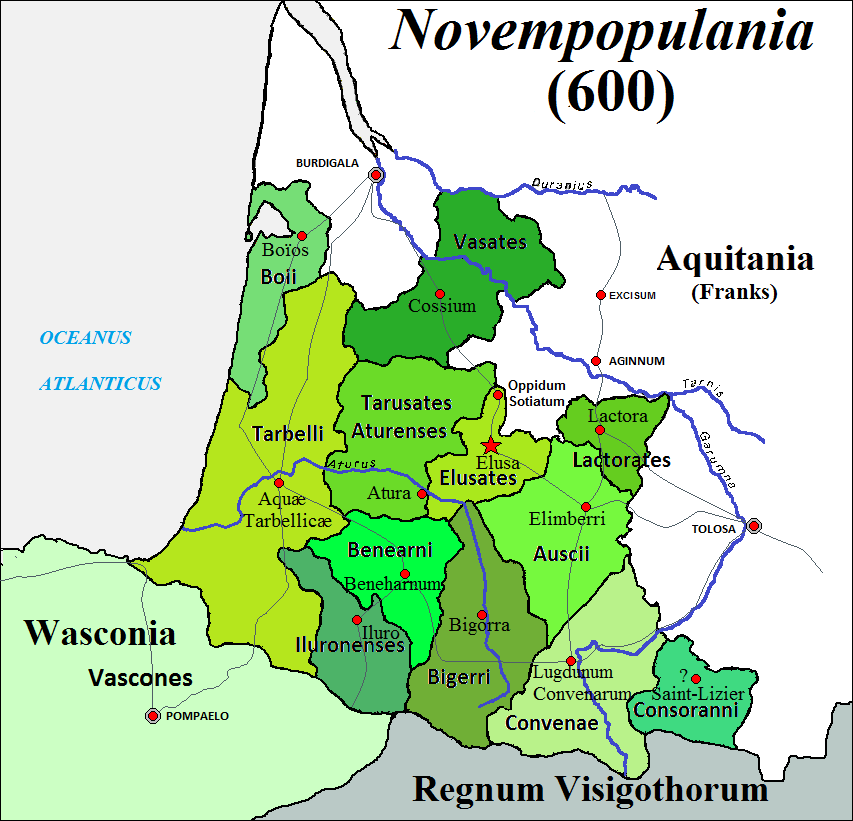
Although the territory originally inhabited by the Aquitani came to be known as Novempopulania (“province of the nine peoples”) in the late Roman Empire and the Early Middle Ages (up to the 6th century), this administrative designation does not reflect the earlier ethnic diversity of the region. Ancient sources indicate that the number of Aquitanian tribes was considerably higher. Strabo mentions about twenty peoples in his Geography. The lists provided by Pliny the Elder and Ptolemy, supplemented by scattered information in the works of Julius Caesar, allow the identification of more than thirty distinct ethnonyms. By comparing these classical sources and incorporating epigraphic evidence, modern scholars generally estimate that pre-Roman Aquitania comprised approximately thirty-two or thirty-three tribes.
Aquitani tribes
- Apiates or Aspiates in the Aspe Valley (Gave d'Aspe Valley)
- Aturenses in the banks of the Adour (Aturus) river
- Arenosii or Airenosini in Aran valley, (high Garonne valley), part of Aquitania and not of Hispania in the Roman Empire
- Ausci in the east around Auch (Elimberris, metropolis of Aquitania)
- Benearni or Benearnenses/Venarni in and around low Béarn, Pau, Pyrénées-Atlantiques
- Bercorates/Bercorcates
- Bigerriones or Begerri in the west of the French département of High Pyrenees (medieval county of Bigorre)
- Boiates/Boates Boii Boiates/Boviates in the coastal region of Pays de Buch and Pays de Born, in the Northwest of Landes
- Camponi (may have been the same tribe as the Oscidates Campestres)
- Cocosates or Sexsignani in the west of Landes département
- Consoranni in the tributary streams of the high Garonne river in the former province of Couserans, today's west half of the Ariège department and extreme south of Haute-Garonne
- Convenae, a “groupement” in the southeast (high Garonne valley) in and around Lugdunum Convenarum
- Datii, in the Ossau Valley, high Béarn
- Elusates in the northeast around Eauze (former Elusa)
- Gates between the Elusates and the Ausci
- Iluronenses in and around Iluro (Oloron-Sainte-Marie)
- Lactorates or Lectorates in and around Lectoure
- Monesii, Osii, or Onesii in the high Garonne river valley (Louchon), only mentioned in Strabo's Geographica
- Onobrisates in Nébouzan in the high Garonne river valley and its tributaries, possibly the same tribe as the Onesii, Osii, or Monesii.
- Oscidates in several valleys and slopes of the west Pyrenees, high Béarn, south of the Iluronenses
- Oscidates Campestres
- Oscidates Montani
- Ptianii in Orthez
- Sassumini/Lassumini/Lassunni
- Sibyllates or Suburates probably around Soule/Xüberoa and also Saubusse; the same of Cæsar’s Sibuzates/Sibusates?
- Sotiates in the north around Sos-en-Albret (south of Lot-et-Garonne department)
- Succasses
- Tarbelli or Tarbelii/Quattuorsignani in the coastal side of Landes, with Dax (Aquis Tarbellicis)
- Tarusates in the Midou, Douze and Midouze valley, east of Cocosates and Tarbelli
- Tarusci in the high Ariège river valley in the former province of Foix, today's east half of the Ariège department
- Umbranici
- Vellates in high Bidassoa river valley
- Venami/Venarni in and around Beneharnum (modern-day Lescar)
- Vasates/Volcates in the north around Bazas (south of Gironde department)
Aquitani related peoples or tribes
In the southern slopes of western Pyrenees Mountains, not in Aquitania but in northern Hispania Tarraconensis:
- Iacetani in high Aragon River valley, in and around Jaca, in the southern slopes of western Pyrenees Mountains in today's northwestern Aragon, Spain
- Vascones in the southern slopes of western Pyrenees Mountains in today's Navarra, Spain
References
References
- (2006). "Encyclopedia of European Peoples". Infobase Publishing.
- These are indeed the opening lines of Caesar’s account of his war in Gaul: ''Gallia est omnis divisa in partes tres, quarum unam incolunt Belgae, aliam Aquitani, tertiam qui ipsorum lingua Celtae, nostra Galli appellantur. Hi omnes lingua, institutis, legibus inter se differunt. Gallos ab Aquitanis Garumna flumen [...] dividit.'' Julius Caesar, [https://www.perseus.tufts.edu/hopper/text.jsp?doc=Perseus:text:1999.02.0002:book=1:chapter=1 De bello Gallico 1.1], edition of [[T. Rice Holmes]]
- ''Aquitania a Garumna flumine ad Pyrenaeos montes et eam partem Oceani quae est ad Hispaniam pertinet; spectat inter occasum solis et septentriones.''
- Trask, R.L.. (1997). "The History of Basque". Routledge.
- E. Demougeot, ''La formation de la Novempopulanie'', Paris, 1979.
- Strabo, ''Geography'', Book IV, 2.1–2.
- Pliny the Elder, ''Naturalis Historia'', Book IV, 108–109.
- Ptolemy, ''Geography'', Book II, 7.
- Julius Caesar, ''Commentarii de Bello Gallico'', Book I, 1; Book III, 20–27.
- J.-P. Bost, ''L’Aquitaine antique'', Bordeaux, 1991.
- Barry Cunliffe, ''The Ancient Celts'', Oxford University Press, 1997.
- Judge, A.. (2007-02-07). "Linguistic Policies and the Survival of Regional Languages in France and Britain". Springer.
This article was imported from Wikipedia and is available under the Creative Commons Attribution-ShareAlike 4.0 License. Content has been adapted to SurfDoc format. Original contributors can be found on the article history page.
Ask Mako anything about Aquitani — get instant answers, deeper analysis, and related topics.
Research with MakoFree with your Surf account
Create a free account to save articles, ask Mako questions, and organize your research.
Sign up freeThis content may have been generated or modified by AI. CloudSurf Software LLC is not responsible for the accuracy, completeness, or reliability of AI-generated content. Always verify important information from primary sources.
Report