From Surf Wiki (app.surf) — the open knowledge base
Appleton, Wisconsin

| Field | Value | ||||||
|---|---|---|---|---|---|---|---|
| official_name | Appleton, Wisconsin | ||||||
| settlement_type | City | ||||||
| image_skyline | Downtown Appleton Skyline.jpg | ||||||
| image_caption | Downtown Appleton viewed from the Fox River | ||||||
| mapframe | yes | ||||||
| mapframe-zoom | 10 | ||||||
| mapframe-point | none | ||||||
| pushpin_map | Wisconsin#USA | ||||||
| pushpin_relief | yes | ||||||
| pushpin_label | Appleton | ||||||
| subdivision_type | Country | ||||||
| subdivision_name | |||||||
| subdivision_type1 | State | ||||||
| subdivision_name1 | Wisconsin | ||||||
| subdivision_type2 | Counties | ||||||
| subdivision_name2 | Outagamie, Calumet, Winnebago | ||||||
| government_type | Mayor–council | ||||||
| leader_title | Mayor | ||||||
| leader_name | Jake Woodford | ||||||
| established_title | Settled | ||||||
| established_date | 1847 | ||||||
| established_title2 | Incorporated | ||||||
| established_date2 | 1853 (village) | ||||||
| 1857 (city) | |||||||
| <!-- Area --> | unit_pref | Imperial | |||||
| area_footnotes | |||||||
| area_total_km2 | 65.49 | ||||||
| area_land_km2 | 64.20 | ||||||
| area_water_km2 | 1.29 | ||||||
| area_total_sq_mi | 25.29 | ||||||
| area_land_sq_mi | 24.79 | ||||||
| area_water_sq_mi | 0.50 | ||||||
| area_water_percent | 1.97 | ||||||
| area_metro_sq_mi | |||||||
| population_as_of | 2020 | ||||||
| population_footnotes | |||||||
| population_total | 75644 | ||||||
| population_density_km2 | 1154.12 | ||||||
| population_density_sq_mi | 2989.15 | ||||||
| population_rank | 6th in Wisconsin | ||||||
| population_metro | 243,147 (US: 194th) | ||||||
| population_urban | 230,967 (US: 171st) | ||||||
| population_density_urban_sq_mi | 2,143.0 | ||||||
| population_demonym | Appletonians | ||||||
| timezone | CST | ||||||
| utc_offset | −06:00 | ||||||
| timezone_DST | CDT | ||||||
| utc_offset_DST | −05:00 | ||||||
| coordinates | |||||||
| elevation_ft | 790 | ||||||
| postal_code_type | ZIP Code | ||||||
| postal_code | 54911, 54912, 54913, 54914, 54915, 54919 | ||||||
| area_code | 920 | ||||||
| website | |||||||
| blank_name | FIPS code | ||||||
| blank_info | 55-02375 | ||||||
| blank1_name | GNIS feature ID | ||||||
| blank1_info | 1560914 | ||||||
| pop_est_footnotes | |||||||
| blank_name_sec2 | Major airport | ||||||
| blank_info_sec2 | Appleton International Airport (ATW) | ||||||
| blank1_name_sec2 | Major Routes | ||||||
| blank1_info_sec2 | [[File:I-41.svg | 26px | link=Interstate 41]] [[File:US 10.svg | 26px | link=U.S. Route 10 in Wisconsin]] [[File:US 41.svg | 26px | link=U.S. Route 41 in Wisconsin]] |
| blank2_name_sec2 | Public Transit | ||||||
| blank2_info_sec2 | [[File:Valley Transit Updated Logo.png | 50px | link=Valley Transit (Wisconsin)]] | ||||
| named_for | Samuel Appleton |
| mapframe-zoom = 10 | mapframe-point = none 1857 (city)
Appleton () is the county seat of Outagamie County, Wisconsin, United States, with small portions extending into Calumet and Winnebago counties. Located on the Fox River north of Lake Winnebago, it is 30 mi southwest of Green Bay and 100 mi north of Milwaukee. The city had a population of 75,644 at the 2020 census, making it the sixth-most populous city in Wisconsin. The Appleton metropolitan statistical area had 243,147 residents. Appleton is part of the broader Fox Cities region.
Appleton was founded in the mid-19th century and developed as a prominent industrial and educational hub, notably with the establishment of Lawrence University in 1847. Its economy has historically been anchored in paper manufacturing and has diversified into retail and healthcare, with St. Elizabeth Hospital and ThedaCare Regional Medical Center–Appleton in the city. It is a cultural center of the Fox River Valley, highlighted by institutions such as the Fox Cities Performing Arts Center and History Museum at the Castle, which celebrates local heritage and figures like magician Harry Houdini. It also hosts regional events such as Octoberfest and the Mile of Music.
History
Native American history
The territory where Appleton is today was formerly occupied by the Ho-Chunk and the Menominee. The Menominee Nation ceded the territory to the United States in the Treaty of the Cedars in 1836. In the Menominee language, Appleton is known as Ahkōnemeh, or "watches for them place".
The first European settlers in Appleton were fur traders seeking to do business with Fox River Valley Native Americans. Hippolyte Grignon built the White Heron in 1835 to house his family and serve as an inn and trading post.
European settlement

Appleton was settled in 1847. It was founded as three unincorporated villages along the Fox River. From south to north along the river, these were Grand Chute, Appleton, and Lawesburg. In 1853, the three were merged into the single incorporated Village of Appleton. John F. Johnston was the first resident and village president. Lawrence University, also founded in 1847, was backed financially by Amos A. Lawrence and originally known as the Lawrence Institute. Samuel Appleton, Lawrence's father-in-law from New England who never visited Wisconsin, donated $10,000 to the newly founded college library, and the town took his name in appreciation.
The paper industry, beginning with the building of the first paper mill in the city in 1853, has been at the forefront of the development of Appleton. In order to provide electricity to the paper industry, the nation's first hydro-electric central station, the Vulcan Street Plant on the Fox River, began operation on September 30, 1882. The power plant also powered the Hearthstone House, the first residence in the world powered by a centrally located hydroelectric station using the Edison system.
Shortly thereafter, in August 1886, Appleton was the site for another national first, the operation of a commercially successful electric streetcar company. Electric lights replaced gas lamps on College Avenue in 1912. Appleton also had the first telephone in Wisconsin, and the first incandescent light in any city outside of the East Coast.
The community was incorporated as a city on March 2, 1857, with Amos Story as its first mayor. Early in the 20th century, it adopted the commission form of government. In 1890, 11,869 people lived in Appleton; in 1900, there were 15,085; in 1910, 16,773; in 1920, 19,571; and in 1940, 28,436.
Significant annexations to the city, taken from the Town of Grand Chute, were performed in the next two decades. The first, the "Glendale" district, was completed on November 8, 1941, growing Appleton north past Glendale Avenue. Another became official on December 22, 1950, after multi-year disputes, when the unincorporated villages of Bell Heights and Whispering Pines were annexed into the city from Grand Chute. Bell Heights added new area to the northwest edge of Appleton, and Whispering Pines, to the northeast, would include land where Appleton Memorial Hospital would later be built. Bell Heights and Whispering Pines increased the population of the city by ten percent, and its area by twenty percent, overnight.
Appleton's tallest building, the 222 Building was built in 1952. The Valley Fair Shopping Center, built in 1954, laid claim to being the first enclosed shopping mall in the United States, although this claim is disputed by other malls. In 2007 most of the structure was demolished, leaving only its east wing. A Pick 'n Save Food Center now stands in its place.
From approximately 1930–1970, Appleton was a sundown town: black people were not allowed to stay overnight, and none lived within its city limits by 1930. In 1936, the Institute of Paper Chemistry tried to hire the famous African-American chemist Percy Julian, but could not figure out how to do this without running afoul of what was stated as "an arcane law on the City of Appleton's books". A fight over Julian's employment ensued, and he was hired by Glidden in Chicago instead. Appleton's sundown status was largely de facto and not de jure; it stood by unwritten consensus and enforcement, such as by police strongly encouraging black people to leave town after dark. A partial exception was made for opera singer Marian Anderson when she sang at Lawrence University in 1941; she was allowed to stay overnight in the Conway Hotel, but even then was not allowed to eat dinner in public.
Following the Flint water crisis, a report of Wisconsin Rust Belt cities showed high levels of lead contamination in the water of Appleton, with children under the age of 1 testing positive for lead. With a state average of 1.9 per 100 for this age group, Appleton tested at 4.5 per 100 for the same age group.
Geography

According to the United States Census Bureau, the city has a total area of 24.82 sqmi, of which 24.33 sqmi is land and 0.49 sqmi is water.
Climate
Appleton has a humid continental climate typical of Wisconsin. Summers are warm to hot and winters are rather cold in comparison. Precipitation is relatively moderate compared to other areas close to the Great Lakes, which means lesser snowfall in winter than in many other cold areas.
A dew point of 90 °F was observed at Appleton at 5 p.m. on July 13, 1995. This is tied for the second highest dew point ever observed in the United States and coincides with the 1995 Chicago heat wave.
Being inland from Lake Michigan, Appleton is prone to temperature extremes. The hottest temperature recorded was 107 F during the 1936 Dust Bowl and the coldest was -32 F in 1929. The coldest maximum on record is -20 F set in 1994 and the warmest minimum being 82 F in 1912. On average, the coldest maximum temperature of the year during the normals between 1991 and 2020 was at a frigid 1 F and the warmest minimum averaged 73 F.
|Jan record high F = 56 |Feb record high F = 72 |Mar record high F = 83 |Apr record high F = 89 |May record high F = 95 |Jun record high F = 101 |Jul record high F = 107 |Aug record high F = 103 |Sep record high F = 101 |Oct record high F = 89 |Nov record high F = 75 |Dec record high F = 64 |year record high F = 107 |Jan avg record high F = 43.4 |Feb avg record high F = 47.4 |Mar avg record high F = 63.0 |Apr avg record high F = 76.1 |May avg record high F = 85.6 |Jun avg record high F = 90.8 |Jul avg record high F = 91.7 |Aug avg record high F = 90.1 |Sep avg record high F = 86.7 |Oct avg record high F = 77.7 |Nov avg record high F = 61.8 |Dec avg record high F = 47.7 |year avg record high F = 94.0 |Jan avg record low F = -10.3 |Feb avg record low F = -7.3 |Mar avg record low F = 2.3 |Apr avg record low F = 19.2 |May avg record low F = 30.7 |Jun avg record low F = 41.6 |Jul avg record low F = 49.6 |Aug avg record low F = 47.0 |Sep avg record low F = 35.0 |Oct avg record low F = 24.6 |Nov avg record low F = 11.7 |Dec avg record low F = -2.9 |year avg record low F = -13.5 |Jan record low F = -30 |Feb record low F = -32 |Mar record low F = -21 |Apr record low F = 7 |May record low F = 23 |Jun record low F = 34 |Jul record low F = 41 |Aug record low F = 35 |Sep record low F = 25 |Oct record low F = 15 |Nov record low F = -7 |Dec record low F = -23 |year record low F = -32
|Jan snow depth inch = 10.1 |Feb snow depth inch = 10.2 |Mar snow depth inch = 7.6 |Apr snow depth inch = 2.2 |May snow depth inch = 0.0 |Jun snow depth inch = 0.0 |Jul snow depth inch = 0.0 |Aug snow depth inch = 0.0 |Sep snow depth inch = 0.0 |Oct snow depth inch = 0.1 |Nov snow depth inch = 1.3 |Dec snow depth inch = 7.4 |year snow depth inch = 13.8
| access-date = June 14, 2021}} | access-date = June 14, 2021}}
Demographics

]]
Appleton is the principal city of the Appleton–Oshkosh–Neenah CSA, a Combined Statistical Area which includes the Appleton (Calumet and Outagamie counties) and Oshkosh–Neenah (Winnebago County) metropolitan areas, which had a combined population of 392,660 at the 2010 census and an estimated population of 409,881 as of 2019.
According to the 2020 census, 62,899 of the city's population lived in Outagamie County, 11,304 lived in Calumet County, and 1,441 lived in Winnebago County.
2020 census
As of the census of 2020, the city's population was 75,644. The population density was 3,051.5 PD/sqmi. There were 31,747 housing units at an average density of 1,280.7 /mi2. Ethnically, the population was 7.3% Hispanic or Latino of any race. When grouping both Hispanic and non-Hispanic people together by race, the city was 80.1% White, 6.4% Asian, 3.13% Black or African American, 0.9% Native American, 0.1% Pacific Islander, 3.2% from other races, and 6.5% from two or more races.
The 2020 census population of the city included 1,275 people in student housing and 318 people incarcerated in adult correctional facilities.
According to the American Community Survey estimates for 2016–2020, the median income for a household in the city was $61,475, and the median income for a family was $76,791. Male full-time workers had a median income of $51,431 versus $41,564 for female workers. The per capita income for the city was $33,282. About 7.8% of families and 10.3% of the population were below the poverty line, including 15.8% of those under age 18 and 6.4% of those age 65 or over. Of the population age 25 and over, 92.6% were high school graduates or higher and 33.6% had a bachelor's degree or higher.
2010 census
As of the 2010 census, there were 72,623 people, 28,874 households, and 18,271 families residing in the city. The population density was 2984.9 PD/sqmi. There were 30,348 housing units at an average density of 1247.3 /mi2. The racial makeup of the city was 87.5% White, 1.7% African American, 0.7% Native American, 5.9% Asian, 2.2% from other races, and 2.0% from two or more races. Hispanic or Latino people of any race were 5.0% of the population.
There were 28,874 households, of which 33.0% had children under the age of 18 living with them, 48.7% were married couples living together, 10.5% had a female householder with no husband present, 4.1% had a male householder with no wife present, and 36.7% were non-families. 29.5% of all households were made up of individuals, and 9% had someone living alone who was 65 years of age or older. The average household size was 2.43 and the average family size was 3.04.
The median age in the city was 35.3 years. 25% of residents were under the age of 18; 10.1% were between the ages of 18 and 24; 27.7% were from 25 to 44; 26.1% were from 45 to 64; and 11.3% were 65 years of age or older. The gender makeup of the city was 49.5% male and 50.5% female.
Hmong community
Per the 2022 American Community Survey five-year estimates, the Hmong population was 2,965 comprising over 70% of the city's Asian population.
Crime
FBI crime statistics for 2019 list the crime rate (per 100,000 population) for Appleton as follows
| Crime | Appleton | Wisconsin | United States | |||
|---|---|---|---|---|---|---|
| Violent crime | ||||||
| Murder | ||||||
| Forcible rape | ||||||
| Robbery | ||||||
| Aggravated assault | ||||||
| Property crime | ||||||
| Burglary | ||||||
| Larceny-theft | ||||||
| Motor vehicle theft |
Economy

As of 2020, the largest employers in the city were:
| Rank | Employer | # of employees | Percentage of |
|---|---|---|---|
| total city employment | |||
| 1 | St. Elizabeth Hospital/Ascension Health | 5,172 | 14% |
| 2 | Thrivent Financial | 2,000 | 5.4% |
| 3 | Appleton Area School District | 1,918 | 5.2% |
| 4 | Miller Electric | 1,400 | 3.8% |
| 5 | ThedaCare Regional Medical Center–Appleton | 1,184 | 3.2% |
| 6 | Outagamie County | 1,147 | 3.1% |
| 7 | Appvion, Inc. | 1,000 | 2.7% |
| 8 | West Business Services | 1,000 | 2.7% |
| 9 | Valley Packaging Industries | 999 | 2.7% |
| 10 | Walmart | 725 | 2% |
Corporations headquartered in Appleton include:
- ASP, Inc.
- Fleet Farm
- John Birch Society
- Miller Electric
Healthcare
The city is served by two hospitals:
- ThedaCare Regional Medical Center–Appleton
- St. Elizabeth Hospital
Arts and culture
Appleton tourist attractions include the Hearthstone Historic House Museum, the four-story mansion that was the first house in US to be powered by hydroelectricity at its completion in 1881. The History Museum at the Castle contains exhibits on Fox River Valley history, including a gallery showcasing Edna Ferber, a Harry Houdini exhibit, and other traveling exhibits. The J. B. Courtney Woolen Mills is a preserved site showcasing the area's historical manufacturing roots.
The Fox Cities Exhibition Center is a prominent venue for conventions and events. The Fox Cities Performing Arts Center is a key location for performing arts, hosting a wide range of theater, musical, and dance performances. The Scheig Center Gardens, formerly named the Gardens of the Fox Cities, a public botanical garden, showcases the seasonal beauty of plants and gardens in Wisconsin. The Trout Museum of Art features a variety of visual art exhibits, contributing to the region's cultural landscape. The John Hart Whorton House is an example of local historic architecture.
Houdini Plaza, on the corner of College Avenue and Appleton Street, has been referred to as the 'front yard' of downtown Appleton. It holds roughly 55 events each year, including summer concerts and part of the downtown farmers market.
The Atlas Science Center, formerly Paper Discovery Center, was a museum and workshop center focused on papermaking and the history of the paper industry in the area. It was first conceived in 1999 as part of the Paper Industry International Hall of Fame, Inc. The Kimberly-Clark Corporation donated its former Atlas Mill on the Fox River in Appleton to house the center, and after it was opened in February 2005, its programs included hands-on work experience, tours, and general information on papermaking. The center closed in November 2024 and donated its remaining assets.
Parks and recreation
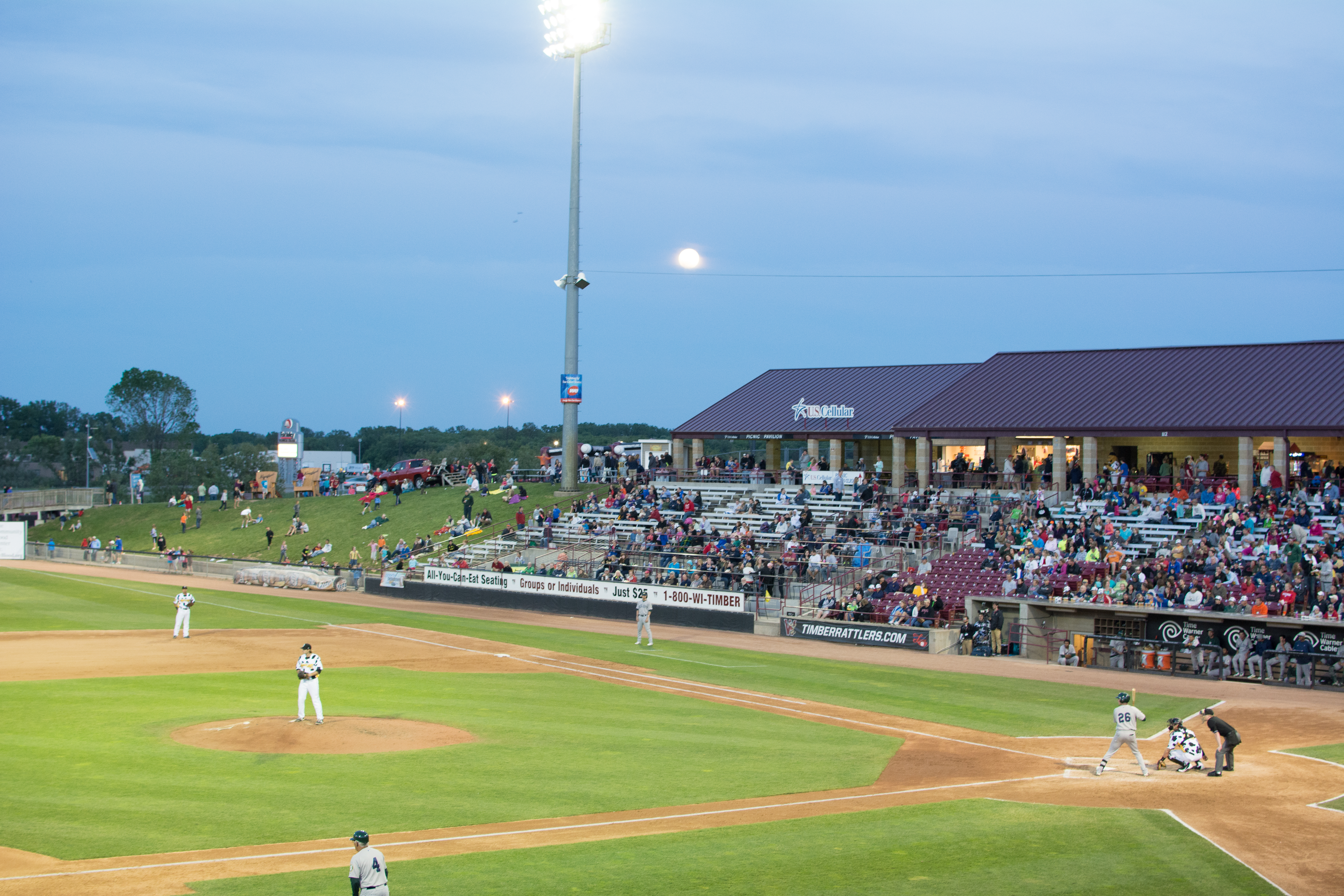
The city of Appleton has 24 neighborhood parks and four community parks in its park system. The neighborhood parks range in size from 2 acre to 16 acre, while the community parks range in size from 25 acre to 139 acre. Goodland Field is a historic site associated with local baseball, while the Neuroscience Group Field at Fox Cities Stadium serves as the home of the minor league Wisconsin Timber Rattlers.
Memorial Park is the largest of the community parks, covering 139 acre. The park's facilities include: seven baseball/softball fields, playground equipment, an indoor ice skating rink, a sledding hill, a picnic pavilion, a catch-and-release fishing pond, grills, and a warming shelter. The park provides a firework display for the Appleton community during the 4th of July holiday.
City Park, established in 1882, is the oldest park in the Appleton park system. The Trout Museum of Art uses the park for its Art in the Park showcase. The show features over 200 artists that attract over 25,000 art enthusiasts annually. Pierce Park is the site of weekly Appleton City Band concerts held during the summer, and of the annual Appleton Old Car Show and Swap Meet. Pierce Park and Telulah Park each feature a disc-golf course. Erb Park and Mead Park each feature a public aquatics facility. Jones Park is the site of the finish line for the Santa Scamper run held during the annual Appleton Christmas Parade, and features an outdoor hockey rink in the winter.
Government

Appleton is governed via the mayor-council system. The mayor appoints department heads, subject to council approval. The city attorney is elected every four years in a citywide vote. The council, known as the common council or city council, consists of 15 members, called alderpersons, all of whom are elected to two-year terms from individual districts.
The current mayor of Appleton, Jake Woodford, was elected in 2020 to his first four-year term. The first mayor of Appleton was Amos Story, elected in April 1857. The longest-serving mayor was Timothy Hanna, who served from 1996 through 2020.
Mayors
Partial of list of Appleton's past mayors:
| Order | Term start | Term end | Mayor | Notes |
|---|---|---|---|---|
| 1 | 1857 | 1859 | ||
| 2 | 1859 | 1860 | ||
| 3 | 1860 | 1862 | ||
| 4 | 1862 | 1865 | ||
| 5 | 1865 | 1866 | ||
| 6 | 1866 | 1867 | ||
| 7 | 1867 | 1868 | ||
| 8 | 1868 | 1870 | ||
| 9 | 1870 | 1871 | ||
| 10 | 1871 | 1872 | ||
| 11 | 1872 | 1873 | ||
| 12 | 1873 | 1875 | ||
| 13 | 1875 | 1875 | ||
| 14 | 1875 | 1877 | ||
| 15 | 1877 | 1878 | ||
| 16 | 1878 | 1879 | ||
| 17 | 1879 | 1880 | ||
| 18 | 1880 | 1882 | ||
| 19 | 1882 | 1883 | ||
| 20 | 1883 | 1887 | ||
| 21 | 1887 | 1889 | ||
| 22 | 1889 | 1892 | ||
| 23 | 1892 | 1893 | ||
| 24 | 1893 | 1894 | ||
| 25 | 1894 | 1897 | ||
| 26 | 1897 | 1900 | ||
| 27 | 1900 | 1904 | ||
| 28 | 1904 | 1906 | ||
| 29 | 1906 | 1908 | ||
| 30 | 1908 | 1910 | ||
| 31 | 1910 | 1913 | Died in office, Dec. 1913. | |
| 32 | 1914 | 1917 | Won Feb. 1914 special election. | |
| 33 | 1917 | 1918 | ||
| 34 | 1918 | 1922 | ||
| 35 | 1922 | 1924 | ||
| 36 | 1924 | 1926 | ||
| 37 | 1926 | 1930 | ||
| 38 | 1930 | 1946 | ||
| 39 | 1946 | 1958 | ||
| 40 | 1958 | 1966 | ||
| 41 | 1966 | 1972 | ||
| 42 | 1972 | 1980 | ||
| 43 | 1980 | 1992 | ||
| 44 | 1992 | 1996 | ||
| 45 | 1996 | 2020 | ||
| 46 | 2020 | Current |
Congressional representation
Appleton is represented by Ron Johnson (R) and Tammy Baldwin (D) in the United States Senate. It is represented in the United States House of Representatives by Tony Wied, who has represented Wisconsin's 8th district since November 2024. In the Wisconsin state legislature, Appleton is divided among four State Assembly Districts (3rd, 55th, 56th, 57th) and two State Senate Districts (1st, 19th). As of the 2018–2019 legislative session, the following representatives serve these districts:
- 3rd Assembly District: Ron Tusler (R–Harrison)
- 55th Assembly District: Nate Gustafson (R–Neenah)
- 56th Assembly District: David Murphy (R–Greenville)
- 57th Assembly District: Lee Snodgrass (D–Appleton)
- 1st Senate District: André Jacque (R–DePere)
- 19th Senate District: Rachael Cabral-Guevara (R–Fox Crossing)
Education

Appleton is served by the Appleton Area School District, which has three high schools, four middle schools, seventeen elementary schools, and sixteen charter schools. The district's main public high schools are Appleton East, Appleton North, and Appleton West. Appleton has two parochial high schools, namely the Catholic Xavier High School and Fox Valley Lutheran High School. Appleton also has charter high schools, including Fox Cities Leadership Academy, Renaissance Academy, Appleton Technical Academy, and Tesla Engineering.
Appleton is home to Lawrence University, a private liberal arts college, and Fox Valley Technical College. Additionally, Globe University, Concordia University Wisconsin, and Rasmussen College have branch campuses in the city.
In recent years, Appleton has emerged as a center for innovation in technology education, particularly in the area of K–12 technology education: the student-driven Appleton Youth Education Initiative has partnered with Microsoft Philanthropies, Plexus Corp., Miron Construction, Schneider National, and Stellar Blue Technologies to organize the Appleton Tech Clinic and HackAppleton, a popular annual hackathon that draws students from all over Wisconsin.{{cite web|url=https://northnoct.com/10389/features/changemakers/the-appleton-youth-education-initiative-the-past-present-and-future/|title=The Appleton Youth Education Initiative: Past, Present, and Future; |publisher=northnoct.com
The city and surrounding area are served by the Appleton Public Library, which was chartered by the city in 1897 and as of 2010 has a collection of over 600,000 items. The library offers free wifi as well as printing and faxing for a small fee.
Infrastructure
Transportation
The city owns Valley Transit, a network of bus lines serving the Fox Valley. Lamers Bus Lines offers intercity buses serving such locations as Wausau, Stevens Point, Waupaca, Oshkosh, Fond du Lac, and Milwaukee.
In April 2021, Bird Rides launched a pilot program with 100 rentable electric scooters that users can operate throughout most of the city. In 2024, the city cut ties with Bird Rides, citing scooter parking concerns and concerns regarding Bird Rides' financial viability. The founder of the company Travis VanderZanden grew up in the Appleton area.
Roads include:
- Interstate 41
- US 10
- US 41
- WIS 47
- WIS 96
- WIS 125
- WIS 441
Rail
Appleton is crisscrossed by the former main lines of the Chicago and North Western Railway (southwest-northeast) and the Milwaukee, Lake Shore and Western Railway (roughly southeast–northwest, and now largely abandoned except for local service to area paper mills and other industries). A north–south branch of the former Wisconsin Central Railroad passes on the west side of the city. All rail service is now operated by Canadian National Railway. Appleton has no intercity passenger rail service, although studies are being undertaken on the feasibility of extending Amtrak rail service to the Fox Cities and Green Bay.
Airport
The Appleton International Airport is 6 mi west of downtown Appleton. With four major airlines, the airport has an annual volume of over 670,000 passengers.
Notable people
Main article: List of people from Appleton, Wisconsin
Sister cities
Appleton is twinned with:
- NIC Chinandega, Chinandega Department, Nicaragua
- JPN Kan'onji, Kagawa, Japan
References
References
- "Mayor's Office {{!}} Appleton, WI".
- "2019 U.S. Gazetteer Files". United States Census Bureau.
- "QuickFacts Appleton city, Wisconsin; United States".
- "List of 2020 Census Urban Areas". United States Census Bureau.
- (June 14, 2016). "Noisey Would Like to Invite This Kid Who Dabbed Through Graduation to Be Our Intern". Vice.
- "U.S. Census website". [[United States Census Bureau]].
- (October 25, 2007). "US Board on Geographic Names". [[United States Geological Survey]].
- (May 24, 2020). "Population and Housing Unit Estimates". United States Census Bureau.
- "Octoberfest Appleton, WI".
- Ted's Vintage Art. "Appleton, WI Historical Map - 1867".
- "Menominee Treaties and Treaty Rights".
- Hoffman, Mike. "Menominee Place Names in Wisconsin".
- (June 1, 2011). "History of Appleton". Appleton Public Library.
- Wineries of Wisconsin and Minnesota By Patricia Monaghan page 126
- "Appleton.org | City of Appleton, Wisconsin".
- "Profile for Appleton, Wisconsin". [[ePodunk]].
- [http://www.beloitdailynews.com/articles/2005/12/15/news/news21.txt "Victorian Christmas"], ''[[Beloit Daily News]]'', December 15, 2005
- ["Appleton brief history]". Wisconsinhistory.org.
- Wisconsin. (1857). "Private and Local Laws Passed by the Legislature of Wisconsin in the Year 1857". Calkins and Proudfit, Printers.
- Rumsey, John. (December 21, 1950). "Annexation of New Wards Will Bring Problems, Benefits to City". The Post-Crescent.
- Rumsey, John. (December 21, 1950). "City to Grow Quickly in Annexation Tonight". The Post-Crescent.
- (July 15, 1952). "24,400 Tons of Building Rest on 271 Steel Piles". The Post-Crescent.
- (2006). "Sundown Towns: A Hidden Dimension of American Racism". Touchstone.
- Anderson, Frank. (May 13, 2010). "Wicked Fox Cities: The Dark Side of the Valley". Arcadia Publishing.
- Bowden, Mary Ellen. (1997). "Chemical Achievers: The Human Face of the Chemical Sciences". Chemical Heritage Foundation.
- Peeples, Scott. "Appleton was indeed a 'Sundown Town'". Celebrate Diversity Fox Cities.
- Anderson, Cheryl. (October 18, 2014). "Lawrence to revisit 1941 concert of Marian Anderson". Post-Crescent.
- (January 1, 2017). "LEAD CONTAMINATION IN THE "RUST BELT": WISCONSIN". Pontiac Tribune.
- "US Gazetteer files 2010". [[United States Census Bureau]].
- "Census of Population and Housing". Census.gov.
- [https://www2.census.gov/programs-surveys/popest/tables/2010-2019/metro/totals/csa-est2019-annres.xlsx Annual Estimates of the Resident Population: April 1, 2010 to July 1, 2019] U.S.Census. Retrieved November 23, 2021
- (May 2023). "Census Bureau profile: Appleton city, Outagamie County, Wisconsin". [[United States Census Bureau]].
- (May 2023). "Census Bureau profile: Appleton city, Calumet County, Wisconsin". [[United States Census Bureau]].
- (May 2023). "Census Bureau profile: Appleton city, Winnebago County, Wisconsin". [[United States Census Bureau]].
- "2020 Decennial Census: Appleton city, Wisconsin". U.S. Census Bureau.
- "Group Quarters Population, 2020 Census: Appleton city, Wisconsin". U.S. Census Bureau.
- "Selected Economic Characteristics, 2020 American Community Survey: Appleton city, Wisconsin". U.S. Census Bureau.
- "Selected Social Characteristics, 2020 American Community Survey: Appleton city, Wisconsin". U.S. Census Bureau.
- "QuickFacts Appleton city, Wisconsin". [[United States Census Bureau]].
- (July 1, 2022). "B02018 Total Asian Alone or in Any Combination Population – 2022 American Community Survey 5-Year Estimates – Appleton, Wisconsin". [[United States Census Bureau]].
- "Wisconsin".
- "Table 5".
- "Table 1".
- (December 31, 2020). "Annual Financial Report - 2020".
- "SECURA sells its longtime Appleton building to Fleet Farm". Post-Crescent Media.
- "J. B. Courtney Woolen Mills". Landmark Hunter.com.
- (February 6, 2024). "Embracing Art and Community: Trout Museum of Art's Exciting Journey to a New Home - Community Foundation for the Fox Valley Region".
- "John Hart Whorton House". Landmark Hunter.com.
- (July 10, 2013). ["Houdini Plaza Opens At Last!–The New Face of Downtown Appleton Infographic]". Whoonew.com.
- "About Us".
- "Paper Industry International Hall of Fame, Inc.".
- (January 6, 2011). "Science Summer Series at Paper Discovery Center".
- Wang, Zhen. "Former Paper Discovery Center in Appleton closes, due to rising operational costs".
- dminteractive.com. "Official Site of the City of Appleton | Appleton, WI". Appleton.org.
- (August 2, 1996). "Appleton, Wisconsin Parks and Places - City Park". Triviaasylum.com.
- "Appleton Parks & Recreation". Appletonparkandrec.org.
- "Appleton Memory Project".
- (December 5, 1913). "Mayor Dead after a Noble Fight for Life". [[The Post-Crescent.
- (February 6, 1914). "But One Candidate Left". The Blanchardville Blade.
- "Concordia's Locations". Concordia University.
- (March 21, 2018). "'Hack Appleton' competition planned for April 8';". postcrescent.com.
- "Computers & Tech {{!}} Appleton Public Library (WI)".
- "Wauwau Appleton Milwaukee Daily Route".
- Behnke, Duke. "Bird wants to return to Appleton and offers to fix persistent scooter parking problems".
- "Appleton's Bird scooter program provides more than 13,000 rides in the first four months". The Post-Crescent.
- (1 September 2024). "Bureau Of Transportation Statistics Data: Appleton International (ATW)".
- "Sister Cities".
This article was imported from Wikipedia and is available under the Creative Commons Attribution-ShareAlike 4.0 License. Content has been adapted to SurfDoc format. Original contributors can be found on the article history page.
Ask Mako anything about Appleton, Wisconsin — get instant answers, deeper analysis, and related topics.
Research with MakoFree with your Surf account
Create a free account to save articles, ask Mako questions, and organize your research.
Sign up freeThis content may have been generated or modified by AI. CloudSurf Software LLC is not responsible for the accuracy, completeness, or reliability of AI-generated content. Always verify important information from primary sources.
Report