From Surf Wiki (app.surf) — the open knowledge base
Apple bobbing
Party game where people grab apples with their teeth

Party game where people grab apples with their teeth
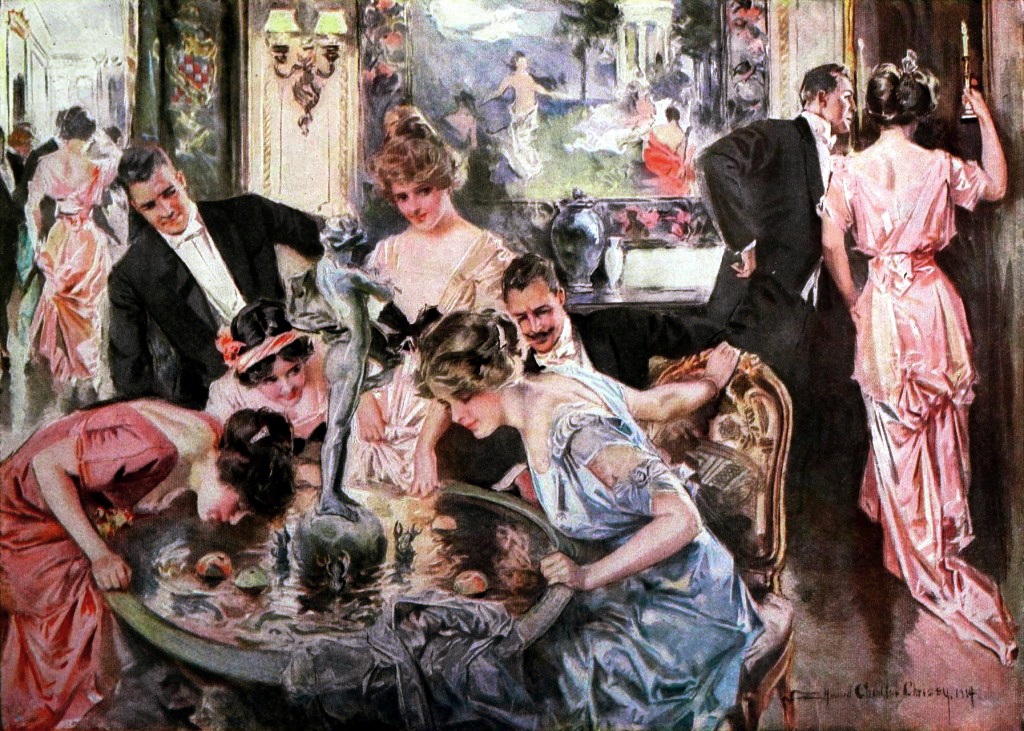
Apple bobbing, also known as bobbing for apples, is a game often played on Halloween and Bonfire Night. The game is played by filling a tub or a large basin with water and putting apples in the water. Because apples are less dense than water, they will float at the surface. Players (usually children) then try to catch one with their teeth. Use of arms is not allowed, and the hands are often tied behind the back to prevent cheating.
In Scotland, this may be called "dooking" (i.e., ducking). In northern England, the game is often called apple ducking or duck-apple. In Ireland and Newfoundland and Labrador, "Snap Apple Night" is a synonym for Halloween. Another variation involves using the mouth to drop a fork from above to 'catch' the apple.
While bobbing for apples is the most common, other times the apples are substituted for nuts (most commonly hazel or chestnut).
Apple on a String
.jpg)
A common variant of bobbing of apples is the game snap apple or apple on a string, in which apples are hung from the ceiling and contestants jump to take bites - the winner is the contestant that manages to eat their entire apple first. To increase the difficulty, it is common to spin the apples beforehand or shake the cords, often catching contestants who are unaware or too slow in the face.
In Scotland, alongside dooking for apples, treacle scones, smeared in additional treacle, are strung from the ceiling at Halloween.
History
The tradition of bobbing for apples dates back to the Roman times, when the Roman army merged their own celebrations with traditional Celtic festivals. During an annual celebration, young unmarried people tried to bite into an apple floating in water or hanging from a string on a line; the first person to bite into the apple would be the next one to be allowed to marry. Apple bobbing was appropriated in the Irish festival Samhain, with apples serving as a sign of fertility and abundance.
Both apple bobbing and an apple on a string in 18th-century Ireland are mentioned by Charles Vallancey in his book Collectanea de Rebus Hibernicis.
A maiden who placed the apple she bobbed under her pillow was said to dream of her future sweetheart.
References
References
- [http://news.bbc.co.uk/2/hi/uk_news/scotland/south_of_scotland/7648188.stm Apple dookers make record attempt] {{Webarchive. link. (2012-05-28 , BBC News, 2 October 2008)
- "Dictionaries of the Scots Language:: SND :: dook v1 n1".
- "Snap Apple Night, or All-Hallow Eve. January 1, 1845".
- link. (2023-10-26 , George Morley Story, W. J. Kirwin, John David Allison, p500, {{ISBN). 0-8020-6819-7
- "Halloween in Scotland". Historic UK.
- (1987). "The lore and language of schoolchildren". Oxford [Oxfordshire] ; New York : Oxford University Press.
- "Dictionaries of the Scots Language:: SND :: traicle n1".
- "6 Scottish Halloween traditions".
- (November 4, 2020). "Recipe: Halloween treacle scones".
- link. (2023-10-26 , Silver RavenWolf, p77, {{ISBN). 1-56718-719-6. Retrieved 21 October 2008.
- "5 Halloween games to play at home this week". Irish Examiner.
- (1786). "Collectanea de Rebis Hibernicis". L. White.
- "What is bobbing for apples?".
This article was imported from Wikipedia and is available under the Creative Commons Attribution-ShareAlike 4.0 License. Content has been adapted to SurfDoc format. Original contributors can be found on the article history page.
Ask Mako anything about Apple bobbing — get instant answers, deeper analysis, and related topics.
Research with MakoFree with your Surf account
Create a free account to save articles, ask Mako questions, and organize your research.
Sign up freeThis content may have been generated or modified by AI. CloudSurf Software LLC is not responsible for the accuracy, completeness, or reliability of AI-generated content. Always verify important information from primary sources.
Report