From Surf Wiki (app.surf) — the open knowledge base
Apollo Lunar Surface Experiments Package
Scientific instruments left by the Apollo astronauts on the Moon

Scientific instruments left by the Apollo astronauts on the Moon
The Apollo Lunar Surface Experiments Package (ALSEP) comprised a set of scientific instruments placed by the astronauts at the landing site of each of the five Apollo missions to land on the Moon following Apollo 11 (Apollos 12, 14, 15, 16, and 17). Apollo 11 left a smaller package called the Early Apollo Scientific Experiments Package, or EASEP.
Background
The instrumentation and experiments that would comprise ALSEP were decided in February 1966. Specifically, the experiments, institutions responsible, and principal investigators and coinvestigators were:
- Passive Lunar Seismic Experiment: Massachusetts Institute of Technology, Frank Press; Columbia University, George Sutton; Georgia Tech, Robert Hostetler
- Lunar Surface Magnetometer: Ames Research Center, C. P. Sonett; Marshall Space Flight Center, Jerry Modisette.
- Medium-Energy Solar Wind: Jet Propulsion Laboratory, C. W. Snyder and M. M. Neugebauer.
- Suprathermal Ion Detection: Rice University, J. W. Freeman, Jr.; Marshall Space Flight Center, Curt Michel.
- Heat Flow Experiment: Columbia University, M. Langseth; Yale University, S. Clark.
- Low-Energy Solar Wind Charged Particle Lunar Environment Experiment: Rice University, B. J. O'Brien.
- Active Seismic Experiment: Stanford University, R. L. Kovach; United States Geological Survey, J. S. Watkins.
- SNAP-27 isotopic power system: Sandia National Laboratories, Jim Leonard
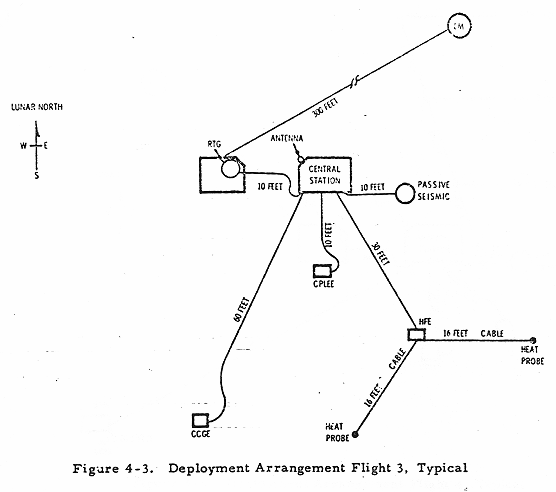
The ALSEP was built and tested by Bendix Aerospace in Ann Arbor, Michigan. The instruments were designed to run autonomously after the astronauts left and to make long-term studies of the lunar environment. They were arrayed around a Central Station which supplied power generated by a radioisotope thermoelectric generator (RTG) to run the instruments and communications so data collected by the experiments could be relayed to Earth. Thermal control was achieved by passive elements (insulation, reflectors, thermal coatings) as well as power dissipation resistors and heaters. Data collected from the instruments were converted into a telemetry format and transmitted to Earth.
Deployment
The ALSEP was stored in the Lunar Module's Scientific Equipment (SEQ) Bay in two separate subpackages. The base of the first subpackage formed the Central Station while the base of the second subpackage was part of the RTG. A subpallet was also attached to the second subpackage which usually carried one or two of the experiments and the antenna gimbal assembly. On Apollo 12, 13, and 14, the second subpackage also stored the Lunar Hand Tool Carrier (HTC). The exact deployment of experiments differed by mission. The following pictures show a typical procedure from Apollo 12.
| Picture | Description | |
|---|---|---|
| [[Image:ALSEP AS12-47-6913.jpg | 150px]] | Pete Conrad opens the SEQ bay doors through a system of lanyards and pulleys. |
| [[Image:ALSEP AS12-46-6783.jpg | 150px]] | Alan Bean removes the second subpackage from the SEQ bay. This was accomplished by using the boom which can be seen extended and a pulley system to set it on the ground. By Apollo 17, astronauts felt that the use of the boom and pulley system complicated the operation. And as such, the entire system was removed for Apollo 17. On Apollo 11, Buzz Aldrin chose not to use the system because of a lack of time. |
| [[Image:ALSEP AS12-46-6784.jpg | 150px]] | The first subpackage, which Conrad had removed from the SEQ bay earlier. |
| [[Image:ALSEP AS12-46-6786.jpg | 150px]] | Bean lowers the RTG cask into a position where he can access it. |
| [[Image:ALSEP AS12-46-6787.jpg | 150px]] | Bean is beginning to remove the dome from the RTG cask. He is using a specialized tool called the Dome Removal Tool (DRT). Note how he has already prepared the RTG for fueling and has already deployed the HTC. Conrad has already removed the subpallet from the RTG subpackage. |
| [[Image:ALSEP AS12-46-6788.jpg | 150px]] | Bean discards the dome with the DRT still attached. Neither had a use afterward. |
| [[Image:Putting the Plutonium 238 fuel into the SNAP 27.jpg | 150px]] | Bean is attempting to remove the fuel element from the cask using the Fuel Transfer Tool (FTT). Note one of the Universal Hand Tools (UHT) attached to the RTG subpackage. On Apollo 12, the fuel element stuck in the cask because of thermal expansion (Bean could feel the heat through his suit). Conrad pounded the side of the cask with a hammer while Bean successfully worked it loose. He then inserted it into the RTG and discarded the FTT. |
| [[Image:ALSEP AS12-46-6792.jpg | 150px]] | Bean attaches the RTG subpackage to the carrybar in preparation for the traverse to the ALSEP deployment site. The carrybar would later be used as the mast for the antenna on the Central Station. |
| [[Image:ALSEP AS12-46-6793.jpg | 150px]] | During the traverse to the ALSEP deployment site, Conrad took this picture. His shadow indicates that he is carrying the subpallet with one of the two UHTs. |
| [[Image:ALSEP AS12-46-6807.jpg | 150px]] | Bean carries the ALSEP out to the deployment site. |
| [[Image:ALSEP AS12-47-6919.jpg | 150px]] | Conrad holds the carrybar in his left hand while he releases the antenna gimbal assembly with a UHT. |
| [[Image:ALSEP Ap13-70-HC-77.jpg | 150px]] | This photo shows Jim Lovell training for Apollo 13. He is currently deploying a mock-up of the Central Station. The Station was spring-loaded. After releasing Boyd bolts, the top of the Station would spring up, deploying it. Note the various locations on top of it which held some of the experiments before deployment. They were also held down with Boyd bolts that were released with a UHT. |
Common elements
Each ALSEP station had some common elements.
| Name | Diagram | Picture | Description | Central Station | Radioisotope Thermoelectric Generator (RTG) | RTG Cask | |
|---|---|---|---|---|---|---|---|
| [[Image:Central Station.jpg | 150px]] | [[Image:ALSEP Apollo 16 Central Station.jpg | 150px]] | The picture shows the Central Station from Apollo 16's ALSEP. | |||
| The Central Station was essentially the command center for the entire ALSEP station. It received commands from Earth, transmitted data, and distributed power to each experiment. Communications with Earth were achieved through a 58 cm long, 3.8 cm diameter modified axial-helical antenna mounted on top of the Central Station and pointed towards Earth by the astronauts. Transmitters, receivers, data processors and multiplexers were housed within the Central Station. The Central Station was a 25 kg box with a stowed volume of 34,800 cubic cm. In addition, on Apollos 12 to 15, a Dust Detector was mounted on the Central Station which measured the accumulation of Lunar dust. | |||||||
| [[File:ALSEP RTG ALSEP.png | 150px]] | [[Image:ALSEP Apollo 14 RTG.jpg | 150px]] | The picture shows the RTG from Apollo 14 with the Central Station in the background. | |||
| The RTG was the power source for the ALSEP. It utilized the heat from the radioactive decay of plutonium-238 and thermocouples to generate approximately 70 watts of power. The base of the RTG was the base of the second ALSEP subpackage. | |||||||
| [[Image:ALSEP Ap14-KSC-70P-508.jpg | 150px]] | The RTG cask stored the plutonium-238 fuel element. It was located to left of the SEQ bay. The cask was designed to withstand a launch vehicle explosion in the event of an abort or a re-entry into Earth's atmosphere (which is what occurred on Apollo 13). The picture shows Edgar Mitchell practicing the removal of the fuel element. |
List of experiments
| Name | Diagram | Description | Active Seismic Experiment (ASE) | Charged Particle Lunar Environment Experiment (CPLEE) | Cold Cathode Gauge Experiment (CCGE) or Cold Cathode Ion Gauge (CCIG) | Heat Flow Experiment (HFE) | Laser Ranging Retroreflector (LRRR) | Lunar Atmosphere Composition Experiment (LACE) | Lunar Ejecta and Meteorites Experiment (LEAM) | Lunar Seismic Profiling Experiment (LSPE) | Lunar Surface Gravimeter (LSG) | Lunar Surface Magnetometer (LSM) | Apollo 12 Passive Seismic Experiment (PSE) | Passive Seismic Experiment Package (PSEP) | Solar Wind Spectrometer Experiment (SWS) | Suprathermal Ion Detector Experiment (SIDE) | ||||||
|---|---|---|---|---|---|---|---|---|---|---|---|---|---|---|---|---|---|---|---|---|---|---|
| [[Image:Active Seismic Experiment Thumper.png | 125px]] | Through the use of seismology the internal structure of the Moon could be determined to several hundred feet underground. The ASE consisted of three major components. A set of three geophones was laid out in a line by an astronaut from the Central Station to detect the explosions. A mortar package was designed to lob a set of four explosives from varying distances away from the ALSEP. Finally, an astronaut-activated Thumper was used to detonate one of 22 charges to create a small shock. The diagram shows the Thumper device. | ||||||||||||||||||||
| The CPLEE was designed to measure the fluxes of charged particles such as electrons and ions. | ||||||||||||||||||||||
| The CCGE experiment was designed to measure the pressure of the Lunar atmosphere. It was originally designed to be part of the SIDE, but its strong magnetic field would have caused interference. The CCIG is on the right of the SIDE in the diagram. | ||||||||||||||||||||||
| The HFE was designed to make thermal measurements of the Lunar subsurface in order to determine the rate at which heat flows out of the interior. The measurements could help determine the abundance of radioisotopes and help understand the thermal evolution of the Moon. The HFE consisted of an electronics box and two probes. Each probe was placed in a hole by an astronaut that was drilled to about 2.5 m deep. | ||||||||||||||||||||||
| [[Image:Laser Ranging Retroreflector.gif | 125px]] | An LRRR is used to reflect a laser beam from Earth, the round-trip timing of the beam is an accurate gauge of the distance to the Moon. The information is used to study Lunar recession due to tidal dissipation and the irregular motion of the Earth. The LRRRs are the only experiments still in use today. The above diagram shows the Apollo 11 version. Apollo 14's was similar to Apollo 11's. The lower diagram shows the larger Apollo 15 version. | ||||||||||||||||||||
| The LACE was designed to detect the composition of the Lunar atmosphere. | ||||||||||||||||||||||
| [[Image:ALSEP Lunar Ejecta and Meteorites Experiment.gif | 125px]] | The LEAM was designed to detect secondary particles that had been ejected by meteorite impacts on the lunar surface and to detect primary micrometeorites themselves. See Lunar soil for some experiment results. | ||||||||||||||||||||
| [[Image:ALSEP Lunar Seismic Profiling Experiment Charge.gif | 125px]] | |||||||||||||||||||||
| [[File:NASA Apollo17 LSPE explosive.jpg | 125px]] | 1/8 | to | 6 | lb | kg | 2}}. The charges were deployed during the rover traverses. | |||||||||||||||
| [[Image:ALSEP Lunar Surface Gravimeter.gif | 125px]] | The LSG was designed to make very accurate measurements of lunar gravity and its change over time. It was hoped the data could be used to prove the existence of gravitational waves. | ||||||||||||||||||||
| [[Image:ALSEP Lunar Surface Magnetometer.svg | 125px]] | The LSM was designed to measure the Lunar magnetic field. The data could be used to determine electrical properties of the subsurface. It was also used to study the interaction of solar plasma and the Lunar surface. | ||||||||||||||||||||
| [[File:ALSEP Passive Seismic Experiment.jpg | 125px]] | The PSE was designed to detect "moonquakes," either naturally or artificially created, to help study the structure of the subsurface. | ||||||||||||||||||||
| [[File:ALSEP Passive Seismic Experiment Package.gif | 125px]] | Similar to the PSE, except it was self-supporting. This meant it carried its own power source (solar arrays), electronics, and communications equipment. In addition, the PSEP also carried a Dust Detector. | ||||||||||||||||||||
| [[Image:ALSEP Solar Wind Spectrometer-en.svg | 125px]] | The SWS was designed to study solar wind properties and its effects on the Lunar environment. | ||||||||||||||||||||
| The SIDE was designed to measure various properties of positive ions in the Lunar environment, provide data on the plasma interaction between solar wind and the Moon, and to determine the electrical potential of the Lunar surface. |
List of missions
Each mission had a different array of experiments.
Apollo 11 (EASEP)

Because of the risk of an early abort on the Moon, geologists persuaded NASA to permit only experiments that could be set up or completed in 10 minutes. As a result, Apollo 11 did not leave a full ALSEP package, but left a simpler version called the Early Apollo Surface Experiments Package (EASEP). Since there was only one 2 hour 40 minute EVA planned, the crew would not have enough time to deploy a full ALSEP, which usually took one to two hours to deploy. Both packages were stored in the LM's SEQ bay.
Engineers designed the EASEP to deploy with one squeeze handle, and the Laser Ranging Retroreflector (LRRR) also deployed within ten minutes. Despite the simpler design, the seismometer was sensitive enough to detect Neil Armstrong's movements during sleep.
| Name | Picture | Notes | LRRR | PSEP | |
|---|---|---|---|---|---|
| [[Image:Apollo 11 Lunar Laser Ranging Experiment.jpg | 150px]] | The transparent dust cover has already been removed and is 3–4m further to the right. The metal reflector mirrors the black sky. | |||
| [[Image:ALSEP AS11-40-5951.jpg | 150px]] | Failed after 21 days |
Apollo 12

| Name | Picture | Notes | LSM | PSE | SWS | SIDE/CCGE | |
|---|---|---|---|---|---|---|---|
| [[Image:ALSEP AS12-47-6920.jpg | 150px]] | Stored on the first subpackage | |||||
| [[Image:ALSEP AS12-47-6917.jpg | 150px]] | Stored on the first subpackage | |||||
| [[Image:ALSEP AS12-46-6812.jpg | 150px]] | Stored on the first subpackage | |||||
| [[Image:ALSEP AS12-47-6922.jpg | 150px]] | Stored on the second subpackage as part of the subpallet. | |||||
| The CCIG can be seen to the left of the SIDE. The CCIG failed after only 14 hours. |
The antenna gimbal assembly was stored on the subpallet. The stool for the PSE, the ALSEP tools, carrybar, and HTC was stored on the second subpackage.
Apollo 13

Because of the aborted landing, none of the experiments were deployed. However, the Apollo 13 S-IVB stage was deliberately crashed on the Moon to provide a signal for the Apollo 12 PSE.
| Name | Notes | CPLEE | CCGE | HFE | PSE |
|---|---|---|---|---|---|
| Stored on the first subpackage | |||||
| Stored on the first subpackage | |||||
| Stored on the first subpackage | |||||
| Stored on the first subpackage |
The antenna gimbal assembly was stored on the first subpackage. The stool for the PSE, the ALSEP tools, carrybar, and the Lunar drill was stored on the subpallet. The HTC was stored on the second subpackage.
Apollo 14

| Name | Picture | Notes | ASE | CPLEE | LRRR | PSE | SIDE/CCGE | |
|---|---|---|---|---|---|---|---|---|
| [[Image:ALSEP AS14-67-9361.jpg | 150px]] | |||||||
| [[Image:ALSEP AS14-67-9374.jpg | 150px]] | The above image shows the mortar device. The lower one shows Lunar Module Pilot Edgar Mitchell operating the Thumper. | ||||||
| The mortar, geophones, and Thumper was stored on the first subpackage. | ||||||||
| Thirteen of the twenty-two Thumper charges were fired successfully. Because of concerns about the deployment of the mortar, none of the four explosives were fired. There was an attempt to fire them at the end of the ALSEP's operational lifetime, but the charges failed to work after being dormant for so long. | ||||||||
| [[Image:ALSEP AS14-67-9364.jpg | 150px]] | Stored on the first subpackage | ||||||
| [[Image:ALSEP AS14-67-9386.jpg | 150px]] | Stored in Quad I of the LM and brought to the ALSEP site separately | ||||||
| [[Image:ALSEP AS14-67-9362.jpg | 150px]] | Stored on the first subpackage | ||||||
| [[Image:ALSEP AS14-67-9373.jpg | 150px]] | Stored on the subpallet. | ||||||
| The SIDE is in the upper-left corner while the CCIG is in the center of the picture. |
The antenna gimbal assembly was stored on the subpallet. The stool for the PSE, the ALSEP tools, carrybar, and HTC was stored on the second subpackage.
Apollo 15

| Name | Picture | Notes | HFE | LRRR | LSM | PSE | SWS | SIDE/CCGE | |
|---|---|---|---|---|---|---|---|---|---|
| [[Image:ALSEP AS15-92-12416.jpg | 150px]] | The center of the picture shows the electronics box and the two wires going to each of the probes. | |||||||
| Stored on the second subpackage. | |||||||||
| During the drilling operations for each of the holes, more resistance was encountered than expected. As a result, the probes could not be inserted to their planned depth. Accurate scientific data could not be obtained from the Apollo 15 experiment until the data could be compared to Apollo 17's. | |||||||||
| [[Image:ALSEP AS15-85-11468.jpg | 150px]] | Stored in Quad III of the LM and brought to the ALSEP site via the Lunar rover | |||||||
| [[Image:ALSEP AS15-86-11588.jpg | 150px]] | Stored on the first subpackage | |||||||
| [[Image:ALSEP AS15-86-11591.jpg | 150px]] | Stored on the first subpackage | |||||||
| [[Image:ALSEP AS15-86-11593.jpg | 150px]] | Stored on the first subpackage | |||||||
| [[Image:ALSEP AS15-86-11596.jpg | 150px]] | The SIDE is on the left while the CCIG is attached on the right. | |||||||
| Stored on the subpallet. | |||||||||
| Note the tilt of the SIDE. This was necessary because of the latitude of Apollo 15's landing site. Also note the boom connecting the SIDE and CCIG. This redesign was done because earlier crews complained about the difficulty to deploy the SIDE/CCIG when only wires connected the two experiments. |
The antenna gimbal assembly was stored on the subpallet. The ALSEP tools, carrybar, and stool for the PSE was stored on the second subpackage.
Apollo 16

| Name | Picture | Notes | ASE | HFE | LSM | PSE | |
|---|---|---|---|---|---|---|---|
| [[Image:ALSEP AS16-113-18377.jpg | 150px]] [[File:Apollo 14 Joe Engle training.jpg | 150px]] | The pictures show the mortar pack (top) and thumper (bottom). Note the new mortar base used to improve the experiment after problems were encountered with Apollo 14's. | ||||
| The mortar, geophones, and Thumper were stored on the first subpackage. The base of the mortar box was stored on the second subpackage. | |||||||
| After three of the explosives were fired successfully, the pitch sensor went off scale. It was then decided not to fire the fourth explosive. Nineteen of the Thumper charges were successfully fired. | |||||||
| [[Image:ALSEP AS16-113-18369.jpg | 150px]] | The picture shows the one heat flow probe that was successfully deployed. | |||||
| Stored on the second subpackage. | |||||||
| After successfully deploying one of the probes, Commander John Young inadvertently caught his foot on the cable to the experiment from the Central Station. The cable was pulled out of its connector on the Central Station. Although some technicians and astronauts on Earth believed that a repair was feasible, mission control ultimately decided that the time necessary for a repair could be put to better use on other work, and so the experiment was terminated. | |||||||
| [[Image:ALSEP AS16-113-18374.jpg | 150px]] | Stored on the first subpackage | |||||
| [[Image:ALSEP AS16-113-18346.jpg | 150px]] | Stored on the first subpackage |
Apollo 17

| Name | Picture | Notes | HFE | LACE | LEAM | LSPE | LSG | |
|---|---|---|---|---|---|---|---|---|
| [[Image:ALSEP AS17-134-20497.jpg | 150px]] | One of the probes can be seen in the foreground while the electronics box and the other probe can be seen in the background. | ||||||
| [[Image:ALSEP AS17-134-20498.jpg | 150px]] | |||||||
| [[Image:ALSEP AS17-134-20500.jpg | 150px]] | The LEAM is in the foreground. The scientific validity of this experiment has been called into question because of some odd data. | ||||||
| [[Image:ALSEP AS17-136-20704.jpg | 150px]] | |||||||
| [[Image:ALSEP AS17-143-21936.jpg | 150px]] | |||||||
| [[File:NASA LSPE geophones Apollo17.jpg | 150px]] | The upper image shows the antenna for the LSPE in the foreground. The middle image shows one of the charges. The bottom image shows the geophones. | ||||||
| [[Image:ALSEP AS17-134-20501.jpg | 150px]] | Because of a design error, the experiment could not accomplish what it was designed for. |
After Apollo
The ALSEP system and instruments were controlled by commands from Earth. The stations ran from deployment until the support operations were terminated on 30 September 1977 due primarily to budgetary considerations. Additionally, by 1977 it was evaluated that the power packs of at least one station could not run both the transmitter and any other instrument. However, the transmitters were not switched off, and all 5 ALSEPs were observed by the Soviet radio telescope RATAN-600 between 18 October and 28 November 1977, after the official termination of their mission.
ALSEP systems are visible in several images taken by the Lunar Reconnaissance Orbiter during its orbits over Apollo landing sites. File:Apollo 17 landing site, labeled.jpg|LRO photo showing the Apollo 17 ALSEP (science package) File:Apollo 12 LRO.jpg|LRO photo showing the Apollo 12 ALSEP
Notes
Encyclopedia Astronautica website, 14 February 1966 entry.
References
Bibliography
- Brzostowski, M.A., and Brzostowski, A.C., Archiving the Apollo active seismic data, The Leading Edge, Society of Exploration Geophysicists, April, 2009.
References
- Apollo 16 Mission [http://www.lpi.usra.edu/lunar/missions/apollo/apollo_16/experiments/as/ Science Experiments - Active Seismic], Lunar and Planetary Institute (accessed 11 Dec 2015)
- [https://www.ninfinger.org/karld/My%20Space%20Museum/ASE.htm Experiment Operations During Apollo EVAs] (accessed 11 Dec 2015)
- Labs, Sandia. (2019-07-15). "Sandia National Laboratories: May 23, 1969: Sandia Helps in Apollo Moon Program".
- [https://www.nasa.gov/history/alsj/alsj-BoydBolts.html Boyd Bolts] {{Webarchive. link. (2011-10-17 (Apollo Lunar Surface Journal))
- Brzostowski and Brzostowski, pp 414-416
- Sarah Stanley. (25 June 2018). "The Case of the Missing Lunar Heat Flow Data Is Finally Solved". Journal of Geophysical Research: Planets.
- [http://ares.jsc.nasa.gov/HumanExplore/Exploration/EXLibrary/docs/ApolloCat/Part1/LEAM.htm Lunar Ejecta and Meteorites] {{webarchive. link. (May 17, 2008)
- [http://www.jsc.nasa.gov/history/oral_histories/LindDL/linddl.pdf Don L. Lind oral history transcript], NASA Johnson Space Center Oral History Project, 27 May 2005.
- [https://repository.hou.usra.edu/bitstream/handle/20.500.11753/892/VF5.pdf Charles Redmond]. National Aeronautics and Space Administration lyndon B. JohMon Spece Cent. Houston, Texas 77058 AC713 483-5111 Charles Redmond RELEASE NO: 77-47. September 12, 1977. p 5. "...Even though the experiments will be terminated, the transmitters will continue to serve Earth as a reference point in astronomy. The Jet Propulsion Laboratory will continue to use the signals from the ALSEP transmitters to assist in the Lab's deep space work including geodetic and astrometric studies and spacecraft navigation. Also, the motion of the lunar orbit will be accurately monitored against a background of extra-galactic stars to test gravitational theories". [https://web.archive.org/web/20210227084720/https://repository.hou.usra.edu/bitstream/handle/20.500.11753/892/VF5.pdf Archived]
- Naugolnaia, M. N.; Spangenberg, E. E.; Soboleva, N. S.; Fomin, V. A. [http://adsabs.harvard.edu/full/1978SvAL....4..302N Determination of selenographic coordinates of objects by RATAN-600.] Pisma v Astronomicheskii Zhurnal, vol. 4, Dec. 1978, p. 562-565. (Soviet Astronomy Letters, vol. 4, Nov.-Dec. 1978, p. 302-303). {{free access
This article was imported from Wikipedia and is available under the Creative Commons Attribution-ShareAlike 4.0 License. Content has been adapted to SurfDoc format. Original contributors can be found on the article history page.
Ask Mako anything about Apollo Lunar Surface Experiments Package — get instant answers, deeper analysis, and related topics.
Research with MakoFree with your Surf account
Create a free account to save articles, ask Mako questions, and organize your research.
Sign up freeThis content may have been generated or modified by AI. CloudSurf Software LLC is not responsible for the accuracy, completeness, or reliability of AI-generated content. Always verify important information from primary sources.
Report