From Surf Wiki (app.surf) — the open knowledge base
Apex predator
Predator at the top of a food chain

Predator at the top of a food chain
An apex predator, also known as a top predator or superpredator, is a predator at the top of a food chain, without natural predators of its own.
Apex predators are usually defined in terms of trophic dynamics, meaning that they occupy the highest trophic levels. Food chains are often far shorter on land, usually limited to being secondary consumers – for example, wolves prey mostly upon large herbivores (primary consumers), which eat plants (primary producers). The apex predator concept is applied in wildlife management, conservation, and ecotourism.
Apex predators have a long evolutionary history, dating at least to the Cambrian period when animals such as Anomalocaris and Timorebestia dominated the seas.
Humans have for many centuries interacted with other apex predators including the wolf, birds of prey, and cormorants to hunt game animals, birds, and fish respectively. More recently, humans have started interacting with apex predators in new ways. These include interactions via ecotourism, such as with the tiger shark, and through rewilding efforts, such as the reintroduction of the Iberian lynx.
Ecological roles
Effects on community
.jpg)
Apex predators affect prey species' population dynamics and populations of other predators, both in aquatic and terrestrial ecosystems. Non-native predatory fish, for instance, have sometimes devastated formerly dominant predators. A lake manipulation study found that when the non-native smallmouth bass was removed, lake trout, the suppressed native apex predator, diversified its prey selection and increased its trophic level. As a terrestrial example, the badger, an apex predator, preys upon and also competes with the hedgehog, a mesopredator, for food such as insects, small mammals, reptiles, amphibians, and the eggs of ground-nesting birds. Removal of badgers (in a trial investigating bovine tuberculosis) caused hedgehog densities to more than double. Predators that exert top-down control on organisms in their community are often considered keystone species.
Effects on ecosystem
Apex predators can have profound effects on ecosystems, as the consequences of both controlling prey density and restricting smaller predators, and may be capable of self-regulation. They are central to the functioning of ecosystems, the regulation of disease, and the maintenance of biodiversity. When introduced to subarctic islands, for example, Arctic foxes' predation of seabirds has been shown to turn grassland into the tundra. Such wide-ranging effects on lower levels of an ecosystem are termed trophic cascades. The removal of top-level predators, often through human agency, can cause or disrupt trophic cascades. For example, a reduction in the population of sperm whales, apex predators with a fractional trophic level of 4.7, by hunting has caused an increase in the population of the large squid, with trophic level over 4 (carnivores that eat other carnivores). This effect, called mesopredator release, occurs in terrestrial and marine ecosystems; for instance, in North America, the ranges of all apex carnivores have contracted whereas those of 60% of mesopredators have grown in the past two centuries.
Conservation
Because apex predators have powerful effects on other predators, herbivores, and plants, they can be important in nature conservation. Humans have hunted many apex predators close to extinction, but in some parts of the world, these predators are now returning. They are increasingly threatened by climate change. For example, the polar bear requires extensive areas of sea ice to hunt its prey, typically seals, but climate change is shrinking the sea ice of the Arctic, forcing polar bears to fast on land for increasingly long periods.
Dramatic changes in the Greater Yellowstone Ecosystem were recorded after the gray wolf, both an apex predator and a keystone species (one with a large effect on its ecosystem), was reintroduced to Yellowstone National Park in 1995 as a conservation measure. Elk, the wolves' primary prey, became less abundant and changed their behavior, freeing riparian zones from constant grazing and allowing willows, aspens, and cottonwoods to flourish, creating habitats for beaver, moose, and scores of other species. In addition to their effect on prey species, the wolves' presence also affected one of the park's vulnerable species, the grizzly bear: emerging from hibernation, having fasted for months, the bears chose to scavenge wolf kills, especially during the autumn as they prepared to hibernate once again. The grizzly bear gives birth during hibernation, so the increased food supply is expected to produce an increase in the number of cubs observed. Dozens of other species, including eagles, ravens, magpies, coyotes, and black bears have also been documented as scavenging from wolf kills within the park.
Comparison of size of orca and great white shark.svg|The great white shark (bottom) is one of the top marine predators; however, the orca (top) is known to prey upon them. Canis lupus pack surrounding Bison.jpg|The wolf is both an apex predator and a keystone species, affecting its prey's behaviour and the wider ecosystem. Skua Runde.jpg|The great skua is an aerial apex predator, both preying on other seabirds and bullying them for their catches. Young Yakushika.jpg|Animal populations among insular environments, which at times naturally lack apex predators, may be controlled through a natural processes even without human interventions.
Human trophic level
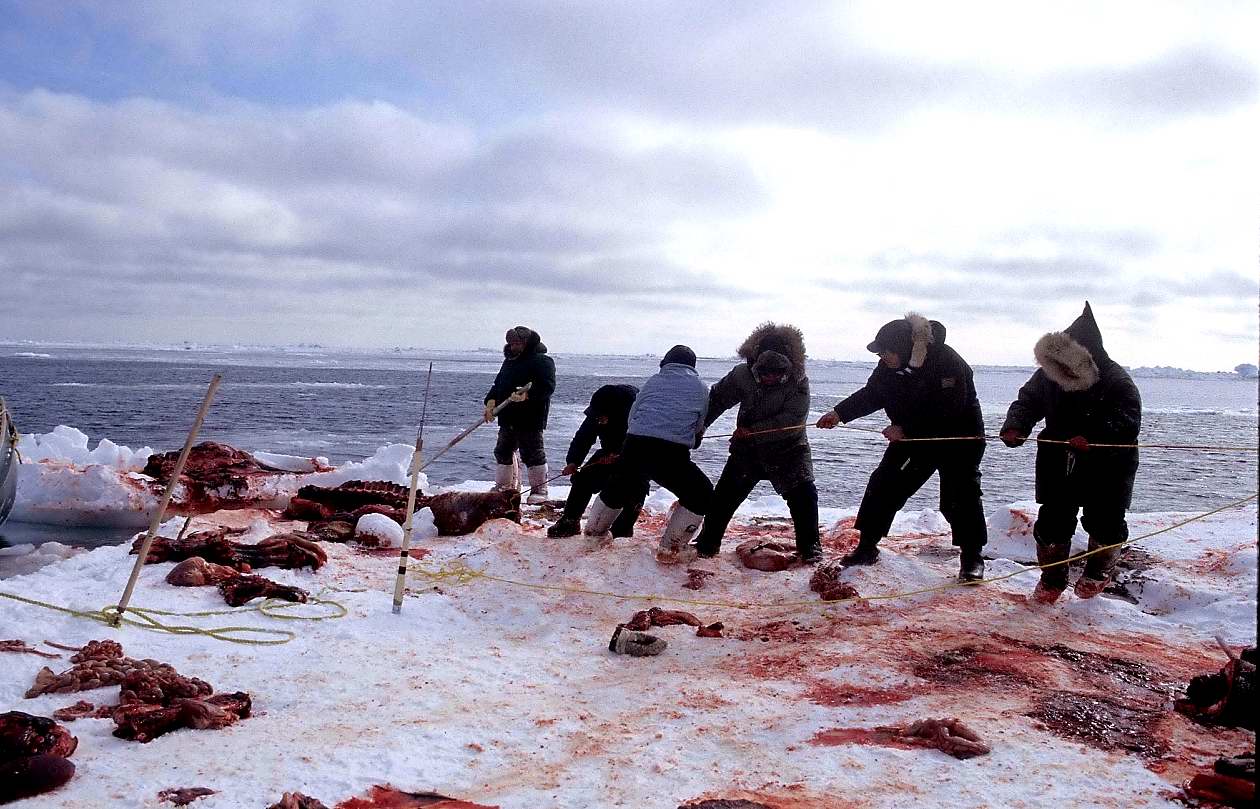
Ecologists have debated whether humans are apex predators. For instance, Sylvain Bonhommeau and colleagues argued in 2013 that across the global food web, a fractional human trophic level (HTL) can be calculated as the mean trophic level of every species in the human diet, weighted by the proportion that that species forms in the diet. This analysis gives an average HTL of 2.21, varying between 2.04 (for Burundi, with a 96.7% plant-based diet) and 2.57 (for Iceland, with 50% meat and fish, 50% plants). These values are comparable to those of non-apex predators such as the anchovy or pig.
However, Peter D. Roopnarine criticized Bonhommeau's approach in 2014, arguing that humans are apex predators and that the HTL was based on terrestrial farming where indeed humans have a low trophic level, mainly eating producers (crop plants at level 1) or primary consumers (herbivores at level 2), which as expected places humans at a level slightly above 2. Roopnarine instead calculated the position of humans in two marine ecosystems, a Caribbean coral reef and the Benguela system near South Africa. In these systems, humans mainly eat predatory fish and have a fractional trophic level of 4.65 and 4.5, respectively, which in Roopnarine's view makes those humans apex predators.
In 2021, Miki Ben-Dor and colleagues compared human biology to that of animals at various trophic levels. Using metrics as diverse as tool use and acidity of the stomach, they concluded that humans evolved as apex predators, diversifying their diets in response to the disappearance of most of the megafauna that had once been their primary source of food.
Evolutionary history

Apex predators are thought to have existed since at least the Cambrian period, around 500 million years ago. Extinct species cannot be directly determined to be apex predators as their behavior cannot be observed, and clues to ecological relationships, such as bite marks on bones or shells, do not form a complete picture. However, indirect evidence such as the absence of any discernible predator in an environment is suggestive. Anomalocaris was an aquatic apex predator, in the Cambrian. Its mouthparts are clearly predatory, and there were no larger animals in the seas at that time.
Carnivorous theropod dinosaurs including Allosaurus and Tyrannosaurus are theorized to have been apex predators, based on their size, morphology, and dietary needs.
A Permian shark, Triodus sessilis, was discovered containing two amphibians (Archegosaurus decheni and Cheliderpeton latirostre), one of which had consumed a fish, Acanthodes bronni, showing that the shark had lived at a trophic level of at least 4.
Among more recent fossils, the saber-tooth cats, like Smilodon, are considered to have been apex predators in the Cenozoic.
Interactions with humans

Hunting
Humans hunted with apex predators in the form of wolves, and in turn with domestic dogs, for 40,000 years; this collaboration may have helped modern humans to outcompete the Neanderthals. Humans still hunt with dogs, which have often been bred as gun dogs to point to, flush out, or retrieve prey. The Portuguese Water Dog was used to drive fish into nets. Several breeds of dog have been used to chase large prey such as deer and wolves.
Eagles and falcons, which are apex predators, are used in falconry, hunting birds or mammals. Tethered cormorants, also top predators, have been used to catch fish.
Ecotourism
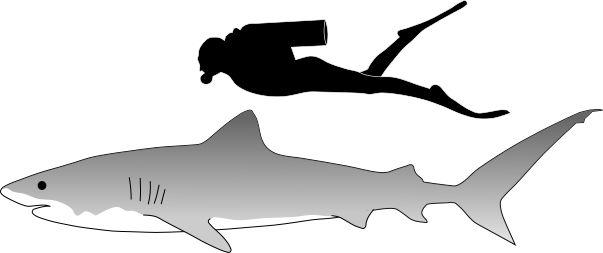
Ecotourism sometimes relies on apex predators to attract business. Tour operators may in consequence decide to intervene in ecosystems, for example by providing food to attract predators to areas that can conveniently be visited. This in turn can have effects on predator population and therefore on the wider ecosystem. As a result, provisioning of species such as the tiger shark is controversial, but its effects are not well established by empirical evidence. Other affected apex predators include big cats and crocodiles.
Rewilding
.jpg)
In some densely populated areas like the British Isles, all the large native predators like the wolf, bear, wolverine and lynx have become extirpated, allowing herbivores such as deer to multiply unchecked except by hunting. In 2015, plans were made to reintroduce lynx to the counties of Norfolk, Cumbria, and Northumberland in England, and Aberdeenshire in Scotland as part of the rewilding movement.
Notes
References
References
- (2013). "Saving large carnivores, but losing the apex predator?". Biological Conservation.
- (2019). "Africa's apex predator, the lion, is limited by interference and exploitive competition with humans". Global Ecology and Conservation.
- Sukhdeo, Michael V. K.. (2012). "Where are the parasites in food webs?". Parasites & Vectors.
- "predator". Online Etymological Dictionary.
- "apex predator". PBS.
- link. (2010-10-28 ''Australia Zoo''. 2007-06-11. Retrieved 2010-01-25.)
- [http://animals.nationalgeographic.com/animals/reptiles/saltwater-crocodile.html "Saltwater Crocodile."] {{webarchive. link. (2013-09-06 ''National Geographic''. Retrieved 2010-01-25.)
- (March 2006). "Rapid food web recovery in response to removal of an introduced apex predator". Canadian Journal of Fisheries and Aquatic Sciences.
- (April 2014). "Impacts of Removing Badgers on Localised Counts of Hedgehogs". PLOS ONE.
- Davic, Robert D.. (2003). "Linking Keystone Species and Functional Groups: A New Operational Definition of the Keystone Species Concept". Conservation Ecology.
- (2015). "What is an apex predator?". Oikos.
- (May 2016). "Ecosystem context and historical contingency in apex predator recoveries". Science Advances.
- Croll, D. A.. (March 2005). "Introduced predators transform subarctic islands from grassland to tundra". [[Science (magazine).
- Egan, Logan Zane. (June 2005). "Effects of preferential primary consumer fishing on lower trophic level herbivores in the Line Islands". [[Stanford University]].
- Pace, M. L.. (December 1999). "Trophic cascades revealed in diverse ecosystems". Trends in Ecology and Evolution.
- (1999). "Anthropogenic extinction of top carnivores and interspecific animal behaviour: implications of the rapid decoupling of a web involving wolves, bears, moose and ravens". Proceedings of the Royal Society B: Biological Sciences.
- (2009). "Cascading top-down effects of changing oceanic predator abundances". Journal of Animal Ecology.
- (March 1988). "Reconstructed Dynamics of Rapid Extinctions of Chaparral-Requiring Birds in Urban Habitat Islands". Conservation Biology.
- (2009). "The Rise of the Mesopredator". BioScience.
- (2011). "Trophic Downgrading of Planet Earth". Science.
- (2018). "Are the ghosts of nature's past haunting ecology today?". Current Biology.
- (27 January 2009). "Climate impacts on polar bears". Polar Bear Specialist Group.
- Lister, Brad & McDaniel, Carl. [http://www.bioinfo.rpi.edu/~bystrc/pub/artWolves.pdf "The wolves of Yellowstone"] {{webarchive. link. (2011-07-20 (2006-04-17), p. 2. Retrieved 2010-01-25.)
- Levy, Sharon. (November 2002). "Top Dogs".
- Wilmers, Christopher C.. (2004). "The gray wolf – scavenger complex in Yellowstone National Park".
- Robbins, Jim. (May–June 1998). "Weaving a new web: wolves change an ecosystem". [[Smithsonian Institution]].
- (2005). "Gray Wolves as Climate Change Buffers in Yellowstone". PLOS Biology.
- (2013-02-15). "Perfluoroalkyl substances in eggs and plasma of an avian top predator, great skua (Stercorarius skua), in the north Atlantic". Environmental Toxicology and Chemistry.
- (2021-03-31). "Declining deer population likely due to natural regulation".
- (2013). "Eating up the world's food web and the human trophic level". Proceedings of the National Academy of Sciences.
- (2014). "Humans are apex predators". Proceedings of the National Academy of Sciences.
- (2021). "The evolution of the human trophic level during the Pleistocene". [[American Journal of Physical Anthropology]].
- Callaway, Ewen. (2011). "Cambrian super-predators grew large in arms race". Nature.
- (22 November 2013). "Neovenatorid theropods are apex predators in the Late Cretaceous of North America". Nature Communications.
- (2002). "Dinosaurian and Mammalian Predators Compared". Paleobiology.
- (2008). "First direct evidence of a vertebrate three-level trophic chain in the fossil record". Proceedings of the Royal Society B: Biological Sciences.
- (2018). "Smilodon: The Iconic Sabertooth". Johns Hopkins University Press.
- McKie, Robin. (1 March 2015). "How hunting with wolves helped humans outsmart the Neanderthals". [[The Guardian]].
- Shipman, Pat. (2015). "The invaders: how humans and their dogs drove Neanderthals to extinction". Harvard University Press.
- (10 March 2017). "The 7 categories of dog". [[The Daily Telegraph]].
- "Portuguese Water Dog". [[The Kennel Club]].
- Fergus, Charles. (2002). "Gun Dog Breeds, A Guide to Spaniels, Retrievers, and Pointing Dogs". The Lyons Press.
- "History of Falconry". The Falconry Centre.
- (February 2004). "Cormorant Predation and the Population Dynamics of Walleye and Yellow Perch in Oneida Lake". Ecological Applications.
- King, Richard J.. (2013). "The Devil's Cormorant: A Natural History". University of New Hampshire Press.
- (2012). "Don't bite the hand that feeds: assessing ecological impacts of provisioning ecotourism on an apex marine predator". Functional Ecology.
- (2017). "Conservation potential of apex predator tourism". Biological Conservation.
- "The rewilding plan that would return Britain to nature". BBC.
- (28 April 2015). "Bring on a few more apex predators". The Daily Telegraph.
This article was imported from Wikipedia and is available under the Creative Commons Attribution-ShareAlike 4.0 License. Content has been adapted to SurfDoc format. Original contributors can be found on the article history page.
Ask Mako anything about Apex predator — get instant answers, deeper analysis, and related topics.
Research with MakoFree with your Surf account
Create a free account to save articles, ask Mako questions, and organize your research.
Sign up freeThis content may have been generated or modified by AI. CloudSurf Software LLC is not responsible for the accuracy, completeness, or reliability of AI-generated content. Always verify important information from primary sources.
Report