From Surf Wiki (app.surf) — the open knowledge base
Anwar Sadat
President of Egypt from 1970 to 1981
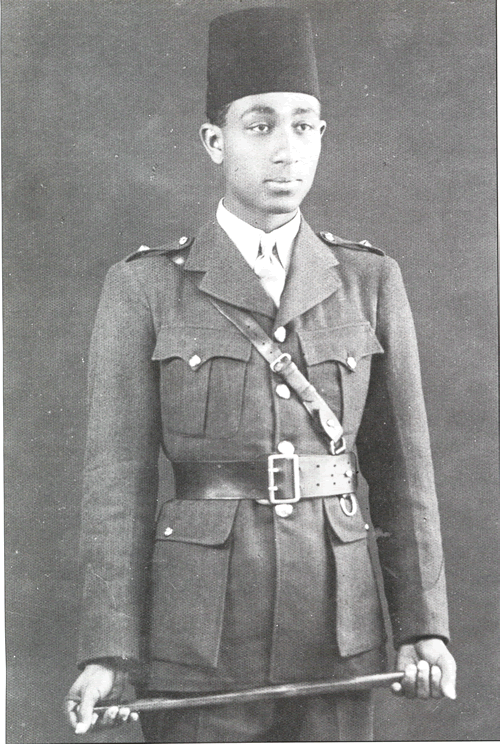
President of Egypt from 1970 to 1981
| Field | Value | |
|---|---|---|
| native_name | أنور السادات | |
| native_name_lang | ar | |
| birth_name | Muhammad Anwar es-Sadat | |
| image | Sadat 1.jpg | |
| caption | Sadat in 1978 | |
| order | 3rd | |
| office | President of Egypt | |
| term_start | 15 October 1970 | |
| term_end | 6 October 1981 | |
| Acting: 28 September – 15 October 1970 | ||
| primeminister | {{List collapsed | title=See list |
| vicepresident | {{List collapsed | title=See list |
| predecessor | Gamal Abdel Nasser | |
| successor | Sufi Abu Taleb (acting) | |
| Hosni Mubarak | ||
| order2 | 37th | |
| office2 | Prime Minister of Egypt | |
| president2 | Himself | |
| term_start2 | 15 May 1980 | |
| term_end2 | 6 October 1981 | |
| predecessor2 | Mustafa Khalil | |
| successor2 | Hosni Mubarak | |
| president3 | Himself | |
| term_start3 | 26 March 1973 | |
| term_end3 | 25 September 1974 | |
| predecessor3 | Aziz Sedky | |
| successor3 | Abdel Aziz Mohamed Hegazy | |
| order4 | 4th | |
| office4 | Vice President of Egypt | |
| president4 | Gamal Abdel Nasser | |
| term_start4 | 19 December 1969 | |
| term_end4 | 14 October 1970 | |
| predecessor4 | Hussein el-Shafei | |
| successor4 | Ali Sabri | |
| president5 | Gamal Abdel Nasser | |
| term_start5 | 17 February 1964 | |
| term_end5 | 26 March 1964 | |
| predecessor5 | Hussein el-Shafei | |
| successor5 | Zakaria Mohieddin | |
| office6 | 2nd Speaker of the National Assembly of Egypt | |
| president6 | Gamal Abdel Nasser | |
| term_start6 | 21 July 1960 | |
| term_end6 | 20 January 1969 | |
| predecessor6 | Abdel Latif Boghdadi | |
| successor6 | Mohamed Labib Skokeir | |
| birth_date | ||
| birth_place | Monufia, Sultanate of Egypt | |
| death_date | ||
| death_place | Nasr City, Cairo, Egypt | |
| death_cause | Assassination | |
| resting_place | Unknown Soldier Memorial | |
| spouse | ||
| children | 7 | |
| party | National Democratic Party | |
| otherparty | Arab Socialist Union | |
| National Union | ||
| Young Egypt Party | ||
| alma_mater | Egyptian Military Academy | |
| allegiance | Egypt | |
| branch | Egypt Egyptian Army | |
| serviceyears | 1938–1952 | |
| rank | [[File:KEgypt-Army-OF-05.svg | 25px]] Colonel (active) |
| [[File:Egypt Army - OF10.svg | 25px]] Field Marshal (honorary) | |
| signature | Anwar El Sadat Signature.svg | |
| module | ||
| honorific_prefix | His Excellency |
Acting: 28 September – 15 October 1970 | Mahmoud Fawzi (1970–1972) | Aziz Sedky (1972–1973) | Himself (1973–1974) | Abdel Aziz Mohamed Hegazy (1974–1975) | Mamdouh Salem (1975–1978) | Mustafa Khalil (1978–1980) | Himself (1980–1981) | Hussein el-Shafei (1970–1973) | Ali Sabri (1970–1971) | Mahmoud Fawzi (1972–1974) | Hosni Mubarak (1975–1981) Hosni Mubarak National Union Young Egypt Party Muhammad Anwar es-Sadat (25 December 1918 – 6 October 1981) was an Egyptian politician and military officer who served as the 3rd president of Egypt, from 15 October 1970 until his assassination by members of the Egyptian Islamic Jihad on 6 October 1981. Sadat was a senior member of the Free Officers who overthrew King Farouk I in the Egyptian Revolution of 1952, and a close confidant of President Gamal Abdel Nasser, under whom he served as the vice president twice and whom he succeeded as president in 1970. In 1978, Sadat and Menachem Begin, Prime Minister of Israel, signed a peace treaty in cooperation with United States President Jimmy Carter, for which they were recognized with the Nobel Peace Prize.
In his 11 years as president, he changed Egypt's trajectory, departing from many political and economic tenets of Nasserism, reinstituting a multi-party system, and launching the Infitah economic policy. As President, he led Egypt in the Yom Kippur War of 1973 to regain Egypt's Sinai Peninsula, which Israel had occupied since the Six-Day War of 1967, making him a hero in Egypt and, for a time, the wider Arab world. Afterwards, he engaged in negotiations with Israel, culminating in the Camp David Accords and the Egypt–Israel peace treaty.
Although reaction to the treatywhich resulted in the return of Sinai to Egyptwas generally favorable among Egyptians, it was rejected by the country's Muslim Brotherhood and the left, which felt Sadat had abandoned efforts to ensure a State of Palestine. The peace treaty was also one of the primary factors that led to his assassination; on 6 October 1981, militants led by Khalid Al-Islambuli opened fire on Sadat with automatic rifles during the 6 October parade in Cairo, killing him.
Early life and revolutionary activities
Anwar Sadat was born on 25 December 1918 in Mit Abu El Kom, part of Monufia Governorate in what was then the Sultanate of Egypt, to a poor family, and he had 14 siblings. One of his brothers, Atef Sadat, later became a pilot and was killed in action in 1973 during the Yom Kippur War. His father, Anwar Mohammed El Sadat, was an Upper Egyptian, and his mother, Sit Al-Berain, was born to an Egyptian mother and a Sudanese father.
He graduated from the Royal Military Academy in Cairo, the capital of what was then the Kingdom of Egypt, in 1938 and was appointed to the Signal Corps. He entered the army as a second lieutenant and was posted to the Anglo-Egyptian Sudan (the Sudan being a condominium under joint British and Egyptian rule at the time). There, he met Gamal Abdel Nasser, and along with several other junior officers they formed the Free Officers, an organization committed to overthrowing British rule in Egypt and eliminating state corruption.
During World War II, Sadat, a member of the fascist and ultranationalist Young Egypt Party, collaborated with Nazi Germany in Egypt as part of Operation Salam. There were meetings and talk amongst some pro-Axis junior officers of a potential revolt, and Sadat later said that he'd wanted to make Egypt "a second Iraq". After the Abdeen Palace incident, Sadat furthered his plans for a coup, but Muslim Brotherhood leader Hassan al-Banna declined to support the plot. He then met with two German agents in Cairo to discuss his plan, but was arrested and imprisoned for much of the war. By the end of the conflict, Sadat had already met with the secret society that decided to assassinate Amin Osman, Minister of Finance in the Wafd Party government, and the head of the Egyptian-British Friendship Society, due to his strong sympathies towards the British. Osman was assassinated in January 1946. Following the assassination of Amin Osman, Sadat returned again and finally to prison.
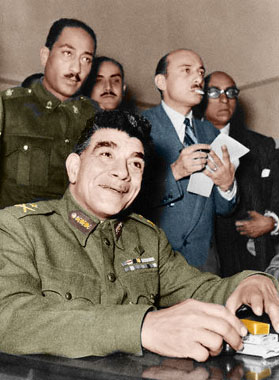
In Qarmidan prison, he faced the most difficult ordeals of imprisonment by being held in solitary confinement, but the first accused in the Hussein Tawfiq case, escaped, and after there is no criminality evidence all the charges fall and the suspected went free. Salah Zulfikar, then young police officer, at that time was the officer in charge in the prison. He believed in his heart of Sadat's heroism and that he played a patriotic role towards his country and that he was convicted and imprisoned because of his love for his country. Zulfikar brought with him food, newspapers and cigarettes and helped his family a lot in obtaining visitor permits to check on him. Anwar Sadat was active in many political movements, including the Muslim Brotherhood, the fascist Young Egypt Party, the pro-Axis and pro-Royalist Iron Guard of Egypt, and the secret military group called the Free Officers. Along with his fellow Free Officers, Sadat participated in the military coup that launched the Egyptian Revolution of 1952, which overthrew King Farouk I on 23 July of that year. Sadat gave the first statement of the revolution over the radio to the Egyptian people.
During Nasser's presidency
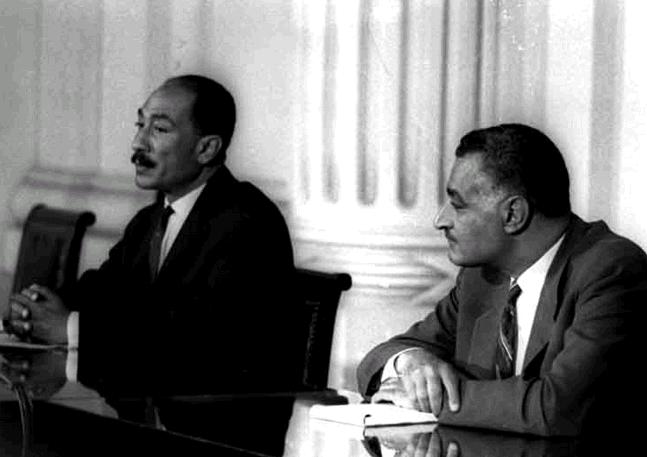

During the presidency of Gamal Abdel Nasser, Sadat was appointed minister of State in 1954. He was also appointed editor of the newly founded daily Al Gomhuria. In 1959, he assumed the position of secretary to the National Union. Sadat was the 2nd president of the National Assembly (1960–1968) and then Vice President of Egypt and member of the presidential council in 1964. He was reappointed as vice president again in December 1969.
Presidency
.jpg)
Some of the major events of Sadat's presidency were his "Corrective Revolution" to consolidate power in 1971, the break with Egypt's long-time ally and aid-giver the USSR, the Yom Kippur War with Israel, the Camp David Accords and the Egypt–Israel peace treaty, the "opening up" (or Infitah) of Egypt's economy, and lastly his assassination in 1981.
Sadat succeeded Nasser as president after the latter's death in October 1970. Sadat's presidency was widely expected to be short-lived.

On 15 May 1971,Le prophète et Pharaon by Kepel, p. 74 Sadat announced his corrective revolution, purging the government, political and security establishments of the most ardent Nasserists. Sadat encouraged the emergence of an Islamist movement, which had been suppressed by Nasser. Believing Islamists to be socially conservative he gave them "considerable cultural and ideological autonomy" in exchange for political support.
In 1971, as part of the Jarring Mission, three years into the War of Attrition in the Suez Canal zone, Sadat endorsed in a letter the peace proposals of UN negotiator Gunnar Jarring, which seemed to lead to a full peace with Israel on the basis of Israel's withdrawal to its pre-war borders. This peace initiative failed as neither Israel nor the United States of America accepted the terms as discussed then.
Corrective Revolution
Main article: Corrective Revolution (Egypt)
Sadat's rising popularity would accelerate after he cut back the powers of the hated secret police, and reformed the Egyptian army for a renewed confrontation with Israel.
Yom Kippur War
Main article: Yom Kippur War
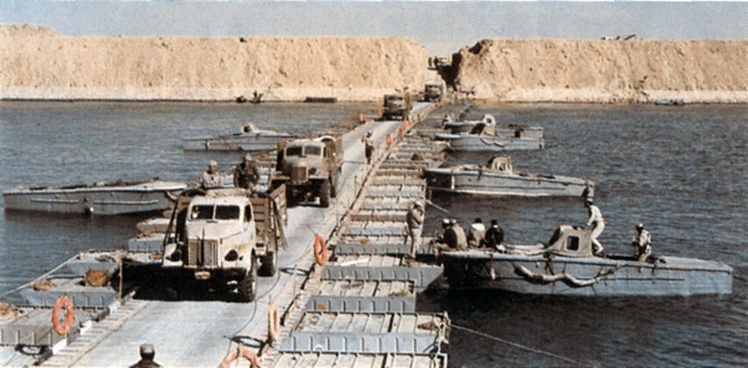
On 6 October 1973, in conjunction with Hafez al-Assad of Syria, Sadat launched the October War, also known as the Yom Kippur War (and less commonly as the Ramadan War), a surprise attack against the Israeli forces occupying the Egyptian Sinai Peninsula, and the Syrian Golan Heights in an attempt to retake these respective Egyptian and Syrian territories that had been occupied by Israel since the Six Day War six years earlier. The Egyptian and Syrian performance in the initial stages of the war astonished both Israel, and the Arab World. The most striking achievement (Operation Badr, also known as The Crossing) was the Egyptian military's advance approximately 15 km into the occupied Sinai Peninsula after penetrating and largely destroying the Bar Lev Line. This line was popularly thought to have been an impregnable defensive chain.

As the war progressed, three divisions of the Israeli army led by General Ariel Sharon had crossed the Suez Canal, trying to encircle first the Egyptian Second Army. Although this failed, prompted by an agreement between the United States of America and the Soviet Union, the United Nations Security Council passed Resolution 338 on 22 October 1973, calling for an immediate ceasefire. Although agreed upon, the ceasefire was immediately broken. Alexei Kosygin, the chairman of the USSR Council of Ministers, cancelled an official meeting with Danish Prime Minister Anker Jørgensen to travel to Egypt where he tried to persuade Sadat to sign a peace treaty. During Kosygin's two-day long stay it is unknown if he and Sadat ever met in person.
The Israeli military then continued their drive to encircle the Egyptian army. The encirclement was completed on 24 October, three days after the ceasefire was broken. This development prompted superpower tension, but a second ceasefire was imposed cooperatively on 25 October to end the war. At the conclusion of hostilities, Israeli forces were 40 kilometres (25 mi) from Damascus and 101 kilometres (63 mi) from Cairo.
Peace with Israel
Main article: Egypt–Israel peace treaty, Anwar Sadat's visit to Jerusalem
.jpg)
The initial Egyptian and Syrian victories in the war restored popular morale throughout Egypt and the Arab World and, for many years after, Sadat was known as the "Hero of the Crossing". Israel recognized Egypt as a formidable foe, and Egypt's renewed political significance eventually led to regaining and reopening the Suez Canal through the peace process. His new peace policy led to the conclusion of two agreements on disengagement of forces with the Israeli government. The first of these agreements was signed on 18 January 1974, and the second on 4 September 1975.
One major aspect of Sadat's peace policy was to gain some religious support for his efforts. Already during his visit to the US in October–November 1975, he invited Evangelical pastor Billy Graham for an official visit, which was held a few days after Sadat's visit. In addition to cultivating relations with Evangelical Christians in the US, he also built some cooperation with the Vatican. On 8 April 1976, he visited the Vatican for the first time, and got a message of support from Pope Paul VI regarding achieving peace with Israel, to include a just solution to the Palestinian issue. Sadat, on his part, extended to the Pope a public invitation to visit Cairo.
Sadat also used the media to promote his purposes. In an interview he gave to the Lebanese magazine Al Hawadeth in early February 1976, he claimed he had secret commitment from the US government to put pressure on the Israeli government for a major withdrawal in Sinai and the Golan Heights. This statement caused some concern to the Israeli government, but Secretary of State Henry Kissinger denied such a promise was ever made.
In January 1977, a series of 'Bread Riots' protested Sadat's economic liberalization and specifically a government decree lifting price controls on basic necessities like bread. The riots lasted for two days and included hundreds of thousands in Cairo. 120 buses and hundreds of buildings were destroyed in Cairo alone. The riots ended with the deployment of the army and the re-institution of the subsidies/price controls. During this time, Sadat was also taking a new approach towards improving relations with the West.
The United States and the Soviet Union agreed on 1 October 1977, on principles to govern a Geneva conference on the Middle East. Syria continued to resist such a conference. Not wanting either Syria or the Soviet Union to influence the peace process, Sadat decided to take more progressive stance towards building a comprehensive peace agreement with Israel.
The 1977 visit by Anwar Sadat to Jerusalem was the first time an Arab leader officially visited Israeli-controlled territory. Sadat met with Israeli prime minister Menachem Begin, and spoke before the Knesset in Jerusalem about his views on how to achieve a comprehensive peace to the Arab–Israeli conflict, which included the full implementation of UN Resolutions 242 and 338.
The peace treaty was finally signed by Anwar Sadat and Israeli prime minister Menachem Begin in Washington, D.C., United States, on 26 March 1979, following the Camp David Accords, a series of meetings between Egypt and Israel facilitated by US president Jimmy Carter. Both Sadat and Begin were awarded the Nobel Peace Prize for creating the treaty. In his acceptance speech, Sadat referred to the long-awaited peace desired by both Arabs and Israelis.
The main features of the agreement were the mutual recognition of each country by the other, the cessation of the state of war that had existed since the 1948 Arab–Israeli War, and the complete withdrawal by Israel of its armed forces and civilians from the rest of the Sinai Peninsula, which Israel had captured during the 1967 Six-Day War.
The agreement also provided for the free passage of Israeli ships through the Suez Canal and recognition of the Strait of Tiran and the Gulf of Aqaba as international waterways. The agreement notably made Egypt the first Arab country to officially recognize Israel. The peace agreement between Egypt and Israel has remained in effect since the treaty was signed.

The treaty was extremely unpopular in most of the Arab World and the wider Muslim World. His predecessor Nasser had made Egypt an icon of Arab nationalism, an ideology that appeared to be sidelined by an Egyptian orientation following the 1973 war (see National identity of Egyptians). The neighboring Arab countries believed that in signing the accords, Sadat had put Egypt's interests ahead of Arab unity, betraying Nasser's pan-Arabism, and destroyed the vision of a united "Arab front" for the support of the Palestinians against the "Zionist Entity". However, Sadat decided early on that peace was the solution. Sadat's shift towards a strategic relationship with the US was also seen as a betrayal by many Arabs. In the United States his peace moves gained him popularity among some Evangelical circles. He was awarded the Prince of Peace Award by Pat Robertson.
In 1979, the Arab League suspended Egypt in the wake of the Egyptian–Israel peace agreement, and the League moved its headquarters from Cairo to Tunis. Arab League member states believed in the elimination of the "Zionist Entity" and Israel at that time. It was not until 1989 that the League re-admitted Egypt as a member, and returned its headquarters to Cairo. As part of the peace deal, Israel withdrew from the Sinai Peninsula in phases, completing its withdrawal from the entire territory except the town of Taba by 25 April 1982 (withdrawal from which did not occur until 1989). The improved relations Egypt gained with the West through the Camp David Accords soon gave the country resilient economic growth. By 1980, however, Egypt's strained relations with the Arab World would result in a period of rapid inflation.
Relationship with Mohammad Reza Shah Pahlavi of Iran

The relationship between Iran and Egypt had fallen into open hostility during Gamal Abdel Nasser's presidency. Following his death in 1970, President Sadat turned this around quickly into an open and close friendship.
In 1971, Sadat addressed the Iranian parliament in Tehran in fluent Persian, describing the 2,500-year-old historic connection between the two lands.
Overnight, the Egyptian and Iranian governments were turned from bitter enemies into fast friends. The relationship between Cairo and Tehran became so friendly that the Shah of Iran, Mohammad Reza Pahlavi, called Sadat his "dear brother".
After the 1973 war with Israel, Iran assumed a leading role in cleaning up and reactivating the blocked Suez Canal with heavy investment. The country also facilitated the withdrawal of Israel from the occupied Sinai Peninsula by promising to substitute the loss of the oil to the Israelis with free Iranian oil if they withdrew from the Egyptian oil wells in western Sinai.
All these added more to the personal friendship between Sadat and the Shah of Iran. (The Shah's first wife was Princess Fawzia of Egypt. She was the eldest daughter of Sultan Fuad I of Egypt and Sudan (later King Fuad I) and his second wife Nazli Sabri.)
After his overthrow, the deposed Shah spent the last months of his life in exile in Egypt. When the Shah died, Sadat ordered that he be given a state funeral and be interred at the Al-Rifa'i Mosque in Cairo, the resting place of Egyptian Khedive Isma'il Pasha, his mother Khushyar Hanim, and numerous other members of the royal family of Egypt and Sudan.
Assassination
Main article: Assassination of Anwar Sadat
The last months of Sadat's presidency were marked by internal uprising.
Earlier in his presidency, Islamists had benefited from the 'rectification revolution' and the release from prison of activists jailed under Nasser. But Sadat's Sinai treaty with Israel enraged Islamists, particularly the radical Egyptian Islamic Jihad. According to interviews and information gathered by journalist Lawrence Wright, the group was recruiting military officers and accumulating weapons, waiting for the right moment to launch "a complete overthrow of the existing order" in Egypt. Chief strategist of El-Jihad was Abbud al-Zumar, a colonel in the military intelligence whose "plan was to kill the main leaders of the country, capture the headquarters of the army and State Security, the telephone exchange building, and of course the radio and television building, where news of the Islamic revolution would then be broadcast, unleashinghe expecteda popular uprising against secular authority all over the country".
In February 1981, Egyptian authorities were alerted to El-Jihad's plan by the arrest of an operative carrying crucial information. In September, Sadat ordered a highly unpopular roundup of more than 1,500 people, including many Jihad members, but also the Coptic Pope and other Coptic clergy, intellectuals and activists of all ideological stripes. All non-government press was banned as well. The roundup missed a Jihad cell in the military led by Lieutenant Khalid Al-Islambuli, who would succeed in assassinating Anwar Sadat that October. The assassination plot altogether was led by Muhammad Abd al-Salam Faraj, an Egyptian Islamic Jihad member who was a civilian engineer.
According to Tala'at Qasim, ex-head of the Gama'a Islamiyya interviewed in Middle East Report, it was not Islamic Jihad but his organization, known in English as the "Islamic Group", that organized the assassination and recruited the assassin (Al-Islambuli). Members of the Group's 'Majlis el-Shura' ('Consultative Council') – headed by the famed 'blind shaykh' – were arrested two weeks before the killing, but they did not disclose the existing plans and Al-Islambuli succeeded in assassinating Sadat.
On 6 October 1981, Sadat was assassinated during the annual victory parade held in Cairo to celebrate Egypt's crossing of the Suez Canal. Al-Islambuli emptied his assault rifle into Sadat's body while in the front of the grandstand, mortally wounding the President. In addition to Sadat, eleven others were killed, including the Cuban ambassador, an Omani general, a Coptic Orthodox bishop and Samir Helmy, the head of Egypt's Central Auditing Agency (CAA). Twenty-eight were wounded, including Vice President Hosni Mubarak, Irish Defence Minister James Tully, and four US military liaison officers.
The assassination squad was led by Lieutenant Al-Islambuli after a fatwā approving the assassination had been obtained from Omar Abdel-Rahman. Al-Salam Faraj and four defendants who directly attacked Sadat, including Al-Islambuli, were found guilty, sentenced to death, and executed on April 15, 1982. Sadat's two military assailants, al-Islambuli and Sergeant Hussein Abbas Mohammed, would be executed by a firing squad, while the three civilian perpetrators, al-Salam Faraj, engineer and former army officer Abdel-Salam Abdel Aal and engineer Atta Tayel Hemida Raheel, were hung. By April 1982, 19 people would be tried for Sadat's assassination, with 17 being jailed and two being acquitted.
Aftermath
Sadat was succeeded by his vice president Hosni Mubarak, whose hand was injured during the attack. Sadat's funeral was attended by a record number of dignitaries from around the world, including a rare simultaneous attendance by three former US presidents: Gerald Ford, Jimmy Carter and Richard Nixon. Sudan's President Gaafar Nimeiry was the only Arab head of state to attend the funeral. Only 3 of 24 states in the Arab LeagueOman, Somalia and Sudansent representatives at all. Israel's prime minister, Menachem Begin, considered Sadat a personal friend and insisted on attending the funeral, walking throughout the funeral procession so as not to desecrate the Sabbath. Sadat was buried in the unknown soldier memorial in Cairo, across the street from the stand where he was assassinated.
Over three hundred Islamic radicals were indicted in the trial of assassin Khalid Al-Islambuli, including future al-Qaeda leader Ayman al-Zawahiri, Omar Abdel-Rahman, and Abd al-Hamid Kishk. The trial was covered by the international press and Zawahiri's knowledge of English made him the de facto spokesman for the defendants. Zawahiri was released from prison in 1984. Abboud al-Zomor and Tareq al-Zomor, two Islamic Jihad leaders imprisoned in connection with the assassination, were released on 11 March 2011.
Despite these facts, the nephew of the late president, Talaat Sadat, claimed that the assassination was an international conspiracy. On 31 October 2006, he was sentenced to a year in prison for defaming Egypt's armed forces, less than a month after he gave the interview accusing Egyptian generals of masterminding his uncle's assassination. In an interview with a Saudi television channel, he also claimed both the United States and Israel were involved noting that no one from the special personal protection group of Sadat fired a single shot during the killing, and not one of them has been put on trial.
Media portrayals of Anwar Sadat

In 1983, Sadat, a miniseries based on the life of Anwar Sadat, aired on US television with Oscar-winning actor Louis Gossett Jr. in the title role. The film was promptly banned by the Egyptian government, as were all other movies produced and distributed by Columbia Pictures, over allegations of historical inaccuracies. A civil lawsuit was brought by Egypt's artists' and film unions against Columbia Pictures and the film's directors, producers and scriptwriters before a court in Cairo, but was dismissed, since the alleged slanders, having taken place outside the country, fell outside the Egyptian courts' jurisdiction.
The film was critically acclaimed in North America, but was unpopular among Egyptians and in the Egyptian press. Western authors attributed the film's poor reception in Egypt to racism – Gossett being African-American – in the Egyptian government or Egypt in general. Either way, one Western source wrote that Sadat's portrayal by Gossett "bothered race-conscious Egyptians and wouldn't have pleased [the deceased] Sadat," who identified as Egyptian and Northeast African, not black. The two-part series earned Gossett an Emmy nomination in the United States.
He was portrayed by Robert Loggia in the 1982 television movie A Woman Called Golda, opposite Ingrid Bergman as Golda Meir.
The first Egyptian depiction of Sadat's life came in 2001, when Ayyam El Sadat (English: The Days of Sadat) was released in Egyptian cinemas. The movie was a major success in Egypt, and was hailed as Ahmed Zaki's greatest performance to date.
Sadat was a recurring character on Saturday Night Live, played by Garrett Morris, who bore a resemblance to Sadat.
Honours awarded
National
- [[File:EGY_Order_of_the_Republic_-_Grand_Cordon_BAR.png|50px]] Collar of the Order of the Republic
- [[File:EGY_Order_of_the_Nile_-_Grand_Cordon_BAR.svg|50px]] Grand Cordon of the Order of the Nile
- [[File:EGY_Order_of_Merit_-_Grand_Cross_BAR.png|50px]] Grand Cross of the Order of Merit
- [[File:EGY_-Order_of_the_Virtues-_Supreme_and_first_classes.svg|50px]] Supreme Class of the Order of the Virtues
Foreign
- Albania: Grand Cross of the Order of Fidelity
- Austria: Grand Star of the Decoration of Honour for Services to the Republic of Austria
- Italy: Knight Grand Cross of the Order of Merit of the Italian Republic
- Kuwait: Collar of the Order of Mubarak the Great
- Malaysia: Honorary Grand Commander of the Order of the Defender of the Realm (SMN (K)) with title Tun (1965)
- Nepal:
- Member First Class of the Order of the Star of Nepal
- Member of the Order of the Benevolent Ruler
- Saudi Arabia: First Class of the Order of King Abdulaziz
- Ba'athist Syria: Member First Class of the Order of the Umayyads
- Tunisia: Grand Cross of the Order of the Republic
- United States:
- Recipient of the Presidential Medal of Freedom (1984)
- Recipient of the Congressional Gold Medal (2018, posthumous)
- Yugoslavia
- Order of the Yugoslav Great Star (1977)
Bibliography
Notes
References
Sources
References
- Finklestone, Joseph. (2013). "Anwar Sadat: Visionary Who Dared". [[Routledge]].
- Serrieh, Joanne. (9 July 2021). "Jehan Sadat, wife of late Anwar Sadat, dies after short battle with illness: Reports". [[Al Arabiya English]].
- "Sadat". [[HarperCollins]].
- "Sadat". [[Oxford University Press]]}}{{cbignore.
- {{Cite Merriam-Webster. Sādāt
- "Peace with Israel".
- Graham, Nick. (21 August 2010). "Middle East Peace Talks: Israel, Palestinian Negotiations More Hopeless Than Ever". [[HuffPost]].
- Vatikiotis, P. J.. (1992). "The History of Modern Egypt". [[Johns Hopkins University Press]].
- Gwertzman, Bernard. (March 26, 1979). "Egypt and Israel Sign Formal Treaty, Ending a State of War After 30 Years; Sadat and Begin Praise Carter's Role". [[The New York Times]].
- (25 January 2010). "Profile: Anwar Sadat The former Egyptian president believed a peace deal with Israel was vital to end wars.". [[Al Jazeera]].
- (6 January 1974). "Sadat's Brother Reported Killed During October War". [[The New York Times]].
- C. J. De Wet. (2006). "Development-induced Displacement: Problems, Policies, and People". Berghahn Books.
- "Sadat's Wife autobiography".
- Alagna, Magdalena. (2004). "Anwar Sadat". The Rosen Publishing Group.
- Wagner, Heather Lehr. (2007). "Anwar Sadat and Menachem Begin: Negotiating Peace in the Middle East". Infobase Publishing.
- (4 April 2014). "New play 'Camp David' retraces 1978 peace accord". Associated Press.
- Sadat, Anwar. (1957). "Revolt on the Nile". Allan Wingate.
- Sādāt, Anwar as-. (1978). "In search of identity: an autobiography". Harper & Row.
- Sadat, Anwat. "Revolt on the Nile". Allan Wingate.
- Sādāt, Anwar as-. (1978). "In search of identity: an autobiography". Harper & Row.
- Benjamin, Milton R.. (1977-11-20). "Sadat: The Man Who Admires A Bold Gamble". Washington Post.
- Sādāt, Anwar as-. (1978). "In search of identity: an autobiography". Harper & Row.
- Alterman, Jon B.. (April 1, 1998). "Sadat and His Legacy: Egypt and the World, 1977–1997". [[The Washington Institute for Near East Policy]].
- (19 February 2017). "Egyptian Revolution of 1952". [[Egypt Today]].
- Alterman, Jon B.. (November 1, 1998). "New Media New Politics?". [[The Washington Institute for Near East Policy]].
- (16 October 1970). "Big 'yes' for Anwar Sadat". Ottawa Citizen.
- (16 December 2000). "Egypt Corrective Revolution 1971". Onwar.
- Kepel, Gilles. (2002). "Jihad: Expansion et Déclin de l"Islamisme". Belknap Press of Harvard University Press.
- (January 1997). "Egypt and Israel – Was There a Peace Opportunity Missed in 1971?". [[Journal of Contemporary History]].
- Podeh, Elie. (2015). "Chances for Peace". [[University of Texas Press]].
- (5 July 2013). "The Egyptian Military's Huge Historical Role". [[National Geographic]].
- Mary Ann Fay. (December 1990). "A Country Study". The Library of Congress.
- "Situation report in the Middle East". [[United States Department of State]].
- Golan, Galia. (1990). "Soviet Policies in the Middle East: From World War Two to Gorbachev". [[Cambridge University Press]].
- (2001). "Righteous Victims: A History of the Zionist-Arab Conflict, 1881–1998". 1999.
- (February 6, 1978). "National Press Club Luncheon Speakers, Anwar Sadat, February 6, 1978". [[National Press Club (United States).
- "Text of diplomatic cable regarding Graham's visit to Egypt (US government website)".
- (1976). "Text of Pope's message to Sadat". Vatican.
- (29 August 1975). "Rumors say Pope may visit Egypt". The Catholic Northwest Progress.
- "Sadat interview to El Hawadeth".
- "Telephone conversation between Kissinger and Rabin, February 5, 1976".
- Mary Ann Weaver, ''Portrait of Egypt'', p. 25
- Olivier, Roy. (1994). "Failure of Political Islam". [[Harvard University Press]].
- Weaver, Mary Ann. (1999). "Portrait of Egypt". Farrar, Straus and Giroux.
- Regev, Mark. (November 24, 2022). "Looking back at Egypt's Anwar Sadat's historic Jerusalem visit, 45 years ago – opinion". [[The Jerusalem Post]].
- "Egyptian President Sadat's Speech in Jerusalem (1977)". [[Economic Cooperation Foundation]].
- Berenji, Shahin. (1 July 2020). "Sadat and the Road to Jerusalem: Bold Gestures and Risk Acceptance in the Search for Peace". [[International Security (journal).
- "Anwar Al-Sadat".
- Vatikiotis, P.J.. (1992). "The History of Modern Egypt". [[Johns Hopkins University]].
- Pace, Eric. (7 October 1981). "Anwar el-Sadat, the Daring Arab Pioneer of Peace with Israel". [[The New York Times]].
- (1978). "The Nobel Peace Prize 1978 – Presentation Speech". Nobel prize.
- "Teaching". Pat Robertson.
- (2014). "Psalm 83: A New Discovery". iUniverse.
- An Ideology of Martyrdom – ''Time''
- Wright, 2006, p. 49
- 'Cracking Down', ''[[Time (magazine). Time]]'', 14 September 1981
- ''Le prophète et Pharaon'' by Kepel, pp. 103–104
- Wright, 2006, p. 50
- Orbach, Danny. (November 2012). "Tyrannicide in Radical Islam: The Case of Sayyid Qutb and Abd al Salam Faraj". Middle Eastern Studies Vol. 48, No. 6.
- (16 April 1982). "Sadat Assassins are Executed". [[The Herald (Glasgow).
- Orbach, Danny. (November 2012). "Tyrannicide in Radical Islam: The Case of Sayyid Qutb and Abd al Salam Faraj". Middle Eastern Studies Vol. 48, No. 6.
- For an account that uses this version of events, look at Middle East Report's January–March 1996 issue, specifically Hisham Mubarak's interview with ? On pages 42–43 Qasim deals specifically with rumors of Jihad Group involvement in the assassination, and denies them entirely.
- (1981). "1981 Year in Review". [[United Press International]].
- (23 March 2005). "Taher Helmi: Feats of circumstance". Al Ahram Weekly.
- "Taher Helmy's Speech at the AUC Commencement Ceremony 2008".
- J. Tyler Dickovick. (9 August 2012). "Africa 2012". Stryker Post.
- Farrell, William E.. (16 April 2025). "5 Sadat Assassins Executed in Egypt". New York Times.
- Kirolos, W.G.. (9 October 1981). "Sadat goes to hero's grave in pyramid". [[United Press International]].
- Avner, Yehuda (2010). ''The Prime Ministers'' (p. 575). The Toby Press, LLC. Kindle Edition.
- Stack, Liam. (17 March 2011). "Egypt Releases Brother of Al Qaeda's No. 2". [[The New York Times]].
- (18 October 2006). "Sadat nephew in court appearance". [[BBC News]].
- (March 28, 1984). "Suit Over Film 'Sadat' Is Dismissed in Cairo". [[The New York Times]].
- Benjamin P. Bowser, ''Racism and Anti-Racism in World Perspective (Sage Series on Race and Ethnic Relations, Volume 13)'', (Sage Publications, Inc: 1995), p. 108
[https://select.nytimes.com/gst/abstract.html?res=F40F1FF63C5F0C718CDDAB0894DC484D81 Upset by 'Sadat,' Egypt Bars Columbia Films] - Walter M. Ulloth, Dana Brasch, ''The Press and the State: Sociohistorical and Contemporary Studies'', ([[University Press of America]]: 1987), p. 483
- Marie, Mustafa. (25 December 2018). "ET presents most prominent works portraying late President Sadat". [[Egypt Today]].
- "Senarai Penuh Penerima Darjah Kebesaran, Bintang dan Pingat Persekutuan Tahun 1965.".
- (14 December 2018). "Trump signs law honoring Anwar Sadat". EgyptToday.
- (1764). "Одликувања". Službeni list SFRJ.
This article was imported from Wikipedia and is available under the Creative Commons Attribution-ShareAlike 4.0 License. Content has been adapted to SurfDoc format. Original contributors can be found on the article history page.
Ask Mako anything about Anwar Sadat — get instant answers, deeper analysis, and related topics.
Research with MakoFree with your Surf account
Create a free account to save articles, ask Mako questions, and organize your research.
Sign up freeThis content may have been generated or modified by AI. CloudSurf Software LLC is not responsible for the accuracy, completeness, or reliability of AI-generated content. Always verify important information from primary sources.
Report