From Surf Wiki (app.surf) — the open knowledge base
Antonov An-24
Soviet turboprop airplane

Soviet turboprop airplane
| Field | Value |
|---|---|
| name | An-24 |
| image | File:Volga-Avia Antonov An-24.jpg |
| caption | Volga-Avia Antonov An-24 |
| type | Transport aircraft / Turboprop Regional airliner |
| national_origin | Soviet Union |
| manufacturer | Antonov |
| first_flight | 29 October 1959 |
| introduction | 1962 |
| status | In limited service |
| primary_user | UTair Cargo |
| more_users | Angara Airlines |
| IrAero | |
| Yakutia Airlines | |
| Soviet Armed Forces | |
| Air Koryo | |
| produced | 1959–1979 |
| number_built | 1,367 (including the Xi'an Y-7) |
| developed_into | Antonov An-30 |
| Antonov An-26 | |
| Antonov An-32 | |
| Xi'an Y-7 | |
| Antonov/Taqnia An-132 |
IrAero Yakutia Airlines Soviet Armed Forces Air Koryo Antonov An-26 Antonov An-32 Xi'an Y-7 Antonov/Taqnia An-132
The Antonov An-24 (Russian/Ukrainian: Антонов Ан-24; NATO reporting name: Coke) is a 44-seat twin turboprop transport/passenger aircraft designed in 1957 in the Soviet Union by the Antonov Design Bureau and manufactured by the Kyiv, Irkutsk and Ulan-Ude Aviation Factories. It was the first of a future family of turboprops by Antonov. The An-30 came next with a cartographic configuration, then the An-26 with a military configuration and lastly the An-32 with modernized equipment. The An-132 was intended to be the next member of the An-24 family, but Saudi Arabia's Taqnia ceased cooperation and the only prototype was destroyed, which led to the project being cancelled. A Chinese licensed-built version, the Xi'an Y-7, is heavily based on the An-24, but is not a member of the family.
Design and development
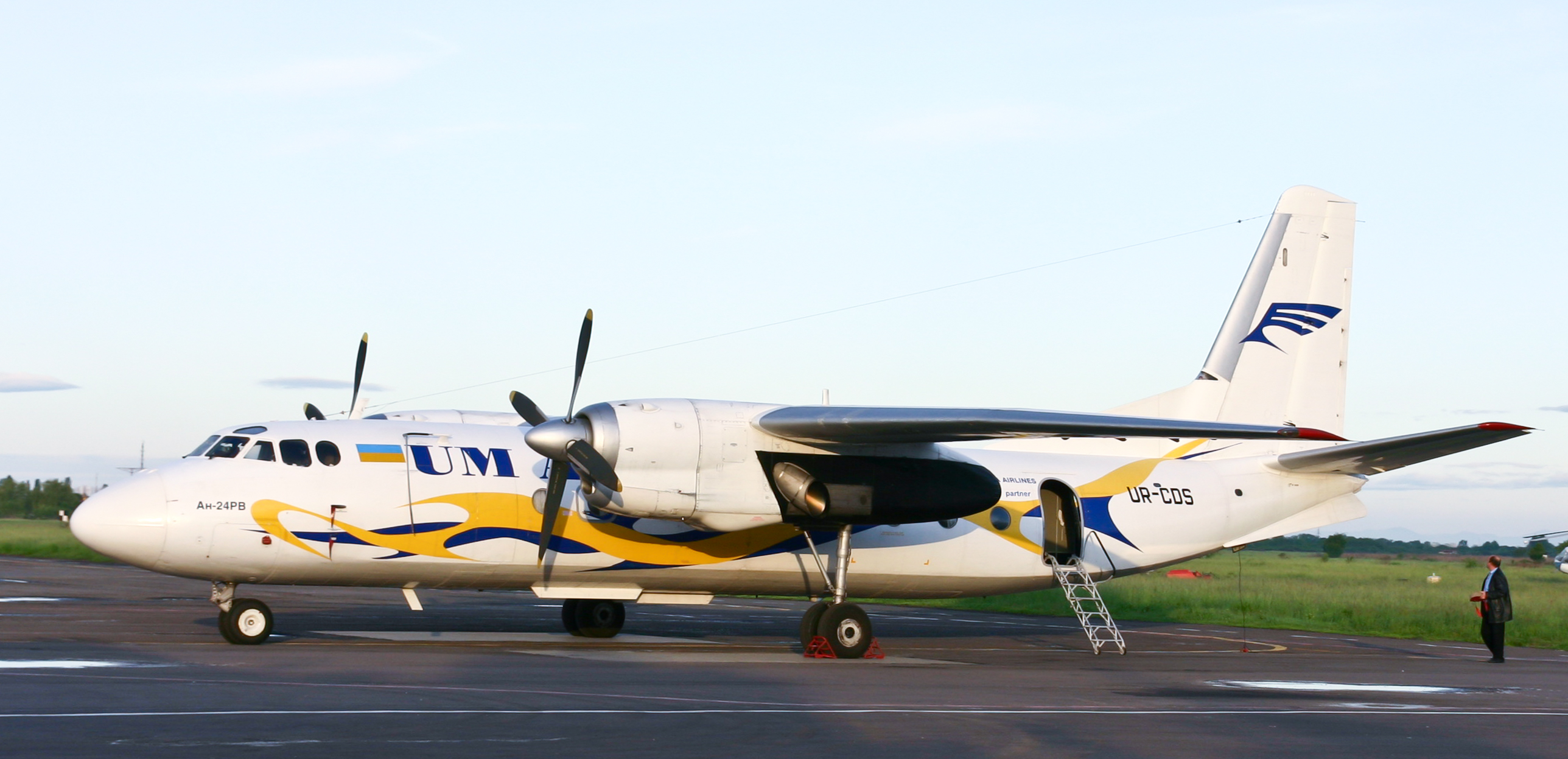

First flown in 1959, the An-24 was produced in some 1,000 units of various versions; in 2023, 93 were still in service worldwide, mostly in the Commonwealth of Independent States and Africa.
It was designed to replace the veteran piston Ilyushin Il-14 transport on short- to medium-haul trips, optimised for operating from rough strips and unprepared airports in remote locations. The high-wing layout protects engines and blades from debris, the power-to-weight ratio is higher than that of many comparable aircraft, and the machine is rugged, requiring minimal ground-support equipment.
Due to its rugged airframe and good performance, the An-24 was adapted to perform many secondary missions, such as ice reconnaissance and engine/propeller test bed, as well as further development to produce the An-26 tactical transport, An-30 photo-mapping/survey aircraft and An-32 tactical transport with more powerful engines. Various projects were envisaged such as a four-jet, short- and medium-haul airliner and various iterations of powerplant.
The main production line was at the Kyiv-Svyatoshino (later renamed "Aviant") aircraft production plant, which built 985, with 180 built at Ulan Ude, and a further 197 An-24T tactical transport/freighters at Irkutsk. Production in the USSR was shut down by 1978.
Production continued at China's Xi'an Aircraft Industrial Corporation, which made licensed, reverse-engineered, and redesigned aircraft as the Xian Y-7 and its derivatives. Manufacture of the Y-7, in civil form, has now been supplanted by the MA60 derivative with western engines and avionics, to improve performance and economy, and widen the export appeal.
The aircraft introduced in Mongolia was initially planned to be used by the air force, but was eventually handed over to a private airline company for use, and some were later used in research facilities. Since then, as the aircraft has deteriorated, it has been stored in Ulaanbaatar.
Total production
| Total Production (Not including Chinese Y-7) | 1979 | 1978 | 1977 | 1976 | 1975 | 1974 | 1973 | 1972 | 1971 | 1970 | 1969 | 1968 | 1967 | 1966 | 1965 | 1964 | 1963 | 1962 | 1961 | 1960 | 1959 | |
|---|---|---|---|---|---|---|---|---|---|---|---|---|---|---|---|---|---|---|---|---|---|---|
| 1367 | 1 | 2 | 10 | 20 | 40 | 80 | 71 | 80 | 90 | 130 | 100 | 150 | 160 | 110 | 60 | 40 | 191 | 26 | 1 | 4 | 1 |
Variants

Prototype
;An-24 : These were the first production aircraft, with a total of six built between 1959 and 1961. They were primarily used for testing the aircraft's instruments and landing gear, and also for ground tests and de-icing tests.
Produced aircraft

_JP6454795.jpg)
;An-24 :Seventeen were built. This was the first production model, separate from the prototypes built between 1959 and 1961. It was approved for production on 19 August 1961, and test engineering flights with passengers took place in September 1962. It entered service between Kiev and Kherson on 31 October 1962. Later, it was decided to replace them with improved models, and all of them were exported to Cuba and used as military transports by the Cuban Air Force. After being used as transports to replace the An-2, two were released to civilian airlines. ;An-24A :200 were built (9 in 1962, 191 in 1963) of this improved version, delivered directly from the Kiev factory. It seated 44 passengers and had a larger interior volume. In addition, the APU exhaust was moved to the tip of the starboard nacelle. This was the second time the designation was used. ;An-24B : 400 aircraft were built in the second production version. A passenger version with seating for up to 52. Maximum takeoff weight was increased to 21 tonnes, a window was added on each side, the double slotted flaps were replaced with single slotted flaps, and the centre chord was extended to compensate for the poor performance of the flaps. Some aircraft were delivered with four additional fuel bladders in the centre wing. Production began in 1964.
;An-24T (Transportnyy – transport) : This is the second time this name has been used for a tactical transport aircraft. It is equipped with a ventral loading hatch, a cargo winch, and an escape hatch behind the nose landing gear, and its mission is to transport airborne troops and infantry to frontline bases. ;An-24RT (Reaktivnyy [Uskoritel'] Transportnyy – boosted transport) : Similar to the AN-24T, fitted with an auxiliary turbojet engine. ;An-24PRT (Poiskovo-spasahtel'nyy Reaktivnyy [Uskoritel'] Transportnyy – SAR boosted transport) : The An-24RT was the basis for the search and rescue aircraft, of which 11 were manufactured, and was fitted with rescue equipment and exploration devices in the cabin. Both were considered important due to their ability to stay in the air. ;An-24RV (Reaktivnyy [Uskoritel'] V – boosted V) :Turbojet boosted export version, similar to the An-24V but fitted with a 1,985-lb (8830 N) thrust auxiliary turbojet engine in the starboard nacelle. ;An-24ShT (Shtabnoy Transportnyy – Staff/HQ transport) : A tactical Airborne Command Post for use by commanders, also capable of forming ground-based communications and HQ.
;An-24TV (Transportnyy V – transport V) :The export cargo version of the An-24T.
;An-24V : An export version of the An-24B, equipped with an AI-24T (SrsII) turboprop engine, available in early and late models. The early model has narrow in-chord wings, double slotted flaps, and a single ventral fin. The later model has a single slotted flap, twin ventral fins, and a modified interior to allow cargo to be carried in addition to passengers. Production began in 1964.
;An-24VSR : A navigation trainer aircraft that was operated in 1965 by modifying a single An-24V aircraft and was intended to train pilots in radio communication.
Special mission aircraft
;An-24ALK (Avtomatizeerovannaya [sistema] Lyotnovo Kontrolya – automatic flight check system) : A single retired passenger An-24A was converted into a satellite observation aircraft for use in navigation satellite calibration missions. It was renamed An-24LR "Toros" for air defense surveillance, but was later modified again and redesignated An-24ALK. The aircraft was equipped with a phototheodolite and a powerful light source for optical sensors.
;An-24LL (Letyushchaya Laboratoriya – flying laboratory) : A single An-24A, decommissioned from passenger transport duty, was converted into an airborne experimental aircraft. The generic suffix LL can apply to any testbed, but in the case of the An-24, it stands for metrology (the science of measurement), which is used to test the airworthiness of production aircraft.
;An-24LP (LesoPozharnyy – forest fire fighter) : Three An-24RV aircraft converted into fire bombers/cloud seeders by installing a tank in the cabin, optical smoke and flame detectors, provision for a thermal imager, racks for carrying flare dispensers and the ability to carry firefighters for para-dropping.
;An-24LR-1 'Toros' (Ice Hummock)(Ledovyy Razvedchik – ice reconnaissance) : At least two An-24Bs converted to carry the 'Toros' SLAR (sideways looking airborne radar) either side of the lower fuselage, for ice reconnaissance, guiding icebreakers, convoys and other shipping.The An-24 incident at Gambell, Alaska occurred 27 February 1974, when a Soviet Antonov An-24LR "Toros" (CCCP-47195) ice reconnaissance aircraft, low on fuel, carrying three crew members and twelve scientists, landed at Gambell Airport.
;An-24LR-2 'Nit' (Thread) :An observation aircraft type for surveying the natural resources of the earth and oceans of the world, modified from a single An-24B in 1978. Equipped with a large "Nit" SLAR pod on the side of the lower fuselage.
;An-24PS (Poiskovo-Spasahtel'nyy – SAR) : A single An-24B aircraft converted for search and rescue duties, rejected after acceptance trials in favour of a derivative of the An-24RT.
;An-24PRT : A search and rescue aircraft built from 12 modified An-24As. Some equipment was omitted to reduce production costs, but this did not hinder rescue operations.
;An-24R :It was a prototype photo reconnaissance aircraft created by modifying a single An-24A, but since the An-30 was superior overall, it ended up serving as a test aircraft and was used to test the photographic cameras to be installed on the An-30.
;An-24RR ([samolyot] Radiotsionnyy Razvedchik – radiation reconnaissance [aircraft]) : Four aircraft converted as Nuclear, biological and chemical warfare reconnaissance versions of the An-24B, carrying RR8311-100 air sampling pods low on the forward fuselage and a sensor pod on a pylon on the port fuselage side.
;An-24RT (Retranslyator – relay installation) : A few An-24T and An-24RT aircraft converted to Communications relay aircraft. Sometimes referred to as An-24Rt to differentiate from the An-24RT.
;An-24T 'Troyanda' (Ukrainian – rose) : An experimental aircraft created in 1968 by removing the winch and measuring equipment from an An-24T.From the 1960s the Soviet Union was faced with nuclear submarine threats that were virtually undetectable with the technology available. To assist in the development of advanced optical, chemical, sonic, infra-red and electromagnetic detection systems, several aircraft were built or modified as test-beds. One significant aircraft was the An-24T 'Troyanda' which was built new, for the development of sonobuoy and infra-red detection systems. As well as equipment inside the cabin, sensors could be mounted in large teardrop fairings either side of the lower forward fuselage, and extra equipment could be carried in extended wing centre-section fairings.
;An-24USh (Uchebno-Shturmanskiy (samolyot) – Navigator training aircraft) : Seven An-24Bs were converted to An-24USh navigator/air traffic controller trainers with five training stations and four standard rows of seats for trainees in waiting. Outwardly the USh was distinguishable by the bulged windows at each training station.
;An-24AEW :In the early 1990s, North Korea installed N-019 Topaz pulse-Doppler radars on at least one of its An-24A aircraft in an attempt to achieve a rudimentary Airborne Early Warning capability.
Ended as a plan only
;An-24A :The aircraft was originally intended to be produced using the Kuznetsov NK-4 turboprop engine, but production was halted when the NK-4 was cancelled. The name was later reused for a production version using a different engine.
;An-24D : A projected long-range airliner version of the An-24B with a single RU-19 booster jet engine in the starboard nacelle, stretched fuselage with seating for 60, strengthened structure and increased fuel capacity.
;An-24K : An 18-seater civilian transport aircraft that was supposed to be operated by a private company's management design department, but it never reached the concept stage.
;An-24AT : A 1962 project for a Tactical transport with rear loading ramp and powered by Isotov TV2-117DS coupled turboprops.
;An-24AT-RD (RD – Reaktivnyye Dvigateli – jet engines) : The An-24AT tactical transport project with two turbojet boosters pod-mounted under the outer wings and a wider loading ramp.
;An-24AT-U (Uskoriteli – boosters) : A projected Tactical transport from 1966 with three or five PRD-63 (Porokhovoy Raketnyy Dvigatel – gunpowder rocket engine) JATO bottles, wider cargo ramp and provision for up to three brake parachutes.
;An-24T (Transportnyy – transport) : (first use) Tactical transport version, rejected due to poor field performance and range, together with inability to load or air-drop vehicles during acceptance testing.
Advanced
;An-26 : Tactical transport with cargo ramp. ;An-30 : Survey/photo-mapping aircraft. ;An-32 : Designed to withstand adverse weather conditions better than the standard An-26. ;An-34 : The initial designation of the An-24T production tactical transport. ;An-44 : Projected cargo aircraft developed from the An-24. Ice reconnaissance and transport versions were also planned. ;An-50 : A mid-1960s project for a jet-powered An-24, with four Ivchenko AI-25 turbofan engines in podded pairs, pylon mounted forward of the wings. Not proceeded with due to competition from the Yak-40. ;Xian Y-7 : The Y-7 is a Chinese built derivative of the An-24/An-26 family. ;MA60 :Upgraded and Westernised Y-7.
Operators
Military operators
.jpg)
; Cambodia: Royal Cambodian Air Force – 2 ; North Korea: Korean People's Army Air Force – 1 (converted to a rudimentary airborne early warning aircraft) ; Russia
- Russian Air Force
- Russian Naval Aviation ; Ukraine
- Ukrainian Air Force
Former military operators
; Afghanistan: The Afghan Air Force received six from 1975 (An-24TV) ; Algeria: Algerian Air Force (Six An-24Vs) ; Angola: People's Air and Air Defence Force of Angola (Six An-24Vs) ; Armenia: Armenian Air Force (One An-24V) ; Azerbaijan: Azerbaijan Air Force (One An-24V) ; Bangladesh: Bangladesh Air Force (One An-24V) ; Belarus: Belarus Air Force (2 An-24Bs) ; Bulgaria: Bulgaria Air Force (One An-24V) ; People's Republic of China
- People's Liberation Army Air Force; as Xian Y-7
- People's Liberation Army Navy Air Force ; Republic of the Congo: Congolese Air Force ; Cuba: Cuban Air Force – Twenty An-24RVs were ordered in 1962 and gradually introduced for transport purposes, but currently only three are deployed. ;Czech Republic: Czech Air Force (before 2005) ; : Czechoslovak Air Force – No longer in service ; German Democratic Republic: Air Forces of the National People's Army ; Egypt: Egyptian Air Force ; Georgia: Georgian Air Force ; Guinea: Military of Guinea ; Guinea-Bissau: Military of Guinea-Bissau ; Equatorial Guinea: Equatorial Guinea Air Force ; Hungary: Hungarian Air Force, none in service, all retired in 1992 ; Iran: Iranian Air Force ; Iraq: Iraqi Air Force ; Kazakhstan: Military of Kazakhstan ; Laos
- Pathet Lao
- Lao People's Liberation Army Air Force ; Lithuania
- Lithuanian Air Force ; Mali: Air Force of Mali – two ; Moldova: Moldovan Air Force ; Mozambique: Military of Mozambique ; Nicaragua: Nicaraguan Air Force ; North Yemen: Yemen Arab Republic Air Force: three bought in 1979 ; Poland: Polish Air Force – 6 operated from 1966 to 1977; replaced with An-26 ; Romania: Romanian Air Force – the last RoAF An-24 was retired in 2007. ; Slovakia: Slovak Air Force – the last SAF An-24 was retired in 2006. ; Somalia: Somali Air Corps ; USSR
- Soviet Air Force
- Soviet Naval Aviation ; Sudan: Sudanese Air Force – at least five An-24TVs purchased from the USSR in the late 1960s. Retired in the late 1990s. ; Syria: Syrian Arab Air Force – 1 as of 2023. The Syrian government of Al-Assad fell to rebels in late 2024, and the Syrian Arab Air Force was dismantled. It was re-established as Syrian Air Force, but the revolution, and the Israeli air strikes that followed it, wrecked havoc in the inventory of the Air Force. In late 2025, the World Air Forces publication by FlightGlobal, which tracks the aircraft inventories of world's air forces and publishes its counts annually, removed all Syrian Air Force's aircraft from their World Air Forces 2026 report. It is thus questionable if the Syrian Air Force has any flying aircraft in their inventory, and in particular, any An-24, as of December 2025. ; Turkmenistan: Military of Turkmenistan ; Uzbekistan: Military of Uzbekistan ; Vietnam: Vietnam People's Air Force ; Yemen: Yemen Air Force
Civil operators
As of July 2018, 86 An-24s were in airline service.
Following fatal incidents in July 2011 Russian President Dmitry Medvedev proposed the accelerated decommissioning of An-24s, which resulted in a ban for this type from scheduled flights inside Russia. However, later the ban was cancelled and, as of 2023, An-24 are still in limited commercial service in Russia.
;Kazakhstan
- SCAT Airlines (7) ;Moldova
- Air Moldova (6) Used on flights to CIS states and as charter aircraft ;Russia
- Angara Airlines (5)
- Komiaviatrans (2)
- ALROSA (airline) (3)
- IrAero (11)
- KrasAvia (3)
- Khabarovsk Airlines (4)
- Polar Airlines (13) Largest passenger operator of An-24
- Yakutia Airlines (4) ; Thailand
- Phetchabun Airlines (1) ;Ukraine
- Motor Sich Airlines (3)
Former civil operators

Civil operators have included: ;[[File:Africa icon.png|20px]] Africa
- Pan African Air Services ;Afghanistan
- Ariana Afghan Airlines
- Pamir Airways ;Belarus
- Belavia ;Bulgaria
- Balkan Bulgarian Airlines ;Cambodia
- PMTair
- President Airlines
- Royal Khmer Airlines ;People's Republic of China
- CAAC Airlines
- China Southern Airlines ;Congo
- Lina Congo ;Cuba
- Aero Caribbean – It operated one An-24B.
- Cubana – It operated the An-24B, An-24V and An-24RV.As of January 2025, five aircraft have been totally lost in crashes (CU-T875 (An-24V), CU-T1262 (AN-24RV), CU-T1295 (An-24RV), CU-T876 (An-24V), CU-T879 (An-24B)). ;German Democratic Republic
- Interflug ;Egypt
- Egyptair
- Misrair ;Guinea
- Air Guinee
- Union des Transports Africains (West Coast Airways) ;Iraq
- Iraqi Airways – An-24B、An-24V、An-24RV、An-24TV ;Kazakhstan
- Air Kazakhstan ;Kyrgyzstan
- Kyrgyzstan Air Company ; Laos
- Lao Aviation ;Lithuania
- Lithuanian Airlines, 1991-1996 ;Lebanon
- Lebanese Air Transport ;Mali
- Air Mali (1960-1989) ;Mongolia
- MIAT Mongolian Airlines
- Hangard Airlines ;North Korea
- Air Koryo ;Pakistan
- Askari Aviation ;Philippines
- Mosphil Aero ;Poland
- LOT Polish Airlines ;Romania
- TAROM ;Russia
- Aeroflot
- Novosibirsk Air Enterprise
- UT Air ; Somalia:
- Jubba Airways ;USSR
- Aeroflot ;Sri Lanka
- Lionair ;Sudan
- Marsland Aviation ;Turkmenistan
- Turkmenistan Airlines (22) ;Ukraine
- Aerosvit ;United Arab Emirates
- Daallo Airlines ;Uzbekistan
- Uzbekistan Airways
| UGA – (Oopravleniye Grazhdahnskoy Aviahtsii | ||||
|---|---|---|---|---|
| - Civil Aviation Directorate) | OAO – (Otdel'nyy Aviaotryad – independent flight detachment) | LO – (Lyotnyy Otryad – flight squad) / (Aviaeskadril'ya – squadrons) | Home base | CIS (Commonwealth of Independent States) Airline |
| Arkhangelsk | 2nd Arkhangelsk | 392nd | Arkhangelsk-Vaskovo | AVL Arkhangelsk Airlines |
| Azerbaijan | Baku | 360th / 1st & 3rd squadrons | Baku-Bina | AZAL (no An-24s) |
| Belorussian | Gomel | 105th / 1st squadron | Gomel | Gomelavia |
| 1st Minsk | 353rd | Minsk-Loshitsa (Minsk-1) | Belavia;Minsk-Avia | |
| Mogilyov | Mogilev | Mogilev-Avia | ||
| Central Regions | Belgorod | Belgorod | Belgorod Air Enterprise (no An-24s) | |
| Bryansk | Bryansk | Bravia (Bryansk-Avia) | ||
| Bykovo | 61st | Moscow-Bykovo | Bykovo Avia | |
| Ivanovo | Ivanovo-Yuzhnyy (Zhukovka) | IGAP (Ivanovo State Air Enterprise) | ||
| Kostroma | Kostroma | Kostroma Air Enterprise | ||
| Kursk | Kursk | Kurskavia | ||
| Ryazan | Ryazan | Ryazan aviatrans | ||
| Tambov | 169th | Tambov-Donskoye | Aviata (Avalinii Tambova) | |
| Tula | 294th | Tula | Tula Air Enterprise | |
| Voronezh | 243rd | Voronezh | Voronezhavia | |
| Vladimir | Vladimir | Vladimir Air Enterprise / Avialeso'okhrana | ||
| East Siberian | Bobaido | Bobaido | Bobaido Air Enterprise | |
| Chita | 136th / 1st Squadron | Chita | Chita Avia | |
| Irkutsk | 134th | Irkutsk-1 | Baikal Airlines | |
| Ust-Ilimsk | Ust-Ilimsk | Ust-Ilimsk Air Enterprise | ||
| Ust-Kut | Ust-Kut | Ust-Kut Air Enterprise | ||
| Ulan-Ude | 138th | Ulan-Ude / Mukhino | Buryatia Airlines | |
| Far Eastern | Sakhalin CAPA / Yuzhno-Sakhalinsk UAD | 147th / 1st Squadron | Yuzhno-Sakhalinsk / Khomutvo | Sakhalinskiye Aviatrassy |
| 1st Khabarovsk | 289th | Khabarovsk | Dalavia Far East Airlines Khabarovsk | |
| Kazakh | Chimkent | 158th | Chimkent | Kazakhstan Airlines;Chimkent-Avia |
| Guryev | 156th | Guryev | Kazakhstan Airlines;Atyrau Air Ways | |
| Karaganda | 14th | Karaganda | Kazakhstan Airlines | |
| Kostanay | 155th | Kostanay | Kazakhstan Airlines | |
| Tselinograd | 239th | Tselinograd | Kazakhstan Airlines;Air Astana | |
| Kirghiz | (dissolved by 1987) | |||
| Komi | Syktyvkar | 366th | Syktyvkar | Komiavia;Komiinteravia |
| Krasnoyarsk | Abakan | 130th | Abakan | Khakassia Airlines (Abakan A.E.) |
| Latvian | Riga | 106th / 2nd Squadron | Riga-Spilve | Latavio |
| Leningrad | Pskov | 320th / 2nd Squadron | Pskov | |
| Lithuanian | Vilnius | 277th / 4th Squadron | Vilnius | Lithuanian Airlines |
| Magadan | Anadyr' | Anadyr'-Ugol'nyy | Chukotavia | |
| Chaunskoye | 6th | Chaunskoye | Chaunskoye Air Enterprise | |
| 1st Magadan | 185th / (1st or 3rd Squadron) | Magadan-Sokol | Kolyma-Avia | |
| Moldavian | Kishinyov | 407th | Kishinyov | Air Moldova |
| North Caucasian | Astrakhan' | 110th | Astrakhan'-Narimanovo | Astrakhan' Airlines |
| Krasnodar | 241st/ 3rd Squadron | Krasnodar | ALK Kuban Airlines | |
| Makhachkala | 111th | Makhachkala | Daghestan Airlines | |
| Stavropol' | Stavropol' | SAAK (Stavropol' Joint Stock AL) | ||
| Taganrog | Taganrog | Tavia | ||
| Tajik | Leninabad | 292nd / 2nd Squadron | Leninabad | Tajikistan Airlines |
| Training Establishments Directorate | KVLUGA (Kirovograd Civil Aviation Higher Flying School) | Kirovograd | Ukraine State Flight Academy | |
| Turkmen | Ashkhabad | 165th / 1st Squadron | Ashkhabad | Turkmenistan Airlines/Akhal |
| Krasnovodsk | 360th / 1st Squadron | Krasnovodsk | Turkmenistan Airlines/Khazar | |
| Mary Composite Independent Air Squadron | Mary | |||
| Tashauz | Tashauz | |||
| Tyumen' | Salekhard | Salekhard | Tyumen' Avia Trans | |
| Surgut | 358th | Surgut | Surgut Avia | |
| Ukrainian | Donetsk | Donetsk | Donbas – East Ukrainian Airlines | |
| Kyiv | 86th / 2nd Squadron | Kyiv-Zhulyany | Air Ukraine / Avialinïi Ukraïny | |
| Kirovograd | Kirovograd-Khmelyovoye | Air URGA | ||
| Lviv | 88th | Lviv | Lviv Airlines | |
| Simferopol | 84th | Simferopol | Aviakompaniya Krym / Crimea AL | |
| Voroshilovgrad | Voroshilovgrad | |||
| Urals | Izhevsk | Izhevsk | Izhavia | |
| Kirov | Kirov | Kirov Air Enterprises (no An-24s) | ||
| Magnitogorsk | Magnitogorsk | Magnitogorsk Air Enterprise | ||
| 1st Perm' | Perm'-Bolshoye Savino | Perm Airlines | ||
| 1st Sverdlovsk | Sverdlovsk-Kol'tsovo | Ural Airlines [Yekaterinburg] | ||
| Uzbek | Samarkand | 163rd | Samarkand | Uzbekistan Airways |
| Tashkent | 160th | Tashkent-Yuzhnyy | Uzbekistan Airways | |
| Volga | Cheboksary | Cheboksary | Cheboksary Air Enterprise | |
| Cheboksary | Nizhnekamsk Independent air Squadron | Nizhnekamsk | Nizhnekamsk Air Enterprise | |
| Gorky | Gorky-Strigino | Nizhegorodskie Airlines (sic) | ||
| TatarCAPA / 1st Kazan | 408th | Kazan | Tatarstan Airlines | |
| Orenburg | 195th / 2nd Squadron | Orenburg-Tsentral'nyy | Orenburg Airlines | |
| Penza | 396th | Penza | Penza Air Enterprise | |
| Saransk | Saransk | |||
| Saratov | Saratov | |||
| Ufa | 415th | Ufa | BAL Bashkirian Airlines | |
| Yoshkar-Ola | Yoshkar-Ola | |||
| West Siberian | Kemerovo | 196th | Kemerovo | |
| Kolpashevo | Kolpashevo | |||
| Novosibirsk | 6th(?) | Novosibirsk-Severnyy | 2nd Novosibirsk Air Enterprise | |
| Tolmachevo | 448th | Novosibirsk-Tolmachevo | Sibir' | |
| Novokuznetsk | 184th | Novokuznetsk | Aerokuznetsk | |
| Omsk | 365th / 2nd Squadron | Omsk | Omsk-Avia | |
| Tomsk | 119trh | Tomsk | Tomsk Avia | |
| Yakutian | Yakutsk | 271st | Yakutsk | Sakha Avia |
| Mirny | Mirny | Almazy Rossii – Sakha (Alrosa) | ||
| GosNII GVF ("state scientific test institute for civil air fleet") | Moscow – Sheremetyevo-1 |
Accidents
Main article: List of accidents and incidents involving the Antonov An-24
Specifications (An-24V)

|prime units?=met General characteristics
|max takeoff weight kg=21000 Powerplant
Performance
- 17.5 min to 6000 m
- 45.2 min to 8100 m
Notes
References
Citations
Bibliography
- .
References
- {{harvnb. Gordon. Komissarov. Komissarov. 2003
- "AeroTransport Data Bank".
- {{harvnb. Stroud. 1968
- "Antonov An-24".
- "Антонов Ан-24".
- {{harvnb. Gordon. Komissarov. Komissarov. 2003
- {{harvnb. Gordon. Komissarov. Komissarov. 2003
- {{harvnb. Gordon. Komissarov. Komissarov. 2003
- {{harvnb. Gordon. Komissarov. Komissarov. 2003
- {{harvnb. Gordon. Komissarov. Komissarov. 2003
- {{harvnb. Gordon. Komissarov. Komissarov. 2003
- {{harvnb. Gordon. Komissarov. Komissarov. 2003
- {{harvnb. Gordon. Komissarov. Komissarov. 2003
- {{harvnb. Gordon. Komissarov. Komissarov. 2003
- {{harvnb. Gordon. Komissarov. Komissarov. 2003
- {{harvnb. Gordon. Komissarov. Komissarov. 2003
- {{harvnb. Gordon. Komissarov. Komissarov. 2003
- {{harvnb. Gordon. Komissarov. Komissarov. 2003
- {{harvnb. Gordon. Komissarov. Komissarov. 2003
- {{harvnb. Gordon. Komissarov. Komissarov. 2003
- {{harvnb. Gordon. Komissarov. Komissarov. 2003
- Bermudez, Joseph S. Jr.. (April 2011). "MiG-29 in KPAF Service". KPA Journal.
- {{harvnb. Gordon. Komissarov. Komissarov. 2003
- {{harvnb. Gordon. Komissarov. Komissarov. 2003
- {{harvnb. Gordon. Komissarov. Komissarov. 2003
- {{harvnb. Gordon. Komissarov. Komissarov. 2003
- {{harvnb. Gordon. Komissarov. Komissarov. 2003
- {{harvnb. Hoyle. 2015
- {{harvnb. Hoyle. 2015
- {{harvnb. Cooper. Weinert. Hinz. Lepko. 2011
- {{harvnb. Cooper. 2017
- Marnix Sap, Carlo Brummer: ''Fortele Aeriene Romane'' in: Lotnictwo Nr. 4/2010 {{in lang. pl
- {{harvnb. Cooper. Weinert. Hinz. Lepko. 2011
- (2023). "The military balance. 2023".
- Hoyle, Craig. (2025). "World Air Forces 2026". [[FlightGlobal]].
- "World Airline Census 2018".
- Odynova, Alexandra. (15 July 2011). "Medvedev's Impossible Airplane Ban".
- (11 July 2011). "Во исполнение поручения Президента Российской Федерации Минтрансом России рассматривается возможность вывода самолетов Ан-24 из эксплуатации на регулярных воздушных линиях". The Ministry of Transport of the Russian Federation.
- {{harvnb. Cooper. Weinert. Hinz. Lepko. 2011
- {{harvnb. Taylor. 1976
- {{harvnb. Gordon. Komissarov. Komissarov. 2003
This article was imported from Wikipedia and is available under the Creative Commons Attribution-ShareAlike 4.0 License. Content has been adapted to SurfDoc format. Original contributors can be found on the article history page.
Ask Mako anything about Antonov An-24 — get instant answers, deeper analysis, and related topics.
Research with MakoFree with your Surf account
Create a free account to save articles, ask Mako questions, and organize your research.
Sign up freeThis content may have been generated or modified by AI. CloudSurf Software LLC is not responsible for the accuracy, completeness, or reliability of AI-generated content. Always verify important information from primary sources.
Report