From Surf Wiki (app.surf) — the open knowledge base
Antonov An-22
Soviet heavy military transport aircraft

Soviet heavy military transport aircraft
| Field | Value |
|---|---|
| name | An-22 "Antei" |
| image | File:Antonov An-22A Antei, Russia - Air Force AN2203462.jpg |
| caption | Antonov An-22 |
| type | Strategic airlifter |
| national_origin | Soviet Union |
| manufacturer | Antonov |
| first_flight | 27 February 1965 |
| introduction | 1967 |
| status | Retired |
| primary_user | Russian Aerospace Forces |
| more_users | Aeroflot |
| Antonov Airlines | |
| produced | 1966–1976 |
| number_built | 68 |
Antonov Airlines
The Antonov An-22 "Antei" (; ; NATO reporting name: "Cock") was a heavy military transport aircraft designed by the Antonov Design Bureau in the Soviet Union. Powered by four turboprop engines, each driving a pair of contra-rotating propellers, its design was the first wide-body transport aircraft and remains the world's largest turboprop-powered aircraft to date. The An-22 first appeared publicly outside the Soviet Union at the 1965 Paris Air Show. Thereafter, the model saw extensive use in major military and humanitarian airlifts for the Soviet Union, and remained in service with the Russian Aerospace Forces until December 2025, when the last operational aircraft crashed during a test flight.
Design and development


In the late 1950s, the Soviet Union required a large military transport aircraft to supplement the Antonov An-8 and An-12s then entering service. Originally known as the An-20, the model is a conventional multi-engined high-wing design. In the early 1960s, the Antonov bureau produced a wooden mock up at its Kyiv, Ukraine, workshops of what was designated the Model 100. The prototype, now designated the An-22, was rolled out on 18 August 1964 and first flew on 27 February 1965. The prototype was given the name Antaeus (sometimes misspelled Antheus) and, after four months of test-flying, was displayed at the 1965 Paris Air Show. All aircraft were built at the Tashkent State Aircraft Factory and the first military delivery was made to the Air Transport Wing at Ivanovo Airbase in 1969.
The aircraft was designed as a strategic airlifter, designed specifically to expand the Soviet Airborne Forces' capability to land with their then-new BMD-1 armoured vehicles. The An-22 cargo hold could accommodate four BMD-1s compared to only one in the An-12.
It had the capability to takeoff from austere, unpaved, and short airstrips, allowing airborne troops to perform air-landing operations. This was facilitated by four pairs of contra-rotating propellers, similar to those on the Tupolev Tu-114. The propellers and exhaust from the engines produced a slipstream over the wings and large double-slotted flaps. The landing gear was ruggedized for rough airstrips. In early versions tire pressures could be adjusted in flight for optimum landing performance. That feature was removed in later models.
The An-22 followed traditional cargo transport design with a high-mounted wing allowing a large cargo space of 33 m in length and a usable volume of 639 m3. The forward fuselage was fully pressurized and provides space for 5 to 8 crew and up to 28 passengers, but the cargo space was pressurized to only 3.55 PSI / 0.245 bar allowing for a lighter airframe. A door equipped with pressure bulkhead was located at frame 14, separating the cargo attendant's compartment from the main cargo compartment. This allowed the rear cargo doors to be opened during flight for paratroops and equipment drop. Like the An-12, the aircraft had a circular fuselage section. The An-22 set a number of payload and payload-to-height world records.
The An-22 had the general appearance of an enlarged version of the earlier Antonov An-12 except that it was fitted with a twin tail. This gave the An-22 better engine-out performance, and reduces height restrictions for hangars. Also of note were large anti-flutter masses on the top of each tail.

Only one production variant was built, the standard An-22. Prototypes, such as the one first featured at the 1965 Paris Air Show had fully glazed noses that lacked the nose-mounted radar of production models. Those aircraft had the radar mounted below the right wheel well fairing, forward of the wheels. Antonov designated a variant with a modified electrical system and an additional augmented flight control system the An-22A but the designation was not used by the military.
A civil airliner version with a lengthened fuselage capable of seating 724 passengers on upper and lower decks was studied but was not built.
Total production
| Total Production | 1975 | 1974 | 1973 | 1972 | 1971 | 1970 | 1969 | 1968 | 1967 | 1966 | 1965 | 1964 | 1963 | |
|---|---|---|---|---|---|---|---|---|---|---|---|---|---|---|
| 68 | 12 | 9 | 9 | 8 | 8 | 7 | 7 | 1 | 1 | 4 | 1 | 0 | 1 |
Variants
.jpg)
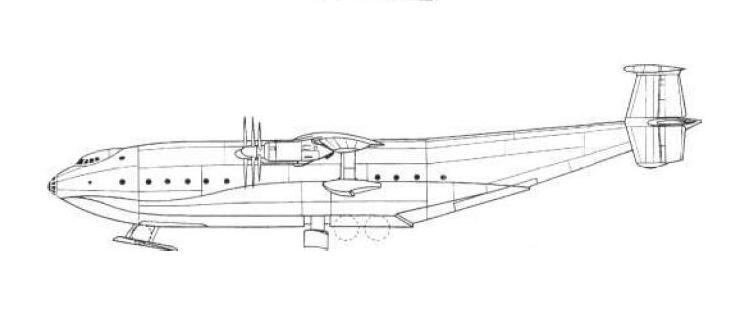
;An-22 :Three original prototypes were built at the Antonov facility in Kyiv, with glass nose. ;Amphibious An-22 :An amphibian version of the An-22 was proposed, but did not progress past the scale model phase. ;An-22 :Initial production variant with external start system, 37 built at Tashkent. ;An-22A :Improved variant with air-start capability, modified electrical system, and updated radio and navigation equipment, 28 built at Tashkent. ;An-22PZ :Conversion of two An-22s to carry wing centre sections or outer wings of Antonov An-124 or An-225 externally above fuselage. Fitted with third centreline fin.
Several other An-22 variants were projected and constructed by Antonov but never entered serial production, notably a nuclear-powered aircraft and a ballistic missile platform.
Operational history
The An-22 was originally built for the Soviet Air Force and Aeroflot (the state airline). Conversion from An-12 in the Air Force began in July 1974. Several Military Transport Aviation units were equipped. The 12th Mginsk Red Banner Military Transport Aviation Division (based at Migalovo) was one of the units which had its three regiments entirely equipped with the An-22s. Another unit that operated it was the 566th Solnechnogorsk Military Transport Aviation Regiment, which used the An-22 from 1970 to 1987.
An early use of the An-22 was to deliver Soviet humanitarian aid to Peru in July 1970 following the Ancash earthquake. One An-22 disappeared on 18 July during these relief flights. An-22s were also used to deliver Soviet military aid to Egypt and Syria during the Yom Kippur War in 1973, to Angola in 1975, and to Ethiopia in 1977.
The An-22s from Migalovo were used for the initial deployment of the Soviet Airborne Troops (VDV) during the 1979 Soviet invasion of Afghanistan. One An-22 was shot down at takeoff (probably by an SA-7 missile) near Kabul on 28 October 1984 with about 250 casualties as the aircraft was used as troop carrier. In 1980, one An-22 crashed at Vnukovo Airport while two crashed at Migalovo (in 1992 and 1994).
In 1984, military An-22s were used to deliver Mi-8 helicopters to Ethiopia during drought relief operations.
In 1986 the aircraft of the 8th Military Air Transport Aviation Regiment from Migalovo were used to deliver materials for the Chernobyl disaster relief operation.
During 1987 the An-22s were used to deliver military equipment to Angola. A year later the military An-22s were used to deliver 15,000 tons and 1,000 personnel for the 1988 Armenian earthquake relief operation.

The An-22 aircraft were often seen at the Le Bourget Air Show, and in 1988 delivered an engine from the An-124 to the Farnborough Airshow.
In late 1980s, the An-22s were used to deliver internal troops to many regional conflicts during and after the breakup of the Soviet Union. In 1995 they deployed the Russian peacekeeping force from the 98th Guards Airborne Division during the Bosnian War.
Approximately 45 An-22s remained in service by the mid-1990s, mostly with the Russian Air Force, being slowly replaced by the bigger turbofan-powered Antonov An-124. The remaining An-22s were operated by an independent military transport aviation squadron at Migalovo base in Tver.
As of December 2018, six An-22s were listed in service with the 76th Military Transport Air Squadron at Tver, with only three aircraft airworthy. They were then planned to remain in service until 2033.
A single civil An-22 (registration number UR-09307) was in service with the Ukrainian Antonov Airlines as of September 26, 2020 but was damaged in 2022 during the initial stages of the Russian invasion of Ukraine.
Reports in August 2024 indicated that Russia had ceased operating their An-22 aircraft, with Antei RF-09309 being flown to Yekaterinburg to be prepared for a museum display. On 9 December 2025, the last operational An-22 crashed in the Ivanovo region, north-east of Moscow. Seven people onboard were presumed dead. Witnesses on the ground said the plane broke up in midair.
Operators
.jpg)
Military
Former
;
- The Russian Aerospace Forces owns 11 aircraft, none of which are in active service.
;
- Soviet Air Force :*8th Military Transport Aviation Regiment :*Other regiments
Civil

Current
;
- Antonov Airlines – a single An-22 (registration number UR-09307) was in service with Antonov Airlines as of September 26, 2020. During the Russian invasion of Ukraine at the Battle of Antonov Airport on February 24, 2022, the aircraft reportedly suffered substantial damage when penetrated by projectiles.
Former
;
- Air Sofia (leased)
Incidents and accidents
As of December 2025, there have been 10 hull losses with a total of 102 fatalities.
| Date | Registration | Location | Fatalities | Brief description | ||||||
|---|---|---|---|---|---|---|---|---|---|---|
| 18 July 1970 | СССР-09303 | The Atlantic Ocean near Keflavík International Airport, Iceland | All of 7 passengers + 15 crew | Was transporting humanitarian aid to Lima, Peru. | ||||||
| 28 December 2010 | RA-09343 | Near Krasny Oktyabr (Tula Oblast, Russia) | All 12 crew | url=http://aviation-safety.net/database/record.php?id=20101228-0 | title=RA09343 Accident description | publisher=Aviation Safety Network | access-date=1 January 2011 | archive-url=https://web.archive.org/web/20110625003857/http://aviation-safety.net/database/record.php?id=20101228-0 | archive-date=25 June 2011 | url-status=live }} The aircraft had been in storage since 2001 and was brought back into flying condition in January 2010. |
| 9 December 2025 | RF-08832 | Ivanovo region | Both passengers + 5 crew | The last operational An-22 was being operated by the Russian Air Force. It came down over the Uvodskoye Reservoir in Ivanovo Oblast, Russia. The aircraft was on a test flight from Ivanovo Severny air base after repairs. |
Specifications (An-22)
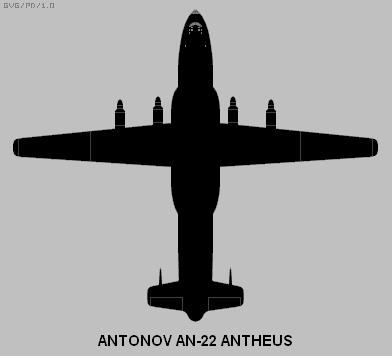
|prime units?=met General characteristics
|max takeoff weight kg=250000 |max takeoff weight note= Powerplant
Performance
|never exceed speed kmh= |never exceed speed note= |minimum control speed kmh= |minimum control speed note= ::::10950 km with maximum fuel and 45000 kg payload |wing loading kg/m2=724.6 |fuel consumption kg/km= |power/mass=0.1088 hp/lb max
- Take-off run: 1300 m
- Landing run: 800 m
On display
A former Ukrainian Air Force AN-22 is on display at the Technik Museum Speyer in Speyer, Germany.
References
References
- Taylor 1969, p. 466
- "✈ russianplanes.net ✈ наша авиация".
- Gordon, Komissarov and Komissarov ''Air International'' January 2006, pp. 35–36.
- Gordon, Komissarov and Komissarov ''Air International'' January 2006, pp. 36–37.
- Gordon, Komissarov and Komissarov ''Air International'' January 2006, p. 37.
- Taghvaee, Babak. (January 2019). "An-22 in the war on terror".
- (2 April 2022). "АЭРОПОРТ ГОСТОМЕЛЬ. Здесь был "русский мир"".
- (9 December 2025). "There’s Likely No Way Back For Russia’s An-22 Turboprop Heavy Transports After Fatal Crash".
- (9 December 2025). "Russia says no survivors in military cargo plane crash".
- (9 December 2025). "Russian Antonov An-22 crashes into a reservoir: All 7 crew feared dead".
- "8th Military-Transport Aviation Regiment".
- "ASN Aircraft accident Antonov An-22A UR-09307 Kyiv-Gostomel Airport (GML)".
- (January 2025). "Антонов АН-22 Антей".
- "RA09343 Accident description". Aviation Safety Network.
- "An-22A c/n 043482272". Dutch Aviation Society.
- (29 December 2010). "Giant Antonov An-22 cargo plane crashes in rural Russia". BBC News.
- (December 9, 2025). "Accident Antonov An-22A RF-08832, Tuesday 9 December 2025". [[Aviation Safety Network]].
- Bailey, Joanna. (9 December 2025). "Russian Antonov An-22 transporter crashes with 7 crew on board".
- (1991). "Jane's all the world's aircraft : 1991–92". Jane's Information Group.
- "The Incomplete Guide to Airfoil Usage".
- (21 December 2024). "Antonov AN-22 {{!}} Technik Museum Speyer {{!}} Germany".
- Sebastian Zacharias. (June 2001). "Antonov An-22 Antheus".
This article was imported from Wikipedia and is available under the Creative Commons Attribution-ShareAlike 4.0 License. Content has been adapted to SurfDoc format. Original contributors can be found on the article history page.
Ask Mako anything about Antonov An-22 — get instant answers, deeper analysis, and related topics.
Research with MakoFree with your Surf account
Create a free account to save articles, ask Mako questions, and organize your research.
Sign up freeThis content may have been generated or modified by AI. CloudSurf Software LLC is not responsible for the accuracy, completeness, or reliability of AI-generated content. Always verify important information from primary sources.
Report