From Surf Wiki (app.surf) — the open knowledge base
Anton Raphael Mengs
German painter (1728–1779)

German painter (1728–1779)
| Field | Value |
|---|---|
| image | File:Mengs, Selbstbildnis.jpg |
| caption | Self-Portrait, , Uffizi, Florence |
| birth_date | |
| birth_place | Ústí nad Labem, Bohemia, Habsburg Empire |
| death_date | |
| death_place | Rome, Papal States |
| occupation | Painter |
| movement | Neoclassical |
| children | Anna Maria Mengs |
| father | Ismael Mengs |
| relatives | Therese Mengs (sister) |
| Julia Charlotte Mengs (sister) |
Julia Charlotte Mengs (sister)
Anton Raphael Mengs (12 March 1728 – 29 June 1779) was a German Neoclassical painter.
Early life
Mengs was born on 12 March 1728, at Ústí nad Labem in the Kingdom of Bohemia, the son of Ismael Mengs, a Danish-born painter who eventually established himself at Dresden, where the court of Electorate of Saxony and Polish-Lithuanian Commonwealth electors and kings was. His older sister, Therese Concordia Maron, was also a painter, as was his younger sister, Julia.
His and Therese's births in Bohemia were mere coincidence. Their mother was not their father's wife; Ismael carried on a years-long affair with the family's housekeeper, Charlotte Bormann. In an effort to conceal the births of two illegitimate children, Ismael took Charlotte, under the pretext of "vacations", to the nearest bigger town abroad, Ústí nad Labem (90 km upstream of the Elbe river). At least in Anton's case, Ismael Mengs took his baby and Charlotte back to Dresden a few weeks after the birth. There they lived for the next 13 years.
In 1741, Ismael moved his family from Dresden to Rome, where he copied in miniature some works of Raphael for the Elector of Saxony, which were intended for Dresden.
Adulthood
In 1749, Anton Raphael Mengs was appointed the first painter to Frederick Augustus, Elector of Saxony, but this did not prevent him from continuing to spend much of his time in Rome. There he married Margarita Guazzi, who had sat for him as a model in 1748. In 1749, Mengs accepted a commission from the Duke of Northumberland to make a copy, in oil on canvas, of Raphael's fresco The School of Athens for his London home. Executed in 1752–5, Mengs's painting is full-sized, but he adapted the composition to a rectangular format and added other figures. It is now in the collection of the Victoria and Albert Museum.
He converted to Catholicism, and in 1754 he became director of the Vatican painting school. In 1757, Mengs painted a superb fresco on the dome of the church of Sant'Eusebio in Rome. His fresco painting Parnassus at Villa Albani gained him a reputation as a master painter.
On two occasions he accepted invitations from Charles III of Spain to go to Madrid, first in 1761.
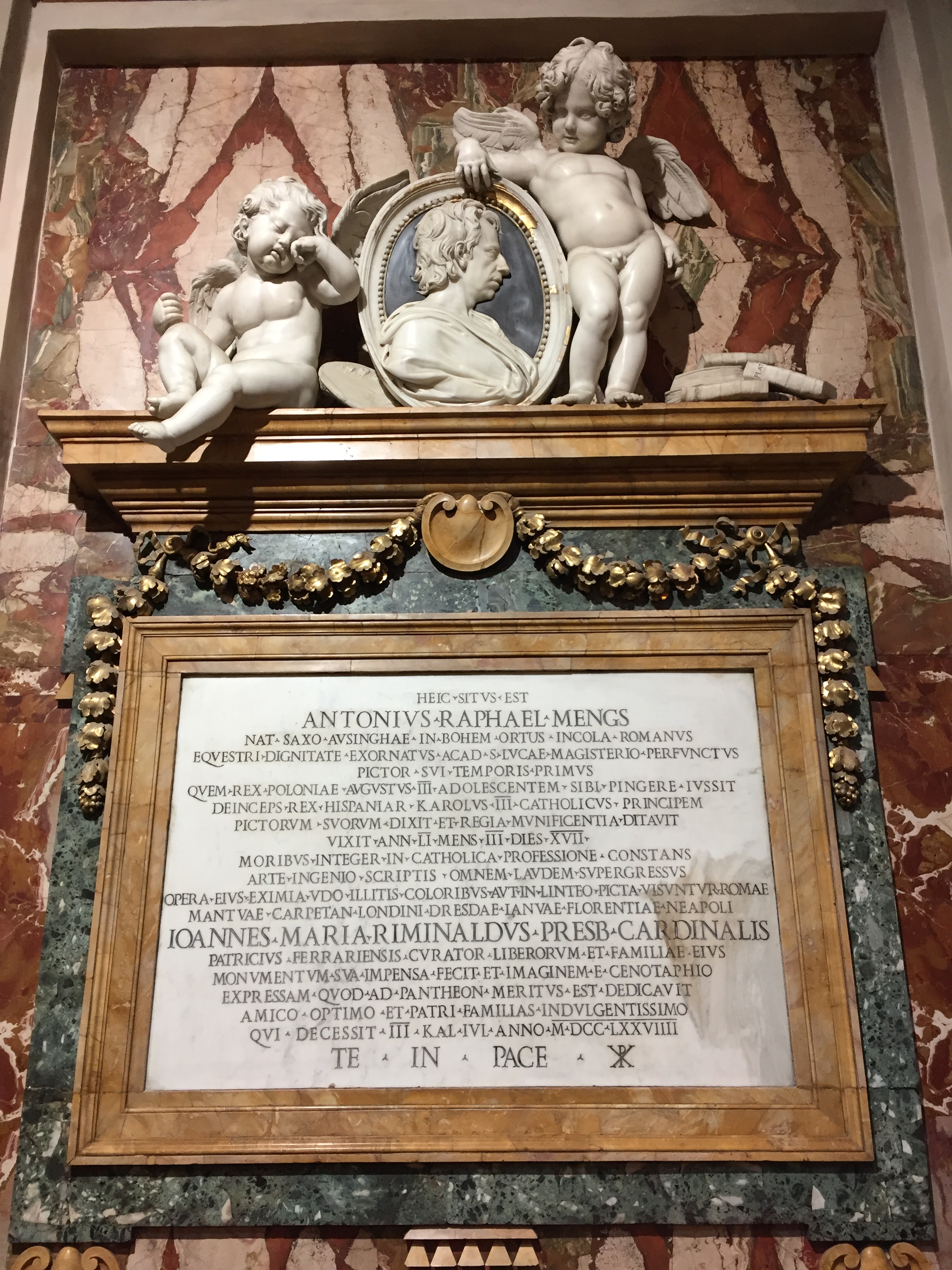
Mengs died in Rome in June 1779 and was buried there in the Church of Santi Michele e Magno.
Career

His portraits and self-portraits show an attention to detail and insight often lost in his grander paintings. His closeness to Johann Joachim Winckelmann has enhanced his historical importance. Mengs came to share Winckelmann's enthusiasm for classical antiquity, and worked to establish the dominance of Neoclassical painting over the then popular Rococo style. At the same time, however, the influence of the Roman Baroque remained strong in his work, particularly in his religious paintings. He would have fancied himself the first neoclassicist, while, in fact, he may be the last flicker of Baroque art. Rudolf Wittkower wrote: "In the last analysis, he is as much an end as a beginning". Goethe regretted that "so much learning should have been allied to a total want of initiative and poverty of invention, and embodied with a strained and artificial mannerism."
.jpg)
Mengs had a well-known rivalry with the contemporary Italian painter Pompeo Batoni. He was also a friend of Giacomo Casanova. Casanova provides accounts of his personality and contemporary reputation through anecdotes in his Histoire de ma vie. Among his pupils in Italy were Anton von Maron (Antonio Maron; (Vienna, 1731- Naples, 1761). His pupils in Spain included Agustín Esteve, Francisco Bayeu and Mariano Salvador Maella.
Besides numerous paintings in Madrid, the Ascension and St Joseph at Dresden, Perseus and Andromeda at Saint Petersburg, and the ceiling of the Villa Albani are among his chief works. A Noli me tangere was commissioned as an altar-piece by All Souls College, Oxford, and is now held in the National Gallery, London. Another altar-piece was installed in Magdalen College, Oxford.
Theoretical writings
Mengs wrote about art in Spanish, Italian, and German. His friendship with Winckelmann notwithstanding, Mengs was little influenced by Winckelmann's ideas; the basis of his extensive writings on art is to be found in the traditional theories that go back to Bellori. He reveals an eclectic theory of art that sees perfection as attainable through a well-balanced fusion of diverse excellences: Greek design combined with the expression of Raphael, the chiaroscuro of Correggio, and the colour of Titian. All his theories and opinions (as well as biography) are in his 646 paged works, which were translated into English. The works of Anthony Raphael Mengs. First painter to his Catholic Majesty Charles III. Translated from the Italian. 1796. accessed 12/28/2025 from https://archive.org/details/worksofanthonyra00meng
Selected works
- Ascension (Dresden, Court Church), 1751/1766
- St Joseph (Dresden, Court Church), 1751/1766
- The Glory of Saint Eusebius (ceiling fresco, Sant'Eusebio, Rome), 1757 (modello, oil on canvas, National Gallery of Canada Ottawa)
- Portrait of Ferdinand I (National Museum of Capodimonte, Naples, Italy), 1759
- Charles III (Museo del Prado, Madrid), 1761
- Infante Don Louis de Borbon (Cleveland Museum of Art, Cleveland, Ohio)
Gallery
File:Anton Raphael Mengs, Prince of Asturias, Future Charles IV of Spain (са 1765) - 02.jpg|Prince of Asturias, Future Charles IV of Spain (са. 1765) File:Anton Raphael Mengs - Infantin Maria Ludovica (1745-1792), Gemahlin von Leopold II.jpg|Portrait of Maria Luisa of Spain File:Mengs, Helios als Personifikation des Mittages.jpg|Helios as Personification of Midday (ca. 1765) File:Anton Raphael Mengs - St. John the Baptist Preaching in the Wilderness - Google Art Project.jpg|St. John the Baptist Preaching in the Wilderness File:Mengs, Diana als Personifikation der Nacht.jpg|Diana as Personification of the Night (ca. 1765) File:Anton Rafael Mengs - Retrato de la marquesa de Llano - Google Art Project.jpg|La marquesa de Llano (ca. 1775) File:Anton Raphael Mengs 017.jpg|Saint Peter File:Anton Raphael Mengs, The Triumph of History over Time (Allegory of the Museum Clementinum), ceiling fresco in the Camera dei Papiri, Vatican Library, 1772 - M0tty.jpg|The Triumph of History over Time, ceiling Vatican Library. File:William Burton Conyngham.jpg|Portrait of William Burton Conyngham (1733–1796) File:Anton Raphael Mengs - The Dream of St. Joseph - Google Art Project.jpg|The Dream of St. Joseph (ca. 1774) File:Johann Joachim Winckelmann (Raphael Mengs after 1755).jpg|Johann Joachim Winckelmann at the Metropolitan Museum of Art (ca. 1777) File:“Portrait of a Lady”.webp|Portrait of an Elegant Lady (1775), Germany File:Anton Raphael Mengs - Maria mit dem Kind und zwei Engeln - GG 126 - Kunsthistorisches Museum.jpg|Madonna with Child and Two Angels (1770–1773), Kunsthistorisches Museum File:Mengs, Jupiter küsst Ganymed.jpg|*Jupiter Kissing Ganymede (*1760), Galleria Nazionale d'Arte Antica
References
Sources
References
- "Anton Raphael Mengs (Bohemian painter)". [[Encyclopædia Britannica]].
- [https://www.pastellists.com/Articles/MENGSj.pdf Jeffares, Neil. "Mengs, Julia Charlotte", ''Dictionary of pastellists before 1800'', July 30, 2020]
- Polt, John H. R.. (1997). "Homenaje a Don Luis Monguió". Juan de la Cuesta.
- [http://www.newadvent.org/cathen/10189a.htm Williamson, George. "Anthon Rafael Mengs." The Catholic Encyclopedia] Vol. 10. New York: Robert Appleton Company, 1911. 21 July 2023 {{PD-notice
- "The School of Athens (after Raphael)". Victoria and Albert Museum.
- There he produced some of his best work, most notably the ceiling of the banqueting hall of the [[Royal Palace of Madrid]], the subject of which was the ''Triumph of [[Trajan]]'' and the ''Temple of Glory.'' After the completion of this work in 1777, Mengs returned to Rome, where he died two years later, in poor circumstances, leaving twenty children, seven of whom were pensioned by the king of Spain.{{EB1911|inline=y|wstitle=Mengs, Antony Raphael|volume=18|page=129}}
- Singer, Dr. Hans W.. (2010). "Stories of the german artists.". Wildside Press.
- "Web Gallery of Art, image collection, virtual museum, searchable database of European fine arts (1000–1900)". wga.hu.
- Wittkower, p 469
- Johann Wolfgang von Goethe, ''Winckelmann und sein Jahrhundert''
- [https://books.google.com/books?id=4KdVAAAAcAAJ Supplemento alla Serie dei trecento elogi e ritratti degli uomini i più illustri in Pittura, Scultura, e Architettura.] by Pellegrino Antonio Orlandi, published by Stamperia Allegrini, Pisoni, e comp, Florence (1776); column 1368–1369.
- Tiepolo, Giovanni Battista. (1996). "Giambattista Tiepolo, 1696-1770".
- "Noli me tangere".
- [[Robert Goldwater. Goldwater, Robert]], and Treves, Marco, eds. ''Artists on Art, from the XIV to the XX Century''. Rev. edn., New York: [[Pantheon Books]], 1947, pp. 244-5.
This article was imported from Wikipedia and is available under the Creative Commons Attribution-ShareAlike 4.0 License. Content has been adapted to SurfDoc format. Original contributors can be found on the article history page.
Ask Mako anything about Anton Raphael Mengs — get instant answers, deeper analysis, and related topics.
Research with MakoFree with your Surf account
Create a free account to save articles, ask Mako questions, and organize your research.
Sign up freeThis content may have been generated or modified by AI. CloudSurf Software LLC is not responsible for the accuracy, completeness, or reliability of AI-generated content. Always verify important information from primary sources.
Report