From Surf Wiki (app.surf) — the open knowledge base
Antigua
Island in Antigua and Barbuda
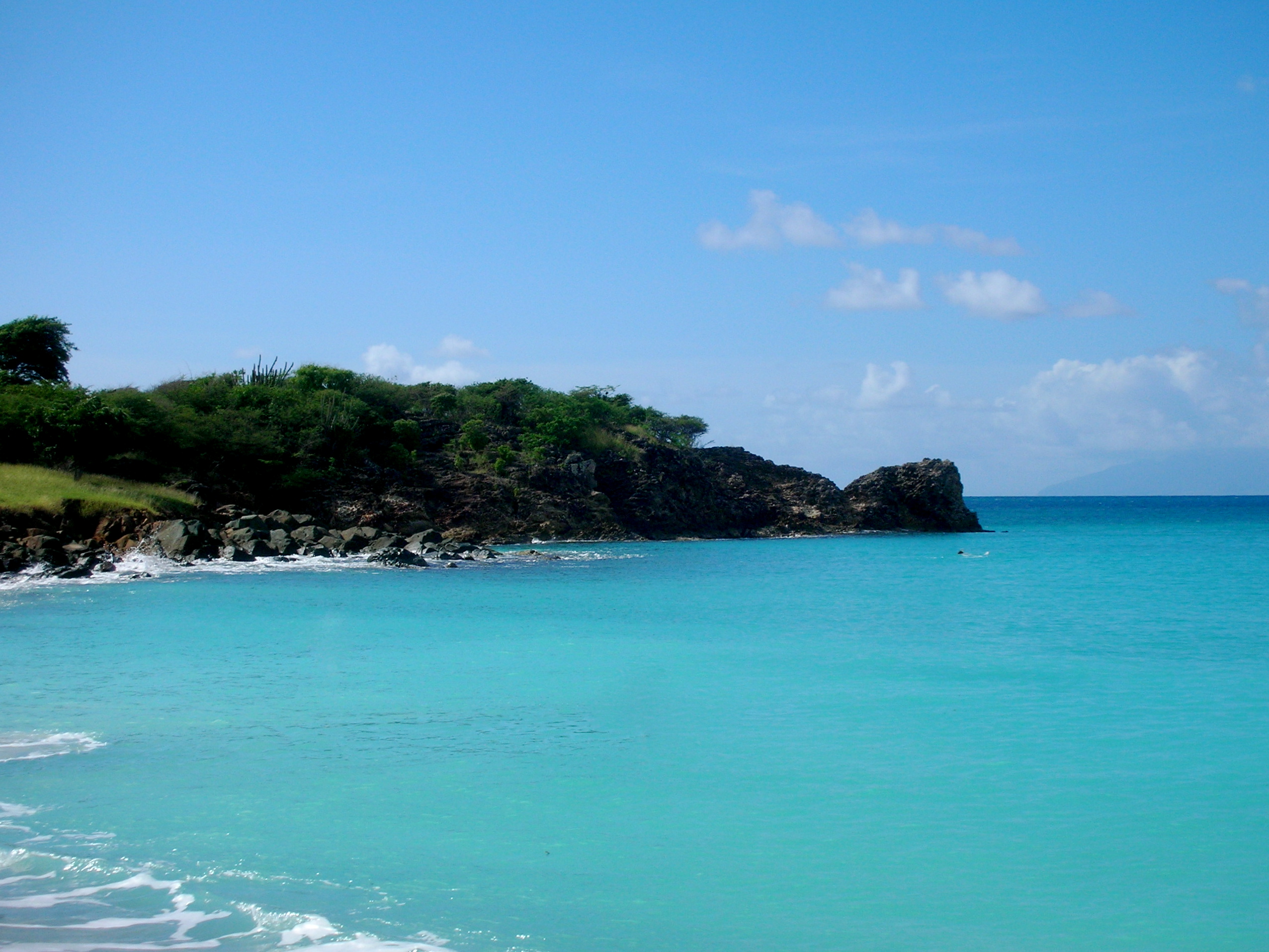
Island in Antigua and Barbuda
| Field | Value |
|---|---|
| name | Antigua |
| image | Antigua.JPG |
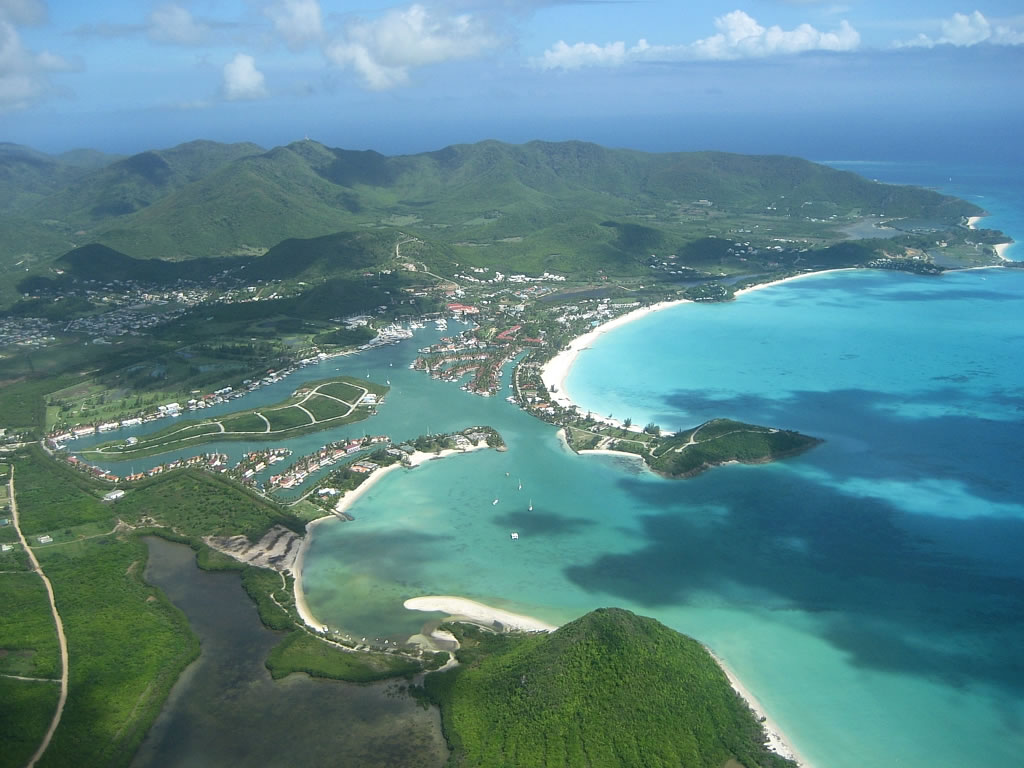
| image_caption | Aerial view of Antigua |
| image_map | Antigua in Antigua and Barbuda.svg |
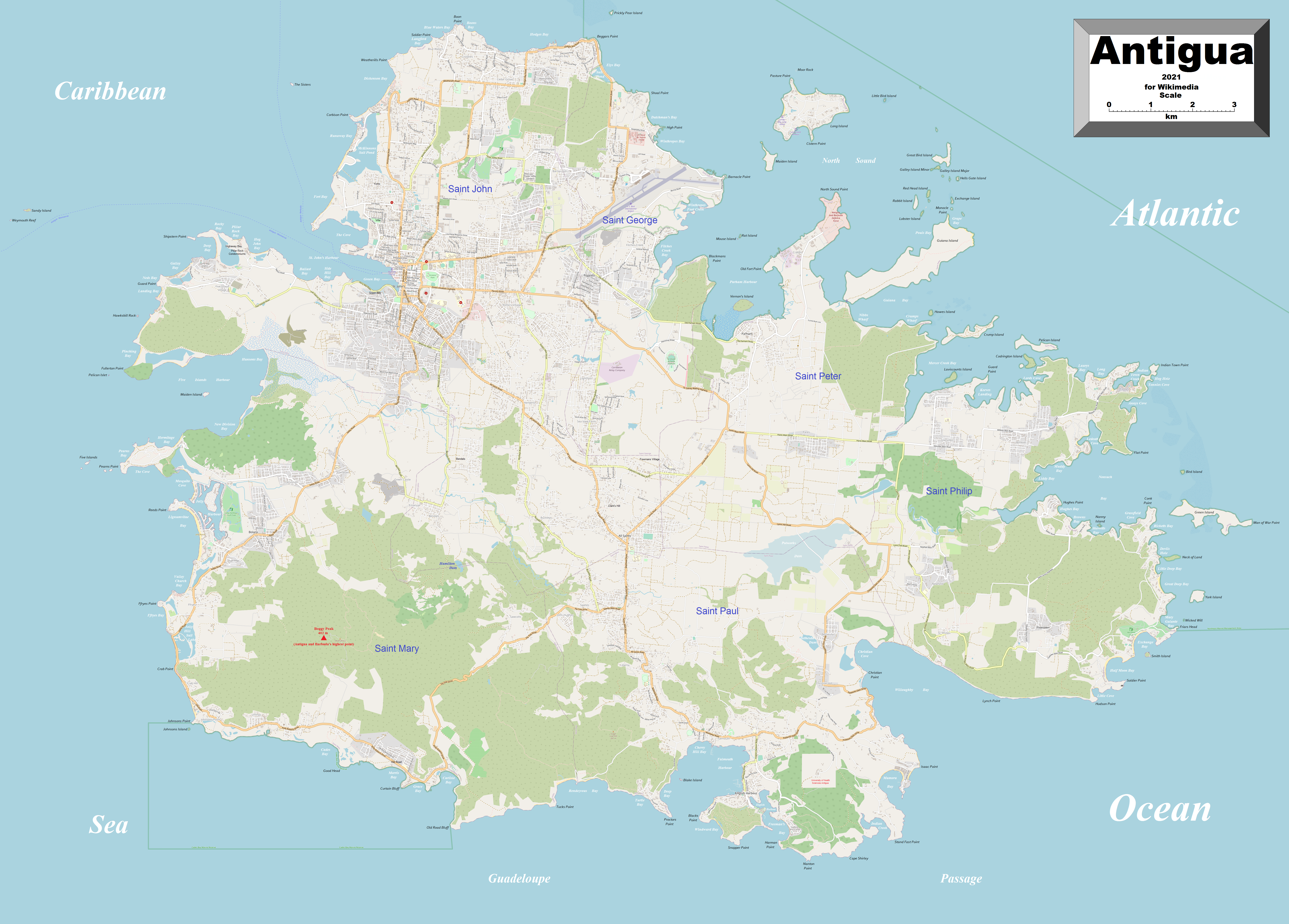
| image_map_caption | Map of Antigua showing the parishes |
| native_name | Aanteega |
| native_name_link | English creole |
| location | Caribbean Sea |
| pushpin_map | Antigua and Barbuda#Lesser Antilles#Caribbean |
| pushpin_label_position | left |
| pushpin_relief | 1 |
| coordinates | |
| archipelago | Leeward Islands |
| total_islands | 1 |
| area_km2 | 281 |
| coastline_km | 87 |
| highest_mount | Boggy Peak |
| elevation_m | 402 |
| country | |
| country_largest_city | St. John's |
| country_largest_city_population | 22,000 |
| population | 95,882 |
| population_as_of | July 2018 |
| density_km2 | 341.22 |
| ethnic_groups | 87.12% Black, 3.86% Other Mixed Race, 1.7% White, 5.64% Other |
| country1_leader_title | Magistrate for Districts "A" and "B" |
| image_map_alt | Antigua in Antigua and Barbuda.svg |
| image_alt | Antigua.JPG |
the island
Antigua is an island in the Lesser Antilles. It is one of the Leeward Islands in the Caribbean region and the most populous island of the country of Antigua and Barbuda. Antigua and Barbuda became an independent state within the Commonwealth of Nations on 1 November 1981.
The island's perimeter is roughly 87 km and its area 281 km2. Its population was 83,191 (at the 2011 Census). The economy is mainly reliant on tourism, with the agricultural sector serving the domestic market.
More than 22,000 people live in the main city, St. John's. The city is situated in the north-west and has a deep harbour which is able to accommodate large cruise ships. Most of the population lives in the island's Central Plain. Other leading population settlements are All Saints (3,412) and Liberta (2,239), according to the 2001 census.
English Harbour on the south-eastern coast provides one of the largest deep water, protected harbors in the Eastern Caribbean. It is the site of UNESCO World Heritage Site Nelson's Dockyard, a restored British colonial naval station named after Vice-Admiral Horatio Nelson. English Harbour and the neighbouring village of Falmouth are yachting and sailing destinations and provisioning centres. During Antigua Sailing Week, at the end of April and beginning of May, an annual regatta brings a number of sailing vessels and sailors to the island to take part in sporting events. Every December for the past 60 years, Antigua has been home to one of the largest charter yacht shows, welcoming super-yachts from around the world.
Etymology
Antigua means "ancient" or "old" in Spanish. In 1493, Christopher Columbus, sailing for Spain, named the island . Some sources say Columbus named the island after a church in Seville called Santa María de la Antigua.** However, there is no church by that name in Seville. Columbus may have actually named the island in honor of the Santa María de la Antigua chapel in Seville Cathedral, or more specifically in honor of the iconic mural Virgen de la Antigua (or Santa María de la Antigua) in Seville Cathedral.
The name Waladli comes from the island's indigenous inhabitants and means approximately "our own". Wadadli is the Creole approximation of the original name.
History


Early Antiguans
The first inhabitants were the Guanahatabey people. Eventually, the Arawak migrated from the mainland, followed by the Carib. Prior to European colonization, Christopher Columbus was the first European to visit Antigua, in 1493.
The Arawak were the first well-documented group of indigenous people to settle Antigua. They paddled to the island by canoe (piragua) from present-day Venezuela, pushed out by the Carib, another indigenous people. The Arawak introduced agriculture to Antigua and Barbuda. Among other crops, they cultivated the Antiguan "black" pineapple. They also grew corn, sweet potatoes (white with firmer flesh than the bright orange "sweet potato" grown in the United States), chili peppers, guava, tobacco, and cotton.
Some of the vegetables listed, such as corn and sweet potatoes, continue to be staples of Antiguan cuisine. Colonists took them to Europe, and from there, they spread around the world. For example, a popular Antiguan dish, dukuna (), is a sweet, steamed dumpling made from grated sweet potatoes, flour and spices. Another staple, fungi (), is a cooked paste made of cornmeal and water.
Most of the Arawak left Antigua about A.D. 1100. Those who remained were raided by the Carib coming from Venezuela. According to The Catholic Encyclopedia, the Caribs' superior weapons and seafaring prowess allowed them to defeat most Arawak nations in the West Indies. They enslaved some and cannibalised others. Watson points out that the Caribs had a much more warlike culture than the Arawak.
The indigenous people of the West Indies built excellent sea vessels, which they used to sail the Atlantic and Caribbean resulting in much of the South American and the Caribbean islands being populated by the Arawak and Carib. Their descendants live throughout South America, particularly Brazil, Venezuela and Colombia. According to A Brief History of the Caribbean, infectious diseases introduced from Europe, high rates of malnutrition and enslavement led to a rapid population decline among the Caribbean's native population. There are some differences of opinions as to the relative importance of these causes.
English and British Colonisation
Christopher Columbus named the island "Antigua" in 1493 in honour of the "Virgin of the Old Cathedral" () found in Seville Cathedral in southern Spain. On his 1493 voyage, honouring a vow, he named many islands after different aspects of St. Mary, including Montserrat and Guadeloupe.
In 1632, a group of English colonists left St Kitts to settle on Antigua. Christopher Codrington, an Englishman, established the first permanent English settlement on the island. Antigua rapidly developed as a profitable sugar colony. For a large portion of Antigua's history, the island was considered Britain's "Gateway to the Caribbean". It was on the major sailing routes among the region's resource-rich colonies. Lord Horatio Nelson, a major figure in Antigua's history, arrived in the late 18th century to defend the island's commercial shipping prowess.
Slavery
,_plate_II_-_BL.jpg)
,_plate_VI_-_BL.jpg)
,_plate_X_-_BL.jpg)
Sugar became Antigua's main crop in about 1674, when Christopher Codrington (c. 1640–1698) settled at Betty's Hope plantation. He came from Barbados, bringing the latest sugar technology with him. Betty's Hope, Antigua's first full-scale sugar plantation, was so successful that other planters turned from tobacco to sugar. This resulted in their importing slaves to work the sugar cane crops.
According to A Brief History of the Caribbean, many West Indian colonists initially tried to use locals as slaves. These groups succumbed easily to disease and/or malnutrition, and died by the thousands. The enslaved Africans adapted better to the new environment and thus became the number-one choice of unpaid labour; they also provided medical services and skilled labour, including carpentry, for their masters. However, the West African slave population in the Caribbean also had a high mortality rate, which was offset by regular imports of very high numbers of new slaves from West and Central Africa.
Sugar cane was one of the most gruelling and dangerous crops slaves were forced to cultivate. Harvesting cane required backbreaking long days in sugar cane fields under the hot island sun. Sugar cane spoiled quickly after harvest, and the milling process was slow and inefficient, forcing the mill and boiling house to operate 24 hours a day during harvest season. Sugar mills and boiling houses were two of the most dangerous places for slaves to work on sugar plantations. In mills wooden or metal rollers were used to crush cane plants and extract the juices. Slaves were at risk of getting their limbs stuck and ripped off in the machines. Similarly, in sugar boiling houses slaves worked under extremely high temperatures and at the risk of being burned in the boiling sugar mixture or getting their limbs stuck.
Today, collectors prize the uniquely designed colonial furniture built by West Indian slaves. Many of these works feature what are now considered "traditional" motifs, such as pineapples, fish and stylized serpents.
By the mid-1770s, the number of slaves had increased to 37,500, up from 12,500 in 1713. The white population, in contrast, had fallen from 5,000 to below 3,000. The slaves lived in wretched and overcrowded conditions and could be mistreated or even killed by their owners with impunity. The Slave Act of 1723 made arbitrary murder of slaves a crime, but did not do much to ease their lives.
Unrest against enslavement among the island's enslaved population became increasingly common. In 1729, a man named Hercules was hanged, drawn and quartered and three others were burnt alive, for conspiring to kill the slave owner Nathaniel Crump and his family. In 1736, an enslaved man called "Prince Klaas" (whose slave name was Court) allegedly planned to incite a slave rebellion on the island. Court was crowned "King of the Coromantees" in a pasture outside the capital of St. John's. The coronation appeared to be just a colourful spectacle but was, for the enslaved people, a ritual declaration of war on the colonists. From information obtained from other slaves, the colonists discovered the plot and implemented a brutal crackdown on suspected rebels. Prince Klaas and four accomplices were caught and executed on the breaking wheel. (However, some doubts exist about Court's guilt.) Six of the rebels were hanged in chains and starved to death, and another 58 were burnt at the stake. The site of these executions is now the Antiguan Recreation Ground.
The American War of Independence in the late 18th century disrupted the Caribbean sugar trade. At the same time, public opinion in Great Britain gradually turned against slavery. "Traveling ... at slavery's end, [Joseph] Sturge and [Thomas] Harvey (1838 ...) found few married slaves residing together or even on the same estate. Slaveholders often counted as 'married' only those slaves with mates on the estate." Great Britain abolished the slave trade in 1807, and all existing slaves were emancipated in 1834.
Administration of Lord Nelson
Horatio Nelson (who was created 1st Viscount Nelson in 1801) was Senior Naval Officer of the Leeward Islands from 1784 to 1787 on . During his tenure, he tried to enforce the Navigation Acts. These acts prohibited trade with the newly formed United States of America. Most of the merchants in Antigua depended upon trading with the USA, so many of them despised Captain Nelson. As a result, he was unable to get a promotion for some time after his stint on the island.
Unlike the Antiguan merchants, Nelson had a positive view of the controversial Navigation Acts:
The Americans were at this time trading with our islands, taking advantage of the register of their ships, which had been issued while they were British subjects. Nelson knew that, by the Navigation Act, no foreigners, directly or indirectly, are permitted to carry on any trade with these possessions. He knew, also, that the Americans had made themselves foreigners with regard to England; they had disregarded the ties of blood and language when they acquired the independence which they had been led on to claim, unhappily for themselves, before they were fit for it; and he was resolved that they should derive no profit from those ties now. Foreigners they had made themselves, and as foreigners they were to be treated.
Nelson said: "The Antiguan Colonists are as great rebels as ever were in America, had they the power to show it."
A dockyard started in 1725, to provide a base for a squadron of British ships whose main function was to patrol the West Indies and thus maintain Britain's sea power, was later named "Nelson's Dockyard" in his honour.
While Nelson was stationed on Antigua, he frequently visited the nearby island of Nevis, where he met and married a young widow, Fanny Nisbet, who had previously married the son of a plantation family on Nevis.
1918 labour unrest
Following the foundation of the Ulotrichian Universal Union, a friendly society which acted as a trade union (which were banned), the sugar cane workers were ready to confront the plantation owners when they slashed their wages. The cane workers went on strike and rioted when their leaders were arrested.
Independence
In 1967, with Barbuda and the tiny island of Redonda, Antigua became an associated state of the Commonwealth, and in November 1981 it was disassociated from Britain.
U.S. government presence
Commissioned, 9 August 1956, the Naval Facility (NAVFAC) Antigua was one of the shore terminal stations that were part of the Sound Surveillance System (SOSUS) and the Integrated Undersea Surveillance System (IUSS), which were used to track Soviet submarines. NAVFAC Antigua was decommissioned 4 February 1984.
From 1958 through 1960 the United States installed the Missile Impact Location System (MILS) in the Atlantic Missile Range, later the Eastern Range, to localize the splashdowns of test missile nose cones. MILS was developed and installed by the same entities that had completed the first phase of the Atlantic SOSUS system. A MILS installation consisting of both a target array for precision location and a broad ocean area system for good positions outside the target area was installed at Antigua, 1300 nmi downrange. The island was the second downrange MILS installation with the furthest being 4400 nmi downrange at Ascension Island.
Until 7 July 2015, the United States Air Force maintained a small base near the airport, designated Detachment 1, 45th Operations Group, 45th Space Wing (known as Antigua Air Station). The mission provided high rate telemetry data for the Eastern Range and its space launches. The unit was deactivated due to US government budget cuts and the property given to the Antiguan Government.
Demographics
Census data
These figures do not include the island of Barbuda.
Source:
| Q48 Ethnic | Counts | % | Total | 83,191 | 100.00% |
|---|---|---|---|---|---|
| African descendent | 72,473 | 87.12% | |||
| Caucasian/White | 1,396 | 1.68% | |||
| East Indian/India | 940 | 1.13% | |||
| Mixed (Black/White) | 740 | 0.89% | |||
| Mixed (Other) | 3,209 | 3.86% | |||
| Hispanic | 2,323 | 2.79% | |||
| Syrian/Lebanese | 568 | 0.68% | |||
| Other | 795 | 0.96% | |||
| Don't know/Not stated | 749 | 0.90% |
| Q58. Country of birth | Counts | % | Total | 83,191 | 100.00% |
|---|---|---|---|---|---|
| Africa | 296 | 0.36% | |||
| Other Latin or North American countries | 164 | 0.20% | |||
| Antigua and Barbuda | 56,620 | 68.06% | |||
| Other Caribbean countries | 765 | 0.92% | |||
| Canada | 350 | 0.42% | |||
| Other Asian countries | 389 | 0.47% | |||
| Other European countries | 301 | 0.36% | |||
| Dominica | 3,629 | 4.36% | |||
| Dominican Republic | 2,076 | 2.50% | |||
| Guyana | 5,993 | 7.20% | |||
| Jamaica | 4,408 | 5.30% | |||
| Montserrat | 628 | 0.76% | |||
| St. Kitts and Nevis | 360 | 0.43% | |||
| St. Lucia | 597 | 0.72% | |||
| St. Vincent and the Grenadines | 662 | 0.80% | |||
| Syria | 296 | 0.36% | |||
| Trinidad and Tobago | 499 | 0.60% | |||
| United Kingdom | 835 | 1.00% | |||
| USA | 2,590 | 3.11% | |||
| USVI United States Virgin Islands | 394 | 0.47% | |||
| Not Stated | 1,337 | 1.61% |
| Q71 Country of Citizenship 1 | Counts | % | Total | 83,191 | 100.00% |
|---|---|---|---|---|---|
| Antigua and Barbuda | 67,569 | 81.22% | |||
| Other Caribbean countries | 547 | 0.66% | |||
| Canada | 195 | 0.23% | |||
| Other Asian and Middle Eastern countries | 422 | 0.51% | |||
| Dominica | 1,754 | 2.11% | |||
| Dominican Republic | 1,342 | 1.61% | |||
| Guyana | 3,674 | 4.42% | |||
| Jamaica | 3,316 | 3.99% | |||
| Montserrat | 261 | 0.31% | |||
| St. Lucia | 326 | 0.39% | |||
| St. Vincent and the Grenadines | 319 | 0.38% | |||
| Trinidad and Tobago | 194 | 0.23% | |||
| United Kingdom | 442 | 0.53% | |||
| USA | 1,322 | 1.59% | |||
| Other countries | 494 | 0.59% | |||
| Not Stated | 1,015 | 1.22% |
| Q71 Country of Citizenship 2 (Country of Second/Dual Citizenship) | Counts | % | Total | 12,759 | 100.00% | NotApp : | 70,432 |
|---|---|---|---|---|---|---|---|
| Other Caribbean countries | 858 | 6.73% | |||||
| Canada | 451 | 3.53% | |||||
| Other Asian and Middle Eastern countries | 238 | 1.86% | |||||
| Dominica | 1,898 | 14.87% | |||||
| Dominican Republic | 729 | 5.72% | |||||
| Guyana | 2,257 | 17.69% | |||||
| Jamaica | 1,103 | 8.64% | |||||
| Montserrat | 345 | 2.70% | |||||
| St. Lucia | 273 | 2.14% | |||||
| St. Vincent and the Grenadines | 348 | 2.73% | |||||
| Trinidad and Tobago | 317 | 2.48% | |||||
| United Kingdom | 981 | 7.69% | |||||
| USA | 2,560 | 20.06% | |||||
| Other countries | 391 | 3.07% | |||||
| Not Stated | 11 | 0.08% |
| Employment status | Counts | % | Total | 63,253 | 100.00% | NotApp : | 19,938 |
|---|---|---|---|---|---|---|---|
| Employed | 38,534 | 60.92% | |||||
| Unemployed | 4,435 | 7.01% | |||||
| Inactive | 19,780 | 31.27% | |||||
| Not stated | 504 | 0.80% |
| Q55 Internet Use | Counts | % | Total | 83,191 | 100.00% |
|---|---|---|---|---|---|
| Yes | 40,429 | 48.60% | |||
| No | 41,238 | 49.57% | |||
| Don't know/Not stated | 1,524 | 1.83% |

Geography
Located in the Leeward Islands, Antigua has an area of 281 km2 with 87 km of coastline. The island is reputed to possess 365 beaches, one for every day of the year. The highest elevation on the island is 402 m.
Various natural points, capes, and beaches around the island include: Boon Point, Beggars Point, Parham, Willikies, Hudson Point, English Harbour Town, Old Road Cape, Johnson's Point, Ffryes Point, Jennings, Five Islands, and Yepton Beach, and Runaway Beach.
Several natural harbours are formed by these points and capes, including: Fitches Creek Bay, between Beggars Point and Parham; Nonsuch Bay between Hudson Point and Willikies; Willoughby Bay, between Hudson Point and English Harbour Town; English Harbour leading into English Harbour Town; Falmouth Harbour recessing into Falmouth; Rendezvous Bay between Falmouth and Old Road Cape; Five Islands Harbour, between Jennings and Five Islands; and Green Bay, the main harbour at St. John's, between Yepton Beach and Runaway Beach.
Fauna
The Antiguan racer is among the rarest snakes in the world. The Lesser Antilles are home to four species of racers. All four have undergone severe range reductions; at least two subspecies are extinct and another, Alsophis antiguae, now occupies only 0.1 per cent of its historical range.
Griswold's ameiva (Ameiva griswoldi) is a species of lizard in the genus Ameiva. It is endemic to Antigua and Barbuda. It is found on both islands.
Administrative divisions
The island is divided into six civil parishes: St. George, Saint Peter, Saint Philip, Saint Paul, Saint Mary, and Saint John. The parishes have no type of local government.
Economy
Main article: Economy of Antigua and Barbuda
The country's official currency is the East Caribbean dollar. Given the dominance of tourism, many prices in tourist-oriented businesses are shown in US dollars. The EC dollar is pegged to the US dollar at a varied rate and averages about US$1 = EC$2.7.
Tourism
Antigua's economy relies largely on tourism, and the island is promoted as a luxury Caribbean escape. Many hotels and resorts are located around the coastline. The island's single airport, VC Bird Airport, is served by several major airlines, including Virgin Atlantic, British Airways, American Airlines, United Airlines, Delta Air Lines, Caribbean Airlines, Air Canada, WestJet, and JetBlue. There is regular air service to Barbuda.
Education
Main article: Education in Antigua and Barbuda
Antigua has two international primary/secondary schools: CCSET International, which offers the Ontario Secondary School Diploma, and Island Academy, which offers the International Baccalaureate. There are also many other private schools but these institutions tend to follow the same local curriculum (CXCs) as government schools.
The island of Antigua currently has two foreign-owned for-profit offshore medical schools, the American University of Antigua (AUA), founded in 2004, and The University of Health Sciences Antigua (UHSA), founded in 1982. The island's medical schools cater mostly to foreign students but contribute to the local economy and health care.
Online gambling
Antigua was one of the first nations to legalize, license, and regulate online gambling and is a primary location for incorporation of online gambling companies. In 2003, Antigua and Barbuda initiated a WTO dispute settlement process with the United States, arguing that although some forms of Internet gambling, such as betting on horse races, are legal in the United States, the Wire Act, the Travel Act and the Illegal Gambling Business Act criminalize all cross-border gambling, constituting a discriminatory measure prohibited under the GATS. In 2004, a panel of the WTO Dispute Settlement Body found that the United States failed to accord services and service suppliers of Antigua treatment no less favorable than that accorded to its own services and service suppliers.
In 2006, the United States Congress voted to approve the Unlawful Internet Gambling Enforcement Act which criminalized the operations of offshore gambling operators which take wagers from American-based gamblers. This was a prima facie violation of the GATS treaty obligations enforced by the WTO, resulting in a series of rulings unfavourable to the US.
On 21 December 2007, an Article 22 arbitration panel ruled that the United States' failure to comply with WTO rules would attract a US$21 million sanction.
The WTO ruling was notable in two respects:
First, although technically a victory for Antigua, the $21 million was far less than the US$3.5 billion which had been sought; one of the three arbitrators was sufficiently bothered by the propriety of this that he issued a dissenting opinion.
Second, a rider to the arbitration ruling affirmed the right of Antigua to take retaliatory steps in view of the prior failure of the US to comply with GATS. These included the rare, but not unprecedented, right to disregard intellectual property obligations to the US.
Antigua's obligations to the US in respect of patents, copyright, and trademarks are affected. In particular, Berne Convention copyright is in question, and also material not covered by the Berne convention, including TRIPS accord obligations to the US. Antigua may thus disregard the WIPO treaty on intellectual property rights, and therefore the US implementation of that treaty (the Digital Millennium Copyright Act, or DMCA)—at least up to the limit of compensation.
Since there is no appeal to the WTO from an Arbitration panel of this kind, it represents the last legal word from the WTO on the matter. Antigua is therefore able to recoup some of the claimed loss of trade by hosting (and taxing) companies whose business model depends on immunity from TRIPS provisions.
Software company SlySoft was based in Antigua, allowing it to avoid nations with laws that are tough on anti-circumvention of technological copyright measures, in particular the DMCA in the United States.
On 3 June 2024, US Ambassador to Antigua and Barbuda Roger Nyhus stated that the US might offer Antigua and Barbuda concessions to resolve the longstanding dispute over the $21 million compensatory amount.
Banking
Swiss American Bank Ltd, later renamed Global Bank of Commerce, Ltd, was formed in April 1983 and became the first offshore international financial institution governed by the International Business Corporations, Act of 1982 to become a licensed bank in Antigua. The bank was later sued by the United States for failure to release forfeited funds from one of its account holders. Swiss American Bank was founded by Bruce Rappaport.
Established in June 1994 as the East European International Bank, the European Union Bank (EUB) (), which was Antigua's first internet bank and was associated with Alex Konanykhin, who had business interests with numerous senior KGB officials, was shut down in 1996 by Antiguan authorities because the bank had failed to file its 1994 audit and was placed in receivership on 8 August 1997 with two Russians listed as bank directors, Vitali Papsuev () and Sergei Ushakov ().
Stanford International Bank was formed by Allen Stanford in 1986 in Montserrat where it was called Guardian International Bank. On 17 February 2009, the U.S. Securities and Exchange Commission charged Allen Stanford, Laura Pendergest-Holt and James Davis with fraud in connection with the bank's US$8 billion certificate of deposit (CD) investment scheme that offered "improbable and unsubstantiated high interest rates". This led the federal government to freeze the assets of the bank and other Stanford entities. On 27 February 2009, Pendergest-Holt was arrested by federal agents in connection with the alleged fraud. On that day, the SEC said that Stanford and his accomplices operated a "massive Ponzi scheme", misappropriated billions of investors' money and falsified the Stanford International Bank's records to hide their fraud. "Stanford International Bank's financial statements, including its investment income, are fictional," the SEC said.
Antigua Overseas Bank (AOB) was part of the ABI Financial Group and was a licensed bank in Antigua. On 13 April 2012, AOB was placed into receivership by the government of Antigua.
On 27 November 2018, Scotiabank, the leading commercial bank on the island, announced plans to sell its banking operations in Antigua and 9 other non-core Caribbean markets to Republic Financial Holdings Limited.
Sport
The major Antiguan sport is cricket. Vivian ("Viv") Richards is one of the most famous Antiguans, who played for, and captained, the West Indies cricket team. Richards scored the fastest Test century at the Antigua Recreation Ground. What's more Brian Lara twice broke the world record for an individual Test innings at the ARG, scoring 375 in 1993/94 and 400 not out in 2003/04. The ARG was replaced by a new cricketing arena, dubbed the Sir Vivian Richards Stadium, constructed in time for the 2007 Cricket World Cup. Both football (soccer) and basketball are becoming popular among the island youth. There are several golf courses in Antigua. Daniel Bailey was the first athlete to win a global world medal at the 2010 IAAF World Indoor Championships.
Being surrounded by water, sailing is one of the most popular sports with Antigua Sailing Week and Antigua Classic Yacht Regatta being two of the region's most reputable sailing competitions. Hundreds of yachts from around the world compete around Antigua each year. Sport fishing is also a very popular sport with several big competitions held yearly. Windsurfing was very popular until kite-surfing came to the island. Kitesurfing or kite-boarding is very popular at Jabbawock Beach.
Notable residents
- Curtly Ambrose, West-Indian cricketer
- Giorgio Armani, Italian fashion designer; owned a home near Deep Bay
- Calvin Ayre, billionaire founder of internet gambling company Bodog Entertainment Group
- Silvio Berlusconi, former Italian Prime Minister
- Richard Branson, Virgin Atlantic mogul
- Mehul Choksi, an Indian alleged scamster, diamond merchant and owner of Gitanjali Jewelers
- Eric Clapton, established an Antiguan drug treatment centre; has a home on the south of the island
- Melvin Claxton, Pulitzer Prize-winning journalist
- Timothy Dalton, actor of James Bond fame
- Heather Doram, artist, activist and educator, who designed the Antiguan and Barbudan national costume.
- Ken Follett, the author of Eye of the Needle, owns a house on Jumby Bay
- Marie-Elena John, Antiguan writer and former African Development Foundation specialist. Her debut novel, Unburnable, was selected Best Debut of 2006 by Black Issues Book Review
- S. D. Jones, professional wrestler known as "Special Delivery Jones" in the WWE in the 1970s and 1980s
- Phil Keoghan, host of The Amazing Race, lived here during part of his childhood
- Jamaica Kincaid, novelist famous for her writings about life on Antigua. Her 1988 book A Small Place was banned under the Vere Bird administration
- Robin Leach of Lifestyles of the Rich and Famous fame.
- Archibald MacLeish, poet and (U.S.) Librarian of Congress.
- Rachel Lambert Mellon, horticulturist and philanthropist, has owned a compound in Antigua's Half Moon Bay since the 1950s.
- Fred Olsen (1891–1986), inventor of the ball propellant manufacturing process
- Mary Prince, abolitionist and autobiographer, who wrote The History of Mary Prince (1831), the first account of the life of a Black woman to be published in the United Kingdom.
- Viv Richards, West Indian cricket legend; the Sir Vivian Richards Stadium in Antigua was named in his honour
- Richie Richardson, former West-Indies cricket team captain
- Andy Roberts, the first Antiguan to play Test cricket for the West Indies. He was a member of the West Indies teams that won the 1975 and 1979 World Cups.
- Sheila Roseau, women´s rights advocate
- Andriy Mykolayovych Shevchenko, former Ukrainian footballer and politician.
- Peter Stringfellow, British nightclub owner
- Thomas J. Watson Jr., CEO of IBM
- Oprah Winfrey, talk-show host
Notes
References
Bibliography
- Antigua Nice (The Antigua Nice article was extracted by D.V. Nicholson's writings for the Antigua Historic Sites and Conservation Commission.)
- The Torture Museum Site
- The Life of Horatio Lord Nelson by Robert Southey Project Gutenberg free book
- The Catholic Encyclopedia
- Veranda Magazine, Island Flourish: West Indian Furnishings by Dana Micucci, March – April 2004
- A Brief History of the Caribbean from the Arawak and the Carib to the Present, by Jan Rogozinski, Penguin Putnam, Inc September 2000
- Article on Antiguan real estate.
References
- "Antigua and Barbuda::Statistics Division/Redatam Webserver | Statistical Process and Dissemination Tool".
- Wells, J. C.. (2000). "Longman Pronunciation Dictionary". Longman.
- (2025-02-03). "Antiguan and Barbudan Creole orthography".
- "Antigua Culture: Antigua & Barbuda Independence Festival".
- "Antigua and Barbuda::Statistics Division/Redatam Webserver {{!}} Statistical Process and Dissemination Tool".
- Handy, Gemma. (2016-09-11). "Nelson's Dockyard: From 'vile hole' to national treasure". BBC News.
- "Antigua Naval Dockyard and Related Archaeological Sites".
- "Antigua Charter Show To Return Bigger & Better For 60th Year".
- (1799). "The Naval Chronicle [ed. by J.S. Clarke, S. and J. Jones].".
- Eden, Charles Henry. (1880). "The West Indies". Sampson Low, Marston, Searle, & Rivington.
- (1821). "Map: A plan of the estate called Jonas's situated in the division of North Sound in the island of Antigua".
- "Antigua and Barbuda".
- Taylor, Isaac. (1896). "Names and Their Histories: Alphabetically Arranged as a Handbook of Historical Geography and Topographical Nomenclature". Rivington, Percival.
- Hall, Linda B.. (2004). "Mary, Mother and Warrior: The Virgin in Spain and the Americas". [[University of Texas Press]].
- Dyde, Brian. (2000). "A History of Antigua: The Unsuspected Isle". Macmillan Caribbean.
- Murphy, Reg. "Common Myths". Archaeology Antigua.
- Barzey, Ursula Petula. (2019-03-05). "Exploring The Historic City Of St John's Antigua".
- "A Plan of the Estate Called Jonas's Situated in the Division of North Sound in the Island of Antigua, the Property of Peter Langford Brooke, Esquire". [[World Digital Library]].
- Watson, Jack Brierley. (1979). "The West Indian Heritage: A history of the West Indies". Murray.
- Rogoziński, Jan. (1999). "A Brief History of the Caribbean: From the Arawak and Carib to the Present". Facts on File.
- Kessler, Herbert L. & Nirenberg, David. ''[https://books.google.com/books?id=-VIC1TWU5JgC&pg=PA270 Judaism and Christian Art: Aesthetic Anxieties from the Catacombs to Colonialism].'' Accessed 23 September 2011.
- "The transatlantic slave trade". National Museums Liverpool.
- Dyde, Brian. "''A History of Antigua''".
- Dyde, B. (2000). [https://www.amazon.com/History-Antigua-Unsuspected-Isle/dp/0333751698 ''A history of Antigua: The unsuspected isle'']. Interlink Publishing Group Incorporated.
- (16 June 2014). "A little bit of background – the crucifixion of Prince Klaas".
- Brian Dyde, ''A History of Antigua'', London & Oxford: Macmillan Education, 2000.
- Dash, Mike. (2 January 2013). "Antigua's Disputed Slave Conspiracy of 1736". [[Smithsonian Institution]].
- Oldfield, Dr John. (17 February 2011). "British Anti-slavery".
- Morrissey, Marietta, ''Slave Women in the New World: Gender Stratification in the Caribbean''. Lawrence, Kans.: University Press of Kansas, 1989 ({{ISBN. 0-7006-0394-8), p. 85 and see p. 99 (author assoc. prof. sociology, University of Toledo).
- Robert Southey. "The Life of Horatio Lord Nelson".
- Rothermund, Dietmar. (2006). "The Routledge Companion to Decolonization". Routledge.
- (March 2022}}{{cite news). "Antigua's 30th Year of Independence". Diplomat Magazine.
- Commander, Undersea Surveillance. "Naval Facility Antiqua August 1956 – February 1984".
- ICAA. (2010). "Integrated Undersea Surveillance System (IUSS) History 1950–2010". IUSS/CAESAR Alumni Association.
- Cone, Bruce E.. (1 July 1976). "The United States Air Force Eastern Test Range — Range Instrumentation Handbook". Eastern Test Range, Directorate of Range Operations.
- 1st Lt. Alicia Wallace. "45th SW says Farewell to Antigua Air Station". Patrick.af.mil.
- Edwards, Shakeema. "Antigua's Got 365 Beaches. Here Are the Top 10". [[Frommer's]].
- "The Beaches of Antigua and Barbuda".
- (2021-10-18). "Who Counted Antigua's 365 Beaches?". The Antiguan.
- (1991). "Status of West Indian racers in the Lesser Antilles". Oryx.
- "American University of Antigua, College of Medicine".
- "UHSA School of Medicine {{!}} University of Health Sciences Antigua".
- "Dispute settlement – the disputes – DS285".
- "United States – Measures affecting the cross-border supply of gambling and betting services".
- (21 Dec 2007). "US TKOs Antigua in bizarre WTO arbitration decision".
- (22 December 2007). "In Trade Ruling, Antigua Wins a Right to Piracy". The New York Times.
- (January 28, 2013). "Antigua to Pursue Sanctions Against the United States in Decade-Long Trade Dispute".
- Van der Sar, Ernesto. (24 January 2013). "Antigua Government Set to Launch 'Pirate' Website To Punish United States".
- "slysoft.com".
- Editorial Staff. (2024-06-03). "US Could Offer Concessions to Resolve Long-Standing Gaming Dispute with Antigua and Barbuda - Antigua News !".
- "Antigua & Barbuda Archive Newsletter, Issue No. 64, April 2002.".
- [https://caselaw.findlaw.com/us-1st-circuit/1148387.html "United States Court of Appeals, First Circuit. UNITED STATES of America, Plaintiff, Appellant, v. SWISS AMERICAN BANK, LTD., et al., Defendants, Appellees". No. 99-1012]. 8 September 1999.
- Benjamin, Juliet. (9 January 2010). "Rappaport dies". Antigua Observer Newspaper.
- Снегирев, Владимир (Snegirev, Vladimir). (1 April 2012). "Владимир Снегирев: Леонид Шебаршин был правильным человеком: Из жизни разведчика". [[Rossiyskaya Gazeta.
- (30 March 2012). "Леонид Владимирович Шебаршин. Биографическая справка". [[RIA Novosti]].
- Казанская, Ольга (Kazanskaya, Olga). (1997). "Герой: Его обласкали в кремлевских кабинетах. В свои неполные тридцать он руководит одним из крупнейших в России банков и добивается для него всех степеней уполномоченности. Он финансирует предвыборную кампанию Бориса Ельцина. Контролирующие органы бессильны перед его детищем -- валютными аукционами. Это не Владимир Потанин и не ОНЭКСИМбанк. Речь идет об Александре Конаныхине и Всероссийском биржевом банке, а события датированы 1991-1992 годами. Нынешним летом Конаныхин вышел из американской тюрьмы. Свое первое за много лет затворничества интервью он дал "Профилю" в США.". [[:ru:Профиль (журнал).
- Бирман, Александр (Birman, Alexander). (17 May 2005). "Орден национального достояния. "Газпромовская" "дочка", которая гуляет сама по себе". [[:ru:Компания (журнал).
- (9 January 2004). "Власти США арестовали бывшего партнера Ходорковского". newsru.com.
- Farah, Douglas. (19 September 1999). "Russian Money Weaves a Tangled Web". [[Washington Post]].
- Rohter, Larry. (20 August 1997). "New Bank Fraud Wrinkle in Antigua: Russians on the Internet". [[New York Times]].
- (10 November 1996). "EUROPEAN UNION BANK". EUROPEAN UNION BANK (eubank.ag).
- "EUROPEAN UNION BANK: ABOUT EUROPEAN UNION BANK". EUROPEAN UNION BANK (eubank.ag).
- Резник, Ирина (Reznik, Irina). (18 February 2003). "Смена караула. Алексей Миллер уволил своего заместителя по безопасности". [[Vedomosti.
- (19 February 2003). "Зачистка "Газпрома"". www.gzt.ru.
- [https://archive.today/20231104032937/https://zoo-vse.ru/aleksandr-konanyhin-zaputalsya-v-rossetyah-biografiya-kommercheskaya-i.html Александр конаныхин запутался в "россетях". Биография Коммерческая и политическая деятельность в России (Alex Konanykhin biography)]
- (23 February 2009). "Stanford Financial charged with 'massive' fraud". [[Stuff.co.nz]].
- Anna Driver. (17 February 2009). "U.S. agents enter Stanford Financial Houston office". Reuters.
- Greenberg, Duncan. (17 February 2009). "Billionaire Stanford Charged With Fraud". forbes.com.
- Goldfarb, Zachary A.. (17 February 2009). "SEC Charges Stanford Financial in $8B Fraud". washingtonpost.com.
- Fitzgerald, Alison. (17 February 2009). "Stanford International Bank Said to Bar Withdrawals Amid Probe". bloomberg.com.
- Jagger, Suzy. (27 February 2009). "Top Stanford official Laura Pendergest-Holt charged with obstruction". The Times.
- [https://www.wsj.com/news/articles/SB123577641445497313 "New SEC Complaint Says Stanford Ran Ponzi Scheme"], ''[[The Wall Street Journal]]'', 27 February 2009.{{subscription required
- (13 April 2012). "Offshore bank placed under receivership". Antigua Observer Newspaper.
- (2018-11-27). "Scotiabank announces new partnership, selling banks in the Eastern Caribbean". Antigua Observer Newspaper.
- "Curtly Ambrose official website".
- Tahna Weston. (7 January 2006). "SUN Weekend".
- [https://www.techvibes.com/blog/calvin-ayre-still-living-it-up-in-antigua "Calvin Ayre still living it up in Antigua"]. TechVibes
- [https://italychronicles.com/berlusconi-antigua-report-question-marks/ Alex Rose, "Berlusconi, Antigua, Report, Question Marks"], 18 October 2010.
- (29 July 2008). "Antigua and Barbuda: Murder rate higher than in New York – Scotsman.com News". The Scotsman.
- (24 June 2004). "Eric Clapton to auction guitars to benefit drug recovery cente – Aggielife".
- "The 1995 Pulitzer Prize Winner in Public Service: The Virgin Islands Daily News, St. Thomas, VI".
- Kevin Brass. (12 September 2006). "Antigua recaptures its reputation for chic – International Herald Tribune".
- Akeem Lasisi. (18 August 2008). "Chimamanda in town for Fidelity Creative Workshop".
- ""Special Delivery" Jones passes away".
- Caruso, Nick. (October 12, 2020). "Amazing Race Host Phil Keoghan Talks Season 32's 'Biggest Hurdle,' Why Show Doesn't Need Twisty Gimmicks". [[TVLine]].
- Handley, Alex. (2022-12-05). "Harvard professor Jamaica Kincaid to speak at UCalgary as Distinguished Visiting Writer".
- Charles D. Sherman. (19 February 2002). "U.S. probes Cuban dolphin deals / ''The Miami Herald'', Cuba News / Noticias – CubaNet News".
- Langer, Adam. (November 3, 2020). "Bob Dylan's First Musical Had a Devil of a Time".
- D. McFadden, Robert. (March 17, 2014). "Rachel Mellon, an Heiress Known for Her Green Thumb, Dies at 103".
- Saxon, Wolfgang. (10 November 1986). "Dr. Fred Olsen, Industrial Chemist, Art Collector and Scholar, is Dead". The New York Times.
- Sommerlad, Joe. (2018-10-07). "Mary Prince: The first woman to publish a slavery memoir in Britain".
- (7 March 2002). "Putting Antigua on the map". BBC News.
- "Richie Richardson cricket academy at Antigua".
- (15 February 2004). "CaribbeanCricket.com – The Independent Voice of West Indies Cricket".
- "Sheila Roseau - U.S. Department of State Trafficking in Persons Report Heroes".
- Fernndez, Jo. (2012-04-10). "Into the blue on Nonsuch Bay".
- Williams, Marjorie. (21 July 1987). "Back to Siberia, with Gusto". [[The Washington Post]].
- Zeveloff, Julie. (25 May 2011). "The FABULOUS Homes, Planes, And Other Toys Of Oprah Winfrey".
This article was imported from Wikipedia and is available under the Creative Commons Attribution-ShareAlike 4.0 License. Content has been adapted to SurfDoc format. Original contributors can be found on the article history page.
Ask Mako anything about Antigua — get instant answers, deeper analysis, and related topics.
Research with MakoFree with your Surf account
Create a free account to save articles, ask Mako questions, and organize your research.
Sign up freeThis content may have been generated or modified by AI. CloudSurf Software LLC is not responsible for the accuracy, completeness, or reliability of AI-generated content. Always verify important information from primary sources.
Report