From Surf Wiki (app.surf) — the open knowledge base
Anti-histone antibodies
Autoantibodies
Autoantibodies
Anti-histone antibodies are autoantibodies that are a subset of the anti-nuclear antibody family, which specifically target histone protein subunits or histone complexes. They were first reported by Henry Kunkel, H.R. Holman, and H.R.G. Dreicher in their studies of cellular causes of lupus erythematosus in 1959–60. Today, anti-histone antibodies are still used as a marker for systemic lupus erythematosus, but are also implicated in other autoimmune diseases like Sjögren syndrome, dermatomyositis, or rheumatoid arthritis. Anti-histone antibodies can be used as a marker for drug-induced lupus.
Specificity
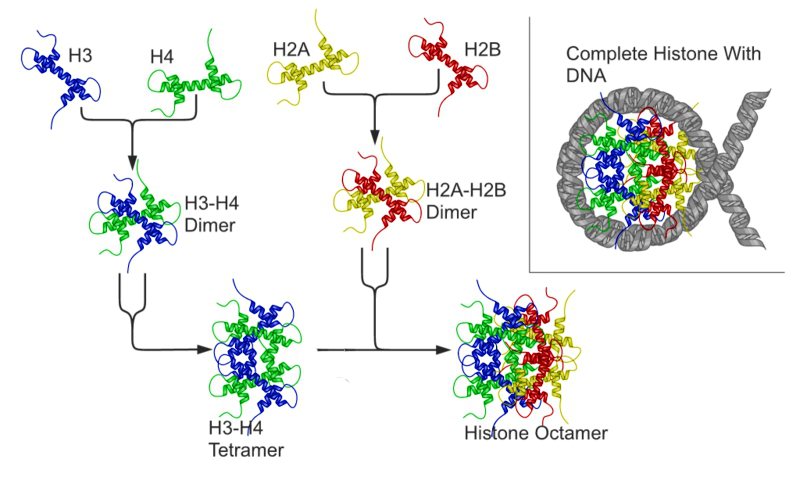
Anti-histone antibodies target five major classes of histone protein subunits: H1, H2A, H2B, H3, and H4. Anti-histone antibodies are diverse, so aside from targeting the protein subunits, different antibodies may also be specific for different complexes, including the H2A-H2B dimer or the H3-H4 tetramer. There is evidence that IgG and IgM anti-histone antibodies produced as a result of different drug exposures are specific to epitopes of different histone complexes. Highly modified histones have been shown to prompt a greater immune response.
Detecting antibodies
Anti-histone antibodies can be clinically detected using an ELISA assay. A blood sample is required for the test.
Indirect immunofluorescence can also be used to detect anti-histone antibodies. Homogeneous, diffuse staining indicates the presence of anti-histone antibodies, chromatin, and some double-stranded DNA.
Implications in disease
Ninety-six percent of patients with lupus induced by procainamide will have a positive test for anti-histone antibodies, and 100% of patients whose lupus was induced by penicillamine, isoniazid, or methyldopa will have a positive test for anti-histone antibodies. In 70% of patients with rheumatoid arthritis, Felty's syndrome, Sjogren's syndrome, systemic sclerosis, and primary biliary cirrhosis, anti-histone antibodies are present. Anti-histone antibodies may also be present in Alzheimer's disease and dementia patients.
A value of greater than 1.5 units relative to a control serum is considered a positive ELISA test for the anti-histone antibodies. Patients with drug-induced lupus erythematosus typically have positive tests for anti-histone antibodies but do not have indications for anti-dsDNA antibodies. Patients with idiopathic systemic lupus erythematosus have both types of autoantibodies present in their blood. Thus, this test can be useful in distinguishing these two illnesses.
References
References
- (2014). "Chapter 23 - Histone Autoantibodies, In Autoantibodies".
- (July 1959). "The L.E. Cell and L.E. Serum Factors". Bulletin of the New York Academy of Medicine.
- (January 1, 1960). "Chapter 20. Multiple "Autoantibodies" to Cell Constituents in Systematic Lupus Erythematosus. In: Ciba Foundation Symposium - Cellular Aspects of Immunity". John Wiley & Sons.
- (2018). "Robbins Basic Pathology". Elsevier.
- "Quanta Lite Histone".
- (6 February 2014). "Serology of Lupus Erythematosus: Correlation between Immunopathological Features and Clinical Aspects". Autoimmune Diseases.
- (August 1991). "Drug-induced anti-histone autoantibodies display two patterns of reactivity with substructures of chromatin". Journal of Clinical Investigation.
- (4 January 2016). "Autoantibodies in SLE: Specificities, Isotypes, and Receptors". Antibodies.
- "HIS - Clinical: Histone Autoantibodies, Serum". Mayo Medical Laboratories.
This article was imported from Wikipedia and is available under the Creative Commons Attribution-ShareAlike 4.0 License. Content has been adapted to SurfDoc format. Original contributors can be found on the article history page.
Ask Mako anything about Anti-histone antibodies — get instant answers, deeper analysis, and related topics.
Research with MakoFree with your Surf account
Create a free account to save articles, ask Mako questions, and organize your research.
Sign up freeThis content may have been generated or modified by AI. CloudSurf Software LLC is not responsible for the accuracy, completeness, or reliability of AI-generated content. Always verify important information from primary sources.
Report