From Surf Wiki (app.surf) — the open knowledge base
Antarctic Muon And Neutrino Detector Array
Neutrino telescope located beneath the Amundsen–Scott South Pole Station (1996–2009)
Neutrino telescope located beneath the Amundsen–Scott South Pole Station (1996–2009)
The Antarctic Muon And Neutrino Detector Array (AMANDA) was a neutrino telescope that was located beneath the Amundsen–Scott South Pole Station. In 2005, after nine years of operation, AMANDA became part of its successor project, the IceCube Neutrino Observatory.
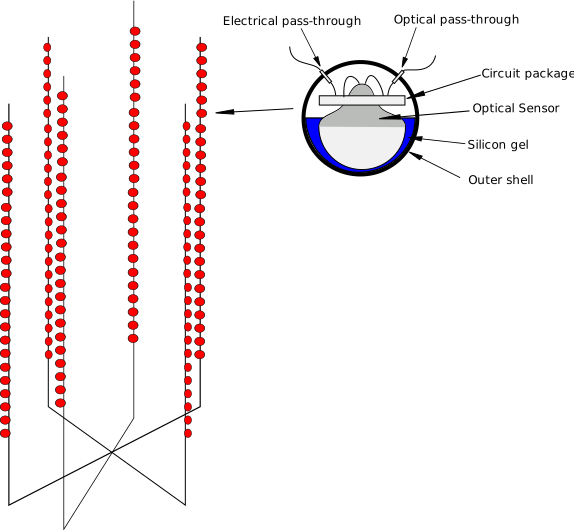
AMANDA consisted of optical modules, each containing one photomultiplier tube, sunk in Antarctic ice cap at a depth of about 1500 to 1900 metres. In its latest development stage, known as AMANDA-II, AMANDA was made up of an array of 677 optical modules mounted on 19 separate strings that are spread out in a rough circle with a diameter of 200 metres. Each string had several dozen modules, that were put in place by "drilling" a hole in the ice using a hot-water hose, sinking the cable with attached optical modules in, and then letting the ice freeze around it.
AMANDA detected very high energy neutrinos (50+ GeV) which pass through the Earth from the northern hemisphere and then react just as they are leaving upwards through the Antarctic ice. The neutrino interacts with nuclei of oxygen or hydrogen atoms contained in the surrounding water ice through the weak nuclear force, producing a muon and a hadronic shower. The optical modules detected the Cherenkov radiation from these latter particles, and by analysis of the timing of photon hits could approximately determine the direction of the original neutrino with a spatial resolution of approximately 2 degrees.
AMANDA's goal was an attempt at neutrino astronomy, identifying and characterizing extra-solar sources of neutrinos. Compared to underground detectors like Super-Kamiokande in Japan, AMANDA was capable of looking at higher energy neutrinos because it is not limited in volume to a manmade tank; however, it had much less accuracy because of the less controlled conditions and wider spacing of photomultipliers. Super-Kamiokande can look at much greater detail at neutrinos from the Sun and those generated in the Earth's atmosphere; however, at higher energies, the spectrum should include neutrinos dominated by those from sources outside the Solar System. Such a new view into the cosmos could give important clues in the search for dark matter and other astrophysical phenomena.
After two years of integrated operation as part of IceCube, the AMANDA counting house (in the Martin A. Pomerantz Observatory) was decommissioned in July and August 2009.
References
Sources
References
This article was imported from Wikipedia and is available under the Creative Commons Attribution-ShareAlike 4.0 License. Content has been adapted to SurfDoc format. Original contributors can be found on the article history page.
Ask Mako anything about Antarctic Muon And Neutrino Detector Array — get instant answers, deeper analysis, and related topics.
Research with MakoFree with your Surf account
Create a free account to save articles, ask Mako questions, and organize your research.
Sign up freeThis content may have been generated or modified by AI. CloudSurf Software LLC is not responsible for the accuracy, completeness, or reliability of AI-generated content. Always verify important information from primary sources.
Report