From Surf Wiki (app.surf) — the open knowledge base
Anta (architecture)
Posts or pillars flanking a doorway

Posts or pillars flanking a doorway
An anta (pl. antæ, antae, or antas; Latin, possibly from ante, "before" or "in front of"), or sometimes parastas (pl. parastades), is a term in classical architecture describing the posts or pillars on either side of a doorway or entrance of a Greek temple – the slightly projecting piers which terminate the side walls (of the naos). Antae are formed either by thickening the walls or by attaching a separate strip and can serve to reinforce brick walls, as in the Heraeum of Olympia (c. 600 BCE).
Antae differ from the pilaster, which is purely decorative, and does not have the structural support function of the anta.
Anta
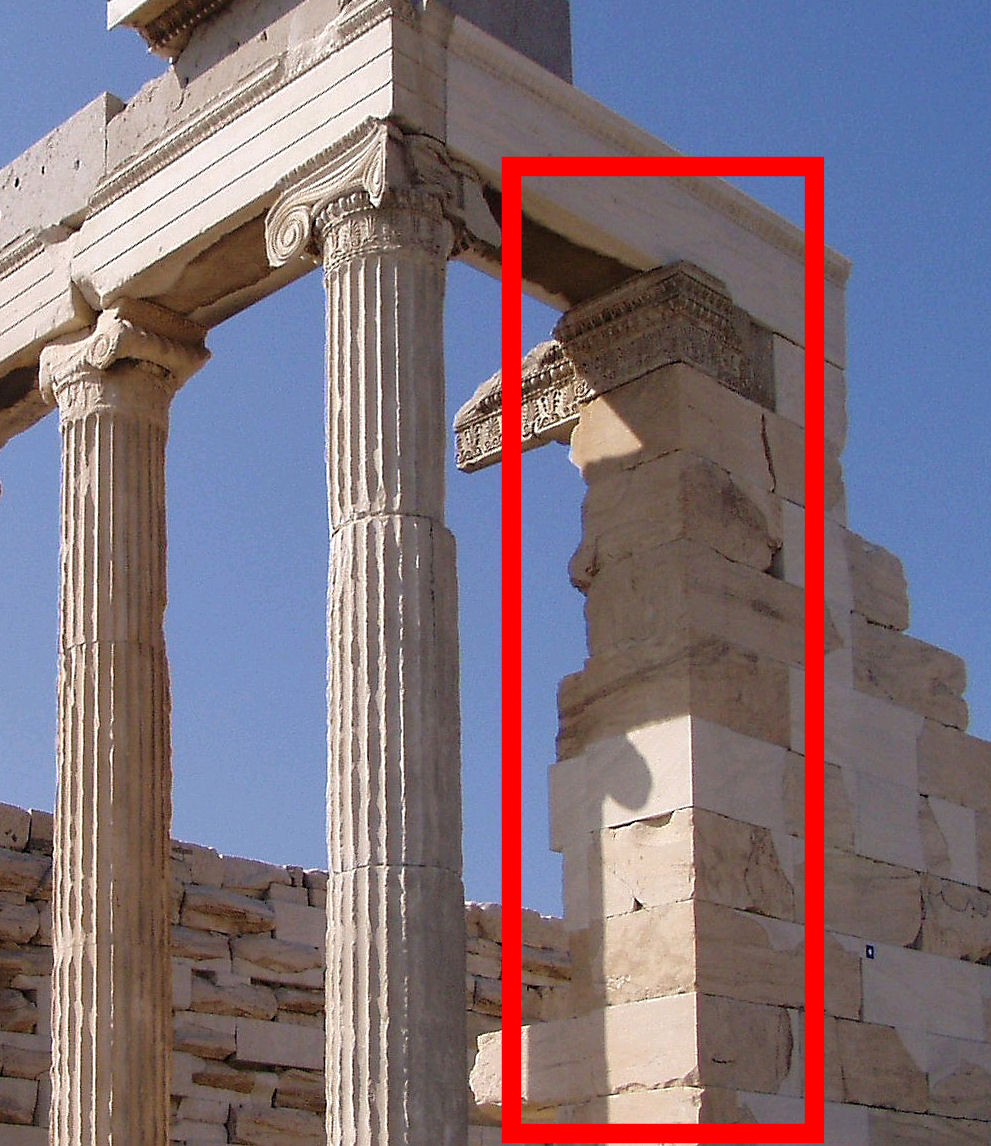
In contrast to columns or pillars, antae are directly connected with the walls of a temple. They owe their origin to the vertical posts of timber employed in the early, more primitive palaces or temples of Greece, as at Tiryns and in the Temple of Hera at Olympia. They were used as load-bearing structures to carry the roof timbers, as no reliance could be placed on walls built with unburnt brick or in rubble masonry with clay mortar. Later, they became more decorative as the materials used for wall construction became sufficient to support the structure.
When there are columns between antae, as in a porch facade, rather than a solid wall, the columns are said to be in antis.
Anta capitals
Main article: Anta capital
The anta is generally crowned by a stone block designed to spread the load from superstructure (entablature) it supports, called an "anta capital" when it is structural, or sometimes "pilaster capital" if it is only decorative as often during the Roman period. In order not to protrude unduly from the wall, these anta capitals usually display a rather flat surface, so that the capital has more or less a brick-shaped structure overall. The anta capital can be more or less decorated depending on the artistic order it belongs to, with designs, at least in ancient Greek architecture, often quite different from the design of the column capitals it stands next to. This difference disappeared with Roman times, when anta or pilaster capitals have design very similar to those of the column capitals.
Distyle in antis
Main article: Distyle in antis
Early Greek temples, the "distyle temples", such as the 6th century BCE Siphnian Treasury had antae on both side of the porch, framing a set of columns (a disposition named "distyle in antis", meaning "two columns in between antae"). "Antae temple" is an alternative term.
File:Treasury of the Siphnians by Hansen.JPG|Early Greek temples such as the Siphnian Treasury had antae on both side of the porch, framing a set of columns. File:EB1911 Greek Art - Restoration of the Treasury of Cnidus.jpg|Front view of the Siphnian Treasury with framing antae File:GR-delphi-schatzhaus-athen.jpg|The Athenian Treasury in Delphi is also a distyle in antis design.
Notes
References
Attribution:
References
- [https://global.britannica.com/technology/anta-architecture Encyclopædia Britannica, Anta entry]
- [https://books.google.com/books?id=WejuAgAAQBAJ&pg=PA214 A handbook of ornament, by Franz-Sales Meyer]
- The Classical Language of Architecture by John Summerson, p.47 "Anta" entry [https://books.google.com/books?id=57aoJE26kQkC&pg=PA47]
This article was imported from Wikipedia and is available under the Creative Commons Attribution-ShareAlike 4.0 License. Content has been adapted to SurfDoc format. Original contributors can be found on the article history page.
Ask Mako anything about Anta (architecture) — get instant answers, deeper analysis, and related topics.
Research with MakoFree with your Surf account
Create a free account to save articles, ask Mako questions, and organize your research.
Sign up freeThis content may have been generated or modified by AI. CloudSurf Software LLC is not responsible for the accuracy, completeness, or reliability of AI-generated content. Always verify important information from primary sources.
Report