From Surf Wiki (app.surf) — the open knowledge base
Anorthite
Calcium-rich feldspar mineral
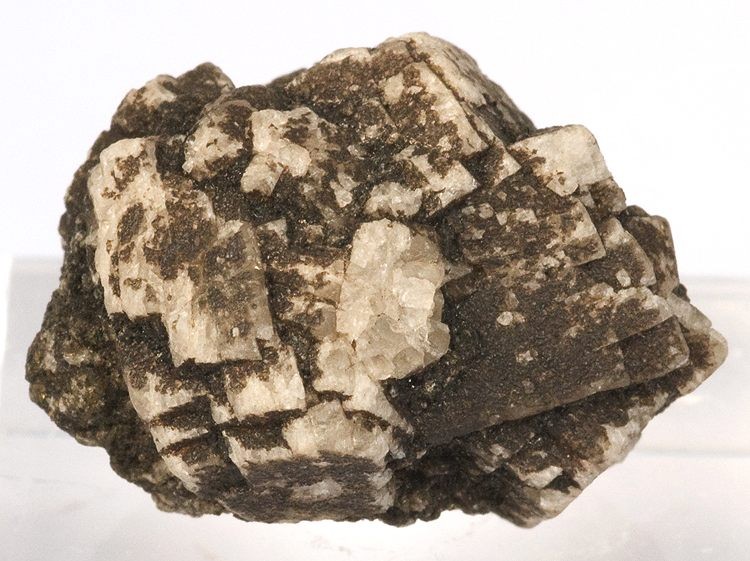
Calcium-rich feldspar mineral
| Field | Value |
|---|---|
| name | Anorthite |
| category | Tectosilicate minerals |
| group | Feldspar group |
| series | Plagioclase feldspar series |
| image | Anorthite-rare08-38b.jpg |
| caption | Anorthite crystals in a basalt vug from Vesuvius (size:6.9 × 4.1 × 3.8 cm) |
| formula | CaAl2Si2O8 |
| IMAsymbol | An |
| molweight | |
| strunz | 9.FA.35 |
| system | Triclinic |
| class | Pinacoidal () |
| (same H-M symbol) | |
| symmetry | P |
| unit cell | a = 8.1768, b = 12.8768 |
| c = 14.169 [Å]; α = 93.17° | |
| β = 115.85°, γ = 92.22°; Z = 8 | |
| color | White, grayish, reddish |
| habit | Anhedral to subhedral granular |
| twinning | Common |
| cleavage | Perfect [001] good [010] poor [110] |
| fracture | Uneven to conchoidal |
| tenacity | Brittle |
| mohs | 6 |
| luster | Vitreous |
| refractive | nα = 1.573–1.577 nβ = 1.580–1.585 nγ = 1.585–1.590 |
| opticalprop | Biaxial (−) |
| 2V | 78° to 83° |
| birefringence | δ = 0.012–0.013 |
| streak | White |
| gravity | 2.72–2.75 |
| melt | 1550 ± 2°C |
| diaphaneity | Transparent to translucent |
| references |
(same H-M symbol) c = 14.169 [Å]; α = 93.17° β = 115.85°, γ = 92.22°; Z = 8
Anorthite (2Si2O8. Anorthite is found in igneous rocks.
Mineralogy
Anorthite is the calcium-rich endmember of the plagioclase solid solution series, the other endmember being albite (NaAlSi3O8). Pure anorthite, containing no sodium, is rare on Earth. Anorthite also refers, however, to plagioclase compositions with more than 90 molecular percent of the anorthite endmember (and up to 10 molecular percent of the albite endmember). The composition of plagioclases is often expressed as a molar percentage of An%, or (for a specific quantity) Ann, where n = Ca/(Ca + Na) × 100. This equation predominantly works in a terrestrial context; exotic locales and in particular Lunar rocks may need to account for other cations, such as Fe2+, to explain differences between optically and structurally derived An% data observed in Lunar anorthites.
At standard pressure, pure anorthite (An100) melts at 1550 ± 2 °C (2822 °F).
Occurrence
Anorthite is a compositional variety of plagioclase. It occurs in mafic igneous rock. It also occurs in metamorphic rocks of granulite facies, in metamorphosed carbonate rocks, and corundum deposits. Its type localities are Monte Somma and Valle di Fassa, Italy. It was first described in 1823. It is more rare in surficial rocks than it normally would be due to its high weathering potential in the Goldich dissolution series.
It also makes up much of the lunar highlands; the Genesis Rock, collected during the 1971 Apollo 15 mission, is made of anorthosite, a rock composed largely of anorthite. Anorthite was discovered in samples from comet Wild 2, and the mineral is an important constituent of Ca-Al-rich inclusions in rare varieties of chondritic meteorites.
References
References
- Warr, L.N.. (2021). "IMA–CNMNC approved mineral symbols". Mineralogical Magazine.
- (1915). "The ternary system CaO-Al2O3-SiO2, with optical study by F.E. Wright". American Journal of Science.
- [http://www.handbookofmineralogy.org/pdfs/anorthite.pdf Handbook of Mineralogy]
- [http://www.mindat.org/min-246.html Mindat]
- [http://webmineral.com/data/Anorthite.shtml Webmineral]
- Ndimofor, A.N.. (2018). "The Fundamentals of Crystallography & Mineralogy". Spears Media Press.
- (21 May 2019). "The significance of plagioclase textures in mid-ocean ridge basalt (Gakkel Ridge, Arctic Ocean)". Contributions to Mineralogy and Petrology.
- (1 August 1973). "Chemical anomalies of Lunar plagioclase, described by substitution vectors and their relation to optical and structural properties". Contributions to Mineralogy and Petrology.
This article was imported from Wikipedia and is available under the Creative Commons Attribution-ShareAlike 4.0 License. Content has been adapted to SurfDoc format. Original contributors can be found on the article history page.
Ask Mako anything about Anorthite — get instant answers, deeper analysis, and related topics.
Research with MakoFree with your Surf account
Create a free account to save articles, ask Mako questions, and organize your research.
Sign up freeThis content may have been generated or modified by AI. CloudSurf Software LLC is not responsible for the accuracy, completeness, or reliability of AI-generated content. Always verify important information from primary sources.
Report