From Surf Wiki (app.surf) — the open knowledge base
Anne-Louis Girodet de Roussy-Trioson
French painter (1767–1824)

French painter (1767–1824)
| Field | Value |
|---|---|
| name | Anne-Louis Girodet-Trioson |
| image | Anne-Louis Girodet autoportrait.jpg |
| caption | Self-portrait, 1790, Hermitage Museum |
| birth_name | Anne-Louis Girodet de Roussy-Trioson |
| birth_date | |
| birth_place | Montargis, Orléanais, France |
| death_date | |
| death_place | Paris, France |
| resting_place | Père Lachaise Cemetery |
| field | Painting |
| movement | Neoclassicism, Romanticism |
| works | Ossian receiving the ghosts of the fallen French Heroes, 1801; The Funeral of Atala, 1808; Portrait de Chateaubriand méditant sur les ruines de Rome, after 1808 |
Anne-Louis Girodet de Roussy-Trioson (; or de Roucy), also known as Anne-Louis Girodet-Trioson or simply Girodet (29 January 17679 December 1824), was a French painter and pupil of Jacques-Louis David, who participated in the early Romantic movement by including elements of eroticism in his paintings. Girodet is remembered for his precise and clear style and for his paintings of members of the Napoleonic family.
Early career
Girodet was born at Montargis. Both of his parents died when he was a young adult. The care of his inheritance and education fell to his guardian, a prominent physician named Benoît-François Trioson, "médecin-de-mesdames", who later adopted him. The two men remained close throughout their lives and Girodet took the surname Trioson in 1812. He changed to the study of painting under a teacher named Luquin and then entered the school of Jacques-Louis David. At the age of 22 he successfully competed for the Prix de Rome with a painting of the Story of Joseph and his Brethren. From 1789 to 1793 he lived in Italy and while in Rome he painted his Hippocrate refusant les presents d'Artaxerxes and Endymion-dormant (now in the Louvre), a work which gained him great acclaim at the Salon of 1793 and secured his reputation as a leading painter in the French school.
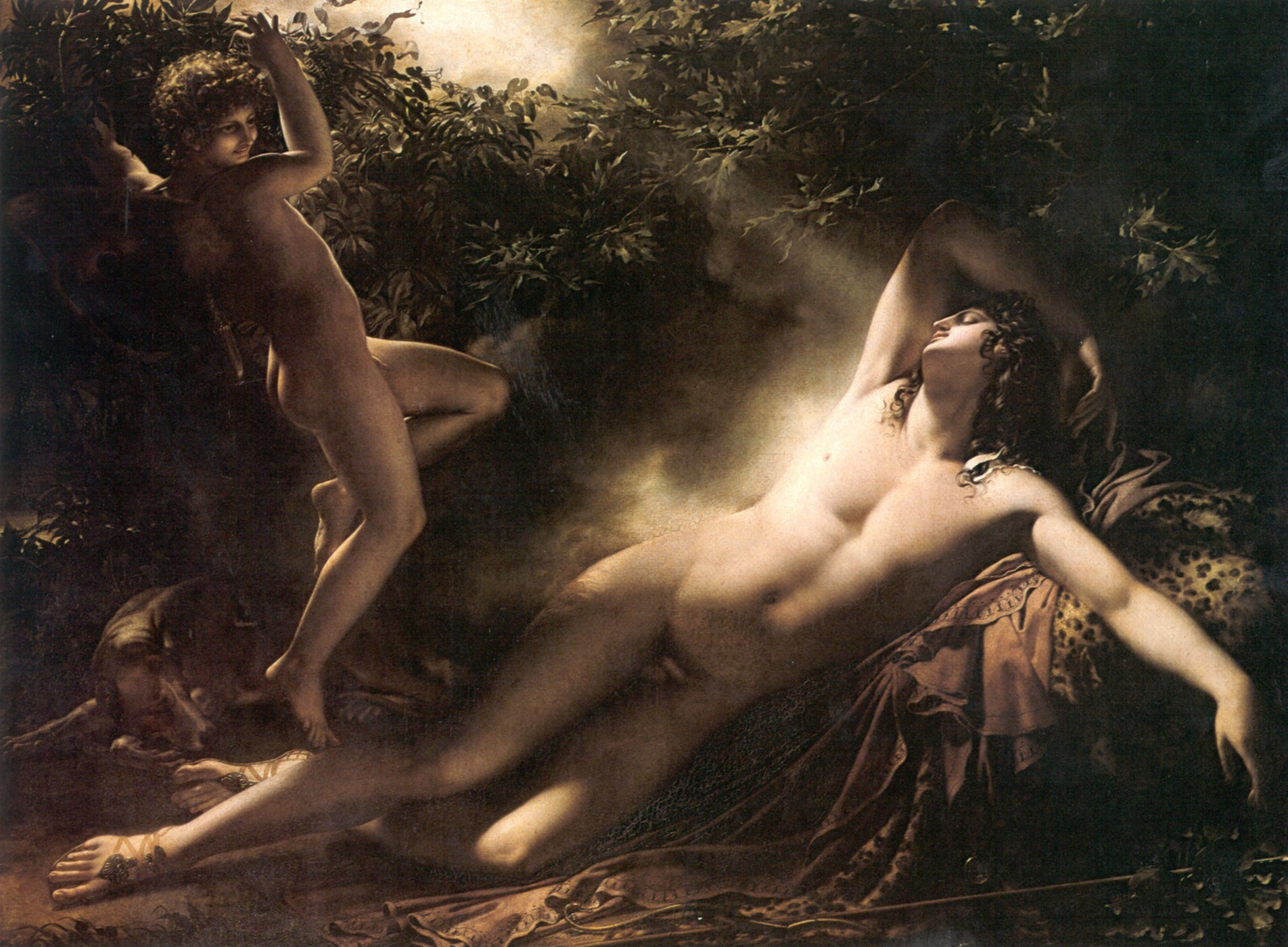
Once he returned to France, Girodet painted many portraits, including some of members of the Bonaparte family. In 1806, in competition with the Sabines of David, he exhibited his ** (Louvre), which was awarded the decennial prize.
Later life


Girodet was a member of the Academy of Painting and of the Institut de France, a knight of the Order of Saint Michael, and officer of the Legion of Honour.
In his forties his powers began to fail, and his habit of working at night and other excesses weakened his constitution. In the Salon of 1812 he exhibited only a Tête de Vierge; in 1819 Pygmalion et Galatée showed a further decline of strength. In 1824, the year in which he produced his portraits of Cathelineau and Bonchamps, Girodet died on December 9 in Paris. At a sale of his effects after his death, some of his drawings realized enormous prices.

Posthumously published work

Girodet produced a vast quantity of illustrations, amongst which may be cited those for the Didot editions of the works of Virgil (1798) and Racine (1801–1805). Fifty-four of his designs for the works of the ancient Greek poet Anacreon were engraved by M. Châtillon. Girodet used much of his time on literary composition. His poem Le Peintre (rather a string of commonplaces), together with poor imitations of classical poets, and essays on Le Génie and La Grâce, were published posthumously in 1829, with a biographical notice by his friend Coupin de la Couperie. Delecluze, in his Louis David et son temps, has also a brief life of Girodet.
Girodet: Romantic Rebel was the first retrospective in the United States devoted to the works of Anne-Louis Girodet de Roussy-Trioson; the exhibition was initiated by the Cleveland Museum of Art and organized by the Musée du Louvre and the Réunion des Musées Nationaux, Paris, in collaboration with the Art Institute of Chicago, the Metropolitan Museum of Art, New York, and the Montreal Museum of Fine Arts, in cooperation with the Musée Girodet, Montargis. The exhibition assembled more than 100 seminal works (about 60 paintings and 40 drawings) that demonstrated the artist's range as a painter as well as a draftsman. The exhibit was shown at the Art Institute of Chicago (February 11–April 30, 2006), Musée du Louvre (September 22, 2005–January 2, 2006), the Metropolitan Museum of Art (May 24–August 27, 2006) and the Montreal Museum of Fine Arts (October 12, 2006–January 21, 2007).
Analysis of the works
Girodet was trained in the neoclassical style of his teacher, Jacques-Louis David, seen in his treatment of the male nude body and his reference to models from the Renaissance and Classical antiquity. However, he also deviated from this style in several ways. The peculiarities which mark Girodet's position as the herald of the romantic movement are already evident in his Sleep of Endymion (1791, also called Effet de lune or "effect of the Moon"). Although the subject matter and pose are inspired by classical precedents, Girodet's diffuse lighting is more theatrical and atmospheric. The androgynous depiction of the sleeping shepherd Endymion is also noteworthy. These early romantic effects were even more notable in his Ossian, exhibited in 1802. Girodet portrayed recently killed Napoleonic soldiers being welcomed into Valhalla by the fictional bard Ossian. The painting is striking for its inclusion of phosphorescent meteors, vaporous luminosity, and spectral protagonists.
The same coupling of classic and romantic elements marks Girodet's Danae (1799) and his Quatre Saisons, executed for the king of Spain (repeated for Compiègne), and shows itself to a ludicrous extent in his Fingal (Leuchtenberg collection, St. Petersburg), executed for Napoleon in 1802. Girodet can be seen here combining aspects of his classical training and traditional education with new literary trends, popular scientific spectacles, and a consummate interest in the strange and the bizarre. In this way his work announces the rise of a romantic aesthetic which prizes individuality, expression, and imagination over an adherence to classical academic precedents.
Gallery
File:Girodet Brutus 1785.jpg|Brutus condemns his sons to death (Brutus condamne ses fils à mort), 1785 File:Jacques-Louis David - Oath of the Horatii - Google Art Project.jpg|The Oath of the Horatii (Le Serment des Horaces, copy after David's original), 1786, Toledo Museum of Art, Ohio File:Anne-Louis Girodet de Roussy-Trioson - Coriolanus Taking Leave of his Family - 2019.169.1 - National Gallery of Art.jpg|Coriolanus Taking Leave of His Family, 1786 File:Girodet La mort de Tatius.jpg|The Death of Tatius (La mort de Tatius), 1788, Musée des Beaux-Arts d'Angers File:Girodet Joseph reconnu par ses frères.JPG|Joseph Recognised by His Brothers, 1789, École nationale supérieure des Beaux-Arts, Paris File:Anne-Louis Girodet de Roussy-Trioson - Portrait d'une jeunesse.jpg|Portrait of a Youth (Portrait d'une jeunesse), , Smith College Museum of Art, Northampton, Massachusetts File:Longchamp081 Girodet Fravega.jpg|Portrait of Giuseppe Fravega (ministre of the Ligurian Republic in Paris), 1796, Musée des beaux-arts de Marseille File:Benoît Agnès Trioson by Anne-Louis Girodet-Trioson, 1797.jpg|Benoît-Agnès Trioson regardant des figures dans un livre, 1797, Musée Girodet, Montargis File:Anne-Louis Girodet De Roucy-Trioson - Portrait of J. B. Belley, Deputy for Saint-Domingue - WGA09508.jpg|Portrait of Jean-Baptiste Belley, 1797, Palace of Versailles Image:Girodet-Trioson - Mademoiselle Lange as Venus, 1798.jpg|Danaé,1798, Museum der bildenden Künste, Leipzig File:Anne-Louis Girodet de Roussy-Trioson - Portrait of Mlle. Lange as Danae - 69.22 - Minneapolis Institute of Arts.jpg|Portrait of Mlle. Lange as Danae, 1799, Minneapolis Institute of Arts, Minnesota Image:The Meeting of Orestes and Hermione.jpg|The Meeting of Orestes and Hermione, File:Anne-Louis Girodet De Roucy-Trioson - Benoît-Agnes Trioson - WGA09505.jpg|Benoît-Agnes Trioson, 1800, Louvre, Paris Image:Anne-Louis Girodet-Trioson 001.jpg|Ossian receiving the Ghosts of the French Heroes, , Château de Malmaison File:Anne Louis Girodet de Roucy-Trioson - Portrait de Napoleon I (Versailles).jpg|Napoleon Bonaparte, Premier Consul, Palais de l'Elysée Image:Anne-Louis Girodet-Trioson 005.jpg|Portrait of Dominique-Jean Larrey (military surgeon in Napoleon's army), 1804, Louvre File:Portrait of the Katchef Dahouth, Christian Mameluke, 1804, by Anne-Louis Girodet-Trioson - Art Institute of Chicago - DSC09533.JPG|Portrait of the Katchef Dahouth, Christian Mameluke, 1804, Art Institute of Chicago Image:Carlo Maria Bonaparte.jpg|Charles Marie Bonaparte (father of Napoléon Bonaparte), 1806 File:Study for "Portrait of an Indian" MET DP135221.jpg|Study for Portrait of an Indian, , Metropolitan Museum of Art, New York File:Madame Erneste Bioche de Misery by Anne-Louis Girodet-Trioson.jpg|Madame Erneste Bioche de Misery, 1807, National Gallery of Canada, Ottawa File:Napoleon en de sleutels van wenen.jpg|Napoleon Receiving the Keys of Vienna, 1808 Image:Anne-Louis Girodet-Trioson 006.jpg|Portrait of Chateaubriand, 1809, , Saint-Malo File:Hortense de Beauharnais.jpg|Portrait of Hortense de Beauharnais, Queen of Holland, wife of King Louis Napoleon, , Rijksmuseum, Amsterdam File:Anne-Louis Girodet de Roussy-Trioson - Esquisse pour ‚La révolte du Caire‘ (ca. 1809).jpg|Sketch for The Revolt of Cairo, , Cleveland Museum of Art File:Anne-Louis Girodet de Roussy-Trioson - La révolte du Caire (ca. 1810).jpg|The Revolt of Cairo, oil and Indian ink on paper, , Art Institute of Chicago Image:Girodet .jpg|The Revolt of Cairo, 1810 File:Anne-Louis Girodet de Roussy-Trioson - Portrait de Louis-Charles Balzac (1811).jpg|Portrait of Charles-Louis Balzac, 1811, Dallas Museum of Art File:Napoleon I (by Anne Louis Girodet de Roucy-Trioson).jpg|Napoleon I in Coronation Robes (Napoléon en costume impérial), , Bowes Museum, England File:Anne-Louis Girodet - Portrait de Prosper de Barante.jpg|Portrait of Prosper de Barante, 1814, Musée d'art Roger-Quilliot, Clermont-Ferrand File:Anne-Louis Girodet-Trioson - Allegory of Victory, 1814.jpg|Allegory of Victory, , Château de Compiègne File:Anne-Louis Girodet-Trioson - Aurora, 1814-15.jpg|Aurora, , Château de Compiègne File:Anne-Louis Girodet-Trioson - Minerva between Apollo and Mercury, 1814-15.jpg|Minerva between Apollo and Mercury, , Château de Compiègne Image:Cathelineau.jpg|Jacques Cathelineau, généralissime vendéen, 1816, Musée d'art et d'histoire de Cholet File:Bonchamps.jpg|Charles-Melchior Arthus, Marquis de Bonchamps, 1816, Musée d'art et d'histoire de Cholet Image:0 Pygmalion et Galatée - A-L. Girodet - RF 2002-4 - Louvre 2.JPG|Pygmalion et Galatée, 1819, Château de Dampierre File:Anne-Louis Girodet de Roucy-Trioson - Tête d'une femme dans un turban.jpg|Head of a Woman in a Turban, , Hermitage Museum, Saint Petersburg File:Girodet Madame Reiset.jpg|Portrait de Madame Reizet assise, 1820 Madame Jacques-Louis-Étienne Reizet (Colette-Désirée-Thérèse Godefroy, 1782–1850) MET DP135222.jpg|Portrait of Madame Reiset, 1823, Metropolitan Museum of Art File:Jacques-Joseph de Cathelineau.jpg|Portrait of Jacques-Joseph de Cathelineau (1787–1832), son of the généralissime File:Capaneus – Study called The Blasphemic (Anne-Louis Girodet-Trioson) - Nationalmuseum - 183684.tif|Capaneus, Leader of The Seven against Thebes (Tête du Blasphémateur), study for Les sept chefs devant Thèbes, Nationalmuseum, Stockholm File:François-René de Chateaubriand by Anne-Louis Girodet de Roucy Trioson.jpg|Undated portrait of François-René de Chateaubriand File:Girodet - Docteur Trioson montargis.jpg|Portrait du Docteur Trioson donnant une leçon de géographie à son fils, undated, Musée Girodet, Montargis File:Anne-Louis Girodet De Roucy-Trioson - Portrait of Joachim Murat - WGA09511.jpg|Portrait of Joachim Murat (?), Hermitage Museum
References
References
- Long, George. (1851) ''The Supplement to the Penny Cyclopædia of the Society for the Diffusion of Useful Knowledge'', C. Knight.
- 2-8041-1526-7.
- Heck, Johann Georg. (1860) ''Iconographic Encyclopaedia of Science'', D. Appleton and company.
- "Girodet: Romantic Rebel". [[Art Institute of Chicago]].
- "Girodet".
- (1996). "Making Trouble for Art History: The Queer Case of Girodet". Art Journal.
- (2018). "Girodet's Galvanized Bodies". Art History.
This article was imported from Wikipedia and is available under the Creative Commons Attribution-ShareAlike 4.0 License. Content has been adapted to SurfDoc format. Original contributors can be found on the article history page.
Ask Mako anything about Anne-Louis Girodet de Roussy-Trioson — get instant answers, deeper analysis, and related topics.
Research with MakoFree with your Surf account
Create a free account to save articles, ask Mako questions, and organize your research.
Sign up freeThis content may have been generated or modified by AI. CloudSurf Software LLC is not responsible for the accuracy, completeness, or reliability of AI-generated content. Always verify important information from primary sources.
Report