From Surf Wiki (app.surf) — the open knowledge base
Anklam
Town in Mecklenburg-Vorpommern, Germany

Town in Mecklenburg-Vorpommern, Germany
| Field | Value |
|---|---|
| type | Town |
| image_photo | Marktplatz Anklam.JPG |
| image_caption | Market square |
| image_coa | DEU Hansestadt Anklam COA.svg |
| coordinates | |
| image_plan | Anklam_in_VG.svg |
| state | Mecklenburg-Vorpommern |
| district | Vorpommern-Greifswald |
| elevation | 5 |
| area | 56.68 |
| postal_code | 17389 |
| area_code | 03971 |
| licence | VG, ANK |
| Gemeindeschlüssel | 13 0 75 005 |
| website | www.anklam.de |
| mayor | Michael Galander |
| party | independent |
Anklam (), formerly known as Tanglim and Wendenburg, is a town in the Western Pomerania region of Mecklenburg-Vorpommern in north-eastern Germany. It is situated on the banks of the Peene river, just 8 km from its mouth in the Kleines Haff, the western part of the Szczecin Lagoon. Anklam has a population of 12,177 (2021) and was the capital of the former Ostvorpommern district. Since September 2011, it has been part of the district of Vorpommern-Greifswald.
History

In the early Middle Ages, there was an important Scandinavian and Wendish settlement in the area near the present town now known as Altes Lager Menzlin. Anklam proper began as an associated Wendish fortress.
In the Middle Ages the town was a part of the Duchy of Pomerania. During the German expansion eastwards, the abandoned fortress was developed into a settlement named Tanglim after its new founder. The site possesses importance as the head of navigation on the Peene. It was elevated to town status in 1244 and became a member of the Hanseatic League the same year or in 1483. The town remained small and non-influential, but achieved a measure of wealth and prosperity with its membership.

As a town of considerable military importance, it suffered greatly during the Thirty Years' War when Swedish and Imperial troops battled over it across a twenty-year span. Amid this and subsequent wars, it also endured repeated outbreaks of fire and plague. It was occupied by imperial forces from 1627 to 1630, and thereafter by Swedish forces. After the war, Anklam became part of Swedish Pomerania in 1648. In 1676, it was captured by Frederick William of Brandenburg.
In 1713, Anklam was looted by soldiers of the Tsardom of Russia. That it was not burned to the ground, as ordered by Peter the Great, was in large part due to the resistance of Christian Thomesen Carl ("Carlson"), after whom a street is named in remembrance. The southern parts of the town were ceded to Prussia by the 1720 Treaty of Stockholm, while a smaller section north of the Peene remained Swedish. It was damaged again during the Seven Years' War in the 1750s and 1760s, with its fortifications being effectively dismantled in 1762. Sweden yielded its remaining part of the town in 1815, when all of Western Pomerania became part of the Prussian province of Pomerania.
In the 19th century, Anklam was connected with Berlin and Stettin (Szczecin) by rail and developed its manufacture of linen and woolen goods, leather, beer, and soap. Its 1871 population was 10,739, which had risen to 14,602 by the turn of the century. By the time of the First World War, it possessed a military school and developed iron foundries and sugar factories. In 1939 the Wehrmacht took over the military school and constructed a military prison on the grounds. In September 1942, the FStGA 8 field penal battalion for Allied prisoners-of-war was established and afterwards relocated to the eastern front.
Anklam was nearly completely destroyed by several bombing raids of the U.S. Air Force in 1943 and 1944 and in the last days of World War II, when the advancing Soviets burned and leveled most of the town. During the final stages of the war, in February 1945, the German-perpetrated death march of Allied POWs from the Stalag XX-B POW camp passed through the town. After the war, Anklam became part of the East German state of Mecklenburg-Vorpommern, and after the dissolution of the province it was part of Bezirk Neubrandenburg from 1952 to 1990. The town was rebuilt in the rather uniform socialist style.
After the 1990 reunification of Germany, Anklam became part of the state of Mecklenburg-Vorpommern, re-created at that time.
Population development
Sights

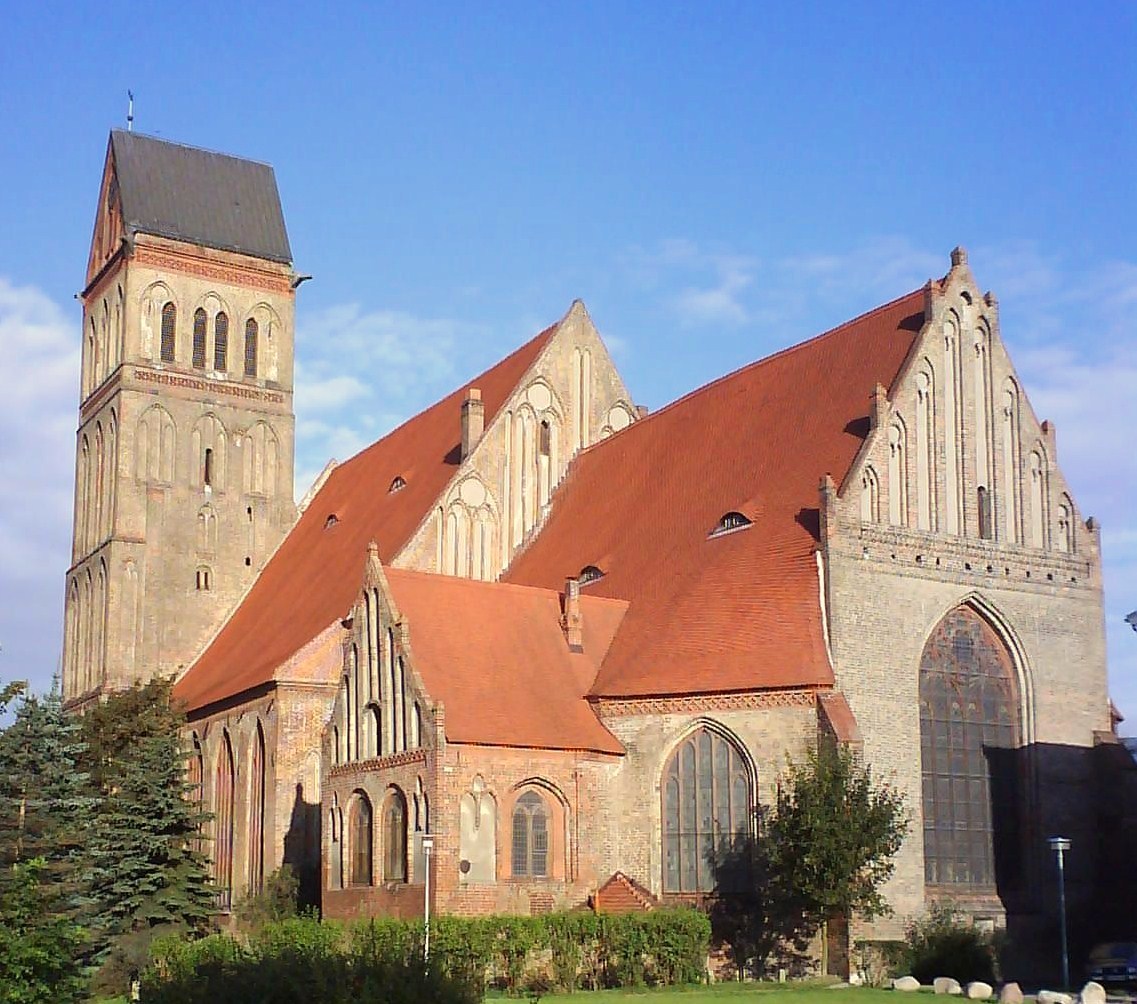
Anklam was a prosperous medieval city but suffered severely during the Thirty Years' War, the Seven Years' War, and the Second World War, as well as from periodic fires. Nonetheless, Anklam has some significant buildings remaining. The 12th-century church of St Mary was rebuilt in the 15th century, had a modern spire added in the 19th, and was repaired in 1947.
Museums
- Museum im Steintor (local history)
- Otto-Lilienthal-Museum
Transport
Anklam is connected with the Autobahn 20 coastal highway.
- Anklam railway station is served by national and local services to Angermünde, Berlin, Dresden, Eberswalde, Frankfurt, Munich, Prague and Stralsund.
Notable people

- Johann Franz Buddeus (1667–1729), philosopher, theologian, professor in Halle and Jena.
- Paschen von Cossel (1714–1805), lawyer, imperial vicar, canon of the cathedral chapter Hamburger
- Friedrich Albrecht Karl Herrmann, Reichsgraf von Wylich und Lottum (1720–1797), Prussian officer
- Carl August Wilhelm Berends (1759–1826), physician, head of the Charité
- Ludwig von Henk (1820–1894), Vice Admiral of the Imperial Navy, member of Reichstag
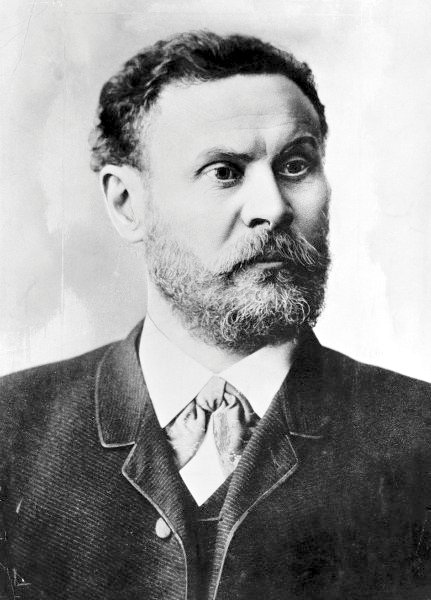
- Otto Lilienthal (1848–1896), aviation pioneer
- Gustav Lilienthal (1849–1933), architect and social reformer
- Johanna Gadski (1872–1932), opera singer
- Julius Urgiß, (1873–1948), German-Jewish screenwriter and critic for Kinematograph
- Heinrich Sahm (1877–1939) a German lawyer, mayor of the Free City of Danzig
- Ulrich von Hassell, (1881–1944), German diplomat and anti-Nazi
- Kurt von Briesen (1886–1941), a German officer, most recently General of Infantry in WWII
- Alice Hechy (1893–1973), a German stage and film actress
- Günter Schabowski (1929–2015), politician (SED)
- Dixon (born Steffen Berkhahn in 1975), house and techno DJ, producer and label manager
- Matthias Schweighöfer, (born 1981), a German actor, voice actor, film director and producer.
Sport
- Peter Hein (born 1943), a German rower, competed at the 1968 Summer Olympics
- Sandro Stallbaum (born 1981), a retired German footballer, played 336 games
- Florian Stritzel (born 1994), a German footballer currently playing for SV Wehen Wiesbaden
International relations
Anklam is twinned with:
Notes
References
References
- Langer, Herbert. (2003). "Gemeinsame Bekannte: Schweden und Deutschland in der Frühen Neuzeit". LIT Verlag.
- Langer, Herbert. (2003). "Gemeinsame Bekannte: Schweden und Deutschland in der Frühen Neuzeit". LIT Verlag.
- (2022). "The United States Holocaust Memorial Museum Encyclopedia of Camps and Ghettos 1933–1945. Volume IV". Indiana University Press, United States Holocaust Memorial Museum.
- Kaszuba, Sylwia. (2021). "Stalag XX B: historia nieopowiedziana". Muzeum Miasta Malborka.
- link. (August 12, 2011)
- {{Cite EB1911. .
This article was imported from Wikipedia and is available under the Creative Commons Attribution-ShareAlike 4.0 License. Content has been adapted to SurfDoc format. Original contributors can be found on the article history page.
Ask Mako anything about Anklam — get instant answers, deeper analysis, and related topics.
Research with MakoFree with your Surf account
Create a free account to save articles, ask Mako questions, and organize your research.
Sign up freeThis content may have been generated or modified by AI. CloudSurf Software LLC is not responsible for the accuracy, completeness, or reliability of AI-generated content. Always verify important information from primary sources.
Report