From Surf Wiki (app.surf) — the open knowledge base
Andronovo culture
Group of Bronze Age cultures, 2000–900 BC
Group of Bronze Age cultures, 2000–900 BC
| Field | Value |
|---|---|
| name | Andronovo culture |
| map | Andronovo area.png |
| mapsize | 300px |
| region | Eurasian steppe |
| period | Late Bronze Age |
| dates | 2000 BC – 1150 BC |
| precededby | Sintashta culture, Okunev culture, Seima-Turbino phenomenon, Kelteminar culture |
| followedby | Karasuk culture, Begazy–Dandybai culture, Tazabagyab culture |
The Andronovo culture is a collection of similar local Late Bronze Age cultures that flourished 2000–1150 BC, spanning from the southern Urals to the upper Yenisei River in central Siberia and western Xinjiang in the east. In the south, the Andronovo sites reached Tajikistan and Uzbekistan. It is agreed among scholars that the Andronovo culture was Indo-Iranian. Some researchers have preferred to term it an archaeological complex or archaeological horizon.
Andronovo culture's first stage may have started as early as the waning years of the 3rd millennium BC, with a focus on cattle grazing in the vast grasslands of the region. The slightly older Sintashta culture ( 2200–1900 BC), formerly included within the Andronovo culture, is now thought to be distinct from Early Andronovo cultures. Allentoft et al. (2015) concluded from their genetic studies that the Andronovo culture and the preceding Sintashta culture were derived from an eastern migration of the Corded Ware culture, given the higher proportion of ancestry matching the earlier farmers of Europe, similar to the admixture found in the genomes of the Corded Ware population.
Discovery
The name derives from the village of Andronovo in the Uzhursky District of Kranoyarsk Krai, Siberia, where the Russian zoologist Arkadi Tugarinov discovered its first remains in 1914. Several graves were discovered, with skeletons in crouched positions, buried with richly decorated pottery. The Andronovo culture was first identified by the Russian archaeologist Sergei Teploukhov in the 1920s.
Dating and subcultures
The culture of Sarazm (4th–3rd millennium BC) precedes the arrival of the Andronovo steppe culture in South Central Asia in the 2nd millennium BC.
Currently only two sub-cultures are considered as part of Andronovo culture:
- Alakul (1900–1500 BC) In the Forest steppe and steppe of the Trans-Urals; northern, western, and central Kazakhstan; western Siberia; reaching southern Central Asia. In Transoxiana region, and Kyzylkum Desert.
- Fëdorovo or Fyodorovka (1900–1300 BC) At Forest steppe in Trans-Urals and Ingala Valley; Southern Siberia and Upper Yenissei; northern, central, and eastern Kazakhstan; Semirech'ye region; the Pamir and Tian Shan Mountains; and Xinjiang. In southern Siberia (earliest evidence of cremation and fire cult)
- Alakul-Fëdorovo (1750–1550 BC). On the other hand, synchronous Alakul-Fedorovo sites mainly appeared in the second quarter of the second millennium BC, in Southern Urals, along with the persistence of the Alakul materials.
Other authors identify the following sub-culture also as part of Andronovo:
- Alekseyevka-Sargary (1500–1000 BC)Yarigin, Sergey, et al. (2024). "Megalithic structure from Burabay: Gold mining and cult communities of the Late Bronze Age of Northern Kazakhstan", in: Archaeological Research in Asia, Volume 39, September 2024, 100536. Late Bronze Age in northern Kazakhstan, contacts with Namazga VI in Turkmenia, Ingala Valley in the south of Tyumen Oblast, in Tobol.
Some authors have challenged the chronology and model of eastward spread due to increasing evidence for the earlier presence of these cultural features in parts of east Central Asia.
Geographic extent
The geographical extent of the culture is vast and difficult to delineate exactly. On its western fringes, it overlaps with the approximately contemporaneous, but distinct, Srubna culture in the Volga-Ural interfluvial. To the east, it reaches into the Minusinsk depression, with some sites as far west as the southern Ural Mountains, overlapping with the area of the earlier Afanasevo culture. Additional sites are scattered as far south as the Kopet Dag (Turkmenistan), the Pamir (Tajikistan) and the Tian Shan (Kyrgyzstan). The northern boundary vaguely corresponds to the beginning of the Taiga. More recently, evidence for the presence of the culture in Xinjiang in far-western China has also been found, mainly concentrated in the area comprising Tashkurgan, Ili, Bortala, and Tacheng area. In the Volga basin, interaction with the Srubna culture was the most intense and prolonged, and Federovo style pottery is found as far west as Volgograd. Mallory notes that the Tazabagyab culture south of Andronovo could be an offshoot of the former (or Srubna), alternatively the result of an amalgamation of steppe cultures and the Central Asian oasis cultures (Bishkent culture and Vakhsh culture). Andronovo influence is thought to have reached as far as the Shang dynasty in China, including the introduction of chariots likely via the Karasuk variant of Andronovo and possibly other intermediary cultures.
.png)
In the initial Sintashta-Petrovka phase, the Andronovo culture is limited to the northern and western steppes in the southern Urals-Kazakhstan. Since then, at the 2nd millennium, in the Alakul Phase (2000–1700 BC), the Fedorovo Phase (1850–1450 BC) and the final Alekseyevka Phase (1400–1000 BC), the Andronovo cultures move intensively eastwards, expanding as far east as the Upper Yenisei River, succeeding the non-Indo-European Okunev culture.
In southern Siberia and Kazakhstan, the Andronovo culture was succeeded by the Karasuk culture (1500–800 BC). On its western border, it is roughly contemporaneous with the Srubna culture, which partly derives from the Abashevo culture. The earliest historical peoples associated with the area are the Cimmerians and Saka/Scythians, appearing in Assyrian records after the decline of the Alekseyevka culture, migrating into Ukraine from ca. the 9th century BC (see also Ukrainian stone stela), and across the Caucasus into Anatolia and Assyria in the late 8th century BC, and possibly also west into Europe as the Thracians (see Thraco-Cimmerian), and the Sigynnae, located by Herodotus beyond the Danube, north of the Thracians, and by Strabo near the Caspian Sea. Both Herodotus and Strabo identify them as Iranian.
Characteristics

The Andronovo culture comprised both highly mobile communities and settled villages, with a notable concentration of settlements in its Central Asian regions. Fortifications include ditches, earthen banks as well as timber palisades, of which an estimated twenty have been discovered. Andronovo villages typically contain around two to twenty houses, but settlements containing as many as a hundred houses have been discovered. Andronovo houses were generally constructed from pine, cedar, or birch, and were usually aligned overlooking the banks of rivers. Larger homes range in the size from 80 to 300 m2, and probably belonged to extended families, a typical feature among early Indo-Iranians. Soma may have originated in the Andronovo culture.
Livestock, horse, and agriculture
Andronovo livestock included cattle, horses, sheep, goats and camels. The domestic pig is notably absent, which is typical of a mobile economy. The percentage of cattle among Andronovo remains are significantly higher than among their western Srubna neighbours. The horse was represented on Andronovo sites and was used for both riding and traction. According to the Journal of Archaeological Science, in July 2020, scientists from South Ural State University studied two Late Bronze Age horses with the aid of radiocarbon dating from Kurgan 5 of the Novoilinovsky 2 cemetery in the Lisakovsk city in the Kostanay region. Researcher Igor Chechushkov, indicated that the Andronovites had an ability on horse riding several centuries earlier than many researchers had previously expected. Among the horses investigated, the stallion was nearly 20 years old and the mare was 18 years old. According to scientists, animals were buried with the person they accompanied throughout their lives, and they were used not only for food, but also for harnessing to vehicles and riding. Agriculture did not play an important role in the Andronovo economy.
Metallurgy
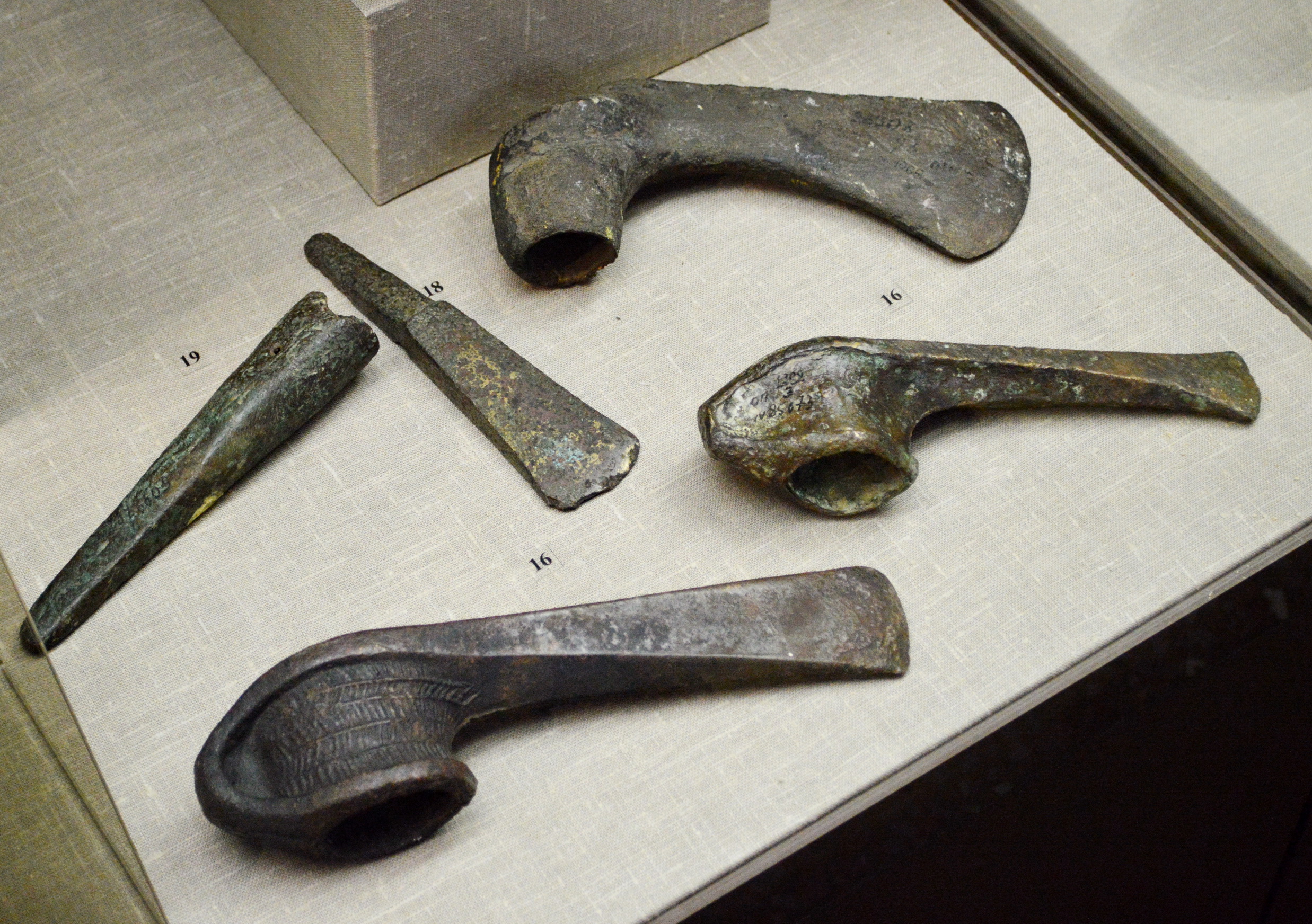
The Andronovo culture is notable for regional advances in metallurgy. They mined deposits of copper ore in the Altai Mountains from around the 14th century BC. Bronze objects were numerous, and workshops existed for working copper.
Pottery
One of the characteristics of Andronovo culture is its pottery, especially in campsites located in Central Asia, some of them very close to settlements of Bactria–Margiana Archaeological Complex in the south. This pottery is called Incised Coarse Ware (ICW), which is handmade and grey to brown in color, as well as incised with geometrical decoration, spread over much of Eurasian region, from Southern Urals to Kashgar, a pottery made by late Bronze Age nomads.
Warfare

"It is likely that militarized elite, whose power was based on the physical control of fellow tribesmen and neighbors with the help of riding and fighting skills, was buried in the Novoilinovsky-2 burial ground. The rider has a significant advantage over the infantryman. There may be another explanation: These elite fulfilled the function of mediating conflicts within the collective, and therefore had power and high social status. Metaphorically, this kind of elite can be called Sheriffs of the Bronze Age" said Igor Chechushkov.
Burials
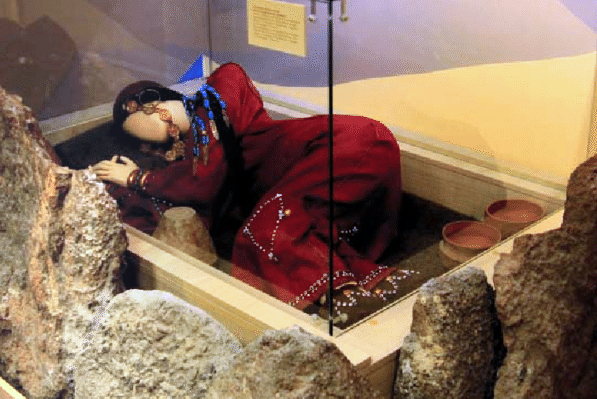
The Andronovo dead were buried in timber or stone chambers under both round and rectangular kurgans (tumuli). Burials were accompanied by livestock, wheeled vehicles, cheek-pieces for horses, and weapons, ceramics and ornaments. Among the most notable remains are the burials of chariots, dating from around 2000 BC and possibly earlier. The chariots are found with paired horse-teams, and the ritual burial of the horse in a "head and hooves" cult has also been found. Some Andronovo dead were buried in pairs, of adults or adult and child.
At Kytmanovo in Russia between Mongolia and Kazakhstan, dated 1746–1626 BC, a strain of Yersinia pestis was extracted from a dead woman's tooth in a grave common to her and to two children. This strain's genes express flagellin, which triggers the human immune response. However, by contrast with other prehistoric Yersinia pestis bacteria, the strain does so weakly; later, historic plague does not express flagellin at all, accounting for its virulence. The Kytmanovo strain was therefore under selection toward becoming a plague (although it was not the plague). The three people in that grave all died at the same time, and the researcher believes that this para-plague is what killed them.
Ethnolinguistic affiliation with Indo-Iranians
Main article: Indo-Iranians
Most researchers associate the Andronovo horizon with early Indo-Iranian languages. It is credited with the invention of the spoke-wheeled chariot around 2000 BC, if we include the Sintashta culture, where the oldest known chariots have been found. The association between the Andronovo culture and the Indo-Iranians is corroborated by the distribution of Iranian place-names across the Andronovo horizon and by the historical evidence of dominance by various Iranian-speaking peoples, including the Saka (Scythians), Sarmatians and Alans, throughout the Andronovo horizon during the 1st millennium BC.
The Sintashta site on the upper Ural River, noted for its chariot burials and kurgans containing horse burials, is considered the type site of the Sintashta culture, forming one of the earliest parts of the "Andronovo horizon". It is conjectured that the language spoken was still in the Proto-Indo-Iranian stage.
Comparisons between the archaeological evidence of the Andronovo and textual evidence of Indo-Iranians (i. e. the Vedas and the Avesta) are frequently made to support the Indo-Iranian identity of the Andronovo. The modern explanations for the Indo-Iranianization of the Iranian plateau and the Indian subcontinent rely heavily on the supposition that the Andronovo expanded southwards into Central Asia or at least achieved linguistic dominance across the Bronze Age urban centres of the region, such as the Bactria–Margiana Archaeological Complex. While the earlier phases of the Andronovo culture are regarded as co-ordinate with the late period of Indo-Iranian linguistic unity, it is likely that in the later period they constituted a branch of the Iranians. According to Narasimhan et al. (2019), the expansion of the Andronovo culture towards the BMAC took place via the Inner Asia Mountain Corridor.
According to Hiebert, an expansion of the BMAC into Iran and the margin of the Indus Valley is "the best candidate for an archaeological correlate of the introduction of Indo-Iranian speakers to Iran and South Asia", despite the absence of the characteristic timber graves of the steppe in the Near East, or south of the region between Kopet Dag and Pamir-Karakorum. Mallory acknowledges the difficulties of making a case for expansions from Andronovo to northern South Asia, and that attempts to link the Indo-Aryans to such sites as the Beshkent and Vakhsh cultures "only gets the Indo-Iranian to Central Asia, but not as far as the seats of the Medes, Persians or Indo-Aryans". He has developed the Kulturkugel model that has the Indo-Iranians taking over Bactria-Margiana cultural traits but preserving their language and religion while moving into Iran and India.
Based on its use by Indo-Aryans in Mitanni and Vedic India, its prior absence in the Near East and Harappan India, and its 17th–16th century BC attestation at the Andronovo site of Sintashta, Kuzmina (1994) argues that the chariot corroborates the identification of Andronovo as Indo-Iranian. Klejn (1974) and Brentjes (1981) found the Andronovo culture much too late for an Indo-Iranian identification since chariot-using Aryans appear in Mitanni by the 15th century BC. However, dated a chariot burial at Krivoye Lake to around 2000 BC.
Eugene Helimski has suggested that the Andronovo people spoke a separate branch of Indo-Iranian. He claims that borrowings in the Finno-Ugric languages support this view. Vladimir Napolskikh has proposed that borrowings in Finno-Ugric indicate that the language was specifically of the Indo-Aryan type.
Since older forms of Indo-Iranian words have been taken over in Uralic and Proto-Yeniseian, occupation by some other languages (also lost ones) cannot be ruled out altogether, at least for part of the Andronovo area, i. e., Uralic and Yeniseian.
Rasmus G. Bjørn (2022) describes the linguistic heritage of the Andronovo cultural complex as "Indo-Iranic dialect continuum", with a later split between Iranic and Indic. Early Iranic can be associated with later stages of the Andronovo horizon. Indo-Iranian derived loanwords via the Andronovo cultural complex can be found in both Proto-Uralic and later in Proto-Turkic, suggesting some forms of contact near the Altai Mountains (specifically the Minusinsk basin) and Mongolia respectively. Some loanwords related to horse pastoralism are also found in Old Chinese.
Physical appearance
In studies from the mid-2000s, the Andronovo have been described by archaeologists as having cranial features similar to ancient and modern European populations though these cranial features are not exclusive to Europeans. Andronovo skulls are similar to those of the Srubnaya culture and Sintashta culture, exhibiting features such as dolicocephaly. Through Iranian and Indo-Aryan migrations, this physical type expanded southwards and mixed with aboriginal peoples, contributing to the formation of modern populations of the northern Indian subcontinent.
In a study including Andronovo-horizon specimens from Aktogai, Kazakhstan, 100% of the Aktogai individuals had light hair, with 60% having light blond hair and the remaining 40% having light brown hair. 60% of this sample was brown eyed, while 40% had blue eyes. 80% had intermediate skin, while 20% had pale skin tones. In samples of the later Maitan cultures (also Andronovo-related), the majority of individuals were still light haired, but there was a significantly higher frequency of dark hair and eye color, although the frequency of pale skin was only slightly lower. In a sample of individuals from the even later Zevakinskiy phase of the Andronovo culture, the overwhelming majority of individuals had dark hair and dark eyes, and intermediate skin tones, with 0% having pale skin and 20% having dark-to-black skin.
Archaeogenetics
The Andronovo culture and its population derived primarily from an eastwards expansion of the Central European Corded Ware culture via the Fatyanovo–Balanovo and Sintashta culture, which are characterized by the combination of mainly Yamnaya-like ancestry and Early European Farmers admixture. The spread of Sintashta-Andronovo ancestry correlates with the expansion of Indo-Iranian-speaking peoples. Andronovo ancestry (c. 57%), in tandem with BMAC admixture (c. 43%), represents the later Iranian dispersal into the Iranian Plateau, while BMAC admixture is not found among the Indo-Aryan migrations into South Asia, suggesting two independent routes, one via the BMAC and one via the Inner Asian mountain corridor.
Studies
Fox et al. (2004) established that, during the Bronze and Iron Age period, the majority of the population of Kazakhstan (part of the Andronovo culture during Bronze Age) was of West Eurasian origin (with mtDNA haplogroups such as U, H, HV, T, I and W), and that prior to the thirteenth to seventh century BC, all Kazakh samples belonged to European lineages.
Keyser et al. (2009) published a study of the ancient Siberian cultures, the Andronovo culture, the Karasuk culture, the Tagar culture and the Tashtyk culture. Ten individuals of the Andronovo horizon in southern Siberia from 1800 BC to 1400 BC were surveyed. Extractions of mtDNA from nine individuals were determined to represent two samples of haplogroup U4 and single samples of Z1, T1, U2e, T4, H, K2b and U5a1. Extractions of Y-DNA from one individual was determined to belong to Y-DNA haplogroup C (but not C3), while the other two extractions were determined to belong to haplogroup R1a1a, which is thought to mark the eastward migration of the early Indo-Europeans. Of the individuals surveyed, only two (or 22%) were determined to be of Asian ancestry, while seven (or 78%) were determined to be of European ancestry, with the majority being light-skinned with predominantly light eyes and light hair.

In a June 2015 study published in Nature, one male and three female individuals of Andronovo culture were surveyed. Extraction of Y-DNA from the male was determined to belong to R1a1a1b. Extractions of mtDNA were determined to represent two samples of U4 and two samples of U2e. The people of the Andronovo culture were found to be closely genetically related to the preceding Sintashta culture, which was in turn closely genetically related to the Corded Ware culture, suggesting that the Sintashta culture represented an eastward expansion of Corded Ware peoples. The Corded Ware peoples were in turn found to be closely genetically related to the Beaker culture, the Unetice culture and particularly the peoples of the Nordic Bronze Age. Numerous cultural similarities between the Sintashta/Andronovo culture, the Nordic Bronze Age and the peoples of the Rigveda have been detected.

A genetic study published in Nature in May 2018 examined the remains of an Andronovo female buried . She was found to be a carrier of the maternal haplogroup U2e1h.
In a genetic study published in Science in September 2019, a large number of remains from the Andronovo horizon was examined. The vast majority of Y-DNA extracted belonged to R1a1a1b or various subclades of it (particularly R1a1a1b2a2a). The majority of mtDNA samples extracted belonged to U, although other haplogroups also occurred. The people of the Andronovo culture were found to be closely genetically related to the people of the Corded Ware culture, the Potapovka culture, the Sintashta culture and Srubnaya culture. These were found to harbor mixed ancestry from the Yamnaya culture and peoples of the Central European Middle Neolithic. People in the northwestern areas of Andronovo were found to be "genetically largely homogeneous" and "genetically almost indistinguishable" from Sintashta people. The genetic data suggested that the Andronovo culture and its Sintastha predecessor were ultimately derived of a remigration of Central European peoples with steppe ancestry back into the steppe. This is in particular defined by the majority (n=12) of R-Z93 SNPs.
Manjusha Chintalapati, Nick Patterson, and Priya Moorjani (in a peer-reviewed paper, 18 July 2022) estimate through DATES (Distribution of Ancestry Tracts of Evolutionary Signals) that genetic characteristics, typical of Andronovo culture's people formed around 900 years before this archaeological culture appeared, 2900 BCE.
Gallery
File:Andronovo decorated bowl.jpg|Andronovo decorated bowl File:Andronovo ceramics 4.png|Andronovo ceramics File:Andronovo ceramics 2.png|Andronovo ceramics File:Предметы Андроновской культуры. Andronovo culture artifacts.jpg|Andronovo tools, foundry molds and pottery File:Andronovo axe and knife.jpg|Andronovo axe and knife File:Spearheads (1, 2) and arrowheads (3–7) of the early Alakul (Petrovka) culture in Central Kazakhstan.png|Spearheads and arrowheads from central Kazakhstan File:Andronovo area.png|Andronovo area. File:Andronovo distribution.png|Andronovo distribution.
Notes
References
Sources
- .
- .
- .
- Jones-Bley, K.; Zdanovich, D. G. (eds.), Complex Societies of Central Eurasia from the 3rd to the 1st Millennium BC, 2 vols, JIES Monograph Series Nos. 45, 46, Washington D.C. (2002), , .
References
- Brown, Dorcas, and David Anthony, (2017). [https://core.tdar.org/document/430440/bronze-age-economy-and-rituals-at-krasnosamarskoe-in-the-russian-steppes "Bronze Age Economy and Rituals at Krasnosamarskoe in the Russian Steppes"], in: The Digital Archaeological Record: "...Particular attention focuses on the role of agriculture during the unusual episode of sedentary, settled pastoralism that spread across the Eurasian steppes with the Srubnaya and Andronovo cultures (1900-1200 BC)..."
- Grigoriev, Stanislav, (2021). [https://www.degruyter.com/document/doi/10.1515/opar-2020-0123/html "Andronovo Problem: Studies of Cultural Genesis in the Eurasian Bronze Age"], in Open Archaeology 2021 (7), '''p.3:''' "...By Andronovo cultures we may understand only Fyodorovka and Alakul cultures..."
- Parpola, Asko, (2020). [https://journal.fi/store/article/view/98032 "Royal 'Chariot' Burials of Sanauli near Delhi and Archaeological Correlates of Prehistoric Indo-Iranian Languages"], in Studia Orientalia Electronica, Vol. 8, No. 1, 23 October 2020, '''p.188''': "...the Alakul' culture (c.2000–1700 BCE) in the west and the Fëdorovo culture (c.1850–1450 BCE) in the east..."
- Grigoriev, Stanislav, (2021). [https://www.degruyter.com/document/doi/10.1515/opar-2020-0123/html "Andronovo Problem: Studies of Cultural Genesis in the Eurasian Bronze Age"], in Open Archaeology 2021 (7), p. 1.
- (18 April 2018). "History of Central Asia, The: 4-volume set". Bloomsbury Publishing.
- {{harvnb. Mallory. 1997
- {{harvnb. Mallory. 1997
- {{harvnb. Beckwith. 2009
- Anthony, David W.. (2007). "The Horse The Wheel And Language. How Bronze-Age Riders From the Eurasian Steppes Shaped The Modern World". Princeton University Press.
- Bendezu-Sarmiento, Julio, 2021. [https://books.openedition.org/mnhn/11725 "The first nomads in Central Asia's steppes (Kazakhstan): An overview of major socio-economic changes, derived from funerary practices of the Andronovo and Saka populations of the Bronze and Iron Ages (2nd-1st millennium BCE)"], in: ''Nomad lives: From Prehistoric Times to the Present Day'', Publications scientifiques du Muséum, Paris, pp. 479–503.
- Bendezu-Sarmiento, Julio, 2021. [https://books.openedition.org/mnhn/11725 "The first nomads in Central Asia's steppes (Kazakhstan)"], Summary (in French): "...Durant la première étape de la culture d'Andronovo (Bronze ancien à la fin du IIIe millénaire avant n.è.), le cheptel (principalement constitué de bovins) était réduit et le fourrage naturel n'était nullement difficile à trouver dans les pâturages proches des habitations..."
- Bendezu-Sarmiento, Julio, (2022). [https://www.academia.edu/97745349/2022%20Bendezu%20Sarmiento%20The%20first%20nomads%20in%20Central%20Asia%20s%20steppes%20Kazakhstan%20Territory%20power%20and%20religion%20Eurasian%20steppe%20civilization%20human%20and%20the%20historical%20and%20cultural%20environment%20II%20p%2046%2052 "The first nomads in Central Asia's steppes (Kazakhstan): Territory, power and religion"], in: Eurasian steppe civilization: Human and the Historical and Cultural Environment, Almaty–Turkistan, '''p. 48''': "During the first stage of the Andronovo culture (Early Bronze Age to the end of the 3rd millennium BC), the livestock (mainly cattle) was small and natural fodder was not difficult to find in the pastures near the settlements."
- {{Harvnb. Koryakova. 1998a.
- Hoshko, Tatiana, (2019). "Oriental Technologies in the Production of Cauldrons of Late bronze Age", in Historiography, Source Studies and Special Historical Disciplines,SKHID No. 2 (160) March–April 2019, p. 87.
- (2015). "Population genomics of Bronze Age Eurasia". [[Nature (journal).
- [[Great Soviet Encyclopaedia]], Article "Andronovo".
- "Nomination to the World Heritage list of Sarazm".
- (26 July 2010). "The Horse, the Wheel, and Language: How Bronze-Age Riders from the Eurasian Steppes Shaped the Modern World". Princeton University Press.
- (4 December 2017). "Tajikistan". Bradt Travel Guides.
- Irannejad, A. Mani, (23 Jul 2024). [https://www.academia.edu/102457461/The%20Indo%20Iranian%20Approach%20to%20Greater%20Iran "The Indo Iranian Approach to Greater Iran"], in: Iran, Journal of the British Institute of Persian Studies, p. 12, Table 2.
- Irannejad, A. Mani, (23 Jul 2024). [https://www.academia.edu/102457461/The%20Indo%20Iranian%20Approach%20to%20Greater%20Iran "The Indo Iranian Approach to Greater Iran"], in: Iran, Journal of the British Institute of Persian Studies, p. 11.
- Irannejad, A. Mani, (23 Jul 2024). [https://www.academia.edu/102457461/The%20Indo%20Iranian%20Approach%20to%20Greater%20Iran "The Indo Iranian Approach to Greater Iran"], in: Iran, Journal of the British Institute of Persian Studies, p. 12, Table 2.
- Grigoriev, Stanislav, (2021). [https://www.academia.edu/45686126/Andronovo%20Problem%20Studies%20of%20Cultural%20Genesis%20in%20the%20Eurasian%20Bronze%20Age "Andronovo Problem: Studies of Cultural Genesis in the Eurasian Bronze Age"] {{Webarchive. link. (9 December 2021 , in Open Archaeology 2021 (7), '''p.28:''' ".... The Fyodorovka dates in the north of the forest-steppe Tobol region are close to the dates in the Southern Transurals and lie in the interval of the 20th–16th centuries BC...Fyodorovka culture, in general, is synchronous with Alakul...")
- Irannejad, A. Mani, (23 Jul 2024). [https://www.academia.edu/102457461/The%20Indo%20Iranian%20Approach%20to%20Greater%20Iran "The Indo Iranian Approach to Greater Iran"], in: Iran, Journal of the British Institute of Persian Studies, p. 11.
- {{Harvcolnb. Diakonoff. 1995
- Irannejad, A. Mani, (23 Jul 2024). [https://www.academia.edu/102457461/The%20Indo%20Iranian%20Approach%20to%20Greater%20Iran "The Indo Iranian Approach to Greater Iran"], in: Iran, Journal of the British Institute of Persian Studies, p. 12, Table 2.
- Degtyareva, A.D., et al., (2019). [https://www.researchgate.net/publication/338504853_METAL_PRODUCTS_OF_THE_ALEKSEYEVKA-SARGARY_CULTURE_FROM_THE_MIDDLE_AND_UPPER_TOBOL_AREAS#full-text Metal Products of the Alekseyevka-Sargary Culture From the Middle and Upper Tobol Areas"], in: Вестник археологии, антропологии и этнографии. 2019. № 4 (47): "The article describes morphological and typological characteristics of non-ferrous metal, determines the formulae of alloys, as well as identifies techniques used for the production of tools by the Alekseyevka-Sargary culture from the South Trans-Urals (15th/14th and 12th/11th BC)..."
- Mallory, J.P., (1997). [https://archive.org/details/EncyclopediaOfIndoEuropeanCulture/page/n55/mode/1up "Andronovo Culture"], in J.P. Mallory and Douglas Q. Adams (eds.), Encyclopedia of Indo-European Culture, Fitzroy Dearborn Publishers, British Library Cataloguing in Publication Data, London and Chicago, '''p. 20''': "...Alekseyevka culture...(1200–1000 BC)..."
- Jia, Peter W., Alison Betts, Dexin Cong, Xiaobing Jia, & Paula Doumani Dupuy, (2017). "Adunqiaolu: new evidence for the Andronovo in Xinjiang, China", in Antiquity 91 (357), pp. 621-639.
- Okladnikov, A. P.. (1994). "The Cambridge history of early Inner Asia". Cambridge Univ. Press.
- {{Harvcolnb. Mallory. 1989
- (2020). "The Metal Road of the Eastern Eurasian Steppe: The Formation of the Xiongnu Confederation and the Silk Road". Springer Singapore.
- {{harvnb. Kuzmina. 2007
- Baumer, Christoph. (2012). "The History of Central Asia". Bloomsbury Academic.
- Wu, Hsiao-yun. (2013). "Chariots in Early China: Origins, cultural interaction, and identity". BAR Publishing.
- Anthony, David W.. (2007). "The Horse The Wheel And Language. How Bronze-Age Riders From the Eurasian Steppes Shaped The Modern World". Princeton University Press.
- (11 June 2015). "Population genomics of Bronze Age Eurasia". [[Nature Research]].
- (2009). "New Radiocarbon Dates and a Review of the Chronology of Prehistoric Populations from the Minusinsk Basin, Southern Siberia, Russia". Radiocarbon.
- George Erdosy (2012), ''The Indo-Aryans of Ancient South Asia: Language, Material Culture and Ethnicity'', Walter de Gruyter, p. 371.
- "The most ancient evidence of horsemanship in the bronze age".
- "Russian Scientists Have Discovered the Most Ancient Evidence of Horsemanship in the Bronze Age - South Ural State University".
- Ventresca Miller, A., Usmanova, E., Logvin, V., Kalieva, S., Shevnina, I., Logvin, A., Kolbina, A., Suslov, A., Privat, K., Haas, K. and Rosenmeier, M., 2014. Subsistence and social change in central Eurasia: stable isotope analysis of populations spanning the Bronze Age transition. Journal of Archaeological Science, 42, pp.525-538.
- Ivanov, S.S.. (2014). "THE NEW FINDS OF ORNAMENTAL SHAFT-HOLE AXES OF BRONZE AGE FROM KYRGYZSTAN". Theory and Practice of Archaeological Research.
- "Central Asian Arts: Neolithic and Metal Age cultures". [[Encyclopædia Britannica (company).
- Cerasetti, Barbara, (2020). [https://www.routledge.com/The-World-of-the-Oxus-Civilization/Lyonnet-Dubova/p/book/9781138722873 "Who interacted with whom? redefining the interaction between BMAC people and mobile pastoralists in Bronze Age southern Turkmenistan"], in: Bertille Lyonnet and Nadezhda A Dubova (eds.), ''The World of the Oxus Civilization'', Routledge, '''p. 487-488:''' "...the presence of the so-called Andronovo or steppe culture in campsites located on the sand dunes among BMAC settlements or close to them, has been clearly brought to light...This culture is characterized by a typical gray-brown handmade pottery with incised geometrical decoration (Incised Coarse Ware - ICW)..."
- Cerasetti, Barbara, (1998). [https://www.researchgate.net/publication/289965226%20Preliminary%20Report%20on%20Ornamental%20Elements%20of%20Incised%20Coarse%20Ware "Preliminary Report on Ornamental Elements of 'Incised Coarse Ware'"], in: A. Gubaev, G. Koshelenko, and M. Tosi (eds.), Murghab: A Civilization Heartland between River and Desert, Istituto Italiano Per L'Africa E L'Oriente, '''p. 67:''' "...a significant amount of Incised Coarse Ware (ICW), related to Bronze Age nomadic stock-riders over a vast portion of Eurasia, between the Urals and [Kashgaria]. Soviet authors have often labelled [it]...as 'Andronovo Ware'..."
- (1 August 2020). "Early evidence for horse utilization in the Eurasian steppes and the case of the Novoil'inovskiy 2 Cemetery in Kazakhstan". Journal of Archaeological Science: Reports.
- "Bronze Age Necropolis Unearthed In Siberia".
- (October 2015). "Early Divergent Strains of Yersinia pestis in Eurasia 5,000 Years Ago". Cell.
- Rasmussen, 575.
- Rasmussen, 578: the phylogenetic tree has RISE505 split off before the common ancestor of historic plague.
- Rasmussen, S15.
- Bjørn, Rasmus G.. (22 April 2022). "Indo-European loanwords and exchange in Bronze Age Central and East Asia". Evolutionary Human Sciences.
- {{Harvcolnb. Anthony. Vinogradov. 1995
- (16 May 2009). "Ancient DNA provides new insights into the history of south Siberian Kurgan people". [[Human Genetics (journal).
- Kuznetsov, P.F.. (1 September 2006). "The emergence of Bronze Age chariots in eastern Europe". Antiquity.
- Hans J.J.G. Holm: The Earliest Wheel Finds, Their Archeology and Indo-European Terminology in Time and Space, and Early Migrations around the Caucasus. Archaeolingua Alapítvány, Budapest, 2019, {{ISBN. 978-615-5766-29-9
- Koryakova, L.. (1998). "An Overview of the Andronovo Culture: Late Bronze Age Indo-Iranians in Central Asia". The Center for the Study of the Eurasian Nomads (CSEN).
- {{Harvcolnb. Mallory. 1989: "The settlement and cemetery of Sintashta, for example, though located far to the north on the Trans-Ural steppe, provides the type of Indo-Iranian archaeological evidence that would more than delight an archaeologist seeking their remains in Iran or India."
- Irannejad, A. Mani. (1 June 2022). "The Old Avesta and Birth of Iranian Identity". Iran.
- Sharma, R.S.. (25 January 2007). "The Age of the Rig Veda". Oxford University Press.
- Francfort, in {{Harv. Fussman et al.. 2005. Fussman et al.. 2005
- {{Harvcoltxt. Anthony. Vinogradov. 1995
Kuzmina (1994), Klejn (1974), and Brentjes (1981), as cited in {{Harvcoltxt. Bryant. 2001 - Helimski, Eugene. [https://web.archive.org/web/20110823073117/http://helimski.com/2.155.RTF ''The southern neighbours of Finno-Ugrians: Iranians or an extinct branch of Aryans ("Andronovo Aryans")?''] In: ''Finnisch-ugrische Sprachen in Kontakt.'' Maastricht 1997, pp. 117–125.
- Напольских В. В. ''Уральско-арийские взаимоотношения: история исследований, новые решения и проблемы.'' [http://www.arheolog-ck.ru/Safronov_sbornik.pdf Индоевропейская история в свете новых исследований. М.: МГОУ, 2010. С. 229—242.] {{Webarchive. link. (14 July 2014)
- Witzel, M. ''Linguistic Evidence for Cultural Exchange in Prehistoric Western Central Asia.'' 2003, ''Sino-Platonic Papers'' 129 ([http://www.people.fas.harvard.edu/~witzel/Sinttashta_Qu.pdf PDF]).
- Bjørn, Rasmus G.. (January 2022). "Indo-European loanwords and exchange in Bronze Age Central and East Asia: Six new perspectives on prehistoric exchange in the Eastern Steppe Zone". Evolutionary Human Sciences.
- {{harvnb. Keyser. Bouakaze. Crubézy. Nikolaev. 2009
- "A genetic probe into the ancient and medieval history of Southern Europe and West Asia -- Supplementary Text". Science.
- (14 January 2022). "Genetic continuity of Indo-Iranian speakers since the Iron Age in southern Central Asia". Scientific Reports.
- (June 2015). "Population genomics of Bronze Age Eurasia". Nature.
- (6 September 2019). "The formation of human populations in South and Central Asia". Science.
- (7 May 2004). "Unravelling migrations in the steppe: mitochondrial DNA sequences from ancient central Asians.". [[Proceedings of the Royal Society]].
- (4 February 2019). "Ancient human genome-wide data from a 3000-year interval in the Caucasus corresponds with eco-geographic regions". Nature Communications.
- (May 2018). "137 ancient human genomes from across the Eurasian steppes". Nature.
- (18 July 2022). "The spatiotemporal patterns of major human admixture events during the European Holocene". eLife.
- (1 January 2021). "Andronovo Problem: Studies of Cultural Genesis in the Eurasian Bronze Age". Open Archaeology.
This article was imported from Wikipedia and is available under the Creative Commons Attribution-ShareAlike 4.0 License. Content has been adapted to SurfDoc format. Original contributors can be found on the article history page.
Ask Mako anything about Andronovo culture — get instant answers, deeper analysis, and related topics.
Research with MakoFree with your Surf account
Create a free account to save articles, ask Mako questions, and organize your research.
Sign up freeThis content may have been generated or modified by AI. CloudSurf Software LLC is not responsible for the accuracy, completeness, or reliability of AI-generated content. Always verify important information from primary sources.
Report