From Surf Wiki (app.surf) — the open knowledge base
Anders Sandberg
Swedish computer scientist, futurist, transhumanist, and philosopher

Swedish computer scientist, futurist, transhumanist, and philosopher
| Field | Value |
|---|---|
| name | Anders Sandberg |
| image | Anders Sandberg FHI.jpg |
| caption | Sandberg in 2016 pictured wearing his medal with instructions to be cryonically preserved in case of legal death |
| birth_date | |
| birth_place | Solna, Sweden |
| occupation | Researcher, science debater, futurist, transhumanist and author |
| education | Stockholm University (PhD in Computational Neuroscience) |
| movement | Transhumanism |
| website |
Anders Sandberg (born 11 July 1972) is a Swedish researcher, futurist and transhumanist. He holds a PhD in computational neuroscience from Stockholm University, and is a former senior research fellow at the Future of Humanity Institute at the University of Oxford.
Work
Sandberg's research centres on societal and ethical issues surrounding human enhancement and new technology, as well as on assessing the capabilities and underlying science of future technologies. His research includes work on cognitive enhancement (methods, impacts, and policy analysis) and technical roadmaps on whole brain emulation, neuroethics, and existential risks. He analysed how to take into account the subjective uncertainty in risk estimates of low-likelihood, high-consequence risk.
Sandberg is known as a researcher, participant and commentator in the public debate on human enhancement, neuroscience, ethics, and future studies.
He is co-founder of and writer for the think tank Eudoxa, and is a co-founder of the Orion's Arm collaborative worldbuilding project. Between 1996 and 2000 he was Chairman of the Swedish Transhumanist Association. He was also the scientific producer for the neuroscience exhibition "Se Hjärnan!" ("Behold the Brain!"), organized by Swedish Travelling Exhibitions, the Swedish Research Council and the Knowledge Foundation, that toured Sweden in 2005–2006. In 2007 he was a postdoctoral research fellow at the Oxford Uehiro Centre for Practical Ethics, working on the EU-funded ENHANCE project on the ethics of human enhancement.
Sandberg is also an electronic artist, whose renderings have been adapted for book covers by futurist Damien Broderick: The Dreaming, Earth is But a Star, The Judas Mandala, Skiffy and Mimesis, Uncle Bones, Warriors of the Tao, and xyzt.
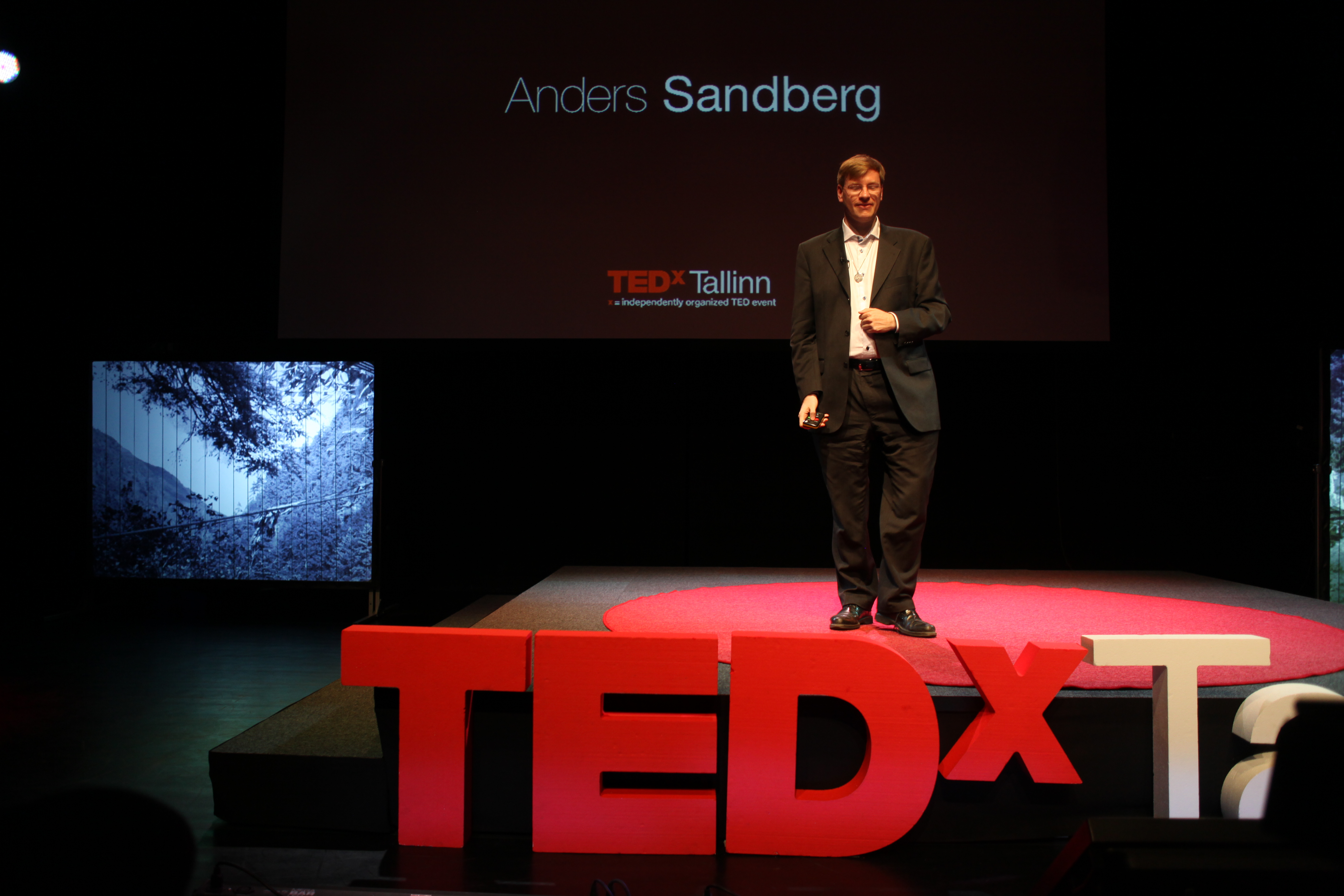
Sandberg has also supported and advocated cryonics, for example by signing an open letter to support research into cryonics and by being an advisor to the UK Cryonics and Cryopreservation Research Network, a UK advocacy group. He has personally arranged to be cryonically preserved after his legal death.
One of his 2014 papers, entitled "Ethics of Brain Emulations", became one of the most downloaded papers in the Journal of Experimental and Theoretical Artificial Intelligence, from a special volume edited by Vincent C. Müller.
With nanotechnologist Eric Drexler and philosopher Toby Ord in 2018 he published a paper entitled "Dissolving the Fermi Paradox". The paper was the first to estimate and rigorously take into account the uncertainties in each term in the Drake equation. These uncertainties, which often span multiple orders of magnitude, can be represented as probability distributions with long tails. Instead of getting a single estimate of the probability of life in our galaxy, they therefore obtained a distribution. They found that there is a high likelihood that we are alone in our galaxy or even alone in the entire observable universe, thus proposing a solution to the famous Fermi paradox, which asks why we do not see signs of intelligent life in the night sky.
In 2018, in response to a question on Physics Stack Exchange, Sandberg published a paper on arXiv entitled "Blueberry Earth", which answered the question, "What if the entire Earth was instantaneously replaced with an equal volume of closely packed, but uncompressed blueberries?" The paper got a large amount of news coverage on Slate, The Atlantic, Popular Mechanics, Atlas Obscura, and in other outlets.
References
References
- "Future of Humanity Institute".
- "Anders Sandberg - Google Scholar Citations".
- (2006). "Converging Cognitive Enhancements". Annals of the New York Academy of Sciences.
- Anders Sandberg, [[Nick Bostrom]] (2008): [http://www.philosophy.ox.ac.uk/__data/assets/pdf_file/0019/3853/brain-emulation-roadmap-report.pdf Whole Brain Emulation: A Roadmap] {{webarchive. link. (3 June 2013 Technical Report #2008-3, Future of Humanity Institute, Oxford University)
- (2008). "Probing the Improbable: Methodological Challenges for Risks with Low Probabilities and High Stakes".
- [http://www.orionsarm.com/xcms.php?r=oa-page&page=gen_earlyyears Orion's Arm, the early years]
- (21 October 2014). "Anders Sandberg : Explorer of the mind". [[Euronews]].
- "Curriculum Vitae of Anders Sandberg".
- (2012-01-15). "Scientists Open Letter on Cryonics".
- "UK Cryonics and Cryopreservation Research Network".
- (11 May 2015). "Meet the people out to stop humanity from destroying itself". [[Quartz (publication).
- "V&A · Project focus {{!}} Cryonics: who wants to live forever?".
- (14 April 2014). "Ethics of brain emulations". Journal of Experimental & Theoretical Artificial Intelligence.
- "Most popular articles".
- (6 June 2018). "Dissolving the Fermi Paradox".
- "Three of The World's Greatest Minds Just Published a New Take on The Famous Fermi Paradox". ScienceAlert.
- "A Q&A With the Brave Scientist Who Figured Out What Would Happen if the Earth Were Made of Blueberries". Slate Magazine.
- (2 August 2018). "Blueberry Earth: The Delicious Thought Experiment That's Roiling Planetary Scientists". The Atlantic.
- (5 August 2018). "What If the Earth Was Made Out of Blueberries?". Popular Mechanics.
This article was imported from Wikipedia and is available under the Creative Commons Attribution-ShareAlike 4.0 License. Content has been adapted to SurfDoc format. Original contributors can be found on the article history page.
Ask Mako anything about Anders Sandberg — get instant answers, deeper analysis, and related topics.
Research with MakoFree with your Surf account
Create a free account to save articles, ask Mako questions, and organize your research.
Sign up freeThis content may have been generated or modified by AI. CloudSurf Software LLC is not responsible for the accuracy, completeness, or reliability of AI-generated content. Always verify important information from primary sources.
Report