From Surf Wiki (app.surf) — the open knowledge base
Andaman and Nicobar Islands
Union territory of India
Union territory of India
| Field | Value |
|---|---|
| name | Andaman and Nicobar Islands |
| image_skyline | {{Photomontage |
| photo1a | The Coral Reef at the Andaman Islands.jpg |
| photo2a | Havelock,_Andaman_&_Nicobar_Islands.JPG |
| photo2b | Ross_Island_(Netaji_Subhas_Bose_Island).jpg |
| photo3a | Andaman.jpg |
| photo3b | Shaheed Island, Andaman Islands, Tropical beach.jpg |
| photo4a | Front_View_of_Cellular_Jail,_Port_Blair.JPG |
| spacing | 1 |
| size | 250 |
| position | center |
| border | 0 |
| color | #000000 |
| foot_montage | Clockwise from top-right: Coral reefs around the islands; Ross Island in South Andaman; Beach at Neil Island; Cellular Jail in Port Blair; Andaman Sea; Havelock Island in Andaman Islands |
| type | Union territory |
| image_seal | Seal of Andaman and Nicobar Islands.png |
| motto | Satyameva Jayate (Sanskrit) |
| "Truth alone triumphs" | |
| image_map | IN-AN.svg |
| coordinates | |
| region | East India |
| formation_date4 | 1 November 1956 |
| capital | Sri Vijaya Puram (Port Blair) |
| largestcity | capital |
| districts | 3 |
| Lt_governor | Devendra Kumar Joshi |
| Chief_secretary | Chandra Bhushan Kumar, IAS |
| lok_sabha_seats | 1 seat |
| judiciary | Calcutta High Court (Port Blair Bench) |
| area_footnotes | |
| area_total_km2 | 8249 |
| area_rank | 29th |
| length_km | 467 |
| width_km | 24 |
| elevation_max_m | 732 |
| elevation_max_point | Saddle Peak |
| elevation_min_m | 0 |
| elevation_min_point | Andaman Sea and Bay of Bengal |
| population_footnotes | |
| population_total | 380,581 |
| population_as_of | 2011 |
| population_rank | 34th |
| population_density | 46 |
| population_urban | 37.7% |
| population_rural | 62.3% |
| population_demonym | Andamanese, Nicobarese |
| 0fficial_Langs | |
| official_script | |
| GDP_total | |
| GDP_year | 2021-22 |
| GDP_rank | 33rd |
| GDP_per_capita | |
| GDP_per_capita_rank | 16th |
| HDI | 0.706 |
| HDI_year | 2022 |
| HDI_rank | 11th |
| literacy | 91.1 |
| literacy_year | 2024 |
| literacy_rank | 11th |
| sex_ratio | 876♀/1000 ♂ |
| sexratio_year | 2011 |
| sexratio_rank | 22nd |
| iso_code | IN-AN |
| registration_plate | AN |
| website | andaman.gov.in |
| mammal | Dugong |
| bird | Andaman wood pigeon |
| flower | Pyinma |
| tree | Andaman Padauk |
"Truth alone triumphs"
The Andaman and Nicobar Islands is a union territory of India comprising 836 islands, of which only 31 are inhabited. The islands are grouped into two main clusters: the northern Andaman Islands and the southern Nicobar Islands, separated by the 150 km-wide Ten Degree Channel. The capital and largest city of the territory, Port Blair (officially Srivijayapuram), is located approximately 1,190 km from Chennai and 1,255 km from Kolkata in mainland India. The islands are situated between the Bay of Bengal to the west and the Andaman Sea to the east. The northernmost point is 901 km from the mouth of the Hooghly River. Indira Point, located at 6°45'10″N and 93°49'36″E on the southern tip of Great Nicobar, is the southernmost point of India.
The territory shares maritime borders with Indonesia located about 165 km to the south, Myanmar located 280 km to the north-east and Thailand located 650 km to the south-east. The islands occupy a total land area of approximately 8249 km2 with a population of 380,581 as per the 2011 census. The territory is divided into three districts: Nicobar, South Andaman, and North and Middle Andaman with the capitals at Car Nicobar, Port Blair and Mayabunder respectively.
Genetic and cultural studies suggest that the indigenous Andamanese people may have been isolated from other populations during the Middle Paleolithic era, more than 30,000 years ago. Archeological evidence of civilisation has been dated back to 2,200 years. In the 11th century, Cholas, one of the three Tamil kingdoms, used the islands as a naval base to launch expeditions in South East Asia. The Danish were the first Europeans to arrive on the islands in 1755. The islands became part of the British Raj in 1868. During the Second World War, the islands were invaded by the Empire of Japan. After Indian Independence in 1947, the region became a province and later a union territory after the adoption of the Constitution of India in 1950.
The islands host the Andaman and Nicobar Command, the only geographical command operated jointly by the three major wings of the Indian Armed Forces: the Army, the Air Force and the Navy. While Hindi and English are the official languages, the major spoken languages include Bengali, Tamil and Telugu. Indigenous people speak any of the Andamanese or Nicobarese family of languages. Hinduism is the majority religion in the union territory, with a significant Christian minority. The islands include North Sentinel Island, home to the Sentinelese people, an uncontacted tribe.
Etymology
The name Andaman might have been derived from Handuman, after the Indian God Hanuman from the Hindu epic Ramayana. The place was called with a similar name by the Malays, who used to be involved in slave trade in the region. The place was also referred by various names such as Angademan by Ptolemy in the 2nd century CE and Angamanian by Marco Polo in 13th century. Nicobar, which was located in the sea route connecting South India to South East Asia, was known as Nakkavaram, meaning "open/naked land" borrowed from Tamil language which later became Nicobar. In the middle ages (500-1500 AD), Nicobar was known as Lankhabatus in Arabia, probably a mis-transcription of the name Nakkavaram. An 11th-century work Kathasaritsagar indicates the name as Narikel Dweep (meaning Coconut Island in Bengali). Marco Polo termed the island as Necuverann, while the islands were known as Lo-Jan Kuo in China, a translation of Nakkavar with the same meaning.
History
Main article: History of the Andaman and Nicobar Islands
Early history
Genetic and cultural studies suggest that the indigenous Andamanese people may have been isolated from other populations during the Middle Paleolithic era, which ended 30,000 years ago. Archeological work on the islands has concentrated on shell midden sites. The islands were mentioned by Ptolemy in the 2nd century CE.
Middle Ages
The Nicobar islands existed on a major trade route connecting India to the South East Asia and had much contact with the outside world for centuries. But there are very few accounts of information as there was no written language with the indigenous people to document their history. The islands appeared in the accounts of travellers like Faxian in the 6th century and I-T'sing in the 7th century.
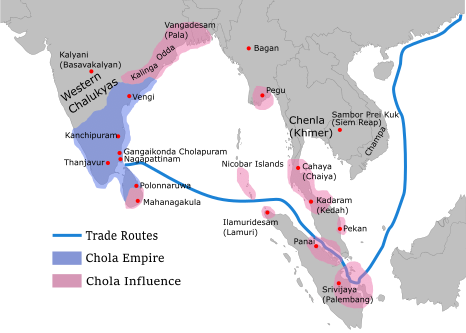
In the 11th century, Rajendra Chola I of the Chola dynasty invaded parts of South East Asia using the Nicobar islands as an intermediate naval base. It was part of an established Chola trade route connecting India and South East Asia, a practice that continued during the subsequent reigns of Rajendra II and Kulothunga I. Chola inscriptions from Thanjavur, dated to 1050, describe the islands as Ma-Nakkavaram meaning "great open/naked land" in Tamil. The islands were later noted by Marco Polo in the 13th century and Friar Oderic in the early 14th century.
European colonisation
.jpg)
The European colonisation on the islands began when settlers from the Danish East India Company arrived on the Nicobar Islands on 12 December 1755. On 1 January 1756, the Nicobar Islands were made into a Danish colony, first named Nye Danmark (New Denmark) and later Frederiksøerne (Frederick's Islands). The islands were managed from the Danish colony of Tranquebar in the Indian mainland. However, various attempts to settle on the islands were unsuccessful due to repeated outbreaks of malaria, which led to the death of the colonists.
Between 1778 and 1783, William Bolts tried to establish an Austrian colony on the Nicobar islands, mistakenly assuming that the Danish had abandoned the claims to the islands, renaming them Theresa islands. In 1789, Archibald Blair of the Royal Indian Navy colonised the Andaman islands, and established a naval base. In 1794, a penal colony was established on the Chatham island and the first batch of 100 prisoners were sent to the island. The prisoners were used for labour, and worked under a civil contract. After two years, the colony was abandoned.The settlement was abandoned in 1796.

In February 1858, the British re-established a colony in Port Blair. A new penal colony was established on the Ross Island near Port Blair, mainly to house the prisoners of the Indian rebellion of 1857, and the first set of 200 convicts arrived at the island in March 1858. The prisoners were used for hard labour and the clearing of forests led to frequent confrontation with the native Andamanese people. Many of the prisoners died in conflict, while some were hanged for trying to escape, apart from deaths due to disease and starvation. Between 1864 and 1868, Italy tried to buy the Nicobar islands from the Danish. On 16 October 1868, the Danish sold the rights to the Nicobar islands to the British, which was made part of the British India in 1869. In 1872, the Andaman and Nicobar Islands were united under a single command and administered by a chief commissioner based out of Port Blair. The construction of the Cellular Jail started in 1896 and was completed in 1906. The jail was used to house political prisoners and independence activists away from the Indian mainland.
World War II

During Second World War, the Andaman and Nicobar islands were invaded by Japan. The Japanese captured Port Blair on 23 March 1942 and established control over the islands. Japan gave provisional control of the islands to the Azad Hind organisation of Subhash Chandra Bose on 29 December 1943, and the Andaman and Nicobar islands were renamed as Shaheed-Dweep (Martyr island) and Swaraj-dweep (Self-rule island) respectively. Bose appointed general A. D. Loganathan as the governor of the islands. However, he had limited power while the real control of the islands remained with the Japanese.
There were reports of widespread looting, arson, rape, and extrajudicial killings during the Japanese occupation. The residents were often killed by the Japanese for trivial reasons. The largest incident was the Homfreyganj massacre on 30 January 1944, where 44 local civilians were shot by the Japanese on suspicion of spying. Approximately 2,000 people were reportedly killed in Port Blair during the occupation, which represented ten per cent of the pre-war population of the settlement. Japanese vice admiral Teizo Hara and major general Tamenori Sato surrendered to lieutenant colonel Nathu Singh Rathore, commanding officer of the Rajput Regiment, on 15 August 1945 aboard the Royal Navy ship HMS Rocksand. On 7 October 1945, the territory was officially handed back to British brigadier J. A. Salomons, commander of the 116th Indian Infantry Brigade, and chief administrator Noel Patterson, in a ceremony at the Gymkhana Ground in Port Blair.
Post independence
During the Partition of India, the British announced their intention to retain possession of the islands and use them to resettle Anglo-Indians and Anglo-Burmese on these islands. The islands were claimed by the Indian National Congress for India and the Muslim League for Pakistan during the partition negotiations. After the Indian Independence in 1947, the islands became part of the Dominion of India. As per the Constitution of India, the Islands were designated as the only part D territory in 1950, to be administered by a lieutenant governor appointed by the Government of India. The islands were later used to resettle people displaced during the partition with a substantial number of displaced immigrants establishing agricultural colonies. The islands became a separate union territory administered by the Government of India, following the re-organization in 1956. The islands have been developed into a key defence establishment since the 1980s due to its strategic location in the Bay of Bengal across the Strait of Malacca.
On 26 December 2004, the coasts of the Andaman and Nicobar islands experienced 10 m high tsunami waves following an undersea earthquake in the Indian Ocean which resulted in more than 2,000 casualties, 46,000 injuries and rendering at least 40,000 homeless. The locals and tourists on the islands suffered the greatest casualties while the indigenous people largely survived unscathed due to movement to high grounds following the oral traditions passed down over generations that warned them to evacuate following earthquakes.
Geography

The territory consists of 836 islands and islets occupying an area of 8249 km2, of which only 31 are permanently inhabited. The islands extend from 6° to 14° North latitudes and from 92° to 94° East longitudes. The islands are grouped into the north Andaman Islands and south Nicobar Islands, separated by the 150 km wide Ten Degree Channel. The Andamans cover an area of 6408 km2 while the Nicobar group covers an area of 1841 km2. The highest point is the Saddle Peak at 732 m, located in North Andaman Island.

The northernmost point of the islands is 901 km away from the mouth of the Hooghly River in the Indian mainland. The territory shares maritime borders with Indonesia located about 165 km to the south, Myanmar located 280 km to the north-east and Thailand located 650 km to the south-east. Indira Point, the southernmost point of India, is located at 6°45'10″N and 93°49'36″E at the southern tip of Great Nicobar. The capital and largest city is Port Blair (officially Srivijayapuram), located 1190 km from Chennai and 1255 km from Kolkata on the Indian mainland. Barren Island, the only active volcano in India, is located in the Andaman Sea.
The islands have a 1962 km long coast-line. The topography of the territory varies significantly across various islands. The islands may have sandy, rocky sandstone or marshy beaches on the coastlines and might be surrounded by shoals and coral reefs. The altitude varies significantly from completely flat islands to gradually raising topography from the coast to the interior in larger islands. The islands are generally surrounded by shallow seas of varying depths in the vicinity with some deep natural bays occurring along certain coasts. The islands have a moderate temperature around the year with the average ranging from 23 °C to 31 °C. The islands have a tropical climate with warm summers and not so chill winters. The rainfall is dependent on the monsoons and tropical cyclones are common in late summer.
Flora and fauna

The islands have mangroves interspersed with marshes, coconut trees or dispersed bushy vegetation along the coast. There are twelve types of forests that occur in the islands including evergreen, deciduous, mangrove, littoral, bamboo, sub-montane and brackish water forests. North Andaman is characterised by wet evergreen forests with climbing plants, Middle Andaman has moist deciduous forests and South Andaman islands have epiphytic vegetation, mostly ferns and orchids. The North Nicobar islands are mostly barren with grasslands while evergreen forests form the dominant vegetation in the central and southern islands of the Nicobar group. The forest coverage is estimated to be 86.2% of the total land area with about 2,200 varieties of plants of which 200 are endemic and 1,300 do not occur in mainland India. There are more than 200 species used for timber.
There are more than 8300 species of fauna of which 1117 are endemic to the islands. Most of the larger species were introduced by colonists and travellers, some of which became endemic due to their prolonged isolation. There are about 55 mammal species of which 32 are endemic with 26 species of rats and 14 species of bats, the most among the mammals. The endangered Indian elephant can be found in forested or mountainous areas of the islands, which were originally introduced from the mainland to help with the timber extraction in 1883. Endangered and critically endangered species endemic to the islands include the Andaman white-toothed shrew, Andaman spiny shrew, Jenkin's shrew, Nicobar spiny shrew, Nicobar tree shrew, Miller's Nicobar rat, Palm rat, Andaman teal, Nicobar scops owl, Andaman boobook and Darwin's eastern frog. Other large fauna include Wild boar, Spotted deer, Barking deer and Sambar deer. There are about 270 species of birds in the islands of which 90 are endemic. The islands' caves are nesting grounds for the Edible-nest swiftlet, whose nests are prized for bird's nest soup. The islands serve as an intermediate resting site for birds such as Horsfield's bronze cuckoo, Zappey's flycatcher and Javan pond heron during long distance migrations. The Nicobar pigeon found in the islands is the closest living relative to the extinct Dodo.

There are about 64 species of reptiles of which half of them are endemic to the islands. More than 1350 species of echinoderms and molluscs and 200 species of corals are found in the seas surrounding the islands. Larger marine species include salt water crocodiles, dugongs, turtles, dolphins and whales. There are more than 1350 species of fishes including 13 fresh water species. The islands are well known for prized shellfish, the commercial exploitation of which began in the early 20th century. The territory is home for about 896 species of winged insects including 225 butterflies species.
There are about nine national parks, 96 wildlife sanctuaries and one biosphere reserve in the islands. The Andaman regional centre of the Zoological Survey of India was established in 1977. The Mahatma Gandhi Marine National Park was established in 1983 and consists of 15 islands in South Andaman.
| Tree | Andaman padauk (Pterocarpus dalbergioides) | [[File:Andeman padauk 05.jpg | 75px]] | Flower | Pyinma (Lagerstroemia hypoleuca) | [[File:Lagerstroemia indica Blanco1.207.png | 75px]] |
|---|
Demographics
|1901|24649 |1911|26459 |1921|27086 |1931|29463 |1941|33768 |1951|30971 |1961|63548 |1971|115133 |1981|188741 |1991|280661 |2001|356152 |2011|380581 |2019|434192
As per the 2011 census, the population was 380,581, of which 202,871 (53.3%) were males and 177,710 (46.7%) were females. The sex ratio was 878 females per 1,000 males. There were a total of 94,551 households and about 143,488 (37.7%) of the population lived in urban areas. Hinduism (69.5%) is the major religion of people of the Andaman and Nicobar Islands followed by Christianity (21.7%) and Islam (8.5%).
The Andaman islands were populated by the indigenous people (the Great Andamanese, the Onge, the Jarawa and the Sentinelese) who were isolated and spoke Andamanese languages for thousands of years. The Nicobar islands, which was part of trade routes and was frequented by travellers, were populated by Shompen people before the islands were settled by Nicobarese people, who spoke Austroasiatic languages. The islands include the North Sentinel Island, home to the Sentinelese people, among the only known uncontacted tribe in India. When the islands were first colonised, the population of the natives were estimated to be around 5,000 and while the population of islands temporarily increased during colonisation, the population saw a massive spike post-1960s due to the policies of the Union Government that encouraged settlers from other parts of the country. In the early 21st century, the population of indigenous people has drastically dropped. , it was estimated to consist of 44 Great Andamanese, 380 Jarawas, 101 Onges, 15 Sentinelese and 229 Shompens. The Government of India is trying to protect the remnant population by providing access to healthcare facilities, communication and social engagement.
- FDEE00|5.53}}
Languages
The Andamanese people speak about a dozen endangered Andamanese languages, which belong to two families, Great Andamanese and Ongan that are unrelated to each other or to any other language group. There are two unattested languages: Sentinelese, spoken by Sentinelese people, who refuse contact with outsiders, which might be related to Ongan as per Anvita Abbi and Jangil, which became extinct in the 1920s. Indigenous to the Nicobar Islands are the Shompen language, spoken by Shompen people and the five Nicobarese languages, which form part of the Austroasiatic language family and are spoken by about people or 7.6% of the population.
The majority of the population, however, are speakers of immigrant languages which include Bengali (28.5%), Tamil (15.2%), Telugu (13.2%), Hindi (12.9%), Malayalam (7.2%). Sadri (5.5%), and Kurukh (4%). Hindi is the official language of the region, while English is declared an additional official language for communication purposes.
Administration and politics
The islands form a part of the union territory of Andaman and Nicobar Islands and is administered by a Lieutenant Governor on behalf of the Government of India. The union territory was established in 1956 with a chief commissioner as the head of the administration. In 1982, the Lieutenant Governor replaced the Chief Commissioner as the head of administration. In 1981, a "Pradesh council" with councillors as representatives of the people was constituted to advise the Lieutenant Governor. The territory sends one representative to Lok Sabha of the Indian Parliament from its Andaman and Nicobar Islands Lok Sabha constituency. The territory is divided into three districts, each headed by a deputy commissioner. The Calcutta High Court has jurisdiction over the islands with a permanent seat at Port Blair.
| Name | Capital | Area | |||||
|---|---|---|---|---|---|---|---|
| (km2) | Population | ||||||
| (2011) | Tehsils | North and Middle Andaman | South Andaman | Nicobar | |||
| Mayabunder | Diglipur, Mayabunder, Rangat | ||||||
| Port Blair | Port Blair, Ferrargunj, Little Andaman | ||||||
| Car Nicobar | Car Nicobar, Nancowry, Great Nicobar |
The indigenous communities have their own system of administration. There are long term settlements known as baraij and short-term settlements known as chang. The coast-dwellers (aryoto) have semi-permanent settlements and the interior groups (eremtaga) dwell on temporary settlements, which enable them to migrate during dry seasons.
Economy
, the GSDP was . Agriculture is a major occupation with nearly 50% of the population engaged in the sector. Only about 48675 ha of land, which is about 6% of the total land area, can be used for agriculture. Rice is the main food crop, grown in about 20% of the arable land. Most of the food for consumption is imported from mainland India. Coconut and arecanut are the cash crops grown in the Nicobar islands. Other crops include pulses, oilseeds, vegetables like okra, brinjal, cucurbit and radish; spices and fruits such as mango, sapota, orange, banana, guava and pineapple. Rubber, red oil, palm and cashew are grown on a limited scale in plantations. The territory has an exclusive economic zone of more than 0.6 million sq. km, which contributes to the fishing industry. , the region produced 27,526 tonnes of fish, mostly from marine sector with minor contribution from inland fisheries.
, there were 1,833 registered small-scale industries with majority being involved in engineering, woodworking and textiles apart from 21 factories. District Industries Centre (DIC) is the body responsible for the development of small and medium industries in the islands. Andaman and Nicobar Islands Integrated Development Corporation Limited (ANIIDCO), established in 1988, is responsible for the development and economic growth of the islands.
Tourism
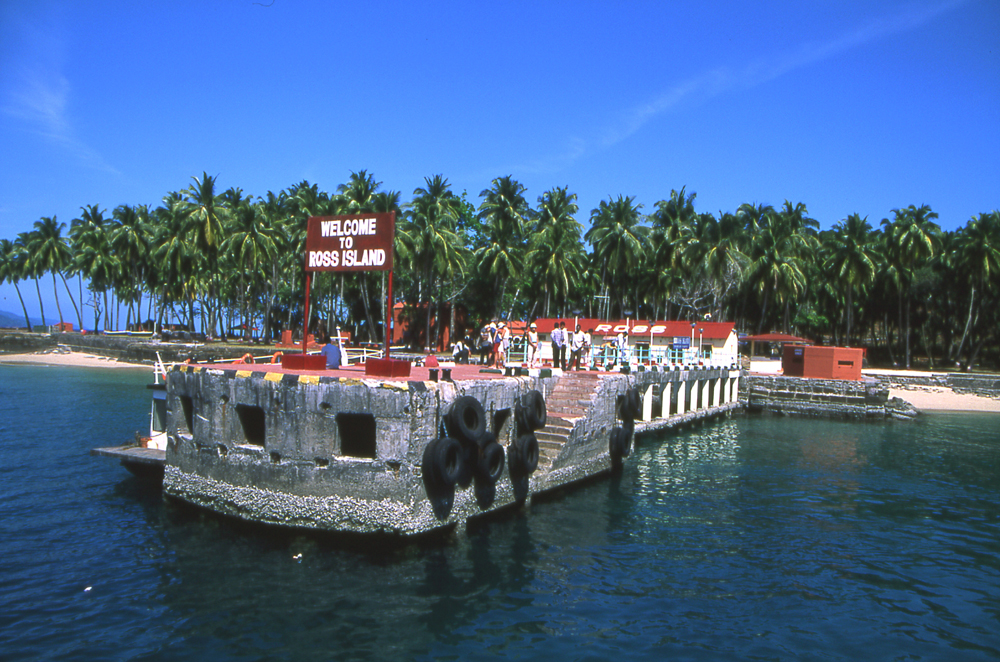
Tourism is one of the major contributors to the economy of the islands. The islands had more than 400,000 visitors in 2016 with a 94% contribution from domestic tourists. In 2018, plans to develop facilities in various islands under the National Institute of Transforming India (NITI) Aayog was initiated by Government of India, with the aim of increasing tourist inflows. Foreign tourists are issued Restricted Area Permits (RAP) which gives access to specific areas with conditions. While domestic tourists do not require a permit to visit the accessible parts of the islands, the tribal reserves are forbidden and requires special permission for access. The islands have many beaches due to its long coastline and various water sports are practised including kayaking, scuba diving and parasailing.
Major attractions include the Cellular Jail, Chatham Saw Mill, Forest Museum, Samudrika Naval Marine Museum, Anthropological Museum, Fisheries Aquarium, Science Center and Carbyn's cove in Port Blair; Bharatpur, Lakshmanpur and Sitapur beaches in Shaheed Dweep; Elephant and Radhanagar beaches in Swaraj Dweep; Hudi tikri, Red, Bird and Bat islands, Amkunj beach near Rangat; Dhaninallah mangroves and Karmatang beach near Mayabunder; limestone caves and mud volcanoes near Diglipur; Craggy island and Ross & Smith islands and various national parks and protected sanctuaries.
Transportation

The islands are served by Veer Savarkar International Airport near Port Blair which has regular flights to major cities in India. The airport operates as a civil enclave, sharing airside facilities with INS Utkrosh of the Indian Navy. The airport has a single runway of 3290 m in length, with the civilian terminal operated by the Airports Authority of India with air traffic operations managed by the Indian Navy. Andaman and Nicobar Command of Indian Armed Forces operates air bases of Car Nicobar AFS, INS Kohassa, INS Utkrosh and INS Baaz.
There are 23 ports along the islands with a major port at Port Blair and eight other significant ports including Diglipur, Mayabunder, Rangat, Hut Bay, Car Nicobar, Katchal and Campbell Bay. In 2022, the Government of India proposed the development of a new container ship terminal and an airport at Great Nicobar. There are 39 light houses situated across the islands.
, there are 422 km long national highways in the state with the major highway being the 230.7 km long NH 4 connecting Port Blair and Diglipur.
Infrastructure
Power
There is no single power grid connecting all the islands and independent power houses caters to the power requirements of individual islands. The islands have an installed power capacity of 68.46 MW with majority of the power generated from diesel power plants and a single hydroelectric powerplant of 5.25 MW on Kalpong river. In 2016, a new 15 MW diesel power plant was established in South Andaman with Japanese assistance. Commissioned in June 2020, a 10 MW photovoltaic power station is operated by NLC India in Port Blair. In 2022, the government proposed additional power plants and infrastructure to be developed in Great Nicobar.
Telecommunication
4G mobile service is provided by various telecom operators in the islands. Till 2020, Internet was provided through satellite links and access was limited. Bharat Broadband Network started work on laying fiber optic submarine cables connecting the islands with Chennai in December 2018. On 10 August 2020, the undersea optical fibre cable went live, which enabled high-speed broadband connections in the islands.
Education
The first primary school in the islands was established in 1881. During Independence, 12 schools were functioning on the islands including one high school. , there are 428 schools functioning in the islands with a total enrolment of 86,081 students. Jawaharlal Nehru Rajkeeya Mahavidyalaya was the first institute of higher education, established in 1967. Mahatma Gandhi Government College was established in 1990 and is affiliated to Pondicherry University. Dr. B. R. Ambedkar Government Polytechnic was established in 1984 and the affiliated engineering college, Dr. B. R. Ambedkar Institute of Technology was established in 1989. Andaman Law College is the only law college in the state, established in 2016. The Andaman and Nicobar Islands Institute of Medical Sciences was established in 1963.
In popular culture
- Arthur Conan Doyle refers to the Andaman islands in the Sherlock Holmes novel The Sign of the Four.
- Bengali author Sunil Gangopadhyay based the events of one his Kakababu series of adventure thriller novels, Sabuj Dwiper Raja (1976), on the islands. In 1979, it was made into a film of the same name, shot extensively on the islands.
- The National Award-winning Malayalam film Kaalapani was set against the backdrop of Port Blair's Cellular Jail and was extensively shot in the islands.
- The Netflix Original Series Kaala Paani is based on a fictional illness that spreads in the islands.
- Hitman 3 features a fictional island in the Nicobar Islands called Ambrose Island that was added as a new map in a free update to the game, and is home to a group of pirates operating in the Strait of Malacca.
Notes
References
References
- "Socio-economic statistics". [[Government of India]].
- "State-wise population". [[Government of India]].
- "India: Subnational HDI". Global Data Labs.
- (23 September 2024). "Annual Report, Periodic Labour Force Survey (PLFS) (July 2023 – June 2024)". National Sample Survey Office, [[Ministry of Statistics and Programme Implementation]], [[Government of India]].
- "History of South Andaman". [[Government of India]].
- "History of North Andaman". [[Government of India]].
- "History of Nicobar". [[Government of India]].
- (2006). "Comment on 'Reconstructing the Origin of Andaman Islanders'". [[Science (journal).
- Cooper, Zarine. (1996). "The Salient Features of Site Location in the Andaman Islands, Indian Ocean". Asian Perspectives.
- Hultzsch, E.. (1991). "South Indian Inscriptions: Tamil Inscriptions of Rajaraja, Rajendra Chola and Others in the Rajarajesvara Temple at Tanjavur". Superintendent, Government Press.
- Nilakanta Sastri, K. A.. (1955). "The Cholas". G. S. Press.
- Murfett, Malcolm H.. "Between 2 Oceans (2nd Edn): A Military History of Singapore from 1275 to 1971".
- Cotterell, Arthur. "Asia: A Concise History".
- (1908). "The Andaman and Nicobar Islands: Local Gazetteer". Government of India.
- Cœdès, George. (1918). "Le Royaume De Srivijaya". Bulletin de l'École Française d'Extrême-Orient.
- (1903). "Hobson-Jobson: A Glossary of Colloquial Anglo-Indian Words and Phrases, and of Kindred Terms, Etymological, Historical, Geographical and Discursive". J. Murray.
- (18 October 2011). "Sources of the History of North Africa, Asia and Oceania in Denmark". Walter de Gruyter.
- Haensel, John Gottfried. (1812). "Letters on the Nicobar islands, their natural productions, and the manners, customs, and superstitions of the natives with an account of an attempt made by the Church of the United Brethren, to convert them to Christianity".
- Williams, Victoria R.. (2020). "Indigenous Peoples: An Encyclopedia of Culture, History, and Threats to Survival". Bloomsbury Publishing.
- von Scherzer, Karl Ritter. "Narrative of the Circumnavigation of the Globe by the Austrian Frigate Novara".
- Vaidik, A.. (2010). "Imperial Andamans: Colonial Encounter and Island History". Palgrave Macmillan.
- Mathur, L. P.. (1967). "A Historical Study of Euro-Asian Interest in the Andaman and Nicobar Islands". Proceedings of the Indian History Congress.
- Murthy, R.V.R.. (2006). "Cellular Jail:a Century of Sacrifices". The Indian Journal of Political Science.
- (14 August 2017). "How India's Cellular Jail was integral in the country's fight for freedom". [[The Independent]].
- L, Klemen. (1999–2000). "The capture of Andaman Islands, March 1942". Forgotten Campaign: The Dutch East Indies Campaign 1941–1942.
- "The forgotten story of the Japanese ruling over (a part of) India". [[The Indian Express]].
- Dasgupta, Jayant. (2002). "Japanese in the Andaman & Nicobar Islands: Red Sun over black Water". Manas Publications.
- Mathur, L. P.. (1985). "Kala Pani: History of Andaman & Nicobar Islands, with a Study of Indiaʼs Freedom Struggle". Eastern Book Corporation.
- Wynn, Stephen. (2020). "The Rise and Fall of Imperial Japan". Pen & Sword Books Limited.
- Murthy, R. V. R.. (2007). "Andaman and Nicobar Islands: A Geo-political and Strategic Perspective". Northern Book Centre.
- (9 October 2020). "Jinnah's bid for Andaman Islands". [[The Friday Times]].
- (1950). "Constitution of India". [[Government of India]].
- "Bengali settlers in the Andaman Islands: the performance of homeland". IIAS Asia.
- (2008). "Andaman and Nicobar Islands Development Report". [[Planning Commission of India]].
- David Brewster. "India's Defense Strategy and the India–ASEAN Relationship, RSIS Monograph No.28".
- (30 January 2019). "A watchtower on the high seas". [[The Tribune (Chandigarh).
- (2007). "Sumatra-Andaman Islands Earthquake and Tsunami of December 6, 2004: Lifeline Performance". [[American Society of Civil Engineers]], Technical Council on Lifeline Earthquake Engineering.
- (20 January 2005). "Tsunami folklore 'saved islanders'". [[BBC News Online]].
- "UT Profile". [[Government of India]].
- "Brief Industrial Profile of Andaman and Nicobar Islands". Government of India Ministry of M.S.M.E.
- "Saddle peak". Britannica.
- (1990). "Maritime Boundaries of India - A Case Study". University of Rhode Island.
- "Indira Point". [[Government of India]].
- (13 September 2024). "Government has decided to rename the capital of Andaman & Nicobar Islands Port Blair as Sri Vijaya Puram". [[Press Information Bureau]].
- "Barren Island". Smithsonian.
- "Barren Island". Ministry of Tourism, [[Government of India]].
- (7 November 2021). "Did You Know India Has an Active Volcano? It's Located in Andaman's Barren Island". News18.
- "About Andamans". [[Government of India]].
- (1983). "Maricultural potential Andaman and Nicobar". [[Central Marine Fisheries Research Institute]].
- "Flora and Fauna". [[Government of India]].
- (2013). "Endemic Fauna of Andaman and Nicobar Islands Bay of Bengal". [[Zoological Survey of India]].
- (2013). "Endemic Animals of Andaman and Nicobar Islands".
- Thomas, Maria. (4 August 2016). "The incredible life of India's iconic swimming elephant". qz.com.
- Sankaran, R.. (1999). "The impact of nest collection on the Edible-nest Swiftlet in the Andaman and Nicobar Islands". Sálim Ali Centre for Ornithology and Natural History.
- Singh, Shiv Sahay. (21 April 2019). "In a first, east Asian birds make Andaman stopover". [[The Hindu]].
- (2002). "Flight of the Dodo". Science.
- "Andaman and Nicobar Islands". ENVIS, [[Government of India]].
- "Biodiversity of Andaman and Nicobar". [[Government of India]].
- "Regional centres". [[Zoological Survey of India]].
- "Mahatma Gandhi Marine National Park". [[Government of India]].
- "State Symbols of India". Ministry of Environment, Forests & Climate Change, Government of India.
- "Decadal Variation In Population Since 1901".
- "Census of India".
- "Population by religion community – 2011". [[Government of India]].
- "Tribes of Andaman". [[Government of India]].
- Pandit, T. N.. (1990). "The Sentinelese". Seagull Books.
- Sekhsaria, Pankaj. (3 April 2017). "How a statist vision of development has brought Andaman's tribals close to extinction". Scroll.
- (24 February 2016). "Tribals in A & N Islands". [[Government of India]].
- (23 November 2021). "Tribal Communities of Andaman and Nicobar celebrate Azadi ka Amrit Mahotsav week of Tribal Affairs with fanfare in their inimitable style". [[Government of India]].
- Manoharan, S. (1983). "Subgrouping Andamanese group of languages". International Journal of Dravidian Linguistics.
- Abbi, Anvita. (20 April 2020). "The Pandemic Also Threatens Endangered Languages". Scientific American.
- Webber, George. (20 May 2013). "George Webber's Lonely Islands, Chapter 8: The Tribes".
- Lal, Parmanand. (1977). "Great Nicobar Island: study in human ecology". Anthropological Survey of India.
- "C-16: Population by mother tongue, India - 2011". Office of the Registrar General & Census Commissioner, India.
- "Report of the Commissioner for linguistic minorities: 52nd report (July 2014 to June 2015)". Commissioner for Linguistic Minorities, Ministry of Minority Affairs, [[Government of India]].
- "Lt Governors and Administrators". [[Government of India]].
- (14 September 1953). "States Reorganisation Act, 1956".
- "Andaman and Nicobar Bill". [[Parliament of India]].
- "State/UT wise Lok Sabha seats". [[Government of India]].
- "Districts of Andaman and Nicobar". [[Government of India]].
- "About, Calcutta High Court". [[Calcutta High Court]].
- "Area and Population". [[Government of India]].
- "Demography". [[Government of India]].
- "GDP of states/UTs". [[Reserve Bank of India]].
- "Eco-tourism in Andaman & Nicobar Islands". [[Government of India]].
- "History of agriculture". [[Government of India]].
- "Objectives of Agriculture". [[Government of India]].
- "Economic survey". [[Government of India]].
- "Holistic Development of Islands".
- "Protected and Restricted Areas". [[Government of India]].
- "For Foreigners". [[Government of India]].
- "Water sports". [[Government of India]].
- "Andaman tour". [[Government of India]].
- "List of Aerodromes Licensed in Public Use Category". [[Directorate General of Civil Aviation (India).
- (22 August 2013). "New Terminal Building at Port Blair Airport by March 2018". [[Press Information Bureau]].
- "Andaman & Nicobar Command: Saga of Synergy". Sainik Samachar.
- (18 January 2019). "Headquarters Andaman Nicobar Command ANC to enhance its operational capability with the upcoming commissioning of INS Kohassa". [[Government of India]].
- "History of Ports". Port Management Board, [[Government of India]].
- "India plans Rs 10,000 cr transshipment port at Great Nicobar Island: PM". [[The Economic Times]].
- (22 November 2022). "Development of Great Nicobar: strategic imperative and ecological concerns". The Indian Express.
- "Light houses". [[Government of India]].
- (30 November 2018). "State-wise length of National Highways in India". [[Ministry of Road Transport and Highways]].
- "Andaman, Road development". [[Government of India]].
- "Electricity in Andaman". [[Government of India]].
- "Electricity department of Andaman". [[Government of India]].
- (13 March 2016). "India collaborates with Japan on Andamans project". [[The Hindu]].
- "These 8 narrow choke-points are critical to the world's oil trade". Business Insider.
- Kala, Rishi Ranjan. (18 June 2024). "The solar way of providing power to eco-sensitive zones". [[Business Line]].
- (23 February 2022). "Power plant profile: NLC Dolly Gunj Solar PV Park, India". Power Technology.
- Ramakrishna, Ishika. (20 October 2022). "Massive infrastructure project threatens Great Nicobar Island". [[The Hindu]].
- (12 August 2020). "Airtel becomes the first mobile operator to launch 4G services in Andaman and Nicobar". [[The Indian Express]].
- (10 August 2020). "PM Modi inaugurates 2,312-kilometre undersea optical fiber cable link between Andaman-Chennai". [[The Indian Express]].
- Sridhar, Lalitha. (17 February 2018). "It's 2018, but still tough to get online in the Andamans". [[The Hindu]].
- "Andaman and Nicobar islands' fast-speed internet will depend on a 2,300 kilometer-long fiber optic cable". Business Insider.
- (26 June 2018). "BSNL to enhance bandwidth 400 times in Andaman and Nicobar island in 2 years". Financial Express.
- (10 August 2020). "PM Modi inaugurates Chennai-Andaman & Nicobar submarine optical cable project". [[The Times of India]].
- "History of education". [[Government of India]].
- "About us". Jawaharlal Nehru Rajkeeya Mahavidyalaya.
- "About us". Mahatma Gandhi Government College.
- "About us". Dr. B. R. Ambedkar Institute of Technology.
- "About us". Andaman Law college.
- "About us". Andaman and Nicobar Islands Institute of Medical Sciences.
- Hill, David. (31 March 2012). "The 'wild' people as tourist stops". [[The Hindu]].
- (9 April 2021). "Indigenous Celebrity: Entanglements with Fame". University of Manitoba Press.
- (21 January 2019). "On Black Water and the Bengali Fear of Seafaring". The Daily Star.
- (9 April 2020). "Kalapani movie, 25 years". ManoramaOnline.
- (18 October 2023). "Kaala Paani Season 1 Review : A well-acted and intriguing survival drama". [[The Times of India]].
- Ivan, Tom. (8 July 2021). "Hitman 3's new Ambrose Island map dated with location reveal trailer". Video Games Chronicle.
This article was imported from Wikipedia and is available under the Creative Commons Attribution-ShareAlike 4.0 License. Content has been adapted to SurfDoc format. Original contributors can be found on the article history page.
Ask Mako anything about Andaman and Nicobar Islands — get instant answers, deeper analysis, and related topics.
Research with MakoFree with your Surf account
Create a free account to save articles, ask Mako questions, and organize your research.
Sign up freeThis content may have been generated or modified by AI. CloudSurf Software LLC is not responsible for the accuracy, completeness, or reliability of AI-generated content. Always verify important information from primary sources.
Report