From Surf Wiki (app.surf) — the open knowledge base
Anastasia Island
Barrier island off the coast of Florida, United States
Barrier island off the coast of Florida, United States
| Field | Value |
|---|---|
| name | Anastasia Island |
| sobriquet | |
| image_name | The view from the Light House.jpg |
| image_caption | View of Anastasia Island from St. Augustine Lighthouse. |
| pushpin_map | Florida#North Atlantic |
| pushpin_label_position | bottom |
| pushpin_relief | 1 |
| pushpin_map_caption | Anastasia Island |
| coordinates | |
| location | North Atlantic |
| grid_reference | |
| country | |
| country_admin_divisions_title | State |
| country_admin_divisions | Florida |
| country_admin_divisions_title_1 | County |
| country_admin_divisions_1 | St. Johns |
Anastasia Island is a barrier island located off the northeast Atlantic coast of Florida in the United States. It sits east of St. Augustine, running north–south in a slightly southeastern direction to Matanzas Inlet. The island is about 14 mi long and an average of 1 mile in width. It is separated from the mainland by the Matanzas River, part of the Intracoastal waterway. Matanzas Bay, the body of water between the island and downtown St. Augustine, opens into St. Augustine Inlet.
Part of the island (the Davis Shores and Lighthouse Park neighborhoods) is within St. Augustine city limits, while other communities on the island include St. Augustine Beach, Coquina Gables, Butler Beach, Crescent Beach, and Treasure Beach.
Fort Matanzas National Monument, a Spanish colonial-era fort built in 1740–1742, is located at the southern end of the island on Rattlesnake Island in the Intracoastal waterway within the park boundaries; it was designed to protect St. Augustine from attack via the Matanzas River.
History
Juan Ponce de León may have landed on the barrier island in 1513. Spanish Admiral Pedro Menéndez de Avilés, founder of St. Augustine, moved his initial settlement to Anastasia Island after a revolt by the Timucuan Indians in 1566. This settlement was short-lived, and the colonists moved back to the mainland at the site of present-day downtown St. Augustine.
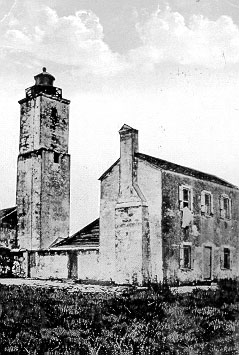
The Spanish built a wooden watch-tower on the northern end of Anastasia Island to warn the town of approaching vessels by raising signal flags. It was sighted by Sir Francis Drake in 1586; consequently he came ashore and attacked the city. The Spanish eventually replaced the tower with a coquina structure that was converted into a lighthouse soon after Florida came into the possession of the United States in 1821. This was replaced by the present-day St. Augustine Light in 1874. The original lighthouse collapsed in 1880 due to beach erosion and the encroachment of the sea. The earliest built residence on Anastasia Island still standing is the lighthouse keepers' house built in 1876 next to the present lighthouse. Several other houses in the Lighthouse Park neighborhood date to the 1880s.
The island was part of a 10,000-acre land grant from the Spanish crown to the land dealer Jesse Fish, who established a plantation, El Vergel (The Orchard), and built his home there in 1763. Fish planted orange groves on the property which produced fruit known as far away as London for its juiciness and sweetness. His production increased annually until 1776, when he shipped a total of 65,000 oranges from Florida.
In 1792, Jesse Fish's son, Jesse Fish, Jr., purchased the tract, amounting to the whole of "St. Anastasia" island except certain lands marked off by officials as reserved, such as the King's Quarry. Sarah Fish, Jesse Fish, Jr.'s wife and heir, filed a claim that was reported to Congress in 1826 as valid by the commissioners for East Florida and the Secretary of State of the United States, and subsequently confirmed by an act of Congress on May 23, 1828.
In 1896, two boys found an oddly shaped carcass on the beach, named the St. Augustine Monster. Long suspected to be the remains of some form of gigantic octopus and gaining the interest of cryptozoologists, analysis from 1995 and 2004 concluded it to be whale blubber.
The land developer David Paul Davis, known as "D. P." or "Doc", a native of Green Cove Springs, developed the Davis Shores neighborhood at the north end of Anastasia Island during the land boom of the mid–1920s. In 1925–1926 he filled in the extensive salt marshes located directly opposite the center of St. Augustine across the Matanzas River. As the construction bubble collapsed and real estate values plummeted, D.P. Davis mysteriously disappeared at sea on October 12, 1926. Construction of the Bridge of Lions had begun in 1925 to provide access to his projected development and was completed in 1927. A rehabilitation and partial replacement of the Bridge of Lions, as well as restoration of its two Medici lions statues began in 2006 and was completed in 2010. During World War II the Coast Guard occupied the lighthouse, and other residences in Davis Shores were used as barracks for soldiers.
Beneath the sandy soil of most of the island lie layers of coquina, a shelly rock in various stages of consolidation. This rock is composed primarily of whole and fragmented shells of the donax, or coquina, clam admixed occasionally with scattered fossils of various marine vertebrates, including sharks' and rays' teeth. This deposition is known as the Anastasia Formation, and was formed during the Late Pleistocene epoch, in the period of successive glacial ages from about 110,000 years to 11,700 years ago. It is the only local natural source of stone, and was quarried by the Spanish and later the British to construct many of the buildings in St. Augustine (including the Castillo de San Marcos). An old well and chimney made of coquina rock, located on Old Beach Road, are all that remain of the Spanish barracks built to house the workers who mined the coquina for construction of the fort. These included quarry overseers, masons, and stonecutters. The years-long project (1672-1695) was accomplished with the help of Native American forced labor and African slaves.
Parks
In addition to Fort Matanzas National Monument, Anastasia island is also home to the 1600 acre, Anastasia State Park.
References
References
- Charles Ledyard Norton. (1892). "Handbook of Florida". Longmans.
- Orrin H. Pilkey. (January 1984). "Living with the East Florida Shore". Duke University Press.
- (March 1989). "A Preliminary inventory of Spanish colonial resources associated with National Park Service units and national historic landmarks, 1987". United States Committee, International Council on Monuments and Sites, for the U.S. Dept. of the Interior, National Park Service.
- (1967). "Castillo de San Marcos National Monument ... and Fort Matanzas National Monument ...: historical research management plan".
- (1957). "The Code of Federal Regulations of the United States of America". U.S. Government Printing Office.
- Edward W. Lawson. (1946). "The Discovery of Florida and Its Discoverer Juan Ponce de Leʹon: By Edward W. Lawson". Edward W. Lawson.
- David B. Williams. (1 July 2009). "Stories in Stone: Travels Through Urban Geology". Bloomsbury Publishing.
- (1 November 2002). "The Settling of St. Augustine". Gareth Stevens.
- James W. Raab. (2008). "Spain, Britain, and the American Revolution in Florida, 1763-1783". McFarland & Company Incorporated Pub.
- Reynolds 1890, p. 78
- Charles Bingham Reynolds. (1890). "The standard guide, St. Augustine". E.H. Reynolds.
- (1 February 1977). "The Hispanic presence in Florida". E. A. Seemann Pub..
- (1992). "America's First City: St. Augustine's Historic Neighborhoods". Tailored Tours Publications.
- Reynolds 1890, p. 79
- (1 October 1999). "Lost Lighthouses: Stories and Images of America's Vanished Lighthouses". Globe Pequot Press.
- William R. Adams. (2009). "St. Augustine and St. Johns County: A Historical Guide". Pineapple Press Inc.
- "St. Augustine Light". Maritime Heritage Program National Park Service.
- Robert L. Gold. (July 1973). "That Infamous Floridian, Jesse Fish". Florida Historical Society.
- Fernando Nuez Viñals. (2002). "La herencia árabe en la agricultura y el bienestar de occidente". Universitat Politècnica de València, Servicio de Publicacion.
- Ida Keeling Cresap. (1982). "The History of Florida Agriculture: The Early Era".
- John McPhee. (1 April 2011). "The John McPhee Reader". Farrar, Straus and Giroux.
- "HENRY L. MITCHELL, Governor of the State of Florida, William D. Bloxham, Comptroller of the State of Florida, et al., Appts., v. CHARLES M. FURMAN, in His Own Right, and as Administrator of Charles M. Furman, Deceased, et al.". Courts.gov.
- Florida Historical Records Survey. (1940). "Spanish Land Grants in Florida: Briefed Translations from the Archives of the Board of Commissioners for Ascertaining Claims and Titles to Land in the Territory of Florida...". State Library Board.
- United States. Supreme Court. (1921). "United States Supreme Court Reports". Lawyers Co-operative Publishing Company.
- Lovejoy, Bess. (2018-05-31). "The Myth of the St. Augustine Monster".
- (April 1995). "On the Giant Octopus ( Octopus giganteus ) and the Bermuda Blob: Homage to A. E. Verrill". The Biological Bulletin.
- (July 2004). "Microscopic, Biochemical, and Molecular Characteristics of the Chilean Blob and a Comparison With the Remains of Other Sea Monsters: Nothing but Whales". The Biological Bulletin.
- David Nolan. (1995). "The Houses of St. Augustine". Pineapple Press Inc.
- (2010). "Paradise for Sale: Florida's Booms and Busts". The History Press.
- (March 2012). "St. Augustine in the Roaring Twenties". Arcadia Publishing.
- Rodney Kite-Powell. (2013). "History of Davis Islands: David P. Davis and the Story of a Landmark Tampa Neighborhood". Arcadia Publishing Incorporated.
- Doug Dillon. (23 December 2010). "St. Augustine". Mitchell Lane Publishers, Incorporated.
- David B. Williams. (1 July 2009). "Stories in Stone: Travels Through Urban Geology". Bloomsbury Publishing.
- "1801-1809 Old Beach Rd St Augustine, FL 32080". Google Maps.
- William R. Adams. (2009). "St. Augustine and St. Johns County: A Historical Guide". Pineapple Press Inc.
- "Old Spanish Chimney and Well". Waymarking.com.
- Daniel S. Murphree. (9 March 2012). "Native America". ABC-CLIO.
This article was imported from Wikipedia and is available under the Creative Commons Attribution-ShareAlike 4.0 License. Content has been adapted to SurfDoc format. Original contributors can be found on the article history page.
Ask Mako anything about Anastasia Island — get instant answers, deeper analysis, and related topics.
Research with MakoFree with your Surf account
Create a free account to save articles, ask Mako questions, and organize your research.
Sign up freeThis content may have been generated or modified by AI. CloudSurf Software LLC is not responsible for the accuracy, completeness, or reliability of AI-generated content. Always verify important information from primary sources.
Report