From Surf Wiki (app.surf) — the open knowledge base
Anak Krakatoa
Volcanic island in the Sunda Strait, Indonesia

Volcanic island in the Sunda Strait, Indonesia
| Field | Value | |
|---|---|---|
| name | Anak Krakatoa | |
| native_name | id | |
| photo | Anak krakatau sebelum tsunami.jpg | |
| photo_caption | Anak Krakatoa in 2018 | |
| photo_alt | Aerial view of volcanic island with another, rocky island in the background | |
| map_caption | Location of the Volcano | |
| location | Sunda Strait | |
| Lampung, Indonesia | ||
| map | Indonesia | |
| map_relief | 1 | |
| coordinates | ||
| elevation | {{plainlist | |
| listing | Ring of Fire | |
| type | Somma-stratovolcano | |
| age | Holocene – very recent | |
| last_eruption | 15 September 2023 |
Lampung, Indonesia
- 157 m (current)
- 338 m (before 2018 eruption)}} Anak KrakatauEnglish translation and common name: Child of Krakatoa is a volcanic island in Indonesia. On 29 December 1927, Anak Krakatau first emerged from the caldera formed in 1883 by the explosive volcanic eruption that destroyed the island of Krakatoa. There has been sporadic eruptive activity at the site since the late 20th century, culminating in a large sector collapse of the volcano, which caused a deadly tsunami in December 2018. There has been subsequent activity since. Owing to its young age the island is one of several in the area that are of interest to, and the subject of extensive study by volcanologists.
History
Background
After the cataclysmic eruption of Krakatoa in 1883, Krakatoa Island lost approximately two-thirds of its mass on the northwest side, obliterating the peaks of Perboewatan and Danan, and leaving only the southern half of the island, including the Rakata volcano, as the last remnant of the original island. The lost area became a shallow sea.
Regrowth
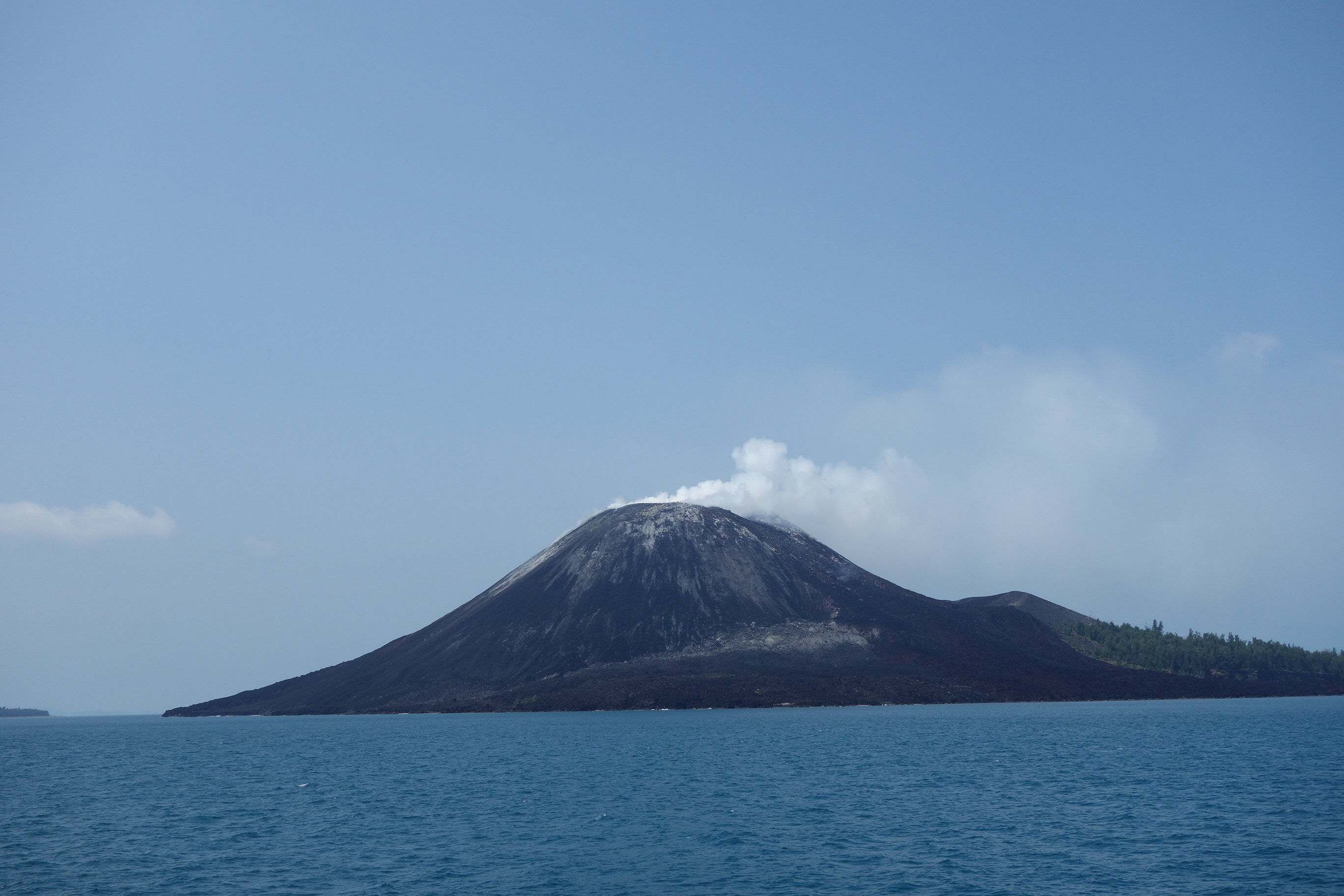
In early 1927 volcanic activity began to appear at the point located between where the former peaks of Mount Perboewatan and Mount Danan had been. This was a short-lived appearance of a small island that was sunk by sea waves within a week. Several months later volcanic activity began to create a more permanent land formation which, owing to rain and waves, once again collapsed under the sea after its volcanic activity stopped. This process recurred several times during the next three years. On 11 August 1930 the volcanic island permanently rose above sea level and was locally named Anak Krakatau (Child of Krakatoa). It has been the site of repeated eruptive episodes ever since. Anak Krakatau's highest point increased at an average rate of 7–9 meters per year through September 2018.
Geography

Anak Krakatau is located in the Sunda Strait—between the islands of Java and Sumatra—in the Indonesian province of Lampung. The volcano is contained within the Ujung Kulon National Park,A UNESCO World Heritage Property and is part of the Pacific Ring of Fire.Global Volcanism Program; Smithsonian Institution, National Museum of Natural History – Department of Mineral Sciences; website; accessed June 2022
Geology
The island is situated approximately 700 km north of the Sunda Trench marking the subduction zone separating the Australian Plate and the fixed Sunda Plate, atop an oceanic crust of less than 25 km in thickness. In geologic terms, it has recently formed within the caldera of the Krakatoa volcanic eruption. The entire island comprises a Somma-stratovolcano system of the late Holocene epoch, and features a pyroclastic cone. The major rock-type components of Anak Krakatau include andesite, dacite, and basalt; with minor indications of trachyte.
The island had reached a maximum elevation of 338 m before its collapse during the 2018 eruptive event.
Volcanic activity
The volcano's most recent eruptive episode began in 1994. Quiet periods of a few days have alternated with almost continuous Strombolian eruptions since then. Hot gases, rocks, and lava were released in an eruption in April 2008. Scientists monitoring the volcano warned people to stay out of a 3 km zone around the island.
On 6 May 2009, the Volcanological Survey of Indonesia raised the eruption alert status of Anak Krakatau to Level 3. An expedition to the volcano revealed that a 100 m wide lava dome was growing in its crater. In January 2012, volcanologists at the University of Oregon warned that a tsunami caused by flank collapse of Anak Krakatau was likely, as it had formed on the steep eastern slope of the large caldera formed by the 1883 explosive eruption.
2018 eruption and aftermath

A new eruptive phase was observed starting in June 2018; and on 15 October 2018, Anak Krakatau had a strong Strombolian to weak Vulcanian eruption that sent lava bombs into the water.
An eruption of the volcano on 22 December 2018 caused a deadly tsunami, with waves up to five meters in height making landfall. On 31 December 2018, the disaster agency stated the tsunami's death toll was 437, with 14,059 injured. The tsunami affected more than 300 kilometers (186 mi) of coastline in Sumatra and Java and 40,000 people were displaced. This made the eruption the second deadliest volcanic eruption of the 21st century to date. Sector collapse—with tsunami generation—was considered a potential hazard immediately before the eruption. Scientists had modeled the possibility six years before the event, and had identified the western flank as the section of the volcano most likely to fail.
Following the December 2018 eruption, it was believed that the southwest sector of the volcano, including the summit, had collapsed during the eruption, triggering the tsunami. On 23 December, this was confirmed by satellite data and helicopter footage, with the main conduit seen erupting from underwater, producing Surtseyan-style activity. The volcano lost over two-thirds of its volume due to this event, and its elevation above sea level was reduced from 338 m to just 110 m.
Satellite radar observations showed that by 10 January 2019, the volcano had continued to form, with further eruptions beginning to re-model the remnant structure. The crater, which had become open to the sea immediately after the eruption, had a complete rim above sea level. In May 2019, phreatomagmatic activity was observed around the newly reconstructed crater as the volcano continued to increase in height and remodel the areas destroyed in 2018.
2020s
Anak Krakatau began erupting again on the morning of 10 April 2020. The first eruption could be heard in the Indonesian capital of Jakarta, over 150 km away, and was spewing out a 200 m high column of ash and smoke according to the Center for Volcanology and Geological Disaster Mitigation's (PVMBG) magma volcanic activity report, which also said that the first eruption lasted one minute and 12 seconds starting at 9:58 p.m. The eruption spewed ash to about 14 km and a secondary ash plume made it to about 11 km. The eruption was largely magmatic with lava fountains visible. No widespread damage was reported, and the eruption ended several hours later.
21 minor eruptions occurred in early 2022, with one on the 24 April being the biggest. A further eruption cycle began on 15 September 2023.
Notes
References
References
- (2002-12-31). "7. Krakatoa, 1883: Devastation, Death, and Ecologic Revival". Princeton University Press.
- "Krakatoa Volcano".
- (15 September 2017). "Krakatoa Volcano: Facts About 1883 Eruption".
- Winchester, S. 2005. Krakatoa. The Day The World Exploded 27 August 1883. Penguin Books.
- (1 January 2013). "Crustal Differentiation Processes at Krakatoa Volcano, Indonesia". Journal of Petrology.
- (1 April 2012). "Magma plumbing beneath Anak Krakatau volcano, Indonesia: evidence for multiple magma storage regions". Contributions to Mineralogy and Petrology.
- [https://www.pbs.org/wildindonesia/island/index.html ''Wild Indonesia: The Birth of an Island''] {{Webarchive. link. (8 May 2021 . PBS online books. Retrieved 27. December 2018.)
- Geologi, Pusat Vulkanologi dan Mitigasi Bencana. (27 December 2018). "Pers Rilis Peningkatan Status G. Anak Krakatau Kamis 27 December 2018".
- "Krakatoa".
- Supriyatin. (11 November 2007). "Indonesia's Krakatau roars, dazzles with fireworks". Reuters India.
- "Status G. Anak Krakatau dinaikkan menjadi Siaga (Level III)". [[Volcanological Survey of Indonesia]].
- (January 2012). "Tsunami Hazard Related to a Flank Collapse of Anak Krakatau Volcano, Sunda Strait, Indonesia". Geological Society, London, Special Publications.
- (20 October 2018). "Krakatau volcano (Indonesia): vulcanian explosions - field report 13-19 Oct 2018". Volcano Discovery.
- Sennert, Sally Kuhn. "Global Volcanism Program {{!}} Report on Krakatau (Indonesia) — 20–26 June 2018".
- (23 December 2018). "Indonesia tsunami: At least 222 Dead and 843 injured after Anak Krakatau volcano erupts".
- Amos, Jonathan. (29 December 2018). "Anak Krakatau: Indonesian Volcano's Dramatic Collapse". BBC News.
- (31 December 2022). "Number of injured in Indonesia tsunami surges to over 14,000". Asean Plus.
- Associated Press. (29 December 2022). "Volcano that triggered tsunami now a quarter of its pre-eruption size".
- (25 December 2018). "22-23 Dec 2018 Eruption & Tsunami of Krakatoa - Updates". [[Volcano Discovery]].
- (1 October 2019). "Complex hazard cascade culminating in the Anak Krakatau sector collapse". Nature Communications.
- Amos, Jonathan. (29 December 2018). "Indonesian volcano's lost stature". BBC News.
- Amos, Jonathan. (10 January 2019). "Anak Krakatau: Finnish radar satellite eyes tsunami volcano".
- (25 May 2019). "Krakatau volcano (Indonesia) activity update and field report: increasing unrest". Volcano Discovery.
- (11 April 2020). "Anak Krakatau erupts, loud rumble heard in virus-stricken Greater Jakarta". The Jakarta Post.
- Dan Satherley. (11 April 2020). "Eruption at Indonesian volcano Krakatoa". Newshub.
- (5 February 2022). "Indonesia's Anak Krakatau Spews Ash 1,500 Metres High".
- (20 December 2025). "Laporan Aktivitas Gunung Api". Volcanological Survey of Indonesia.
- "Anak Krakatau volcano erupts, spews huge ash tower".
- (27 November 2023). "Overall Green alert Volcanic eruption for Krakatau".
This article was imported from Wikipedia and is available under the Creative Commons Attribution-ShareAlike 4.0 License. Content has been adapted to SurfDoc format. Original contributors can be found on the article history page.
Ask Mako anything about Anak Krakatoa — get instant answers, deeper analysis, and related topics.
Research with MakoFree with your Surf account
Create a free account to save articles, ask Mako questions, and organize your research.
Sign up freeThis content may have been generated or modified by AI. CloudSurf Software LLC is not responsible for the accuracy, completeness, or reliability of AI-generated content. Always verify important information from primary sources.
Report