From Surf Wiki (app.surf) — the open knowledge base
Amylose
| NFPA-H = 1 | NFPA-F = 1 | NFPA-R = 0
Amylose is a polysaccharide made of α-D-glucose units, bonded to each other through α(1→4) glycosidic bonds. It is one of the two components of starch, making up approximately 20–25% of it. Because of its tightly packed helical structure, amylose is more resistant to digestion than other starch molecules and is therefore an important form of resistant starch.
Structure
Amylose is made up of α(1→4) bound glucose molecules. The carbon atoms on glucose are numbered, starting at the aldehyde (C=O) carbon, so, in amylose, the 1-carbon on one glucose molecule is linked to the 4-carbon on the next glucose molecule (α(1→4) bonds). The structural formula of amylose is pictured at right. The number of repeated glucose subunits (n) is usually in the range of 300 to 3000, but can be many thousands.
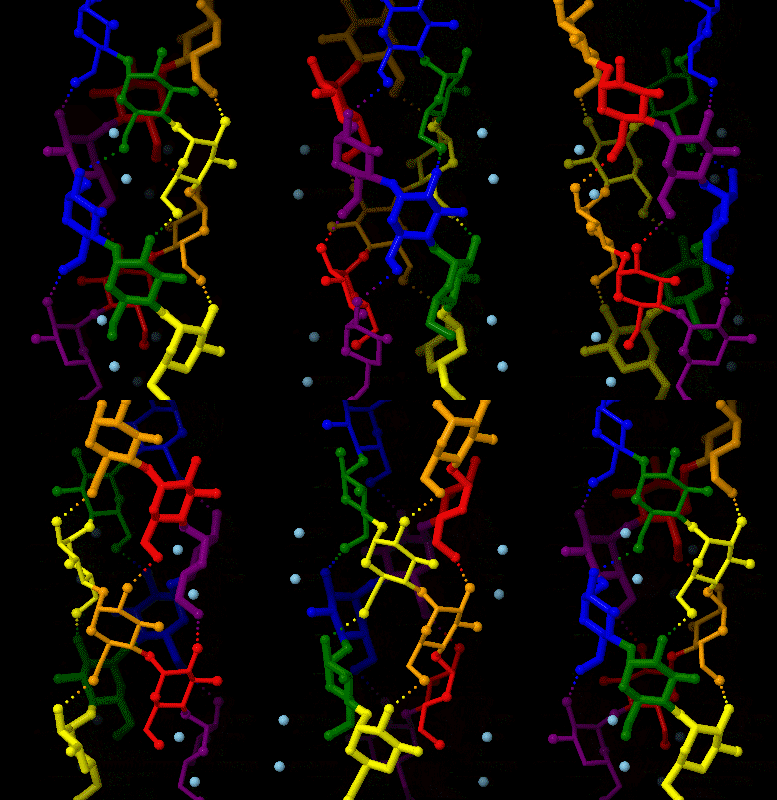
There are three main forms of amylose chains can take. It can exist in a disordered amorphous conformation, found both in starch granules and in hydrated amylose (when starch is cooked in water). There are also two different helical forms. Starting with purified amylose, it can bind with another amylose molecule in a double helix (A or B form), or it can bind with a guest molecule such as iodine, a fatty acid, or an aromatic compound, known as the V form. Within this form, there are many different variations. Each is notated with V and then a subscript indicating the number of glucose units per turn. The most common is the V6 form, which has six glucose units a turn. V8 and possibly V7 forms exist as well. These provide an even larger space for the guest molecule to bind.{{Cite journal
This linear structure can have some rotation around the phi and psi angles, but for the most part bound glucose ring oxygens lie on one side of the structure. The α(1→4) structure promotes the formation of a helix structure, making it possible for hydrogen bonds to form between the oxygen atoms bound at the 2-carbon of one glucose molecule and the 3-carbon of the next glucose molecule.
Fiber X-ray diffraction analysis coupled with computer-based structure refinement has found A-, B-, and C- polymorphs of amylose. Each form corresponds to either the A-, the B-, or the C- starch forms. A- and B- structures have different helical crystal structures and water contents, whereas the C- structure is a mixture of A- and B- unit cells, resulting in an intermediate packing density between the two forms.
Physical properties
High-amylose forms of starch make it more resistant to digestion. Amylose is soluble in hot water. It also reduces the crystallinity of amylopectin and how easily water can infiltrate the starch. The higher the amylose content, the less expansion potential and the lower the gel strength for the same starch concentration. This can be countered partially by increasing the granule size.
Function
Amylose is important in plant energy storage. It is less readily digested than amylopectin. It makes up about 30% of the stored starch in plants, though the percentage varies by species and variety. The digestive enzyme α-amylase breaks down starch molecules into maltotriose and maltose, which can be used as sources of energy.
Amylose is also an important thickener, water binder, emulsion stabilizer, and gelling agent in industrial and food-based contexts. Loose helical amylose chains have a hydrophobic interior that can bind to hydrophobic molecules such as lipids and aromatic compounds. The one problem with this is that, when it crystallizes or associates, it can lose some stability, often releasing water in the process (syneresis). When amylose concentration is increased, gel stickiness decreases but firmness increases. When other things, including amylopectin, bind to amylose, the viscosity can be affected, but incorporating κ-carrageenan, alginate, xanthan gum, or low-molecular-weight sugars can reduce the loss in stability. The ability to bind water can add substance to food, possibly serving as a fat replacement. For example, amylose is responsible for causing white sauce to thicken, but, upon cooling, the solid and the water will partly separate. Amylose is known for its good film-forming properties, useful in food packaging. Excellent film-forming behavior of amylose was studied already in 1950s. Amylose films are better for both barrier properties and mechanical properties when compared to the amylopectin films.
In a laboratory setting, it can act as a marker. Iodine molecules fit neatly inside the helical structure of amylose, binding with the starch polymer that absorbs certain known wavelengths of light. Hence, a common test is the iodine test for starch. If starch is mixed with a small amount of yellow iodine solution, a blue-black color will be observed. The intensity of the color can be tested with a colorimeter, using a red filter to discern the concentration of starch present in the solution. It is also possible to use starch as an indicator in titrations involving iodine reduction. It is also used in amylose magnetic beads and resin to separate maltose-binding protein.
Recent studies
High-amylose varieties of rice, the less sticky long-grain rice, have a much lower glycemic load, which could be beneficial for diabetics.
Researchers have identified the Granule Bound Starch Synthase (GBSS) as the enzyme that specifically elongates amylose during starch biosynthesis in plants. The waxy locus in maize encodes for the GBSS protein. Mutants lacking the GBSS protein produce starch containing only amylopectin, such as in waxy corn. In Arabidopsis leaves, another gene, encoding the Protein Targeting to STarch (PTST) protein, is required in addition to GBSS for amylose synthesis. Mutants lacking either protein produce starch without amylose. Genetically modified potato cultivar Amflora by BASF Plant Science was developed to not produce amylose.
References
References
- (November 1975). "Which Starch Fraction is Water-Soluble, Amylose or Amylopectin?". Journal of Chemical Education.
- "Resistant starch".
- Nelson, David and Michael M. Cox. Principles of Biochemistry. 5th ed. New York: W. H. Freeman and Company, 2008.{{page needed. (March 2019)
- [https://log-web.de/chemie/Start.htm?name=amylose_V&lang=en a visualisation with references to the literature is found here ]
- "Starch".
- (1978). "The Crystal Structures of A-, B- and C-Polymorphs of Amylose and Starch". Starch - Stärke.
- (2013). "Resistant starch: promise for improving human health". [[Advances in Nutrition]].
- "Which Starch Fraction is Water-Soluble, Amylose or Amylopectin?".
- (1975). "Which starch fraction is water-soluble, amylose or amylopectin?". Journal of Chemical Education.
- (2001). "Relationships between thermal, rheological characteristics and swelling power for various starches". Journal of Food Engineering.
- (2014). "Physicochemical, thermal and rheological properties of starches isolated from malting barley varieties". Journal of Food Science and Technology.
- (2017). "Progress in High-Amylose Cereal Crops through Inactivation of Starch Branching Enzymes". Frontiers in Plant Science.
- (2009). "Impact of molecular structure of amylopectin and amylose on amylose chain association during cooling". Carbohydrate Polymers.
- (April 1951). "Preparation of Films from Amylose". Industrial & Engineering Chemistry.
- (July 1998). "Structure, mechanical and barrier properties of amylose and amylopectin films". Carbohydrate Polymers.
- (December 2002). "Effect of glycerol on behaviour of amylose and amylopectin films". Carbohydrate Polymers.
- "Biochemistry Structure and Function".
- "Amylose Magnetic Beads(E8035), pMAL Companion Products, NEB".
- (December 1989). "Properties of Thai cooked rice and noodles differing in glycemic index in noninsulin-dependent diabetics". Plant Foods for Human Nutrition (Dordrecht, Netherlands).
- (2010). "Biochemistry and Genetics of Starch Synthesis". Annual Review of Food Science and Technology.
- (2015). "PROTEIN TARGETING TO STARCH is Required for Localising GRANULE-BOUND STARCH SYNTHASE to Starch Granules and for Normal Amylose Synthesis in Arabidopsis". PLOS Biology.
This article was imported from Wikipedia and is available under the Creative Commons Attribution-ShareAlike 4.0 License. Content has been adapted to SurfDoc format. Original contributors can be found on the article history page.
Ask Mako anything about Amylose — get instant answers, deeper analysis, and related topics.
Research with MakoFree with your Surf account
Create a free account to save articles, ask Mako questions, and organize your research.
Sign up freeThis content may have been generated or modified by AI. CloudSurf Software LLC is not responsible for the accuracy, completeness, or reliability of AI-generated content. Always verify important information from primary sources.
Report