From Surf Wiki (app.surf) — the open knowledge base
Amplitude and phase-shift keying
Digital modulation scheme
Digital modulation scheme
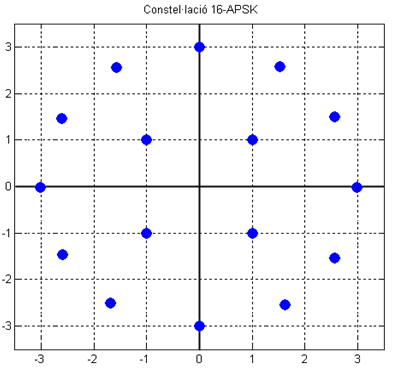
Amplitude and phase-shift keying (APSK) is a digital modulation scheme that conveys data by modulating both the amplitude and the phase of a carrier wave. In other words, it combines both amplitude-shift keying (ASK) and phase-shift keying (PSK). This allows for a lower bit error rate for a given modulation order and signal-to-noise ratio, at the cost of increased complexity, compared to ASK or PSK alone.{{cite journal
Quadrature amplitude modulation (QAM) can be considered a subset of APSK because all QAM schemes modulate both the amplitude and phase of the carrier. Conventionally, QAM constellations are rectangular and APSK constellations are circular, however this is not always the case. The distinction between the two is in their production; QAM is produced from two orthogonal signals. The advantage of APSK over conventional QAM is a lower number of possible amplitude levels and therefore a lower peak-to-average power ratio (PAPR). The resilience of APSK to amplifier and channel non-linearities afforded by its low PAPR have made it especially attractive for satellite communications, including DVB-S2.{{cite journal | access-date = 11 June 2021 | url-access= subscription
Constellations
There are many APSK constellations. Circular constellations are the most common. There may be multiple circular constellations of the same order, for example 16-APSK could be implemented using a (1, 5, 10) constellation or a (5, 11) constellation. Increasing the number of rings decreases the bit error rate but increases the PAPR. Other APSK constellations include triangular, rectangular and hexagonal constellations.
A careful design of the constellation geometry can approach the Gaussian capacity as the constellation size grows to infinity. For the regular QAM constellations, a gap of 1.56 dB is observed. The previous solution, where the constellation has a Gaussian shape, is called constellation shaping.
References
References
- Ershov, A.N., Berezkin, V.V., Petrov, S.V., Petrov, A.V. and Pochivalin, D.A., 2018. [http://spacedevice.ru/wp-content/uploads/2020/04/5_p44_0118en.pdf Features of Calculation and Design of High-Speed Radio Links for Earth Remote Sensing Spacecraft].
- [http://www.satmagazine.com/story.php?number=1051727556 "Standard + Customized APSK Schemes For Satellite Transmission"] By Donald Vanderweit, Agilent Technologies, Inc.
- H. Méric, [https://ieeexplore.ieee.org/xpl/articleDetails.jsp?arnumber=7105353&newsearch=true&queryText=%20Approaching%20the%20Gaussian%20channel%20capacity%20with%20APSK%20constellations Approaching The Gaussian Channel Capacity With APSK Constellations], ''IEEE Communications Letters''.
This article was imported from Wikipedia and is available under the Creative Commons Attribution-ShareAlike 4.0 License. Content has been adapted to SurfDoc format. Original contributors can be found on the article history page.
Ask Mako anything about Amplitude and phase-shift keying — get instant answers, deeper analysis, and related topics.
Research with MakoFree with your Surf account
Create a free account to save articles, ask Mako questions, and organize your research.
Sign up freeThis content may have been generated or modified by AI. CloudSurf Software LLC is not responsible for the accuracy, completeness, or reliability of AI-generated content. Always verify important information from primary sources.
Report