From Surf Wiki (app.surf) — the open knowledge base
Amoghavajra
8th century Buddhist monk

8th century Buddhist monk
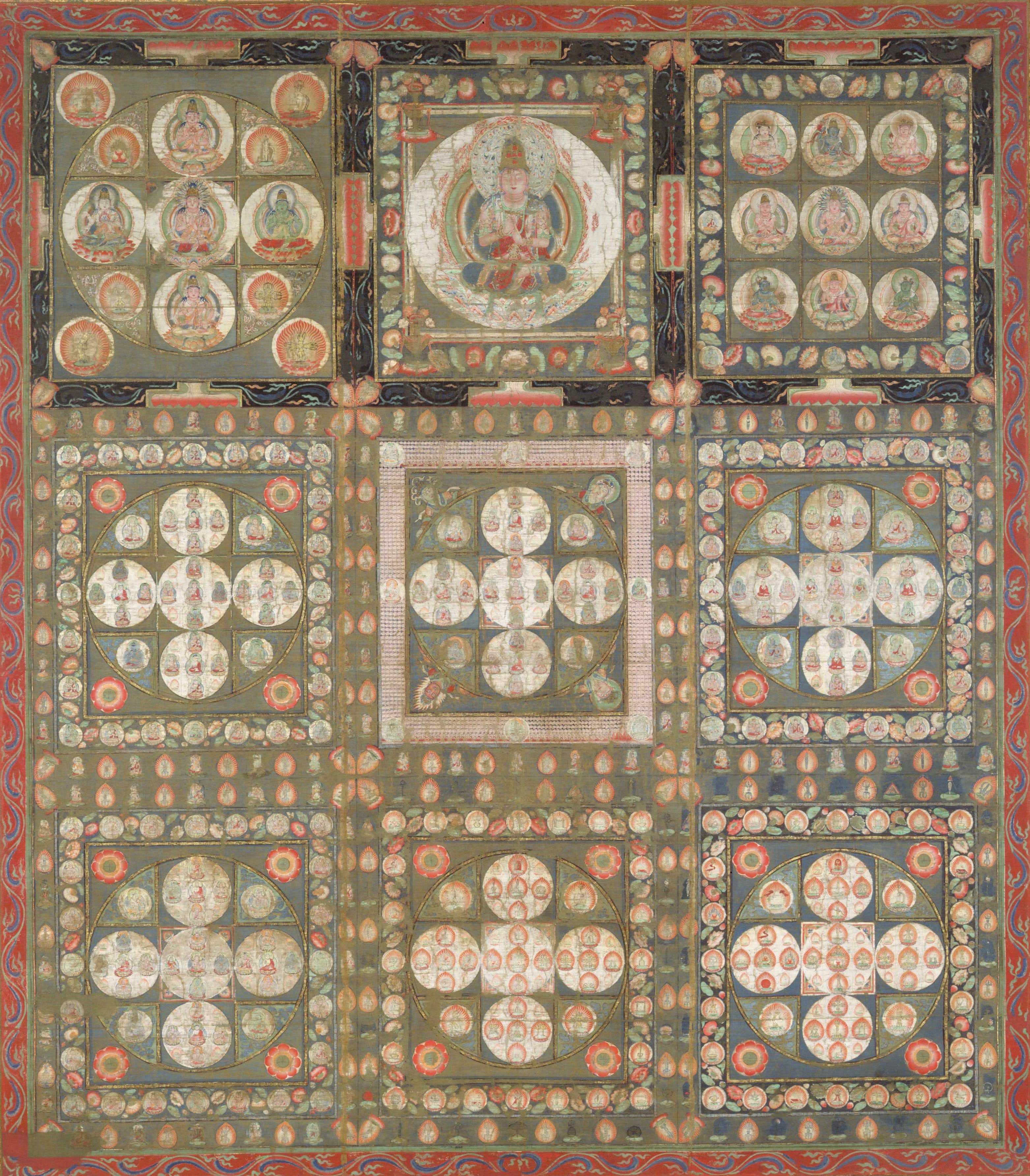
Amoghavajra ( ; , 705–774) was a prolific translator who became one of the most politically powerful Buddhist monks in Chinese history and is acknowledged as one of the Patriarchs of Zhenyan Buddhism and Shingon Buddhism.
Life
There are differing views as to where Amoghavajra's origins were from. Zhao Qian states that Amoghavajra was born in Samarkand of an Indian merchant or Brahmin father as according to Feixis's Stele Inscription and a mother of Sogdian origin. Yan Ying referred to Amoghavajra simply as being "a person of the Western Regions". Alternatively, Quan Deyu's image hall stele inscription states that Amoghavajra was from Sri Lanka. Yuanzhao also repeats the claim that Amoghavajra was from Sri Lanka.
Amoghavajra went to China at age ten after his father's death. In 719, he was ordained into the sangha by Vajrabodhi and became his disciple. After all foreign monks were expelled from China in 741, he and some associates went on a pilgrimage to gather texts, visiting Sri Lanka, Indochina and India. During this voyage, he apparently met Nagabodhi, Vajrabodhi's master, and studied the Tattvasaṃgraha Tantra at length. He returned to China in 746 with some five hundred volumes gathered from Sri Lanka.
In 750, he left the court to join the military governorship of General Geshu Han of the Tang dynasty, for whom he conducted large-scale tantric initiations at his field headquarters. In 754, he translated the first portion of the Tattvasaṃgraha Tantra texts (Taishō Tripiṭaka. 865), central to the Outer Tantras of Vajrayana Buddhism, which became one of his most significant accomplishments. He regarded its teachings as the most effective method for attaining enlightenment yet devised, and incorporated its basic schema in several writings.
Amoghavajra was captured during the An Lushan Rebellion but in 757 was freed by loyalist forces, whereupon he performed rites to purify the capital and consolidate the security of the Tang state. Two years later, he initiated the emperor Emperor Suzong of Tang as a chakravartin.
Amoghavajra assisted the Tang dynasty state against the An Lushan rebellion. He carried out Vajrayana rituals which were ostensibly effective in supernaturally attacking and destroying An Lushan's army including the death of one of An Lushan's generals, Zhou Zhiguang.
In 765, Amoghavajra used his new rendition of the Humane King Sutra in an elaborate ritual to counter the advance of a 200,000-strong army of Tibetan and Uyghurs which was poised to invade Chang'an. Its leader, Pugu Huai'en, dropped dead in camp and his forces dispersed.
The opulent Jinge Temple on Mount Wutai was completed in 767, a pet project of Amoghavajra, one of his many efforts to promote the Bodhisattva Mañjuśrī as the protector of China. Amoghavajra continued to perform rites to avert disaster at the request of Emperor Daizong of Tang.
On his death in 774, three days of mourning were officially declared, and he posthumously received various exalted titles. The Chinese monks Huilang, Huiguo and Huilin were among his most prominent successors. Seventy-seven texts were translated by Amoghavajra according to his own account, though many more, including original compositions, are ascribed to him in the Chinese canons.
References
References
- (2021). "Amoghavajra". Brill's Encyclopedia of Buddhism Online.
- Acri, Andrea. (2016). "Esoteric Buddhism in Mediaeval Maritime Asia: Networks of Masters, Texts, Icons". ISEAS-Yusof Ishak Institute.
- (2018). "Appreciation of Relics, Stupas, and Relic Stupas in Eighth Century Esoteric Buddhism: Taisho Tripitaka Texts and Archaeological Residues in Guhya Lanka_Part 2". The Indian International Journal of Buddhist Studies.
This article was imported from Wikipedia and is available under the Creative Commons Attribution-ShareAlike 4.0 License. Content has been adapted to SurfDoc format. Original contributors can be found on the article history page.
Ask Mako anything about Amoghavajra — get instant answers, deeper analysis, and related topics.
Research with MakoFree with your Surf account
Create a free account to save articles, ask Mako questions, and organize your research.
Sign up freeThis content may have been generated or modified by AI. CloudSurf Software LLC is not responsible for the accuracy, completeness, or reliability of AI-generated content. Always verify important information from primary sources.
Report