From Surf Wiki (app.surf) — the open knowledge base
Amleth
Figure in medieval Scandinavian romance
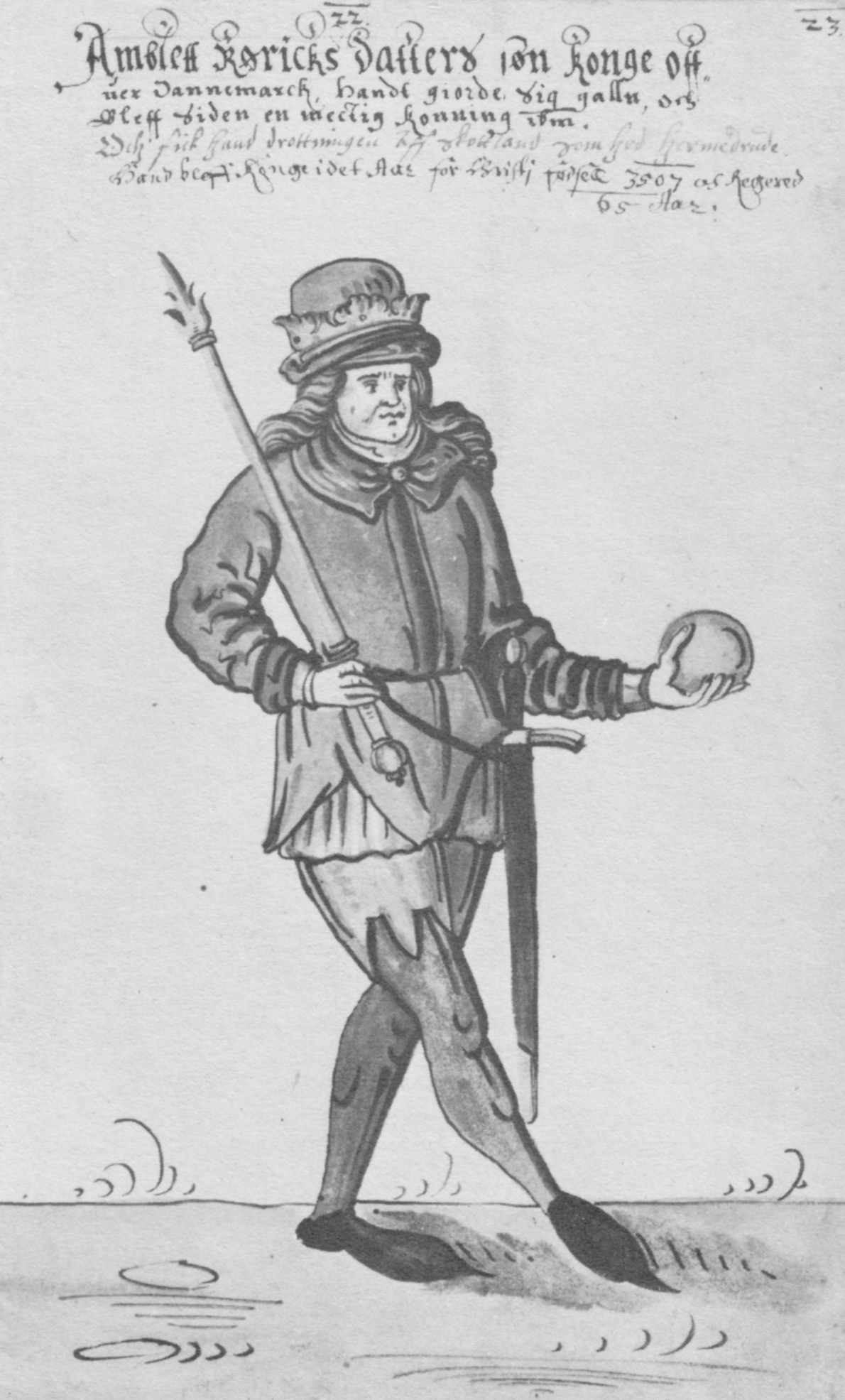
Figure in medieval Scandinavian romance
Amleth (; Latinized as Amlethus) is a figure in a medieval Scandinavian legend, the direct inspiration of the character of Prince Hamlet, the hero of William Shakespeare's tragedy Hamlet, Prince of Denmark. The chief authority for the legend of Amleth is Saxo Grammaticus, who devotes to it parts of the third and fourth books of his Gesta Danorum, completed at the beginning of the 13th century. Saxo's version is supplemented by Latin and vernacular compilations from a much later date. In all versions, prince Amleth (Amblothæ) is the son of Horvendill (Orwendel), king of the Jutes. It has often been assumed that the story is ultimately derived from an Old Icelandic poem, but no such poem has been found; the extant Icelandic versions, known as the Ambales-saga or Amloda-saga, are considerably later than Saxo. Amleth's name is not mentioned in Old-Icelandic regnal lists before Saxo. Only the 15th-century Sagnkrønike from Stockholm may contain some older elements.
Name
The Old Icelandic form Amlóði is recorded twice in Snorri Sturluson's Prose Edda. According to the section Skaldskaparmal, the expression Amlóða mólu ('Amlóði's quern-stone') is a kenning for the sea, grinding the skerries to sand. In a poem by the 10th-century skald Snæbjörn the name of the legendary hero Amlóði is intrinsically connected to the word líðmeldr ('ale-flower'), leading to the conclusion that the nine mermaids, who operated the "hand-mill of the sea", "long ago ground the ale-flour of Amlóði". The association with flour milling and beer brewing, the gold carried around, the net used to catch people and the association with the nine female waves place Amleth on a par with the deity Aegir and his wife Rán.
The late 12th-century Amlethus, Amblothæ may easily be latinizations of the Old Norse name. The etymology of the name is unknown, but there are various suggestions.
Icelandic Amlóði is recorded as a term for a fool or simpleton in reference to the simulated madness of the legendary Danish prince. Henry Harrison, Surnames of the United Kingdom: A Concise Etymological Dictionary vol. 1 (1912), p. 184. One suggestion is based on the "fool" or "trickster" interpretation of the name, composing the name from Old Norse ama "to vex, annoy, molest" and óðr "fierceness, madness" (also in the theonym Odin). The Irish and Scottish word amhlair, which in contemporary vernacular denotes a dull, stupid person, is handed down from the ancient name for a court jester or fool, who entertained the king but also surreptitiously advised him through riddles and antics.
A more recent suggestion is based on the Eddaic kenning associating Amlóði with the mythological mill grótti, and derives it from the Old Irish name Admlithi "great-grinding", attested in Togail Bruidne Dá Derga.
Attention has also been drawn to the similarity of Amleth to the Irish name Amhladh (variously Amhlaidh, Amhlaigh, Amhlaide), itself a Gaelic adaptation of the Norse name Olaf..
In a stanza from the Irish Annals of the Four Masters, compiled in the 1600s, the Irish Queen Gormflaith laments the death of her husband, Niall Glundubh, at the hands of one Amhlaide at the battle of Ath-Cliath (919). The identity of the killer of Niall Glundubh is otherwise recorded as Sigtrygg Caech, the father of that Olaf Cuaran (i.e. Anlaf, gaelicized Amhlaide) who was the prototype of the English Havelok.
In a controversial suggestion going back to 1937, the sequence æmluþ contained in the 8th-century Old Frisian runic inscription on the Westeremden yew-stick has been interpreted as a reference to "Amleth". Contemporary runic research does not support this conclusion. N. Kapteyn, 'Zwei Runeninschriften aus der Terp von Westeremden', Beiträge zur Geschichte der deutschen Sprache und Literatur 57 (1937), 160-226. H. Arntz, Handbuch der Runenkunde 2nd ed. 1944 ("Gegen das hohe Land stellte sich Hamlet. Vor seinen Eiben hat das Unwetter sich ducken müssen. Vor diesem Eibenstäbchen ducke sich die Flut"). "Eibe" in Reallexikon der germanischen Altertumskunde, Volume 6 (1973), p. 527. ophamu gistadda amluþ : iwim ost ah þukn iwi os ust dukale "Auf (bez. gegen) Opheim nahm Stellung (nahm den kampf auf, constitit) Amluþ. Vor (seinen) eiben hat sich die brandung geduckt. Vor (dieser) eibe ducke sich die brandung"'; Arend Quak,'Runica Frisica', in: R.H. Bremmer et al. (eds.), Aspects of Old Frisian Philology. Amsterdamer Beiträge zur älteren Germanistik, 31/32 (1990), 357-370, 365.
Comparative mythology
The similarities of Saxo's version with the classical tale of Lucius Junius Brutus as told by Livy, by Valerius Maximus, and by Dionysius of Halicarnassus are likely deliberate, as the incident of the gold-filled sticks could hardly appear fortuitously in both, and a comparison of the harangues of Amleth (Saxo, Book iv.) and Brutus (Dionysius, iv. 77) shows marked similarities. In both tales, the usurping uncle is ultimately succeeded by the nephew. The latter has escaped notice during his youth by a feigned madness. Nevertheless, the parts played by the personages who in Shakespeare became Ophelia and Polonius, the method of revenge, and the whole narrative of Amleth's adventure in England, have no parallels in the Latin story.
Further resemblances exist in the Ambale's Saga with the tales of Bellerophon, of Heracles, and of Servius Tullius. This concerns especially the episode of the "traitorous letter" (ordering the death of the bearer), also found in the Old French (13th-century) Dit de l'empereur Constant, and further afield in various Arabian and Indian tales.
There are also striking similarities between the story of Amleth and that of Kai Khosrow in the Shahnameh (Book of the King) of the Persian poet Firdausi. In ancient Egyptian mythology, a similar tale of a king who is murdered by a jealous brother but avenged by his son appears in the narrative of Osiris, Set and Horus.
16th-century reception
Main article: Sources of Hamlet
Outside Scandinavia, the story of Amleth or Hamlet was popularized through François de Belleforest's French Histoires tragiques (Paris, Chez Jean Hupeau, 1572, Fueil 149), where it appears as the fifth story of the fifth volume. An English version, The Hystorie of Hamblet, was published in 1608. An English stage version, conventionally known as the Ur-Hamlet, appeared by 1589. The play is lost but is mentioned in a few other sources, the first being Thomas Nashe's 1589 preface to Robert Greene's Menaphon.
William Shakespeare wrote his play Hamlet sometime between 1599 and 1602. The Ur-Hamlet is thought to be his primary source; his version owes but the outline of the story to Saxo. In character, Shakespeare's Prince Hamlet is diametrically opposed to his prototype. Amleth's madness was certainly altogether feigned; he prepared his vengeance a year beforehand and carried it out deliberately and ruthlessly at every point. His riddling speech has little more than an outward similarity to the words of Hamlet. However, he resembles him in his disconcerting penetration into his enemies' plans.
Modern adaptations
Henry Treece adapted the story of Amleth from Saxo for his 1966 novel The Green Man.
The legend was taken as the basis of a 1994 film by Gabriel Axel, Prince of Jutland (also known as Royal Deceit), with Gabriel Byrne as Fenge, Helen Mirren as Geruth and Christian Bale as Amled.
The Amleth story was also the basis for the 1994 Disney film The Lion King.
The legend, woven together with Shakespeare's play, forms the basis for Alan Gordon's novel An Antic Disposition (2004), the fifth novel in Gordon's "Fools' Guild" series.
Amleth's story was also adapted into the 2022 film The Northman, directed by the American director Robert Eggers who also co-wrote the script with Icelandic author Sjón, with Alexander Skarsgård as Amleth.
References
- Peter Tunstall (trans.) The Chronicle of the Kings of Lejre (2003)
- Arthur G. Brodeur (trans.) Prose Edda (1916)
- Oliver Elton (trans.) Saxo Grammaticus' "Amleth, Prince of Denmark" (1894), Books I-IX
References
- (1898). "Hamlet in Iceland: Being the Icelandic Romantic Ambales Saga". [[David Nutt (publisher).
- Anthony Faulkes, '[https://vsnr.org/wp-content/uploads/2021/11/Saga-Book-XXIX.pdf The Earliest Icelandic Genealogies and Regnal Lists]', in: ''Saga-Book'' 29 (2005), p. 115-119.
- Sturluson, Snorri. (2007). "Edda: Skáldskaparmál, vol. 1: Introduction, Text and Notes". Viking Society for Northern Research.
- Cf. ''[http://www.heimskringla.no/wiki/Skáldskaparmál Skáldskaparmál]'', ed. [[Guðni Jónsson]] (1935), section 33. ''Sjávarkenningar'' (sea-kennings), no. 94.
- Sturluson, Snorri. (1995). "Edda". J.M. Dent.
- Cf. the older translation by I. Gollancz, ''Hamlet in Iceland'', London, Northern Library, vol. 3., 1898, p. xi: "Tis said, sang Snaebjorn, that far out, off yonder ness, the Nine Maids of the Island Mill stir amain the host-cruel skerry-quern—they who in ages past ground Hamlet's meal. The good chieftain furrows the hull's lair with his ship's beaked prow. Here the sea is called Amlodhi's Mill."
- Edith Marold (ed.), '[https://skaldic.org/m.php?p=verse&i=4041 Snæbjǫrn, Lausavísur 1]', in: Kari Ellen Gade and Edith Marold (eds.), ''Poetry from Treatises on Poetics. Skaldic Poetry of the Scandinavian Middle Ages'', vol. 3, Turnhout: Brepols, 2017, p. 377.
- [[Ferdinand Holthausen]], ''Vergleichendes und Etymologisches Wörterbuch des Altwestnordischen'', 1948.
- Collinson, Lisa A.. (2011). "A new etymology for Hamlet? The names Amlethus, Amlóði and Admlithi". The Review of English Studies.
- '[https://books.google.com/books?id=iLINAQAAIAAJ&pg=PA17 Gesta Danorum pa danskæ. cod. Holm. B 77 og C 67]', in: ''Gammeldanske Krøniker'', ed. Marcus Lorenzen, Copenhagen, Samfund til udgivelse af Gammel Nordisk Litteratur, 1887-1913, part 1, p. 1-60, 17. On the dating of the chronicle: Anders Leegaard Knudsen, ''[https://books.google.com/books?id=-U1VtjnDr7wC&pg=PA17 Saxostudier og rigshistorie på Valdemar Atterdags tid]'', Kopenhagen 1994, p. 17-19.
- '[https://books.google.com/books?id=iLINAQAAIAAJ&pg=PA204 Sagnkrønike i Stockholm, Efter Cod. Holm. K 46 4]', in: ''Gammeldanske Krøniker'', ed. Marcus Lorenzen, Copenhagen, Samfund til udgivelse af Gammel Nordisk Litteratur, 1887-1913, part. 3, p. 193-219, 204-205.
- Translation and commentary: Marijane Osborn & Janice Hawes, 'Afterword: Amlæd (Hamlet)', in: ''ANQ'' 20 (2007), nr. 3, p. 74-77 (Special Issue, Part II: Beyond the Mere: Other Versions of Beowulfian Stories).
- T.W., [https://books.google.com/books?id=p5VUAAAAYAAJ&pg=PA473 "Amleth"] in ''The Biographical Dictionary of the Society for the Diffusion of Useful Knowledge'', Longman, Brown, Green, and Longmans, 1843.
- Thomas Spray, ""[https://www.academia.edu/84365887/Grei%C3%BEetta_er_fullt_flaerdar_og_falskleita_The_many_ghosts_of_Hamlet_in_sagas_and_folklore Grei þetta er fullt flaerdar og falskleita": The many ghosts of Hamlet in sagas and folklore"], in Pre-Print Papers of the 18th International Saga Conference: Sagas and the Circum-Baltic Arena: Helsinki and Tallinn, 7th–14th August 2022, edited by Frog, Joonas Ahola, Jesse Barber and Karoliina Kouvola, 311-318. Helsinki: Folklore Studies, Department of Cultures, University of Helsinki.
- (1850). "On the plots of Shakespeare's Plays". The Shakespeare Society.
- (1973). "Perspectives on Hamlet: collected papers of the Bucknell-Susquehanna Colloquium on Hamlet, held at Bucknell and Susquehanna Universities, April 27 and 28, 1973". Bucknell University Press.
- (2000). "The Cambridge companion to Shakespeare on film".
- (2019). "How the Lion King made it to the stage". Cavendish Square.
- (17 April 2022). "The Northman review". [[The Observer]].
This article was imported from Wikipedia and is available under the Creative Commons Attribution-ShareAlike 4.0 License. Content has been adapted to SurfDoc format. Original contributors can be found on the article history page.
Ask Mako anything about Amleth — get instant answers, deeper analysis, and related topics.
Research with MakoFree with your Surf account
Create a free account to save articles, ask Mako questions, and organize your research.
Sign up freeThis content may have been generated or modified by AI. CloudSurf Software LLC is not responsible for the accuracy, completeness, or reliability of AI-generated content. Always verify important information from primary sources.
Report