From Surf Wiki (app.surf) — the open knowledge base
Amhara Region
Regional state in northern Ethiopia
.jpg)
Regional state in northern Ethiopia
| Field | Value |
|---|---|
| name | Amhara Region |
| native_name | አማራ ክልል |
| settlement_type | Regional state |
| image_caption | From top, left to right: |
| Fasil Ghebbi, Blue Nile Falls,Grand Renaissance Dam,Church of Saint George, Genneta Maryam, Guzara Castle and Simien Mountains | |
| image_flag | Flag of the Amhara Region.svg |
| image_seal | Amhara Region emblem.png |
| image_map | Amhara in Ethiopia.svg |
| map_caption | Map of Ethiopia showing the Amhara Region |
| coordinates | |
| subdivision_type | Country |
| subdivision_name | Ethiopia |
| established_date | 1999 |
| founder | |
| seat_type | Capital |
| seat | Bahir Dar |
| parts_type | |
| parts | |
| leader_title | Chief Administrator |
| leader_name | Arega Kebede |
| unit_pref | Metric |
| area_total_km2 | 194,708.96 |
| area_rank | 3rd |
| population_total | 23,879,000 |
| population_as_of | 2025 |
| population_density_km2 | auto |
| population_rank | 2nd in Ethiopia |
| population_demonym | Amharas |
| iso_code | ET-AM |
| blank_name_sec1 | HDI (2021) |
| blank_info_sec1 | 0.477 |
| · 9th of 11 | |
| demographics_type1 | Demographics |
| demographics1_title1 | Official language |
| demographics1_title2 | Other languages and ethnicities |
| demographics1_info1 | Amharic |
| demographics1_info2 | Awi Agaw, Argobba, Qemant,Oromo |
| website | |
| official_name | Amhara National Regional State |
| flag_size | 120px |
| seal_size | 80px |
Fasil Ghebbi, Blue Nile Falls,Grand Renaissance Dam,Church of Saint George, Genneta Maryam, Guzara Castle and Simien Mountains · 9th of 11
The Amhara Region (), officially the Amhara National Regional State (), is a regional state in northern Ethiopia and the homeland of the Amhara, Awi, Argobba, and Qemant people. Its capital is Bahir Dar which is the seat of the Regional Government of Amhara. Amhara is the site of the largest inland body of water in Ethiopia, Lake Tana (which is the source of the Blue Nile), Grand Renaissance Dam and Semien Mountains National Park (which includes Ras Dashan, the highest point in Ethiopia). Amhara is bordered by Sudan to the west and northwest and by these regions of Ethiopia: Tigray to the north, Afar to the east, Benishangul-Gumuz to southwest, and Oromia to the south. Towns and cities in Amhara include: Dessie, Gonder, Debre Birhan, Debre Tabor, Kombolcha, Weldiya, Debre Markos, Seqota, Kobo, and Metema. The Regions name is said to mean “noble” or “highland”.e
History
During the Ethiopian Empire, Amhara included several provinces (such as Bete Amhara, Gojjam, Gonder, Angot, Dembiya, Bezemo, Shewa and Lasta), most of which were ruled by native Ras or Negus. The current Amhara region corresponds to often large parts of the former provinces of Begemder, Dembiya, Angot, Bete Amhara,Bezemo, Gojjam and Shewa. With the rise of the Solomonic Dynasty in 1270 under Emperor Yekuno Amlak in Bete Amhara near town Dessie around Lake Hayk (born in the Maqdalla region) and until the establishment of Gondar as the new imperial capital around 1600, the Debre-Birhan to Mekane-Selassie region was the primary seat of the roving Wolloye-Shewan emperors. This period is most significant in the formation of the medieval Ethiopian state, the spread and consolidation of Ethiopian Orthodox Christianity (following the example set by the Zagwe kings in preserving the Axumite heritage) and propagating to the core provinces (besides Tigray/Eritrea, and Lasta) of Bete Amhara, Gojjam, Begemder, northern Shewa, Gafat, and Damot
The region's recorded history, in fact, goes back to the early 13th century. For example, St. George's Church in the town of Woreilu (whose Tabot is reputed to have been carried by Emperor Menelik at the Battle of Adwa) was established around 1200.
The parish of Mekane Selassie (መካነ ሥላሴ), near Neded and the home of the cathedral by the same name, served as a favourite royal playground. The construction of Mekane Selassie (meaning: the abode of the Trinity) was begun by Emperor Naod (1494-1508) and completed by his son Emperor Lebna Dengel. This was a year before the church (along with a large number of monasteries in the region) was sacked and burned down in 1531 by the invasion led by Ahmad bin Ibrahim. Francisco Alvarez, who had earlier visited the church, confirms that its size was some 150 feet by 150 feet — wholly covered in gold leaf, inlaid with gems, pearls and corals
21st century
After the social movements of 2014–2017, Amhara nationalism developed strongly in the region, with a discourse that includes both issues of power balance between elites and territorial claims. Several local politicians, such as Dejene Maru backed by General Asaminew Tsige, were able to control armed factions.
On 22 June 2019, factions of the security forces of the region attempted a coup d'état against the regional government, during which the President of the Amhara region, Ambachew Mekonnen, was assassinated. A bodyguard siding with the nationalist factions assassinated General Se'are Mekonnen – the Chief of the General Staff of the Ethiopian National Defense Force – as well as his aide, Major General Gizae Aberra. The Prime Minister's Office accused Brigadier General Asaminew Tsige, head of the Amhara region security forces, of leading the plot, and Tsige was shot dead by police near Bahir Dar on 24 June.
In April 2023, a strife occurred between the regional special forces of federal government and Fano militia units, advancing to large scale protests in Gondar, Kobo, Seqota, Weldiya on 9 April. Further insurgency was escalated between the two belligerents, resulted in War in Amhara. Since August 2023, Fano militants and ENDF troops intermittently controlled most part of the region, leading to major human rights violations and subsequent state of emergency. Since the outbreak of the war, the region experienced internal displacements, extrajudicial killings and extensive property damages. According to the Ethiopian Human Rights Commission (EHRC) reports, 45 civilians were killed in Amhara region by security forces for allegedly supporting Fano in late January 2024.
Geography
Water flow
The Amhara region is home to five lakes: Lake Tana, Lake Hayq, Lake Ardibbo, Lake Zengena and Lake Tirba.

According to the Ethiopian government website, the Amhara Highlands receive 80% of Ethiopia’s total annual rainfall of and are the country's most fertile and climatically hospitable region. Lake Tana, in the Amhara Region, is the source of the Blue Nile—at Bahir Dar. When the Blue Nile's flow is at maximum volume (during the rainy season from June to September), it supplies about two-thirds of the water of the Nile proper. Until the 1970 completion of the Aswan High Dam in Egypt, the Blue Nile, together with the Atbara River to its north (which also flows out of the Ethiopian Highlands), caused annual Nile floods that contributed to the fertility of the Nile Valley. This aided the rise of ancient Egyptian civilization, which in turn enabled the development of Egyptian mythology.
Lake Tana
Lake Tana contains several islands, whose numbers vary depending on the water level in the lake. (Over the last 400 years, that level has fallen about 2 m.) In the early 17th century, according to a contemporaneous report by Manoel de Almeida, a Portuguese missionary, there were 21 islands, which he described as "formerly large, but now much diminished,” and seven or eight of them had monasteries on them. In the late 18th century, James Bruce visited the area and noted that, though the locals reported that there were 45 inhabited islands, he believed that "the number may be about eleven." A mid-twentieth-century account reported 37 islands and said that 19 of were the current or former sites of either monasteries or churches.
The lake islands were the home of ancient Ethiopian emperors. Treasures of the Ethiopian Church are kept in the isolated island monasteries (including Kebran Gabriel, Ura Kidane Mehret, Narga Selassie, Daga Estifanos, Medhane Alem of Rema, Kota Maryam and Mertola Maryam). The body of Yekuno Amlak is interred in the monastery of St. Stephen on Daga Island; other Emperors whose tombs are on Daga include Dawit I, Zara Yaqob, Za Dengel and Fasilides. Other important islands in Lake Tana include Dek, Mitraha, Gelila Zakarias, Halimun, and Briguida.
In the late 20th century, the scholar Paul B. Henze reported being shown a rock on the island of Tana Qirqos and being told it was where the Virgin Mary had rested during her journey back from Egypt. He was also told that Saint Frumentius, the bishop known for introducing Christianity to Ethiopia, was "allegedly buried on Tana Cherqos."
Landmarks


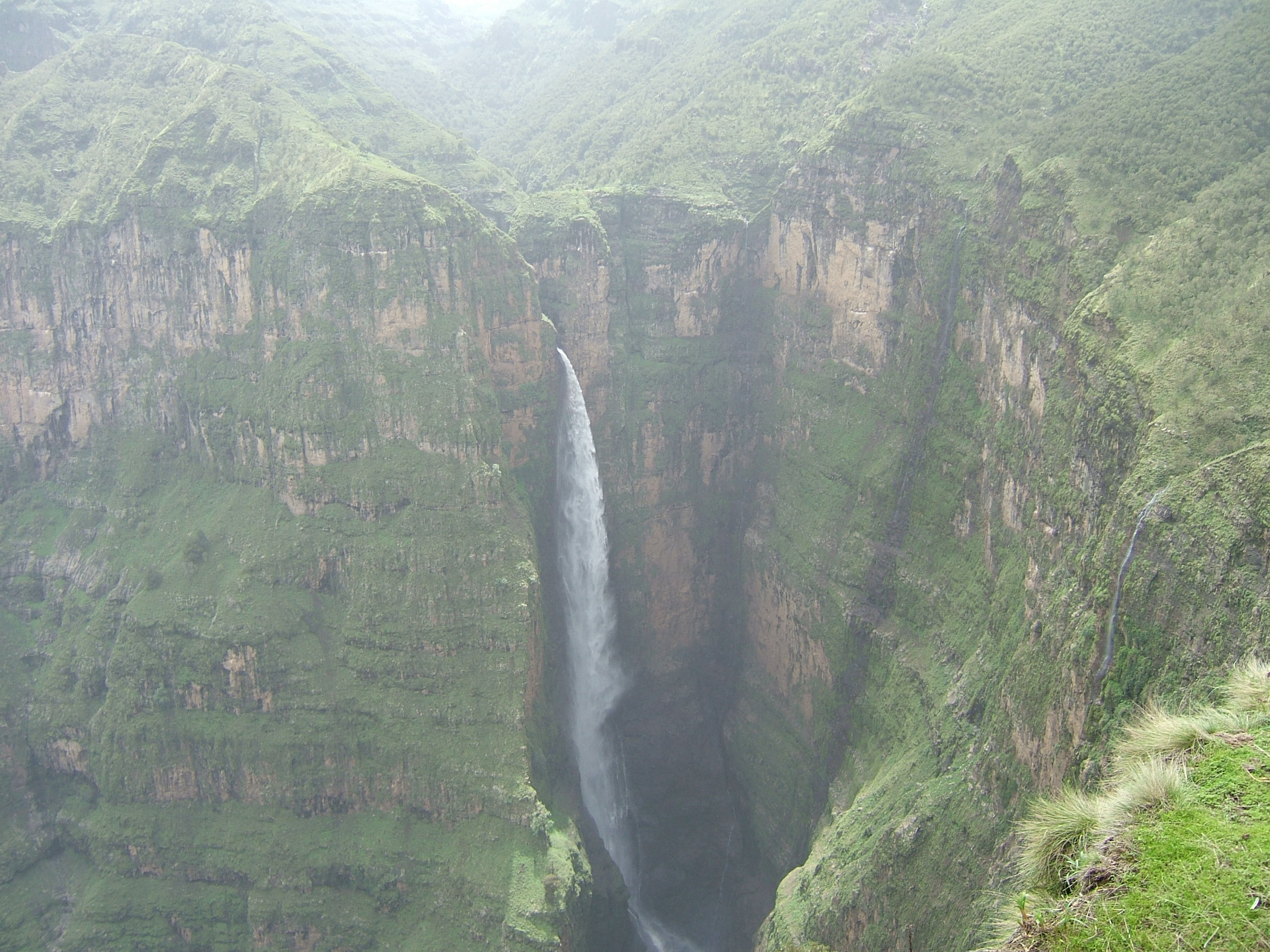
The Amhara region has the most world heritage sites of any region in Ethiopia and is endowed with natural and geographic wonders and ecosystems. The region contains Ethiopia's largest inland body of water Lake Tana, which is the source of the Blue Nile river. In 2015 Lake Tana was recognized as a UNESCO Biosphere Reserve for its enormous biodiversity, and national and international importance. The Semien Mountains National Park has been designated as one of the first natural World Heritage Site by UNESCO in the world, and the very first in Africa in the natural criteria since 1978. Chosen for its spectacular landscapes and global significance for biodiversity conservation. Situated within the Semien Mountains, Ethiopia's highest peaks Ras Dashen reaches an elevation of (4,543 m). The park also has Ethiopia's second and third highest mountains, Kidis Yared (4,453 m) and Mount Bwahit (4,437 m). The park is home to endangered species found nowhere else in the world, examples of endemic fauna include the iconic walia ibex, the gelada baboon, and the Ethiopian wolf (or Simien fox) among others. The wide range of altitudes has given the country a variety of ecologically distinct areas, leading to the evolution of endemic species in ecological isolation.
.jpg)
Amhara region also leads in cultural world heritage sites in Ethiopia, with the Rock Hewn Churches of Lalibela jointly added with Senegal's Gorée island as Africa's first World Heritage site by Unesco in the cultural criteria in 1978. Lalibela and its medieval monolithic churches attracts by far the most number of pilgrims annually of any religious site in Ethiopia. The New Jerusalem was built in response to the capture of old Jerusalem by Muslim forces during the Siege of Jerusalem (1187), after which Muslims denied Ethiopian Christians pilgrimages to the Holy land. Unesco also added Fasil Ghebbi in 1979 as a cultural World Heritage Site. The Royal Enclosure of Fasil Ghebbi was the seat of the Ethiopian Emperors in Gondar the royal capital for more than two centuries(1636 to 1864 AD). The Fasil Ghebbi consist of some twenty palaces, royal buildings, the royal library, a chancellery, a banqueting hall, stables for the horses, highly decorated churches, monasteries and unique public and private buildings that was built during the reign of several emperors in the Gondarine period. The complex covers an area of 70 square kilometers.
Demographics

Based on the 2007 census conducted by the Central Statistical Agency of Ethiopia (CSA), the Amhara region has a population of 17,221,976. 8,641,580 were men and 8,580,396 women; urban inhabitants number 2,112,595 or 12.27% of the population. With an estimated area of 154,708.96 km2, this region has an estimated density of 108.2 people per square kilometer. For the entire region, 3,983,768 households were counted, which results in an average for the region of 4.3 persons to a household, with urban households having on average 3.3 and rural households 4.5 people. The projected population as of 2022 was 32,134,988.
.jpg)

In the previous census, conducted in 1994, the region's population was reported to be 13,834,297 of whom 6,947,546 were men and 6,886,751 women; urban inhabitants numbered 1,265,315 or 9.15% of the population.
According to the CSA, , 28% of the total population had access to safe drinking water, including 19.89% of rural inhabitants and 91.8% of urban inhabitants. Values for other reported common indicators of the standard of living for Amhara include the following: 17.5% of the inhabitants fall into the lowest wealth quintile; adult literacy for men is 54% and for women 25.1%; and the regional infant mortality rate is 94 infant deaths per 1,000 live births, which is greater than the nationwide average of 77; at least half of these deaths occurred in the infants’ first month of life.
| 1994 | 13,834,297 | 2007 | 17,221,976 | 2022 | 23,216,000
Ethnic groups
At 91.47% of the local population, the region is predominantly inhabited by people from the Semitic-speaking Amhara ethnic group. Most other residents hail from other Afro-Asiatic language communities, including the Agaw/Awi, Oromo, Beta Israel, Qemant, Agaw/Kamyr and Argobba. Gumuz is another community located in parts in Amhara Region, speaking a Nilo-Saharan language.
| Ethnic group | 1994 Census | 2007 Census | |||
|---|---|---|---|---|---|
| Amhara | 91.2% | 91.47% | |||
| Agaw/Awi | 2.7% | 3.46% | |||
| Oromo | 3% | 2.62% | |||
| Agaw/Kamyr | 1% | 1.39% | |||
| Argobba | 0.3% | 0.41% | |||
| Qemant | 1.2% | N/A | |||
| Tigrayan | 0.9% | 0.65 |

_-_Outside_Gondar_-_Ethiopia_(8688161971).jpg)
Religion
The predominant religion of the Amhara for centuries has been Christianity, with the Ethiopian Orthodox Tewahedo Church playing a central role in the culture of the Amhara region. According to the 2007 census, 82.5% of the population of the Amhara region (which is 91.2% Amhara) were Ethiopian Orthodox; 17.2% were Muslim, and 0.2% were Protestant ("P'ent'ay"). The Ethiopian Orthodox Church maintains close links with the Coptic Orthodox Church of Alexandria. Easter and Epiphany are the most important celebrations, marked with services, feasting and dancing. There are also many fast days throughout the year, when only vegetables or fish may be eaten.
Marriages are often arranged, with men marrying in their late teens or early twenties. Traditionally, girls were married as young as 14, but in the 20th century, the minimum age was raised to 18. After a church wedding, divorce is frowned upon. Each family hosts a separate wedding feast after the wedding.
.jpg)
Economy
Manufacturing
There are several industrial parks that are in operation or under construction. The Kombolcha IP was built at a cost of $90 million and employs 20,000 people. Arerti IP and Debre Birhan IP are under construction.
Agriculture
.jpg)
About 90% of the Amhara are rural and make their living through farming, mostly in the Ethiopian highlands. Barley, corn, millet, wheat, sorghum, and teff, along with beans, peppers, chickpeas, and other vegetables, are the most important crops. In the highlands one crop per year is normal, while in the lowlands two are possible. Cattle, sheep, and goats are also raised. The CSA of Ethiopia estimated in 2005 that farmers in Amhara had a total of 9,694,800 head of cattle (representing 25% of Ethiopia's total cattle), 6,390,800 sheep (36.7%), 4,101,770 goats (31.6%), 257,320 horses (17%), 8,900 mules (6%), 1,400,030 asses (55.9%), 14,270 camels (3.12%), 8,442,240 poultry of all species (27.3%), and 919,450 beehives (21.1%).
Education
Public universities
There are ten public universities in Amhara Region
-
Bahir Dar University, in Bahir Dar, established in 2001
-
Debre Berhan University, in Debre Berhan, established in 2007
-
Debre Markos University, in Debre Markos, established in 2007
-
Injibara University, in Injibara, established in 2015
-
Wollo University, in Dessie and Kombolcha, established in 2007
-
University of Gondar, in Gondar, established in 1953
-
Debre Tabor University, in Debre Tabor, established in 2008
-
Woldia University, in Woldia, established in 2011
-
Mekdela Amba University, in South Wollo, established in 2015
-
Debark University, established in 2020
-
Injibara University, Injibara, Established in 2020


Government
The government of Amhara is composed of the executive branch, led by the President; the legislative branch, which comprises the State Council; and the judicial branch, which is led by the state Supreme Court.
Executive branch
The executive branch is headed by the Chief Administrator of Amhara Region. The current Chief Administrator is Yilikal Kefale, a Prosperity Party member who was elected on 30 September 2021. The current vice president is Alemnew Mekonnen. The other offices in the executive branch cabinet are the Regional Health Bureau (Dr. Abebaw Gebeyehu), Educational Bureau (Yilikal Kefyalew), and 20 other officials.
Judicial branch
There are three levels of the Amhara state judiciary. The lowest level is the court of common pleas: each woreda maintains its own constitutionally mandated court of common pleas, which maintain jurisdiction over all justiciable matters. The intermediate-level court system is the district court system. Four courts of appeals exist, each retaining jurisdiction over appeals from common pleas, municipal, and county courts in an administrative zone. A case heard in this system is decided by a three-judge panel, and each judge is elected.
The highest-ranking court, the Amhara Supreme Court, is Amhara's "court of last resort". A seven-justice panel composes the court, which, by its own discretion, hears appeals from the courts of appeals, and retains original jurisdiction over limited matters. The chief judge is called the President of Amhara Supreme Court (Yeneneh Simegn).
Legislative branch
The State Council, which is the highest administrative body of the state, is made up of 294 members.
National politics
Amhara is represented by 138 representatives in the Federal Democratic Republic of Ethiopia House of Peoples' Representatives.
Administrative zones
Like other regions in Ethiopia, Amhara is subdivided into administrative zones. There are 11 zones and 67 woredas.
| Number | Zone | Area in km2 | Population estimate 2022 | Administrative Capital |
|---|---|---|---|---|
| 1 | Agew Awi Zone | 9,148.43 | 1,077,144 | Injibara |
| 2 | East Gojjam Zone | 14,004.47 | 2,351,855 | Debre Marqos |
| 3 | North Gondar Zone | 45,944.63 | 2.929,628 | Gondar |
| 4 | North Shewa Zone | 15,936.13 | 1,837,490 | Debre Birhan |
| 5 | North Wollo Zone | 12,172.50 | 1,500,303 | Weldiya |
| 6 | South Gondar Zone | 14,095.19 | 2,051,738 | Debre Tabor |
| 7 | South Wollo Zone | 17,067.45 | 2,518,867 | Dessie |
| 8 | Wag Hemra Zone | 9,039.04 | 463,505 | Sekota |
| 9 | West Gojjam Zone | 13,311.94 | 2,106,596 | Finote Selam |
| 10 | Bahir Dar Special Zone | 213.44 | 474,743 | Bahir Dar |
Culture
The Aholalo is a festival celebrated in the northern region of Ethiopia. The festival is traditionally celebrated in the province of Wollo.
References
References
- "Projected Population of Ethiopia 2025". Ethiopian Statistical Service.
- "Sub-national HDI - Area Database - Global Data Lab".
- (29 March 2022). "Amhara Regional State".
- Room, Adrian. (2008). "African placenames : origins and meanings of the names for natural features, towns, cities, provinces, and counties". Jefferson, N.C. : McFarland & Co..
- Blackhurst, Hector. (October 1974). "Church and State in Ethiopia, 1270–1527. By Taddesse Tamrat. Oxford: Clarendon Press, 1972. Pp. xv + 327, bibl., ill., maps. £5·50.". Africa.
- (15 May 2017). "The Prester John of the Indies".
- (17 November 2020). "" Tedjemerwal " : ressorts sociaux, enjeux matériels et significations locales d'une entrée en guerre". [[Politique Africaine]].
- (23 June 2019). "President of the Amhara region killed". Ethiopia Observer.
- Ingber, Sasha. (23 June 2019). "Ethiopia Army Chief Killed In Attempted Coup, Government Says". NPR.
- (24 June 2019). "Alleged Ethiopian coup mastermind shot dead after 36-hour manhunt". i24 news.
- Ford, Neil. (2023-05-05). "Ethiopia: Crackdown in Amhara risks escalating conflict".
- "Ethiopian forces killed 'at least 45 citizens' in Amhara, rights body says".
- The Amhara National Regional State – Ethiopian Government Portal. 2017. [Online] Available at http://www.ethiopia.gov.et/stateamhara {{Webarchive. link. (2 February 2017 . [Accessed 30 January 2017].)
- C.F. Beckham and G.W.B. Huntingford, ''Some Records of Ethiopia, 1593-1646'', (series 2, no. 107; London: [[Hakluyt Society]], 1954), p. 35 and note.
- Paul B. Henze, ''Layers of Time: A History of Ethiopia'' (New York: Palgrave, 2000), p.73
- (22 October 2018). "Lake Tana Biosphere Reserve, Ethiopia".
- "Simien Mountains | World Heritage Site".
- "Mount Ras Dejen | mountain, Ethiopia | Britannica".
- Centre, UNESCO World Heritage. "Simien National Park".
- Centre, UNESCO World Heritage. "Rock-Hewn Churches, Lalibela".
- "Fasil Ghebbi, Gondar Region".
- link. (14 November 2010, Tables 2.1, 2.5, 3.1, 3.2, 3.4.)
- "Population Projection of Ethiopia for All Regions At Wereda Level from 2014 – 2017". Federal Democratic Republic of Ethiopia Central Statistical Agency.
- [http://www.csa.gov.et/pdf/Basic_welfare_Indicator/Households%20by%20sources%20of%20drinking%20water.pdf "Households by sources of drinking water, safe water sources"] {{webarchive. link. (5 March 2009 CSA Selected Basic Welfare Indicators (accessed 28 January 2009))
- Macro International Inc. [https://web.archive.org/web/20090305231219/http://pdf.usaid.gov/pdf_docs/PNADM636.pdf "2008. Ethiopia Atlas of Key Demographic and Health Indicators, 2005." (Calverton: Macro International, 2008)], pp. 2, 3, 10 (accessed 28 January 2009)
- "African Marriage ritual".
- (1967). "The World and Its Peoples: Africa, North and East, Part 2, Volume 23". Greystone Press.
- Asrat, Amare. (8 July 2017). "Kombolcha industrial park inaugurated". Fana Broadcasting Company.
- Lifang, Song. (13 July 2017). "Ethiopia plans to have 15 industrial parks by June 2018". Xinhua.
- [http://www.csa.gov.et/surveys/National%20statistics/national%20statistics%202005/Agriculture.pdf "CSA 2005 National Statistics"] {{webarchive. link. (18 November 2008 , Tables D.4 - D.7)
- "A-Z list of Amhara Region (Ethiopia) Universities".
- (13 March 2020). "Mekdela Amba University 2020 Ethiopia".
- (23 November 2016). "Amhara Region Announces Appointment of 22 Cabinet Members". Ethiopian News Agency.
- (14 August 2015). "MOU Signing ceremony With Federal and Regional Supreme Courts of Ethiopia to Facilitate Support for Clearance of Backlog Files".
- Lansford, Tom. (2015). "Political Handbook of the World 2015". CQ Press.
This article was imported from Wikipedia and is available under the Creative Commons Attribution-ShareAlike 4.0 License. Content has been adapted to SurfDoc format. Original contributors can be found on the article history page.
Ask Mako anything about Amhara Region — get instant answers, deeper analysis, and related topics.
Research with MakoFree with your Surf account
Create a free account to save articles, ask Mako questions, and organize your research.
Sign up freeThis content may have been generated or modified by AI. CloudSurf Software LLC is not responsible for the accuracy, completeness, or reliability of AI-generated content. Always verify important information from primary sources.
Report