From Surf Wiki (app.surf) — the open knowledge base
American Relief Administration
US military effort to prevent starvation in Europe

US military effort to prevent starvation in Europe
| Field | Value |
|---|---|
| name | American Relief Administration |
| image | File:Motion Picture Day Jan 26 1921.jpg |
| caption | Proceeds from admissions on Motion Picture Day in 1921 went to Hoover's European relief |
| type | Non-governmental organization, Non-profit organization |
| founded_date | |
| founders | United States Congress |
| key_people | Herbert Hoover, future president |
| area_served | Europe, Russia |
| focus | Humanitarianism |
| method | Aid |
| Non-profit_slogan =
American Relief Administration (ARA) was an American relief mission to Europe and later post-revolutionary Russia after World War I. Herbert Hoover, future president of the United States, was the program director.
The ARA's immediate predecessor was the important United States Food Administration, also headed by Hoover. He and some of his collaborators had already gained useful experience by running the Commission for Relief in Belgium which fed seven million Belgians and two million northern French during World War I.
ARA was formed by United States Congress on February 24, 1919, with a budget of 100 million dollars ($ in ). Its budget was boosted by private donations, which resulted in another 100 million dollars. In the immediate aftermath of the war, the ARA delivered more than four million tons of relief supplies to 23 war-torn European countries. Between 1919 and 1921, Arthur Cuming Ringland was chief of mission in Europe. ARA ended its operations outside Russia in 1922; it operated in Russia until 1923.
American relief and Poland
About 20% of the organization's resources were directed to the newly established Second Polish Republic. Much of its resources were helping Polish children, who expressed their appreciation by sending illustrated letters to Hoover. ARA however has been criticized by Russian sympathizers for aiding Polish soldiers amidst the Soviet invasion of Poland. Polish leader Józef Piłsudski has written a note of personal thanks to Hoover; one of the streets in Warsaw has been named after him; he also received honorary degrees from the Jagiellonian University, Warsaw University and Lwów University, among other honors (such as several honorary citizenships of various Polish towns). A monument dedicated to American helpers has been constructed in Warsaw.
Colonel Alvin B. Barber headed the group from 1919 to 1922. Specific areas had directors as well, such as William N. Haskell, who was Director of the ARA in Romania as of 1919.
American relief and the Russian famine of 1921
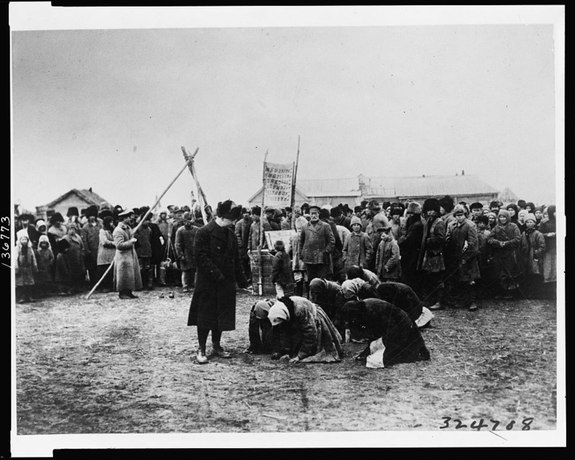
Under Herbert Hoover, very large scale food relief was distributed to Europe after the war through the American Relief Administration. In 1921, to ease the devastating famine in the Russian SFSR that was triggered by the Soviet government's war communism policies, the ARA's director in Europe, Walter Lyman Brown, began negotiating with the Russian People's Commissar for Foreign Affairs, Maxim Litvinov, in Riga, Latvia (at that time not yet annexed by the USSR). An agreement was reached on August 21, 1921, and an additional implementation agreement was signed by Brown and People's Commissar for Foreign Trade Leonid Krasin on December 30, 1921. The U.S. Congress appropriated $20,000,000 for relief under the Russian Famine Relief Act of late 1921. Hoover strongly detested Bolshevism, and felt the American aid would demonstrate the superiority of Western capitalism and thus help contain the spread of communism.
At its peak, the ARA employed 300 Americans, more than 120,000 Russians and fed 10.5 million people daily. Its Russian operations were headed by Col. William N. Haskell. The Medical Division of the ARA functioned from November 1921 to June 1923 and helped overcome the typhus epidemic then ravaging Russia. The ARA's famine relief operations ran in parallel with much smaller Mennonite, Jewish and Quaker famine relief operations in Russia. In addition, the Vatican created a Papal Relief Mission under the ARA, headed by Father Edmund A. Walsh, SJ.

The ARA's operations in Russia were shut down on June 15, 1923, after it was discovered that Russia under Lenin renewed the export of grain.
Notes
References
- "Oral History Interview with Arthur Ringland by Richard D. McKinzie". Truman Library.
- "Letters to Herbert Hoover from the children of Bielsk and Siemiatycze".
- (August 13, 1922). "Col. Barber Quits Poland. Terminates Services There and Starts for Home". [[The New York Times]].
- Kaba, John. (1919). "Politico-economic Review of Basarabia". American Relief Administration.
- Benjamin M. Weissman, "Herbert Hoover and the famine in Soviet Russia, 1921-23" in Mark Hatfield, ed. ''Herbert Hoover Reassessed'' (1981) pp 390–396.
- Bertrand M. Patenaude, "A Race against Anarchy: Even after the Great War ended, famine and chaos threatened Europe. Herbert Hoover rescued the continent, reviving trade, rebuilding infrastructure, and restoring economic order, holding a budding Bolshevism in check." ''Hoover Digest'' 2 (2020): 183-200 [https://www.hoover.org/research/race-against-anarchy online]
- See Lance Yoder's "Historical Sketch" in the online [http://www.mcusa-archives.org/MCC/ix-13201(russia%20photos).html Mennonite Central Committee Photograph Collection] {{Webarchive. link. (February 4, 2012)
- See David McFadden et al., ''Constructive Spirit: Quakers in Revolutionary Russia'' (2004).
- Patrick J. McNamara. (2005). "A Catholic Cold War: Edmund A. Walsh, S.J., and the Politics of American Anticommunism". Fordham University Press.
- Charles M. Edmondson, "An Inquiry into the Termination of Soviet Famine Relief Programmes and the Renewal of Grain Export, 1922–23", ''Soviet Studies,'' Vol. 33, No. 3 (1981), pp. 370–385
This article was imported from Wikipedia and is available under the Creative Commons Attribution-ShareAlike 4.0 License. Content has been adapted to SurfDoc format. Original contributors can be found on the article history page.
Ask Mako anything about American Relief Administration — get instant answers, deeper analysis, and related topics.
Research with MakoFree with your Surf account
Create a free account to save articles, ask Mako questions, and organize your research.
Sign up freeThis content may have been generated or modified by AI. CloudSurf Software LLC is not responsible for the accuracy, completeness, or reliability of AI-generated content. Always verify important information from primary sources.
Report