From Surf Wiki (app.surf) — the open knowledge base
American crocodile
Species of crocodile endemic to the Neotropics
.jpg)
Species of crocodile endemic to the Neotropics
Laurenti, 1768
- Lacerta alligator? Blumenbach, 1779
- Crocodylus caudiverbera? Bonnaterre, 1789
- Crocodylus floridanus Hornaday, 1875
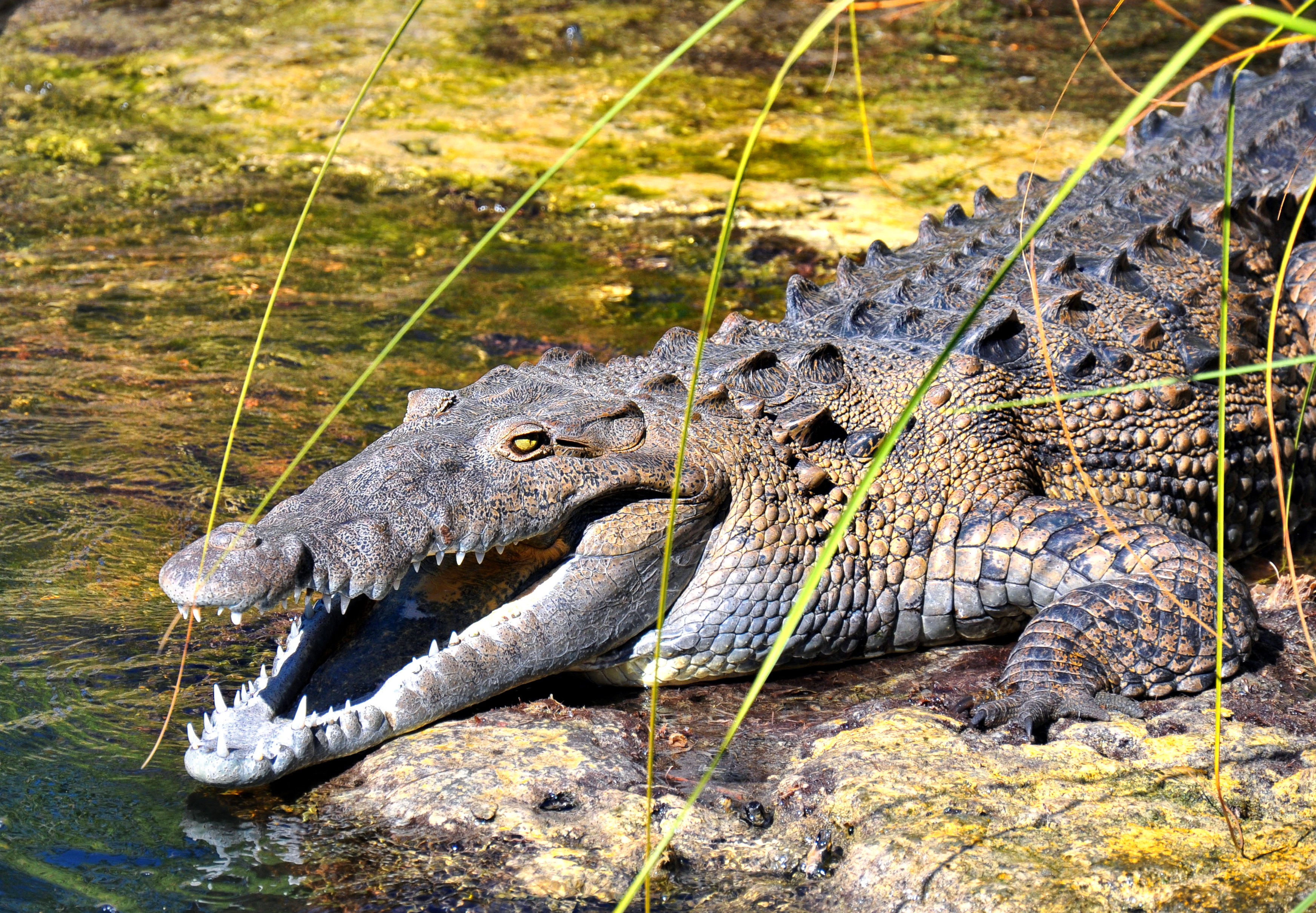
The American crocodile (Crocodylus acutus) is a species of crocodilian found in the Neotropics. It is the most widespread of the four extant species of crocodiles from the Americas, with populations present from South Florida, the Caribbean islands of Cuba, Jamaica, and Hispaniola, and the coasts of Mexico to as far south as Peru, Ecuador, Colombia, and Venezuela.
The habitat of the American crocodile consists largely of coastal areas. It is also found in river systems, but tends to prefer salinity, resulting in the species congregating in brackish lakes, mangrove swamps, lagoons, cays, and small islands. Other crocodiles also have tolerance to saltwater due to salt glands underneath the tongue, but the American crocodile is the only species other than the saltwater crocodile to commonly live and thrive in saltwater. They can be found on beaches and small island formations without any freshwater source, such as many cays and islets across the Caribbean. They are also found in hypersaline lakes; one of the largest known populations inhabits Lago Enriquillo in the Dominican Republic.
The American crocodile is one of the largest crocodile species. Males can reach lengths of more than 7 m, weighing over 1000 kg. On average, mature males are more in the range of 2.9 to in length weighing up to about 400 kg. As with other crocodile species, females are smaller, rarely exceeding 3.8 m in length even in the largest-bodied population.
Like any other large crocodilian, the American crocodile is potentially dangerous to humans, but it tends not to be as aggressive as some other species. American crocodiles coexist with the American alligator in Florida, and with the smaller spectacled caiman within Central America and South America. The IUCN lists the American crocodile as vulnerable, and is a federally threatened, flagship species and ecological indicator within the Florida Everglades World Heritage Site.
Taxonomy and etymology
The American crocodile was described by Georges Cuvier in 1807, and became known as the "sharp-snout alligator". In 1822, Constantine Samuel Rafinesque postulated that the species was in fact a crocodile.
The species was redescribed as Crocodylus floridanus by William Temple Hornaday in 1875, when Hornaday and C. E. Jackson were sent to Florida to collect alligator hides. Upon hearing of a "big old gator" in Arch Creek at the head of Biscayne Bay, Hornaday and his companions searched for it and reported:
In a few hours, we got sight of him, out on the bank in a saw-grass wallow. He was a monster for size—a perfect whale of a saurian, gray in color—and by all the powers, he was a genuine crocodile!
Crocodylus floridanus is now considered an invalid junior synonym of C. acutus.
Recent genetic assays indicate that Jamaican populations of the American crocodile may be genetically distinct from the sympatric Cuban crocodile, despite a significant history of hybridization. Further comparative genetic analyses of Caribbean populations of the American and Cuban crocodile indicate that insular populations of Cozumel and Banco Chinchorro may be genetically distinct species.
Evolution
Until 2020, the evolution of the American crocodile was poorly understood. However, the discovery of the Miocene species Crocodylus checchiai indicates that it, the Orinoco crocodile (Crocodylus intermedius), Morelet's crocodile (C. moreletii), and the Cuban crocodile (C. rhombifer) all share an ancestor hailing from Africa. The newly discovered animal may also represent the base of the evolutionary radiation of these animals, representing the missing link between crocodiles in Africa and the Americas.
The genus Crocodylus likely originated in Africa and radiated outward toward Southeast Asia and the Americas, although an Australia/Asia origin has also been considered. Phylogenetic evidence supports Crocodylus diverging from its closest recent relative, the extinct Voay of Madagascar, around 25 million years ago, near the Oligocene/Miocene boundary. American crocodile populations in Florida, Jamaica and Hispaniola (in the Dominican Republic) differ in gene frequencies. The only confirmed fossil of an American crocodile has been recovered from the Early/Middle Pleistocene Río Tomayate locality of El Salvador, although another find may have been recovered from Florida.
Below is a cladogram based on a 2018 tip dating study by Lee & Yates simultaneously using morphological, molecular (DNA sequencing), and stratigraphic (fossil age) data, as revised by the 2021 Hekkala et al. paleogenomics study using DNA extracted from the extinct Voay.
Characteristics

The American crocodile is a highly fecund species. Average clutch size is 38 eggs, and fecundity is over 20% after 15 years old. The species has a high adult survival rate and a long life span. Like all true crocodilians, the American crocodile is a quadruped, with short, stocky legs; a long, powerful tail; and a scaly hide with rows of ossified scutes running down its back and tail. Due to the crocodile preferring to live in saline environments these scutes can often house epibionts such as ticks, leeches, barnacles, and even sea anemones. Individuals can be identified by using multiple dorsal scute patterns. Its snout is elongated and includes a strong pair of jaws. A 3.2 m, 164 kg specimen had a bite force of 4355 N. Its eyes have nictitating membranes for protection, along with lacrimal glands, which produce tears.
The nostrils, eyes, and ears are situated on the top of its head, so the rest of the body can be concealed underwater for surprise attacks. Camouflage also helps it prey on food. The snout is longer and narrower than that of the American alligator, but broader on average than that of the Orinoco crocodile. American crocodiles are also paler and more grayish than the relatively dark-hued American alligator. This crocodile species normally crawls on its belly, but it can also "high walk". Larger specimens can charge up to nearly 10 mph. They can swim as fast as 20 mph by moving their bodies and tails in a sinuous fashion, but they cannot sustain this speed.
Adults have a uniform grayish-green coloration with white or yellow undersides, while juveniles have dark cross-banding on the tail and back.

Size
New hatchlings are about 27 cm in length and about 60 g in mass. The average adult in the continental rivers can range from 2.9 to long and weigh up to 382 kg in males, while females can range from 2.5 to and weigh up to 173 kg, the lower total length representing their average size at sexual maturity, the upper representing the expected upper size limit for the respective sex in most known populations. Common weights of adult American crocodiles in Florida may range from 50 to with corresponding lengths of 2.5 to. With extensive conservation efforts underway, there appears to be an increase in the number of large American crocodiles in Florida, some of the largest reportedly exceeding 4 m in length. Eight adult American crocodiles from Costa Rica ranged in total length from 2.82 to. Large adults of this species are capable of reaching 500 - in weight, with individuals approaching 6 m exceeding 1000 kg in weight, ranking it among the largest living crocodilians in the Neotropical realm. It is estimated that specimens of C. acutus measuring 3 m in TL would weigh around 100 kg, specimens measuring 4 m in TL would weigh around 270 kg, and specimens measuring 6.25 m in TL would weigh around 1100 kg. However, body mass can be fairly variable in mature adults. A large male specimen from Costa Rica measuring 4.83 m in total length weighed about 538 kg. On the other hand, another specimen measuring 3.95 m in total length was found to have weighed 500 kg An individual named "Papillon" was considered to be one of the largest American crocodiles in captivity. It measured 4.3 m in length, weighed 500 kg, and was estimated to be more than 80 years old when he died. The largest recorded female measured 4.4 m in length and weighed 450 kg. Exceptionally large specimens may arguably exceed 5 m, possibly reaching or exceeding 6.1 m, but such specimens are unverified and possibly dubious although some are arguably supported by size projections from skull lengths. These exceptionally large crocodiles are estimated to range between 6 and in length and weigh between 900 and, though these are mere estimations and not verified.

Distribution and habitat

The American crocodile is the most widespread of the four extant species of crocodiles from the Americas. They are saltwater-tolerant, and have thus been capable of colonizing a multitude of islands within the Caribbean, and on some coastal Pacific islands as well making it the most widely distributed New World crocodile. the Greater Antilles (excluding Puerto Rico and Isla de la Juventud, where they are replaced by the introduced spectacled caiman), Martinique, southern Mexico (including the Yucatán Peninsula), Central America, and the South American countries of Colombia, Peru, Venezuela (including on Margarita Island), and Ecuador. The American crocodile is especially plentiful in Costa Rica.
American crocodiles coexist with the American alligator in Florida and the spectacled caiman within Central America. The only other crocodiles present within the American crocodile's range are the Morelet's crocodile, and the critically endangered Cuban and Orinoco crocodiles. Recent morphological and genetic analyses have demonstrated hybridization with Cuban crocodiles among American crocodiles of the Yucatan.
Caribbean
One of its largest documented populations (the largest in the Caribbean) is in Lago Enriquillo, a hypersaline lake in the Dominican Republic. In Haiti, the only population known is in the brackish lake Etang Saumâtre, where the population is nearing extirpation due to overhunting and poaching. In Jamaica, the species inhabits most of the swamps available, as well as brackish portions of rivers. American crocodiles have recently been sighted in Grand Cayman, leading experts to believe the species may be swimming from Cuba (which is home to a large American crocodile population) and slowly repopulating Grand Cayman. There have been reports of American crocodiles in Trinidad, however, those sightings are thought to have arisen due to the accidental translocation of the animal outside of its normal range. The species is thus not considered indigenous to Trinidad. Due to changing climate, which increases the frequency of hurricanes and cyclones in the Caribbean, American Crocodiles are reported to have decreased body condition. This is most likely due to the changes on the areas salinity, temperature and prey availability which could impede the recovery of these populations.
Florida
The American crocodile's saline tolerance may have allowed it to inhabit limited portions of the United States, particularly southern Florida. Contrary to popular misinformation, the presence of the American alligator is not the reason the American crocodile was unable to populate brackish waters north of Florida, but rather the climate, as crocodiles are less tolerant of cold. They are primarily found south of the latitude of Miami, in Everglades National Park, Florida Bay, Biscayne Bay, Dry Tortugas National Park and the Florida Keys. A sizable population occurs near Homestead, at the Turkey Point Nuclear Generating Station. Some individuals have been sighted in Palm Beach, Brevard, Pinellas and Sarasota counties. Their range in Florida is the only place in the world where alligators and crocodiles coexist.
The current US population, estimated at 2,000 and growing, is a sign of return to the northernmost portion of their range. There were suspicions as early as 1829 by Rafinesque that there were more than just alligators in the state, but confirmation could not be acquired until 1869, when a specimen could be brought back for examination. Records show they were plentiful in areas like Key Largo, Miami Beach, and wherever there were the appropriate mangroves for nesting and foraging. However, at the end of the 19th century, hunting them for their leather became a cottage industry in South Florida, and beginning in 1910, habitat destruction commenced on a massive scale, with the construction of a railroad designed to connect the mainland with the Keys. Crocodile hunters, who migrated to the upper Florida Keys before and after the railroad's construction, slaughtered almost every crocodile in northeast Florida Bay for the commercial market. The widespread hunting did not cease until the 1970s: at one point in that decade, there were fewer than thirty total nests counted. As of 2020, further population seems to be expanding south to reclaim former habitat in the Florida Keys, where numbers are multiplying quickly, and old records indicate they once inhabited mangroves as far north as Tampa Bay.
Biology and behavior
American crocodiles are more susceptible to cold weather than American alligators.{{cite journal

Cleaning symbiosis involving fish and the American crocodile has been described.
Hunting and diet

American crocodiles are apex predators, and any aquatic or terrestrial animal they encounter in freshwater, riparian and coastal saltwater habitats is potential prey.
The snout of the American crocodile is broader than some specialized fish-eating crocodilians (e.g., gharials and freshwater crocodiles), allowing it to supplement its diet with a wider variety of prey. In addition the snout gets even broader and bulkier as the animal matures, a sign for a shift in prey items. Prey species have ranged in size from the insects taken by young American crocodiles to full-grown cattle taken by large adults, and can include various birds, mammals, turtles, snakes, lizards, smaller crocodilians, echinoderms, insects, arachnids, crabs, other crustaceans, snails, other molluscs, frogs, fish, and occasionally carrion and fruits. In Haiti, hatchling and juvenile American crocodiles lived primarily off of fiddler crabs (Uca ssp.), making up 33.8% and 62.3% of the diet by weight, respectively. Elsewhere, aquatic insects and their larvae and snails are near the top of the food list for American crocodiles at this very early age. Immature and subadult American crocodiles, per a study in Mexico, have a more diverse diet that can include insects, fish, frogs, small turtles, birds and small mammals. One specimen of 1.2 m had a catfish, a mourning dove and a bare-tailed woolly opossum in its stomach.
In Florida, bass, tarpon and especially mullet, large crabs, snakes, mammals that habit the riparian and coastal regions of the Everglades, such as opossums and raccoons appeared to be the primary prey of American crocodiles. In Southern Florida, it was found that American Crocodiles rely on marine food sources 65% of the time and rely on water gleaned from marine food 80% of the time. In Haiti, adults appeared to live largely off of various birds, including herons, storks, flamingos, pelicans, grebes, coots and moorhens, followed by concentrations of fish including Tilapia and Cichlasoma, at times being seen to capture turtles, dogs and goats. One 3 m adult from Honduras had stomach contents consisting of a 1.5 m crocodile of its own species, a turtle shell and peccary hooves. It was noted that historically in Mexico that, among several local farmers, the capturing of livestock by American crocodiles has been a source of some conflict between humans and American crocodiles and large adults occasionally can become habitual predators of goats, dogs, pigs and cattle. In Quintana Roo, Mexico, most prey that could be determined was fish for sub-adults and adults with sub-adults having a broader prey base than either younger or adult American crocodiles. In Costa Rica, American crocodiles have been recorded hunting and killing adult female olive ridley sea turtles (Lepidochelys olivacea) when they come to nest around beaches. Reportedly, these American crocodiles hunt primarily in the first few hours after nightfall, especially on moonless nights, although they will feed at any time. It hunts in the typical way for most crocodilians, ambushing terrestrial prey when it comes to edge of the water or is sitting in shallows and dragging it down to be drowned or attempting to ambush aquatic prey from near the surface of the water.
Interspecies predatory relations
Adult American crocodiles are apex predators; they have no natural predators. They are known predators of lemon sharks, and sharks avoid areas with American crocodiles.
,_EVER,_NPSPhoto,_SCotrell,_4-2011_(9255694189).jpg)
Usually, American alligators are dominant over and more behaviorally aggressive than American crocodiles. However, on one occasion, an American crocodile in a Florida zoo escaped its cage and started a fight with a large male American alligator in a bordering pen, and was killed. Conversely, there is one confirmed case of an American crocodile preying on a sub-adult American alligator in the wild in Florida. American alligators and American crocodiles do not often come into conflict in the wild, due largely to habitat partitioning and largely separate distributions.
There are several records of American crocodiles killing and eating spectacled caimans in South America. Areas with healthy American crocodile populations often hold only limited numbers of spectacled caimans, while conversely areas that formerly held American crocodiles but where they are now heavily depleted or are locally extinct show a growth of caiman numbers, due to less competition as well as predation. In areas of Cuba where the two species coexist, the smaller but more aggressive Cuban crocodile is behaviorally dominant over the larger American crocodile. In Mexico, some Morelet's crocodile individuals have escaped from captivity, establishing feral populations and creating a problem for the populations of American crocodile, which must compete with this invasive species.
Reproduction
American crocodiles breed in late fall or early winter, engaging in drawn-out mating ceremonies in which males emit low-frequency bellows to attract females. Body size is more important than age in determining reproductive capabilities, and females reach sexual maturity at a length of about 2.8 m. In February or March, gravid females will begin to create nests of sand, mud, and dead vegetation along the water's edge. Mounds are often built in areas such as well-drained beaches and abandoned canal levees. Nest location is crucial, and with the correct amount of vegetation, the eggs will develop within a small temperature range. Because sex determination is temperature-dependent in crocodilians, slight aberrations in temperature may result in all-male or all-female clutches, which would possibly harm the health of the population. About one month later, when it is time to lay, the female will dig a wide hole diagonally into the side of the nest and lay 30 to 70 eggs in it, depending on her size. Females will maintain and reuse these holes for many years. After laying, the female may cover the eggs with debris or leave them uncovered. The white, elongated eggs are 8 cm long and 5 cm wide, with a number of pores in the brittle shell.
During the 75- to 80-day incubation period, the parents will guard the nest, often inhabiting a hole in the bank nearby. Females especially have been known to guard their nests with ferocity. But in spite of these precautions, American crocodile eggs sometimes fall prey to raccoons in Florida, Belize and Costa Rica (arguably the most virulent natural predator of crocodilian nests in the Americas), white-nosed coatis in Costa Rica, foxes, skunks (Conepatus, Mephitis and Spilogale spp.) in Mexico or other scavenging mammals (including coyotes in Mexico and American black bears in southern Florida), as well as red imported fire ants in Florida, crabs (Atlantic blue crabs in Florida and great land crabs in Mexico) and vultures (turkey vultures in Florida and black vultures in Panama). In Panama, green iguanas were seen to dig up and prey on American crocodile eggs occasionally, although in several cases were caught by the mother American crocodile and eaten. Crocodilian eggs are somewhat brittle, but softer than bird eggs. Despite noticeable nest guarding during egg incubation, guarding of young after hatching seems to be minimal in this species.

This species exists mostly in tropical areas with distinct rainy seasons, and the young hatch near the time of the first rains of the summer (July–August) after the preceding dry season, and before the bodies of water where they live flood. In this stage of development of their young, mother American crocodiles exhibit a unique mode of parental care. During the hatching process, when the young American crocodiles are most vulnerable to predation, they will instinctively call out in soft, grunt-like croaks. These sounds trigger the female to attend to the nest, uncovering the eggs if they have been covered. Then she will aid the hatchlings in escaping their eggs and scoop them up with her mouth, carrying them to the closest water source.
The hatchlings, which are 24 to in length, have been reported to actively hunt prey within a few days of hatching. It is not uncommon for the mother to care for her young even weeks after they have hatched, remaining attentive to their calls and continuing to provide transportation. About five weeks after hatching, the young American crocodiles disband in search of their own independent lives. On average only 16% of hatchlings will make it to adulthood, with most falling prey to several types of raptorial birds, other reptiles, and large fishes (e.g., roadside hawks in Mexico, laughing falcons in Mexico, barred catfish in Colombia, Atlantic tarpons in Florida, common snook in Florida, lemon sharks in Florida, boa constrictors in Belize, black spiny-tailed iguanas in Costa Rica, and spectacled caimans in Venezuela). Those that do survive grow rapidly, feeding on insects, fish and frogs. Additionally, some young American crocodiles feed on each other.
In Florida, American crocodiles may be eaten by some growth stage of invasive snakes such as Burmese pythons, reticulated pythons, Southern African rock pythons, Central African rock pythons, boa constrictors, yellow anacondas, Bolivian anacondas, dark-spotted anacondas, and green anacondas.
Facultative parthenogenesis
Facultative parthenogenesis has been shown to occur in C. acutus based on data from whole genome sequencing. The evidence supports a particular mechanism of parthenogenesis, terminal fusion automixis during meiosis.
Conservation status

The International Union for Conservation of Nature (IUCN) lists the species as vulnerable. On March 20, 2007, the United States Fish and Wildlife Service declassified the American crocodile as an endangered species, changing its status to "threatened". It remains protected from poaching and killing under the federal Endangered Species Act. NatureServe considers the Florida population "Imperiled".
Because of hide hunting, pollution, loss of habitat, and commercial farming, the American crocodile is endangered in parts of its range. Within habitats across Florida and Biscayne Bays, the construction of canal networks has also impacted American crocodiles by reducing freshwater flow and thus increasing the duration and frequency of hypersalinity events. In southern Florida, about two-thirds of American crocodile deaths are attributed to road collisions, about 10% to intentional killing, and only about 5% to natural causes. In recent years in Jamaica there has been rampant poaching of the species for their meat and there has been a significant population drop compounded by the lack of action by the government. On Hispaniola, they were once found throughout the island, but currently, the only confirmed remaining presence is at the two largest lakes on the island: Etang Saumâtre in Haiti, and Lago Enriquillo in the Dominican Republic.
An estimated 1,000 to 2,000 American crocodiles live in Mexico, Central America and South America, but population data is limited. An additional 500 to 1,200 are believed to live in southern Florida. It is estimated that the population of mature individuals as of 2020 is around 5,000.
Relationship with humans
,_NPSPhoto_(9258471158).jpg)
Attacks by American crocodiles have been reported in Mexico, Costa Rica, and Panama. The American crocodile rates somewhere in the middle of all crocodilians temperamentally. The species usually does not attack people as regularly as Old World crocodiles do; the estimated number of attacks is considerably smaller than those by the saltwater (C. porosus) and Nile crocodiles (C. niloticus), which are considered the most aggressive crocodilians towards humans. Particular to this species, it is noted for having a shy demeanor and clearly does not want anything to do with humans; it will not stand its ground and will flee humans at the very sight of them. The Cuban crocodile (C. rhombifer) is rather more aggressive in interspecies interactions than the American crocodile and attacks and displaces American crocodiles when they are kept in mixed species enclosures at zoos or at crocodile farms together, despite being smaller than the American species. However, attacks on humans are rarely reported in Cuban crocodiles, due to its much more limited habitat and range.
In May 2007, two instances occurred within one week of children being attacked and killed by American crocodiles—one in Mexico just south of Puerto Vallarta and one in Costa Rica. On August 24, 2014, a man and a woman were swimming in a canal in Gables by the Sea, a community in Coral Gables, Florida, at 02:00, a canal where crocodiles were known to occur, when they were bitten in the shoulder and the hand by an American crocodile. Although the crocodile was 12 ft in length, and weighed an estimated 550 lb, it did not press the attack, but released and moved away from its victims. (Florida Fish & Wildlife Conservation Commission, Crocodile Response Program) This was the first documented wild crocodile attack on humans in Florida since records of human-crocodile conflict have been kept. There have reportedly been 36 American crocodile attacks on humans from 1995 to 2017 in the Cancun area of southeastern Mexico.
Notes
References
References
- (6 September 2021). "Phylogenetic analysis of a new morphological dataset elucidates the evolutionary history of Crocodylia and resolves the long-standing gharial problem". [[PeerJ]].
- (2022). "''Crocodylus acutus''".
- "Appendices". CITES.
- Thorbjarnarson, John. (1989). "Crocodiles: their ecology, management, and conservation". International Union for Conservation of Nature and Natural Resources.
- "American Crocodile". People.wcsu.edu.
- Ellis, T. M.. (1981). "Tolerance of sea water by the American crocodile, ''Crocodylus acutus''". Journal of Herpetology.
- (2013-04-15). "American Crocodiles, American Crocodile Pictures, American Crocodile Facts — National Geographic". Animals.nationalgeographic.com.
- (August 2002). "The Amphibians and Reptiles of Costa Rica: A Herpetofauna Between Two Continents, Between Two Seas". University of Chicago Press.
- (2016). "Peterson Field Guide to Reptiles and Amphibians of Eastern and Central North America". HarperCollins.
- "ANIMAL BYTES — American Crocodile". Seaworld.org.
- "WEC 38/UW157: American Crocodiles (''Crocodylus acutus'') in Florida". Edis.ifas.ufl.edu.
- "Crocodilian Species — American Crocodile (''Crocodylus acutus'')". Crocodilian.com.
- (2021-05-19). "American crocodiles (Crocodylus acutus) as restoration bioindicators in the Florida Everglades". PLOS ONE.
- {{ITIS
- "Crocodylus acutus (American crocodile)".
- Levin, Ted. (2004). "Liquid Land: A Journey Through the Florida Everglades". [[University of Georgia Press]].
- Hornaday, William T.. (1875). "The crocodile in Florida". The American Naturalist.
- (July–August 2001). "A New Day Dawns in the Everglades". Audubon Magazine.
- Hornaday, William T.. (1925). "A Wild-animal Round-up". C. Scribner's Sons.
- {{ITIS
- (15 October 1933). "Crocodilian Nomenclature". Copeia.
- (2020-07-02). "High levels of population genetic differentiation in the American crocodile (Crocodylus acutus)". PLOS ONE.
- (2025-06-01). "Novel island species elucidate a species complex of Neotropical crocodiles". Molecular Phylogenetics and Evolution.
- (23 July 2020). "Old African fossils provide new evidence for the origin of the American crocodiles". Scientific Reports.
- Oaks, Jamie R.. (2011). "A time-calibrated species tree of Crocodylia reveals a recent radiation of the true crocodiles". Evolution.
- (2021-04-27). "Paleogenomics illuminates the evolutionary history of the extinct Holocene "horned" crocodile of Madagascar, Voay robustus". Communications Biology.
- (1991). "Genetic Variation in Populations of the American Crocodile". Journal of Herpetology.
- Cisneros, Juan Carlos. (2005). "New Pleistocene Vertebrate Fauna from El Salvador". Revista Brasileira de Paleontologia.
- Michael S. Y. Lee. (27 June 2018). "Tip-dating and homoplasy: reconciling the shallow molecular divergences of modern gharials with their long fossil". [[Proceedings of the Royal Society B]].
- (2017). "Life histories and conservation of long-lived reptiles, an illustration with the American crocodile (''Crocodylus acutus'')". Journal of Animal Ecology.
- Guggisberg, C. A. W.. (1972). "Crocodiles: Their Natural History, Folklore, and Conservation". [[David & Charles]].
- (March 2016). "Epibiont sea anemones inhabiting the American crocodile Crocodylus acutus". Marine Biodiversity.
- (2017). "Scute Patterns as an Individual Identification Tool in an American Crocodile (''Crocodylus acutus'') Population on Coiba Island, Panama". Journal of Herpetology.
- Erickson, G. M.. (2012). "Insights into the ecology and evolutionary success of crocodilians revealed through bite-force and tooth-pressure experimentation". PLOS ONE.
- (1993). "Fauna of Australia". Australian Government Publishing Service.
- (August 2005). "Living with Alligators: A Florida Reality". UF/IFAS Extension Service.
- "American Crocodile". [[Miami Science Museum]].
- (1998). "Reptiles and Amphibians Eastern-Central North America". [[Houghton Mifflin]].
- (2005). "The Amphibians and Reptiles of Costa Rica: A Herpetofauna between Two Continents, between Two Seas". [[University of Chicago Press]].
- "American Crocodile". [[National Geographic Society]].
- Thorbjarnarson, J.B.. (1986). "Crocodiles: Proceedings of the 7th Working Meeting of the Crocodile Specialist Group of the Species Survival Commission of the International Union for Conservation of Nature and Natural Resources, Caracas, Venezuela, 21 to 28 October 1984". IUCN.
- (2009). "A recent capture of a large American Crocodile (''Crocodylus acutus'') in Florida". Florida Field-Naturalist.
- (April 2011). "Ocular disease in American crocodiles (''Crocodylus acutus'') in Costa Rica". J Wildl Dis.
- (2005). "The amphibians & reptiles of the Bay Islands and Cayos Cochinos, Honduras". Bibliomania!.
- (2010). ""TERRAPENE CAROLINA TRIUNGUIS (Three-toed Box." Herpetological Review, 41(4)". ORNATA, T. O..
- (2017). "The Legendary "Papillon" — An American crocodile (''Crocodylus acutus'') icon for Tabasco State, Mexico". IUCN — Species Survival Commission.
- (2009). "Record size for a female ''Crocodylus acutus'' in the Grijalva River, Chiapas, Mexico". IUCN — Species Survival Commission.
- Wood, Gerald. (1983). "The Guinness Book of Animal Facts and Feats". Guinness Superlatives.
- (2000). "Status and conservation of the American crocodile, ''Crocodylus acutus'', in Belize". Biological Conservation.
- (December 2010). "Herpetological Review".
- Anna. (2020-10-08). "Are There Crocodiles In Florida? What To Do If You Spot One".
- "American crocodile (''Crocodylus acutus'') — Species Profile".
- (12 August 2008). "8 Crocodiles kill man in Mexico". Sindh Today.
- (2020-07-02). "High levels of population genetic differentiation in the American crocodile (Crocodylus acutus)". PLOS ONE.
- (September 2017). "Morphological diversity of the American crocodile (Crocodylus acutus) in the Yucatán Peninsula". Zoomorphology.
- (2025-06-01). "Novel island species elucidate a species complex of Neotropical crocodiles". Molecular Phylogenetics and Evolution.
- "Lago Enriquillo and Lac Azuéi, Dominican Republic and Haiti". Global Nature Fund.
- Ahrenfeldt, Robert H.. (1954-05-05). "Identification of the Amphibia and Reptilia Recorded in Jamaica growing rapidly by Hans Sloane (1688–89)". American Society of Ichthyologists and Herpetologists.
- "Crocodylus acutus (American Crocodile)".
- (2020-10-01). "Major hurricanes affect body condition of American crocodile Crocodylus acutus inhabiting Mexican Caribbean islands". Marine Ecology Progress Series.
- (April 2025}} Within the United States, the American crocodile's distribution is generally limited to the southern tip of Florida, though at least two have been found as far north as the [[Tampa Bay area]].{{cite news). "Trappers catch crocodile in Lake Tarpon". Tampa Bay Times.
- "The American Crocodile: A Story of Recovery". Fort Lauderdale Research and Education Center.
- "Providing a home for the American crocodile". Florida Power & Light.
- Allen, Greg. (21 April 2007). "American Crocodiles Make a Comeback". National Public Radio.
- Pittman, Craig. (August 5, 2013). "Croc found in Lake Tarpon traveled 350 miles from South Florida home". Tampa Bay Times.
- (31 December 2017). "Do alligators and crocodiles exist together anywhere in the world?".
- Krueger, Radha. (2016-10-14). "American Crocodile".
- Charles LeBuff. (2016). "Historical review of American crocodiles (Crocodylus acutus) along the Florida Gulf Coast". Bulletin of the Florida Museum of Natural History.
- (14 October 2016). "American Crocodile".
- "Turning back time: The recovery of the American crocodile • Earth.com".
- (2016). "Spatial Ecology of the American Crocodile in a Tropical Pacific Island in Central America". PLOS ONE.
- "American Crocodile (''Crocodylus acutus'')". Florida Museum of Natural History.
- "Crocodylus acutus (American Crocodile)".
- "''Crocodylus acutus'' (American crocodile)".
- "American Crocodile (''Crocodylus acutus'')".
- (1988). "The Status and Ecology of the American Crocodile in Haiti". Bulletin of the Florida State Museum.
- (1974). "Los Crocodylia de Mexico: estudio comparativo". Instituto Mexicano de Recursos Naturales Renovables.
- "American Crocodile". People.wcsu.edu.
- (2012-02-13). "Estimating marine resource use by the American crocodile ''Crocodylus acutus'' in southern Florida, USA". Marine Ecology Progress Series.
- (1924). "Notes on Central American crocodiles". Field Museum of Natural History.
- (10 December 2008). "Feeding habits of the american crocodile, crocodylus acutus (cuvier, 1807) (reptilia: crocodylidae) in the Southern Coast of Quintana Roo, México". Acta Zoológica Mexicana.
- Ortiz, R. M.. (1997). "Predation upon olive ridley sea turtles (''Lepidochelys olivacea'') by the American crocodile (''Crocodylus acutus'') at Playa Nancite, Costa Rica". Chelonian Conservation and Biology.
- (2001). "The behavior and sensory biology of elasmobranch fishes: an anthology in memory of Donald Richard Nelson". Springer Netherlands.
- (2012). "Biology of Sharks and Their Relatives". CRC Press.
- (24 April 1978). "Status and Nesting Biology of the American Crocodile, ''Crocodylus acutus'', (Reptilia, Crocodilidae) in Florida". Journal of Herpetology.
- "Cuban Crocodile, ''Crocodylus rhombifer''".
- Hurley, Brigid-Catherine. "''Crocodylus moreletii'' (Morelets Crocodile)".
- Ogden, John C.. (1978). "Status and Nesting Biology of the American Crocodile, Crocodylus acutus, (Reptilia, Crocodilidae) in Florida". Journal of Herpetology.
- (1 December 2013). "The Role of Predation in Shaping Crocodilian Natural History". Herpetological Monographs.
- (31 October 1981). "Interactions between Nesting Crocodiles and Iguanas". Journal of Herpetology.
- (2000-08-01). "Nesting Ecology of the American Crocodile in the Coastal Zone of Belize". Copeia.
- (2017). "Life histories and conservation of long-lived reptiles, an illustration with the American crocodile (Crocodylus acutus)". Journal of Animal Ecology.
- (January 2012). "Final Environmental Assessment For The Large Constrictor Snakes Listed As Injurious Wildlife under the Lacey Act". U.S. Fish and Wildlife Service.
- (June 2023). "Discovery of facultative parthenogenesis in a new world crocodile". Biol Lett.
- (21 March 2007). "U.S. Crocodiles Shed "Endangered" Status". [[National Geographic Society]].
- (21 March 2007). "American croc no longer listed as endangered". NBC News.
- "NatureServe Explorer 2.0".
- (September 2008). "American crocodile, ''Crocodylus acutus'', mortalities in southern Florida". Florida Field Naturalist.
- (14 June 2016). "The 'Croc Whisperer' Saving Jamaica's Crocodiles One at a Time".
- "Crocodilian Species — American Crocodile (''Crocodylus acutus'')".
- "American Crocodile (''Crocodylus acutus'')". National Parks Conservation Association.
- (2012). "Crocodiles. Proceedings of the 21st Working Meeting of the Crocodile Specialist Group, Manila, Philippines". IUCN.
- (10 September 2010). "American Crocodile".
- "American Crocodile: Species Profile — Everglades National Park (U.S. National Park Service)".
- (3 May 2007). "Boy killed in crocodile attack in Mexico". NBC News.
- (5 May 2007). "Crocodile makes off with boy". Television New Zealand.
- D'Oench, Peter. (2014-08-25). "Gables Croc Attack, First Time In Florida « CBS Miami". Miami.cbslocal.com.
- (July 4, 2017). "American tourist urinating in Cancun lagoon loses arm to crocodile attack". [[New York Daily News]].
This article was imported from Wikipedia and is available under the Creative Commons Attribution-ShareAlike 4.0 License. Content has been adapted to SurfDoc format. Original contributors can be found on the article history page.
Ask Mako anything about American crocodile — get instant answers, deeper analysis, and related topics.
Research with MakoFree with your Surf account
Create a free account to save articles, ask Mako questions, and organize your research.
Sign up freeThis content may have been generated or modified by AI. CloudSurf Software LLC is not responsible for the accuracy, completeness, or reliability of AI-generated content. Always verify important information from primary sources.
Report