From Surf Wiki (app.surf) — the open knowledge base
Amastrianum
Public square in Constantinople
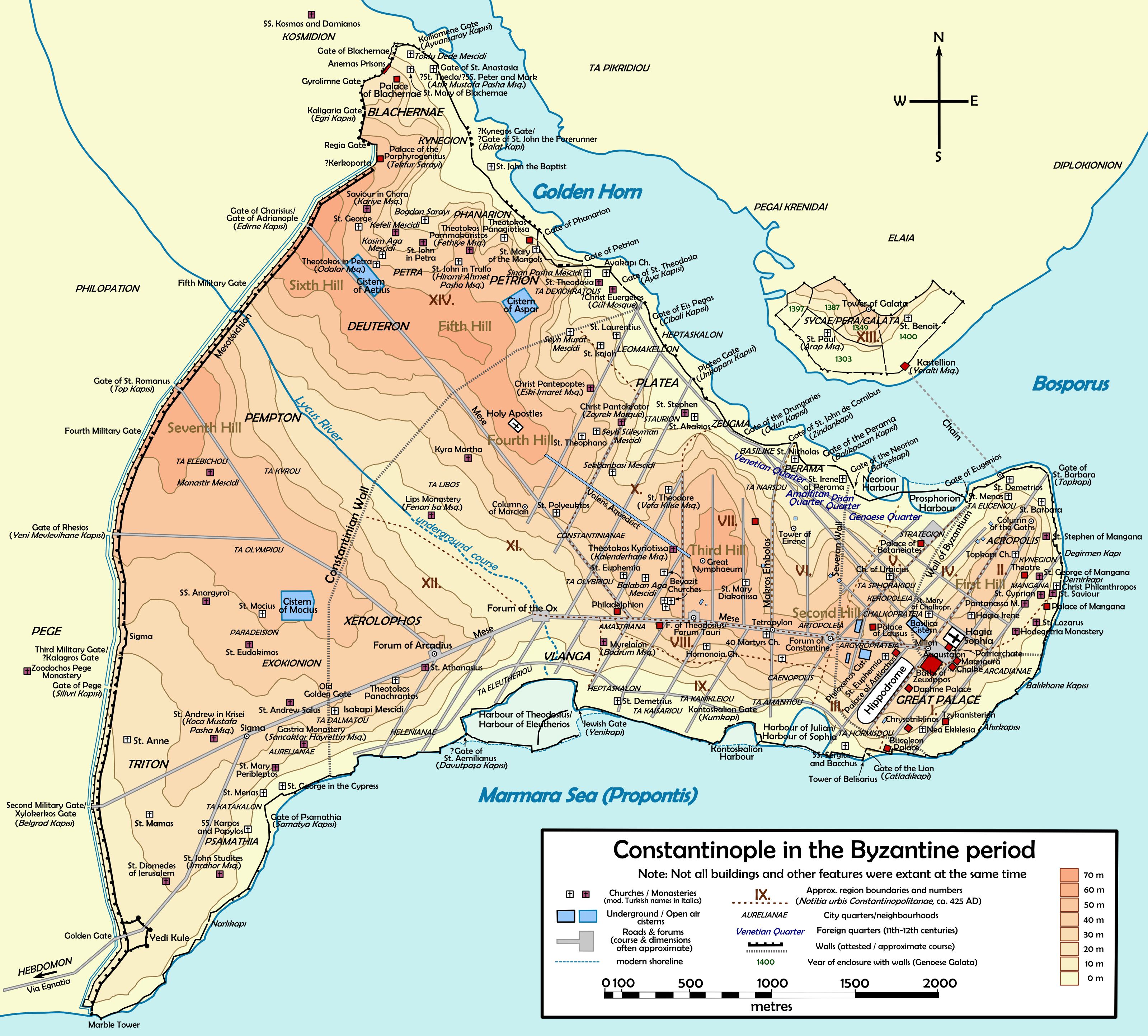
Public square in Constantinople
The Amastrianum (, ), also called Forum Amastrianum by modern authors, was a public square () in the city of Constantinople (today's Istanbul). Used also as place for public mutilations and executions, it disappeared completely after the end of the Byzantine Empire.
Location
The precise location of the square is unknown: in the work De Ceremoniis, written by Emperor Constantine VII Porphyrogenitus (reigned 913–959), the square was located along the southern branch of the Mese odós (the main street of the city), between the Philadelphion and the Forum Bovis, both stations of imperial processions coming from the Great Palace and heading to the western part of the city. Because of that, the Amastrianum should have lain in the valley of the Lycus creek, between the seventh and the third hills of Constantinople, at midway between the modern neighbourhoods of Şehzadebaşı and Aksaray. the square lay in a plain zone on the southern slope of the fourth hill of Constantinople, more or less where the modern roads Atatürk Caddesi and Şehzadebaşı Caddesi cross each other.
History
No Byzantine source defines directly the Amastrianum as a forum, but from the context it is clear that it was a public square. Its name derived from the city of Amastris (modern Amasra) in Paphlagonia (a region on the Black Sea coast of north central Anatolia), either because someone from that city who had come to Constantinople for business was killed here, or because it was a place of execution for delinquents, and the Paphlagonians had a reputation for being criminals.
Architecture
_01.jpg)
The forum is supposed to have had a rectangular plan. It was adorned with several pagan statues: among them, one of Zeus as Helios and one of a sleeping Heracles. Moreover, groups of turtles and birds, and 16 statues of drakes adorned the place. The square was delimited by a marble fence whose small columns were adorned with the crescent. The strange ornaments, together with its usage as execution place, spread among the populace the belief that the Amastrianum was inhabited by devils.
According to the Parastaseis syntomoi chronikai (a Byzantine Guide of the city written in the 8th or 9th century), in the square lay also the edifice named Modius (, pr. "Modion"). This landmark, built in front of the house of a certain Krateros, had a central plan with columns bearing a vault topped by a pyramid. The Modius had been erected by Emperor Valentinian I (r. 364–375), who introduced this standard to Constantinople. A statue of him carrying a modius lay under the monument's vault. Over the years the original meaning of the bronze hands was forgotten and the place was actually used to punish criminals, often through mutilation.
The square's proposed locations have not yet been excavated.
Notes
Sources
- {{cite book
- {{cite book
References
- Janin (1964), p. 69
- According to another source,Mamboury (1953, p. 73
- Administratively, it was included in the ninth ''Regio'' of the city.Mamboury (1953, p. 67
- Janin (1964), p. 68
- iconoclast]] emperor [[Constantine V. Constantine V Kopronymos]] (r. 741–775), and [[Basil the Macedonian]] (r. 867–886) burned the slaves responsible of having killed their master. In 932, [[Romanos I Lekapenos]] (r. 920–944) let burn at the stake here [[Basil the Copper Hand]], who assumed the identity of the usurper [[Constantine Doukas (usurper)
- Janin (1964), p. 104
- The building hosted a silver exemplar of the ''[[Ancient Roman units of measurement#Dry_measure. modius]]'', the [[Ancient_Roman_units_of_measurement#Dry measure. largest Roman dry measure unit]] and was used above all in the [[cereals]] trade. The exemplar on display was supposed to represent the [[Standard (metrology). horrea]] complexes related to the public grain supply from Egypt, the [[Cura Annonae. a''nnona'']]. These were the {{Langx. la. Horrea Alexandrina. la. Horrea Theodosiana
This article was imported from Wikipedia and is available under the Creative Commons Attribution-ShareAlike 4.0 License. Content has been adapted to SurfDoc format. Original contributors can be found on the article history page.
Ask Mako anything about Amastrianum — get instant answers, deeper analysis, and related topics.
Research with MakoFree with your Surf account
Create a free account to save articles, ask Mako questions, and organize your research.
Sign up freeThis content may have been generated or modified by AI. CloudSurf Software LLC is not responsible for the accuracy, completeness, or reliability of AI-generated content. Always verify important information from primary sources.
Report