From Surf Wiki (app.surf) — the open knowledge base
Althaea (mythology)
Character in Greek mythology
Character in Greek mythology
| Field | Value |
|---|---|
| type | Greek |
| image | Side Relief from Urban Sarcophagus 02 (49346506631).jpg |
| caption | Althaea kills Meleager, side relief on a Roman marble sarcophagus, 2nd century. |
| deity_of | Queen of Calydon |
| abode | Aetolia, Calydon |
| spouse | Oeneus |
| siblings | Leda, Plexippus, Toxeus, Hypermnestra, Evippus, Iphiclus, and Eurypylus |
| father | Thestius |
| mother | Leucippe or Eurythemis |
| children | Meleager, Deianira, Toxeus, Melanippe, Eurymede, Thyreus, Pheres, Clymenus, Agelaus, Periphas, and Gorge |
In Greek mythology, Althaea (; from ἀλθαίνω althaino, "to cure", also "a kind of mallow"), also rendered Althea or Althaia, was queen of Calydon through her marriage to King Oeneus. Althaea appears in myths surrounding the fabled Calydonian boar hunt, and is infamous for murdering her son Meleager.
Family
Althaea was the daughter of King Thestius of Aetolia, son of Ares. She was therefore a Pleuronian princess. Her mother may have been Leucippe or Eurythemis, daughter of Cleoboea. She had two sisters: Leda and Hypermnestra, and four brothers: Iphiclus, Plexippus, Eurypylus, and Evippus. Toxeus has also been named as Althaea's brother. Through her sister Leda, Althaea was the aunt of Helen of Troy, Clytemnestra, and Castor and Pollux.
Althaea married Oeneus, king of Calydon. Together they had sons Meleager, Toxeus, Thyreus, Pheres, Clymenus, Agelaus, Periphas and daughters Deianeira, Gorge, Melanippe and Eurymede. According to some accounts, Meleager was the result of a liaison with Ares and Ancaeus was named as her son by the god Poseidon. Likewise, Deianeira was sometimes described as the daughter of Dionysus; Hyginus wrote that the affair was carried out with Oeneus' permission and knowledge, and as a reward, Dionysus taught him how to cultivate grapes.
Mythology
Seven days after Althaea gave birth to Meleager, the Moirai Clotho, Lachesis, and Atropos appeared to her. They told Althaea that her son's life was bound to that of a log (brand) burning in the family hearth; he would only live as long as the brand was unconsumed by fire. Althaea removed the brand from the hearth and buried it in the palace or placed it in a chest.
Meleager grew to be a noble prince, well-respected by his peers. One spring, when Oeneus was sacrificing the first fruits of the season to the gods, he accidentally omitted Artemis, goddess of the hunt. Enraged by the slight, Artemis unleashed a massive, ferocious boar on Calydon. The animal rampaged across the countryside destroying crops, killing any person it came across, and forcing people to take shelter within the city walls. Oeneus gathered together a group of warriors to kill the boar, including Meleager, the famous huntress Atalanta, and a few of Althaea's brothers, potentially Plexippus and Toxeus. Meleager dealt the killing strike to the boar, but gave the skin to Atalanta both because he had fallen in love with her and because she had landed the first and many subsequent blows onto the animal. However, Meleager's uncles were outraged that Meleager would give the prize to a woman and non-family member. They forcefully took the skin from Atalanta, and Meleager retaliated by killing them both.
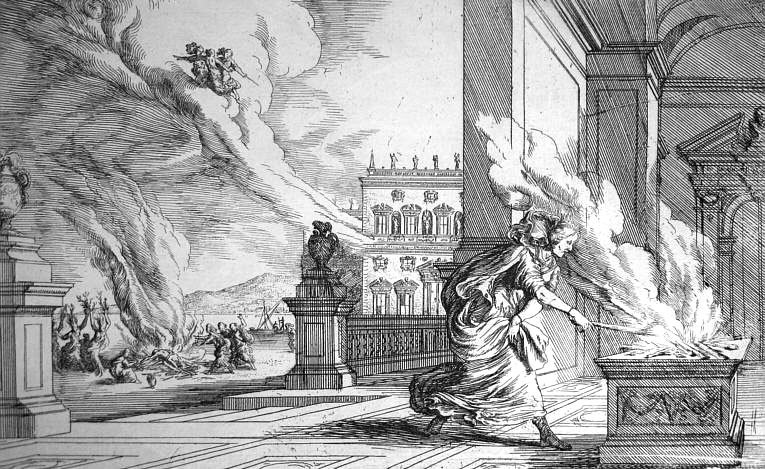
When Althaea learned what had happened, she was distraught and enraged. She took the brand from where she had concealed it and threw it onto the hearth, killing her son. However, she was unable to withstand her grief, and afterwards committed suicide by hanging or stabbing herself. All of Meleager's sisters besides Gorge and Deianira mourned continuously at Meleager's tomb until Artemis transformed them into birds and moved them to the island of Leros, where they were called the Meleagrids.
Alternately, some authors claim that there was no brand. Instead, they write that Althaea killed her son by cursing him; the gods granted her wishes for vengeance and killed him. Additionally, Homer's version of the story in the Iliad differs significantly from other accounts. He writes that a war broke out between the Curetes and the Calydonians after the hunt ended, during which Meleager killed many of Althaea's brothers. Althaea was struck with grief, and prayed to Hades and Persephone for revenge; Meleager then fell in battle, potentially due to the interference of the Erinyes. After his death, Althaea and Meleager's wife Cleopatra hung themselves.
Family tree
Notes
References
- Aeschylus, translated in two volumes. 2. Libation Bearers by Herbert Weir Smyth, Ph. D. Cambridge, MA. Harvard University Press. 1926. Online version at the Perseus Digital Library. Greek text available from the same website.
- Antoninus Liberalis, The Metamorphoses of Antoninus Liberalis translated by Francis Celoria (Routledge 1992). Online version at the Topos Text Project.
- Gaius Julius Hyginus, Fabulae from The Myths of Hyginus translated and edited by Mary Grant. University of Kansas Publications in Humanistic Studies. Online version at the Topos Text Project.
- Hesiod, Catalogue of Women from Homeric Hymns, Epic Cycle, Homerica translated by Evelyn-White, H G. Loeb Classical Library Volume 57. London: William Heinemann, 1914. Online version at theio.com
- Homer, The Iliad with an English Translation by A.T. Murray, Ph.D. in two volumes. Cambridge, MA., Harvard University Press; London, William Heinemann, Ltd. 1924. Online version at the Perseus Digital Library.
- Homer, Homeri Opera in five volumes. Oxford, Oxford University Press. 1920. Greek text available at the Perseus Digital Library.
- Publius Ovidius Naso, Metamorphoses translated by Brookes More (1859–1942). Boston, Cornhill Publishing Co. 1922. Online version at the Perseus Digital Library.
- Publius Ovidius Naso, Metamorphoses. Hugo Magnus. Gotha (Germany). Friedr. Andr. Perthes. 1892. Latin text available at the Perseus Digital Library.
- Thomas Bulfinch. Bulfinch's Mythology: The Age of Fable or Stories of Gods and Heroes. 1855 (Chapter XVIII).
References
- (1992). "The Metamorphoses of Antoninus Liberalis: A translation with a commentary". Rootledge.
- Beekes, Robert. (2010). "Etymological Dictionary of Greek".
- [[Apollodorus of Athens. Apollodorus]], ''[[Bibliotheca (Apollodorus)
- [[Antoninus Liberalis]], ''Metamorphoses'', [https://topostext.org/work/216#2 2]
- [[Strabo]], ''[[Geographica
- [[Hyginus (Fabulae). Hyginus]], ''[[Fabulae]]'', [https://topostext.org/work/206#14.3 14.3]
- [[Apollodorus of Athens. Apollodorus]], ''[[Bibliotheca (Apollodorus)
- "George W. Mooney, Commentary on Apollonius: Argonautica, Summary, line 199".
- Schmitz, Leonhard. (1867). "Althaea". [[Little, Brown and Company]].
- [[Ovid]], ''[[Metamorphoses]]'', [https://www.perseus.tufts.edu/hopper/text?doc=Perseus:text:1999.02.0028:book=8:card=260&highlight=toxeus 8.260]; See ''[https://www.perseus.tufts.edu/hopper/text?doc=Perseus:text:1999.04.0061:poem=3&highlight=toxeus Commentary]'' Note 92 on the Oenides
- [[Gaius Julius Hyginus. Hyginus]], ''[[Fabulae]]'', [https://topostext.org/work/206#174 174]
- [[Hesiod]], ''[[Catalogue of Women. Ehoiai]]'' fr. 25.14–17
- [[Gaius Julius Hyginus. Hyginus]], ''[[Fabulae]]'', [https://topostext.org/work/206#171 171]
- [[Gaius Julius Hyginus. Hyginus]], ''[[Fabulae]]'', [https://topostext.org/work/206#14.3 14.3]
- [[Euripides]], ''Cyclops'', [https://www.perseus.tufts.edu/hopper/text?doc=Perseus:text:1999.01.0094:card=1&highlight=althaea#note39 1]; See Note 5
- [[Ovid]], ''[[Metamorphoses]]'', [https://www.perseus.tufts.edu/hopper/text?doc=Perseus%3Atext%3A1999.02.0028%3Abook%3D8%3Acard%3D451 8.451]
- [[Homer]], ''[[Iliad
- [[Bacchylides]], ''Epinicians'', [https://www.perseus.tufts.edu/hopper/text?doc=Perseus%3Atext%3A1999.01.0064%3Abook%3DEp%3Apoem%3D5 5]
- E. M. Cope, ''Commentary on the Rhetoric of Aristotle'', [https://www.perseus.tufts.edu/hopper/text?doc=Perseus:text:1999.04.0080:book=2:chapter=2&highlight=althea 2.2]
- [[Diodorus Siculus]], ''Library'', [https://penelope.uchicago.edu/Thayer/E/Roman/Texts/Diodorus_Siculus/4B*.html#34 4.34.4].
- [[Aeschylus]], ''[[Libation Bearers]],'' [https://www.perseus.tufts.edu/hopper/text?doc=Perseus%3Atext%3A1999.01.0008%3Acard%3D602 602]
- [[Pausanias (geographer)
- [[Homer]], ''[[Iliad]]'', [https://www.perseus.tufts.edu/hopper/text?doc=Hom.%20Il.%209.529&lang=original 9.529]
This article was imported from Wikipedia and is available under the Creative Commons Attribution-ShareAlike 4.0 License. Content has been adapted to SurfDoc format. Original contributors can be found on the article history page.
Ask Mako anything about Althaea (mythology) — get instant answers, deeper analysis, and related topics.
Research with MakoFree with your Surf account
Create a free account to save articles, ask Mako questions, and organize your research.
Sign up freeThis content may have been generated or modified by AI. CloudSurf Software LLC is not responsible for the accuracy, completeness, or reliability of AI-generated content. Always verify important information from primary sources.
Report