From Surf Wiki (app.surf) — the open knowledge base
Altar call
Tradition in some Christian churches
Tradition in some Christian churches
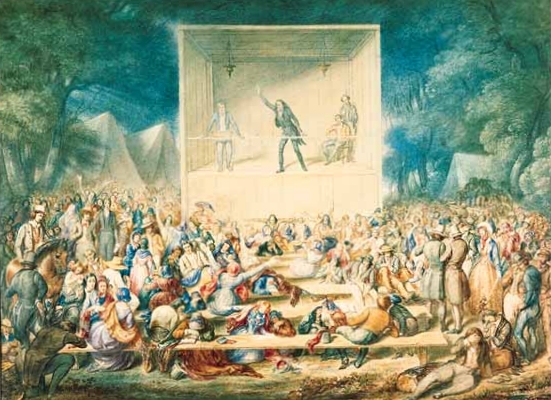
An altar call is a tradition in some Christian churches in which those who wish to make a new spiritual commitment to Jesus Christ are invited to come forward publicly. It is so named because the supplicants gather before the altar located at the front of the church sanctuary; it is common for people to kneel at the chancel rails or mourner's bench that delimits the altar. Most altar calls occur at the conclusion of a sermon or homily.
Background

Altar calls are a recent historic phenomenon beginning in the 1830s in America. During these, people approached the chancel rails, anxious seat, or mourner's bench to pray. One of the most famous 19th-century revivalists, Charles Grandison Finney, "popularized the idea of the 'altar call' in order to sign up his converts for the abolition movement" according to Jim Wallis. In many churches of Wesleyan-Arminian (Methodist) theology, the altar call, in addition to being an invitation for people to experience the new birth, is also often used to implore believers to experience the second work of grace, known as entire sanctification (baptism with the Holy Spirit). Notable examples in history of using altar calls include Billy Sunday, D. L. Moody, and Billy Graham.
The use of altar calls is controversial. Rick Warren notes that the Bible does not refer to any similar practice. Some in the Reformed churches object to the use of the altar call for a variety of reasons. It is argued that the practice is intimidating and therefore creates an unnecessary and artificial barrier to those who would become Christians but are then unwilling to make an immediate public profession under the gaze of an assembly. Others object in that they may mislead people into confusing outward conduct with spiritual change. In doing so, they argue, altar calls may actually give people false assurance about their salvation. In addition, Carey Hardy argues that they change "the essence of the gospel", create believers with false professions of faith, and do not "follow the biblical method for public identification".
References
References
- Anyabwile, Thabiti. (April 29, 2011). "What About Altar Calls?". [[The Gospel Coalition]].
- Hardy, Carey. (February 21, 2005). "Fool's Gold? Discerning Truth in an Age of Error". Crossway Books.
- Wallis, Jim. (January 1981). "The Call to Conversion: Why Faith Is Always Personal but Never Private". [[HarperCollins.
- Balmer, Randall. (November 18, 2005). "Protestantism in America". Columbia University Press.
- Kling, David W.. (2010). "Encyclopedia of the Bible and Its Reception Online". De Gruyter.
- Warren, Rick. "Preaching for Life Change Seminar: International Version".
- Alexander, Paul. "Altar Call Evangelism". 9Marks.
- Hardy, Carey. (February 21, 2005). "Fool's Gold? Discerning Truth in an Age of Error". Crossway Books.
This article was imported from Wikipedia and is available under the Creative Commons Attribution-ShareAlike 4.0 License. Content has been adapted to SurfDoc format. Original contributors can be found on the article history page.
Ask Mako anything about Altar call — get instant answers, deeper analysis, and related topics.
Research with MakoFree with your Surf account
Create a free account to save articles, ask Mako questions, and organize your research.
Sign up freeThis content may have been generated or modified by AI. CloudSurf Software LLC is not responsible for the accuracy, completeness, or reliability of AI-generated content. Always verify important information from primary sources.
Report