From Surf Wiki (app.surf) — the open knowledge base
Altai Krai
First-level administrative division of Russia

First-level administrative division of Russia
| Field | Value | |
|---|---|---|
| en_name | Altai Krai | |
| ru_name | Алтайский край | |
| image_map | Map of Russia (2014–2022) - Altai Krai (Crimea disputed).svg | |
| coordinates | ||
| image_coa | Coat of Arms of Altai Krai (Latest version).svg | |
| image_flag | [[File:Flag of Altai Krai.svg | 130px]] |
| political_status | Krai | |
| political_status_link | Krais of Russia | |
| federal_district | Siberian | |
| economic_region | West Siberian | |
| adm_ctr_type | Administrative center | |
| adm_ctr_name | Barnaul | |
| adm_ctr_ref | ||
| pop_2021census | 2,163,693 | |
| pop_2021census_rank | 22nd | |
| urban_pop_2021census | 58.1% | |
| rural_pop_2021census | 41.9% | |
| pop_2021census_ref | ||
| pop_latest | 2390638 | |
| pop_latest_date | January 2014 | |
| pop_latest_ref | ||
| area_km2 | 167996 | |
| area_km2_rank | 22nd | |
| established_date | September28, 1937 | |
| established_date_ref | ||
| license_plates | 22 | |
| ISO | RU-ALT | |
| leader_title | Governor | |
| leader_title_ref | ||
| leader_name | Viktor Tomenko | |
| legislature | Legislative Assembly | |
| legislature_ref | ||
| website | http://www.altairegion22.ru |
Altai Krai (Алтайский край) is a federal subject of Russia (a krai). It borders, clockwise from the west, Kazakhstan (East Kazakhstan Region, Abai Region and Pavlodar Region), Novosibirsk and Kemerovo, and the Altai Republic. Its administrative centre is the city of Barnaul. As of the 2021 Census, the population of the krai was 2,163,693.
Name
The region is named after the Altai Mountains.
History
Bone fragments of the Denisova hominin originate from the Denisova Cave in Altai Krai.
This area is part of a great crossroads in the ancient world. Nomadic tribes crossed through the territory during periods of migration. These nomadic tribes consisted of different peoples. Archeological sites reveal that ancient humans lived in the area. The Altay people are a Turkic people, some of whom settled here, who were originally nomadic and date back to the 2nd millennium BC.{{cite web |access-date=2006-11-30 | archive-url= https://web.archive.org/web/20061230202239/http://www.waytorussia.net/Features/RussianPeople/2003Sept24/| archive-date=December 30, 2006| url-status= live}}
The territory of the krai has been controlled by the Xiongnu Empire (209 BC–93 AD), the Rouran Khaganate (330–555), the Mongol Empire (1206–1368), the Golden Horde, the Northern Yuan (1368–1691) and the Zunghar Khanate (1634–1758).
After the Russian Revolution and the rise of the Russian Soviet Federative Socialist Republic, the policy of war communism was imposed on the rural population of Altai Krai, destroying the livelihood of many local farmers. In response, the peasant rebellion of Sorokino broke out in 1921; this uprising was quickly crushed by the Red Army. Many locals who had taken part in the rebellion were later put on trial and convicted to hard labor or execution, in accordance with NKVD Order No. 00447 in 1937.
During the interwar period, the Soviet state collectivised the livestock and husbandry activities of the Altai population within Altai Krai, resulting in local resistance to the measures and their subsequent migration, with their herds, to China and Mongolia.
In June 1942 Altai Krai was one of the territories to which the families of men deported from Eastern Europe, in particular "foreigners" and "other ethnicities" such as Kola Norwegians, Lithuanians and Latvians, by Soviet Russia to GULAG hard labor camps.
Geography


Altai Krai has rolling foothills, grasslands, lakes, rivers, and mountains. The highest point of the krai is the 2490 m tall Mayak Shangina.
The climate is severe with long cold dry winters and hot, usually dry summers. The region's main waterway is the Ob River, which gives its name to the Ob Plateau. The Biya and Katun Rivers are also important. The biggest lakes are Lake Kulunda, Lake Kuchuk, Bolshoye Topolnoye, Bolshoye Yarovoye and Lake Mikhaylov.{{cite web |access-date=2006-11-29 |archive-url=https://web.archive.org/web/20061104230423/http://www.kommersant.com/t-82/r_5/n_426/Altai_Territory/| archive-date=November 4, 2006| url-status=live}}
Altai Krai has rich natural resources, including lumber, as well as significant mineral reserves. These include the nonferrous metals lead, manganese, tungsten, molybdenum, bauxite, and gold, as well as iron ore. Forests cover about 60000 km2 of the krai's land. See also Geography of South-Central Siberia.
This region of Siberia is extremely important due to its biodiversity, an area of over 1.6 e6ha is recognised by UNESCO as a World Heritage Site. The area is home to animals considered rare, including the endangered snow leopard.
Administrative divisions
Main article: Administrative divisions of Altai Krai
Heraldry
Flag
The flag of Altai Krai is red, with the leftmost portion blue. The blue portion contains, in golden yellow, a stylized depiction of an upright ear of wheat. Centered in the red field is the coat of arms of the territory. It is derived from the flag of the Russian Soviet Federative Socialist Republic.
Coat of arms
The coat of arms of Altai Krai was established in 2000. It includes a shield of French heraldry form with a basement of 8/10th of its height and a sharp part in the middle of the bottom part. Bottom edges of the shield are rounded. The shield is divided with a horizontal stripe into two equal parts. In the upper part has a blue background, which is a symbol of glory, is a steamy oven of the 18th century, which reflects a historical past of the krai. In the bottom part on the red background, which is a symbol of dignity, braveness and courage, is an image of the Koluvan Queen of Vases mainly in green color, which is kept in the Hermitage Museum. The shield is framed with golden wheat ears which represent agriculture as a main industry of Altai Krai.
Politics
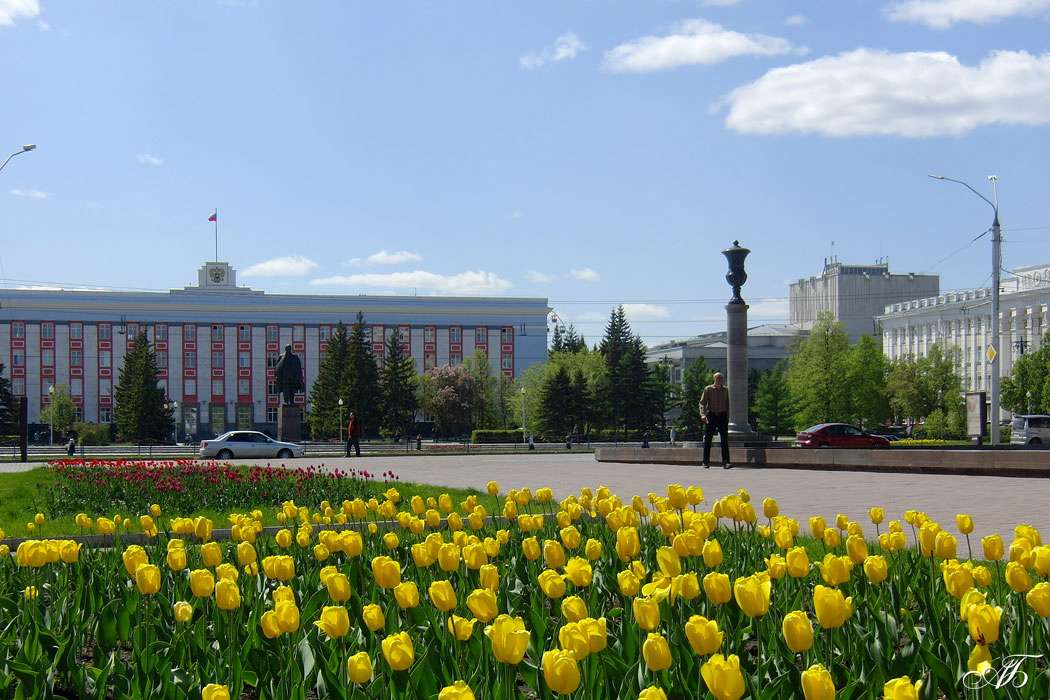
During the Soviet period, the high authority in the krai was shared between three persons: The first secretary of the Altai CPSU Committee (who in reality had the most authority), the chairman of the Krai Soviet (legislative power), and the Chairman of the Krai Executive Committee (executive power). Since 1991, CPSU lost all the power, and the head of the krai administration, and eventually the governor was appointed/elected alongside elected regional parliament.
The Charter of Altai Krai is the fundamental law of the region. The Legislative Assembly of Altai Krai is the regional standing legislative (representative) body. The Legislative Assembly exercises its authority by passing laws, resolutions, and other legal acts and by supervising the implementation and observance of the laws and other legal acts passed by it. The highest executive body is the Krai Government, which includes territorial executive bodies such as district administrations, committees, and commissions that facilitate development and run the day to day matters of the province. The Krai Administration supports the activities of the Governor who is the highest official and acts as guarantor of the observance of the krai Charter in accordance with the Constitution of Russia.
On August7, 2005, the krai's then-head of administration Mikhail Yevdokimov died in a car crash.
In the regional parliament election held in 2016, the United Russia party received 44 seats; the A Just Russia party received 6; the Communist Party and Liberal Democratic Party received 8 each.
In the State Duma of the 7th convocation (2016–2021), Altai Krai is represented by 10 deputies: Nikolai Gerasimenko, Victor Zobnev, Daniil Bessarabov, Oleg Bykov, Valery Yelykomov, Natalya Kuvshinova, Ivan Loor, and Alexander Prokopyev from United Russia; from A Just Russia – Alexander Terentyev; from the Communist Party – Sergey Shargunov. Two representatives of the region work in the Federation Council – Sergey Belousov and Alexander Karlin.
List of chairpersons of the Altai Krai Legislative Assembly
The chairperson of the Altai Krai Legislative Assembly is the presiding officer of that legislature.
Office-holders
| Name | Took office | Left office |
|---|---|---|
| Aleksandr Surikov | 1994 | 1996 |
| Aleksandr Nazarchuk | 1996 | 2008 |
| Ivan Loor | 2008 | 2016 |
| 2016 | present |
Economy
As of 2013 the Krai's largest enterprises were supermarket chain , coke fuel producer Altai-Koks and rolling stock manufacturer Altaivagon. Evalar – a prominent dietary supplement manufacturer – is also located in Altai Krai.
In January 2019, the average wage in Altai Krai was 23,941 RUB, which was an increase of 6.3% over the previous year.
Demographics
Population: |1959 | 2683265 |1970 | 2670261 |1979 | 2674614 |1989 | 2822305 |2002 | 2607426 |2010 | 2419755 |2021 | 2163693 |2025 | 2098979
Ethnic groups
| Ethnicity | Population | Percentage |
|---|---|---|
| Russians | 1,863,686 | 95.5% |
| Germans | 25,361 | 1.3% |
| Ukrainians | 10,614 | 0.5% |
| Kazakhs | 5,586 | 0.3% |
| Tajiks | 5,230 | 0.3% |
| Armenians | 5,100 | 0.3% |
| Other | 36,856 | 1.8% |
| Ethnicity not stated | 211,260 | – |
_2.jpg)
Vital statistics for 2024:
- Births: 15,351 (7.3 per 1,000)
- Deaths: 32,249 (15.3 per 1,000)
Total fertility rate (2024):
1.24 children per woman
Life expectancy (2021):
Total — 68.60 years (male— 64.08, female— 73.10)
Settlements
Religion
According to a 2012 survey 22.6% of the population of Altay Krai adheres to the Russian Orthodox Church, 3% are unaffiliated Christians, 1% are Orthodox Christian believers without belonging to any church or are adherents of other Orthodox churches, 1% are adherents of Islam. In addition, 31% of the population declares to be "spiritual but not religious", 27% is atheist, and 14.4% follows other religions or did not give an answer to the question.
Sister district
- China Xinjiang, China
References
Notes
Sources
- {{Cite Soviet law
- {{cite book
References
- Charter of Altai Krai, Article{{spaces6
- "Оценка численности постоянного населения по субъектам Российской Федерации". [[Federal State Statistics Service (Russia).
- Altai Krai Territorial Branch of the [[Russian Federal State Statistics Service. Federal State Statistics Service]]. [http://akstat.gks.ru/wps/wcm/connect/rosstat_ts/akstat/resources/c313ce8042e6e96f889ded553db9bdfa/%D0%A3%D1%82%D0%B2%D0%B5%D1%80%D0%B6%D0%B4%D0%B5%D0%BD%D0%BD%D0%B0%D1%8F+%D1%87%D0%B8%D1%81%D0%BB%D0%B5%D0%BD%D0%BD%D0%BE%D1%81%D1%82%D1%8C.htm Оценка численности населения на 1 января 2014 года и в среднем за 2013 год] {{Webarchive. link. (October 19, 2015 {{in lang). ru
- Resolution of September{{spaces28, 1937
- Charter of Altai Krai, Article{{spaces79
- Charter of Altai Krai, Article{{spaces67
- Warikoo, K.. (2017). "Eurasia and India: Regional Perspectives". Routledge.
- "Greater Altai{{spaces}}– Altai Krai, Republic of Altai, Tyva (Tuva), and Novosibirsk{{spaces}}— Crossroads".
- History of Mongolia, Volume II, 2003
- Olson, James Stuart. (1998). "An ethnohistorical dictionary of China". Greenwood Publishing Group.
- [http://media.search.lt/GetFile.php?OID=265380&FID=774974 Lietuvos žydų tremtinių sąrašas Parengė Galina Žirikova pagal: "Genocido aukų vardynas 1939–1941 m." Lietuvos gyventojų genocido ir rezistencijos centras. 1998–2005 m.]
- "Russian program{{spaces}}— Altai".
- [https://studref.com/487119/agropromyshlennost/geograficheskoe_polozhenie_geologicheskoe_stroenie_relef_poverhnosti_zapadnoy_sibiri Geographical position, geological structure and surface topography of the south of Western Siberia (in Russian)]
- "Герасименко Николай Федорович".
- "Зобнев Виктор Викторович".
- "Бессарабов Даниил Владимирович".
- "Быков Олег Петрович".
- "Елыкомов Валерий Анатольевич".
- "Кувшинова Наталья Сергеевна".
- "Лоор Иван Иванович".
- "Прокопьев Александр Сергеевич".
- "Терентьев Александр Васильевич".
- "Шаргунов Сергей Александрович".
- "Депутаты Государственной Думы РФ от Алтайского края".
- "Карлин Александр Богданович".
- "Члены Совета Федерации от Алтайского края".
- "АЛЕЙНИКОВ АНДРЕЙ АНАТОЛЬЕВИЧ{{spaces}}/{{spaces}}"Российская Федерация"{{spaces}}/{{spaces}}III выпуск{{spaces}}/{{spaces}}ВСЕ ГЕРОИ ЭНЦИКЛОПЕДИИ / Издательство "Спец-Адрес"".
- "Altai Krai Legislative Assembly".
- "Новости, анализ, прогнозы в сфере экономики и бизнеса, общества и политики".
- (March 17, 2019). "Какова средняя зарплата в Алтайском крае? – Толк 17.03.2019".
- "Предварительная оценка численности постоянного населения на 1 января 2025 года". [[Federal State Statistics Service (Russia).
- "Национальный состав населения". [[Federal State Statistics Service (Russia).
- (21 February 2025). "Естественное движение населения в разрезе субъектов российской федерации за декабрь 2024 года".
- (2025-02-25). "Рейтинг рождаемости в регионах: кто в лидерах, а кто в аутсайдерах {{!}} Москва".
- "Демографический ежегодник России". [[Federal State Statistics Service (Russia).
- [http://sreda.org/en/arena "Arena: Atlas of Religions and Nationalities in Russia"]. Sreda, 2012.
- [http://c2.kommersant.ru/ISSUES.PHOTO/OGONIOK/2012/034/ogcyhjk2.jpg 2012 Arena Atlas Religion Maps]. "Ogonek", № 34 (5243), 27/08/2012. Retrieved 21/04/2017. [https://web.archive.org/web/20170421154615/http://c2.kommersant.ru/ISSUES.PHOTO/OGONIOK/2012/034/ogcyhjk2.jpg Archived].
- "China and Russia sister cities".
This article was imported from Wikipedia and is available under the Creative Commons Attribution-ShareAlike 4.0 License. Content has been adapted to SurfDoc format. Original contributors can be found on the article history page.
Ask Mako anything about Altai Krai — get instant answers, deeper analysis, and related topics.
Research with MakoFree with your Surf account
Create a free account to save articles, ask Mako questions, and organize your research.
Sign up freeThis content may have been generated or modified by AI. CloudSurf Software LLC is not responsible for the accuracy, completeness, or reliability of AI-generated content. Always verify important information from primary sources.
Report