From Surf Wiki (app.surf) — the open knowledge base
Alpinia zerumbet
Species of flowering plant
Species of flowering plant
|access-date= March 19, 2011 }}
- Alpinia cristata Griff.
- Alpinia fimbriata Gagnep.
- Alpinia fluvitialis Hayata
- Alpinia penicillata Roscoe
- Alpinia schumanniana Valeton
- Amomum nutans (Andrews) Schult.
- *Catimbium speciosum *(J.C.Wendl.) Holttum
- Languas schumanniana (Valeton) Sasaki
- Languas speciosa (J.C.Wendl.) Small
- Renealmia nutans Andrews
- Renealmia spectabilis Rusby
- Zerumbet speciosum J.C.Wendl.
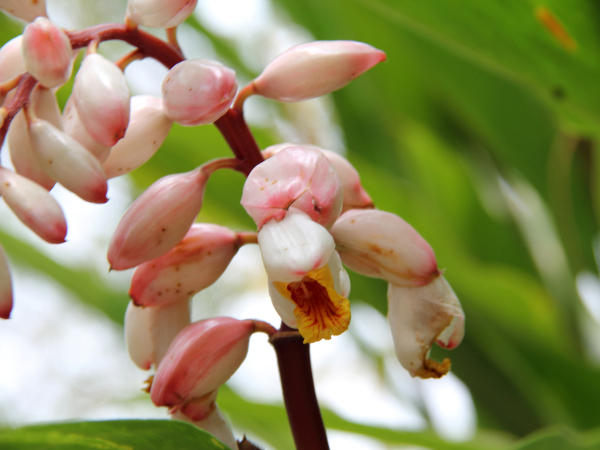
Alpinia zerumbet, commonly known as shell ginger among other names, is a perennial species of ginger native to East Asia. The plants can grow up to 8 to tall and bear colorful funnel-shaped flowers. They are grown as ornamentals and their leaves are used in cuisine and traditional medicine.
Names
Alpinia zerumbet is called a "shell ginger" or "shell flower" most commonly, because its individual pink flowers, especially when in bud, resemble sea shells. Other common names in English include "pink porcelain lily", "variegated ginger, and "light galangal".
In Japan, A. zerumbet is called gettō (ゲットウ [月桃]) in standard Japanese. In the languages of the Ryukyu Islands, it is known as sannin (サンニン) on Okinawa, shanin (シャニン) on Tanegashima in the Ōsumi Islands, sa'nen (サネン) on Amami Ōshima, sani (サニ) on Okinoerabujima, samin (サミン) on Miyako-jima, samin (サミン), sa'nin (サニン) and sami (サミ) on Ishigaki Island, sami (サミ) on Taketomi Island and sa'nin (サニン) on Iriomote Island. It is known as souka (ソウカ) on Chichijima in the Bonin Islands and sōka (ソーカ) in the Daitō Islands east of the Ryukyus.
In Taiwan, A. zerumbet is called yuètáo (月桃) in Mandarin Chinese, hó͘-chú-hoe (虎子花) or ge̍h-thô/go̍eh-thô (月桃) in Taiwanese Hokkien kiéu-kiông (枸薑) or ngie̍t-thò (月桃) in Siyen Hakka. In the island's aboriginal languages, it is known as silu in Bunun, jiaboe and garyo in Paiwan, bussiyan, bissiyan and bassiyan in Atayal and lalengac in Sakizaya.
In China, it is called yànshānjiāng (艷山薑), as well as yùtáo (玉桃), cǎoběn zhíwù (草本植物) and dà húluóbo (大胡蘿蔔) among other names.
Characteristics
Native to eastern Asia, Alpinia zerumbet is a rhizomatous, evergreen tropical perennial that grows in upright clumps 8 to tall in tropical climates. It bears funnel-formed flowers. Flowers have white or pink perianths with yellow labella with red spots and stripes. There are three stamens, but only one has pollen. There is one pistil. The fruit is globose with many striations. In more typical conditions, it reaches 4 to feet tall in the green house, and 3 to feet tall, as a house plant.{{cite web |access-date= March 19, 2011
It was originally called Alpinia speciosa, which was also the scientific name of torch ginger. To avoid the confusion, it was renamed A. zerumbet while torch ginger was reclassified in the genus Etlingera. No species is accepted as A. speciosa today.
Cultivation
Alpinia zerumbet is best grown in rich medium-wet, to wet well drained soils in full sun to part shade. Afternoon shade in hot summer climates, is recommended. Indoors, the plant must have bright light and humid conditions. Flowering rarely occurs before the second year.
Uses
The long leaf blades of A. zerumbet are used for wrapping zongzi, a traditional Chinese dish made of rice stuffed with different fillings. In Okinawa, Japan, its leaves are sold for making an herbal tea and are also used to flavor noodles and wrap muchi rice cakes.
The plant's dried fruits are treated as one of the numerous medicinal spice ingredients in a Sichuan hot pot soup base under the name shārén (沙仁) in Sichuan Mandarin Chinese.
Statistically, Okinawan natives who consume a traditional diet that includes A. zerumbet have a very long life expectancy. Recent research has investigated its effects on human longevity and the phytochemicals that may be responsible.
A. zerumbet contains many kavalactones structurally related to the compounds in kava (Piper methysticum) and may help prevent high glucose induced cell damage in human umbilical vein endothelial cells.
Gallery
File:Shell Ginger Alpinia zerumbet 7395.JPG|Flowers of Alpinia zerumbet, the shell ginger File:Alpinia zerumbet variegata.jpg|Alpinia zerumbet variegata, cultivated for ornamental use File:豔山姜花序總苞 20190508131956.jpg|A. zerumbet inflorescence protected by two bracts before flower bloom File:Shell ginger Alpinia zerumbet.jpg|A closeup of the A. zerumbet flower with its shell shape File:Alpinia zerumbet (Pers.) B.L.Burtt & R.M.Sm.jpg|Alpinia zerumbet (Pers.) B.L.Burtt & R.M.Sm., Hawaii File:Alpinia zerumbet (Pers.) B.L.Burtt & R.M.Sm.-1.jpg|Alpinia zerumbet, Hawaii (island)
References
References
- "''Alpinia zerumbet'' (shell ginger)". Hawaiian Ecosystems at Risk project.
- Olander, S.B.. (2020). "''Alpinia zerumbet''".
- Datiles, Marianne Jennifer. (2014-03-06). "Alpinia zerumbet (shell ginger)". CABI Compendium.
- [https://note.com/aroma_mokutsuyu/n/nd409df92a93b "月桃の香りや効果効能がパワフル!"] Retrieved 5 July 2023. {{inlang. ja
- [http://www.gettou.info/name-gettou.html "由来記月桃" [The origin of 'getto']] at 月桃インフォメーション [Alpinia zerumbet information]. Retrieved 5 July 2023. {{inlang. ja
- en. zh
- szy
- "艷山薑 Yanshanjiang".
- {{ThePlantList
- "Okinawan plant holds promise of elixir of youth". BusinessWorld Publishing.
- (2018). "Viewpoint: A Contributory Role of Shell Ginger (Alpinia zerumbet) for Human Longevity in Okinawa, Japan?". US National Institute of Health.
- (2022). "Kavalactones isolated from Alpinia zerumbet (Pers.) Burtt. Et Smith with protective effects against human umbilical vein endothelial cell damage induced by high glucose". Natural Product Research.
This article was imported from Wikipedia and is available under the Creative Commons Attribution-ShareAlike 4.0 License. Content has been adapted to SurfDoc format. Original contributors can be found on the article history page.
Ask Mako anything about Alpinia zerumbet — get instant answers, deeper analysis, and related topics.
Research with MakoFree with your Surf account
Create a free account to save articles, ask Mako questions, and organize your research.
Sign up freeThis content may have been generated or modified by AI. CloudSurf Software LLC is not responsible for the accuracy, completeness, or reliability of AI-generated content. Always verify important information from primary sources.
Report