From Surf Wiki (app.surf) — the open knowledge base
Alpina
High-performance luxury cars brand by BMW

High-performance luxury cars brand by BMW
| Field | Value | |
|---|---|---|
| name | BMW Alpina | |
| predecessor | Alpina Burkard Bovensiepen | |
| logo | Alpina logo.svg | |
| former_name | Alpina (1965–2025) | |
| type | Brand | |
| foundation | {{Plainlist | |
| founder | Burkard Bovensiepen | |
| location | Munich, Germany | |
| key_people | Andreas Bovensiepen (CEO) | |
| industry | Automotive | |
| products | Automobiles | |
| parent | BMW | |
| homepage |
- 1965 (as a company)
- 2026 (as a brand)
Alpina is a high-end luxury automobile brand by BMW. Alpina originally started as an automobile manufacturing company named Alpina Burkard Bovensiepen, based in Buchloe, in the Ostallgäu district of Bavaria, Germany that develops and sells high-performance versions of BMW cars. The company was officially renamed BMW Alpina in 2025. Alpina works closely with BMW and their processes are integrated into BMW's production lines, and is recognized by the German Ministry of Transport as an automobile manufacturer, in contrast to other performance specialists, which are aftermarket tuners. The Alpina B7 is produced at the same assembly line in Dingolfing, Germany (BMW Plant Dingolfing), as BMW's own 7 Series. The B7's twin-turbo 4.4-litre V8 is assembled by hand at Alpina's facility in Buchloe, Germany, before being shipped to BMW for installation, and the assembled vehicle is then sent back to Alpina for finishing touches.
The firm was founded in 1965 by Burkard Bovensiepen (1936–2023), a member of the Bovensiepen family of industrialists. On 10 March 2022, BMW announced its intention to acquire Alpina. That same day, BMW wrote on its website that it had officially acquired the brand.
History
Alpina's roots can be traced back to 1962, when Burkard Bovensiepen developed a Weber dual carburetor for the BMW 1500. This carburetor was well received by the automotive press, as well as BMW's own sales boss Paul G. Hahnemann. In 1964, BMW certified the quality of this Alpina product by awarding BMW vehicles fitted with the Alpina system the full factory guarantee.
Alpina Burkard Bovensiepen KG was established on 1 January 1965 in Kaufbeuren, Bavaria. The company had eight employees. Although Alpina started by producing typewriters, the original Alpina ceased to exist at the end of the 1960s in their attempt to move into the textile industry. In 1965, Burkard established a BMW tuning business, following his success with investments in the stock market. He started the tuning business in an outbuilding of the original Alpina typewriter factory. The company worked on carburetors and revised cylinder heads. By 1970, with seventy employees, the original facility changed locations from Kaufbeuren to Buchloe.
In its first years, Alpina established its core competency by tuning carburetors and camshafts to extract more power from BMW engines, elements that eventually defined the company's logo, which came into being in 1967. Between 1968 and 1977, Alpina cars did very well in competition. The highlight was in 1970, when the team's cars won the European Touring Car Championship, the German Hillclimb Championship, rally and track racing championships, and the prestigious Spa 24 Hours.
Alpina officially withdrew from racing in 1988 because of capacity limitations and restrictions. Tied to this was the decision to begin production of a new set of BMW Alpina automobiles.
Brand distinctions
Since 1983, Alpina has been recognized by the German Federal Ministry of Transport as an automobile manufacturer, thus Alpina-built cars are branded and registered as Alpina instead of BMW, although an Alpina can be serviced at all BMW dealerships, and is fully covered if a warranty issue arises. Alpina automobiles are also sold at some BMW dealerships.
Distinctive features of Alpina vehicles are the fact that these models are literally "manu-factured", meaning "hand-made". The production process switches between fine tuning the engine, delivering it to the BMW plant, marrying engine and body there, and bringing it back to Alpina for interior upgrade with Alpina's specific components, again all in a hand-made process that allows only limited production numbers. Besides engine and interior, Alpina also optimizes the transmission and installs steering wheel-mounted button shifters (called Switch-Tronic) on most cars, with paddle shifters used on the B4 S Edition 99. This has historic reasons, since Alpina was the first to mount shifting buttons on the steering wheel. Distinguishing marks from the exterior are the 20-spoke alloy wheels with hidden valves under the center cap and the "Alpina Blue" or "Alpina Green" metallic exterior colours. Inside, "the finest materials are used to fabricate the exclusive feel". A typical blue and green pattern is often used on interior parts such as stitching on leather. A thin, pinstriped style outside body decor set in gold or silver is also a hallmark of older Alpina cars which is an option on new Alpina models. Another distinguishing mark is the Alpina wordmark at the bottom of the car's front, a design heralded from its racing cars. A metal plate inside also proves the heritage and the serial number of the car.
Compared to cars from BMW's in-house performance subsidiary, BMW M, Alpina's vehicles have more emphasis on Touring, higher torque, and have their own Alpina-style shiftable ZF automatic transmissions instead of manual or semi-automatic transmissions. For instance, regarding the high performance variants of the BMW E60 5 Series, the B5 offers a different take on performance and how to accomplish it. Unlike BMW M's own M5 which has a naturally aspirated, high-revving 5.0L V10, the Alpina B5 uses a supercharged 4.4L V8 which produces similar horsepower and greater torque at lower rpm.
Current lineup


- Alpina D3 Bi-Turbo Saloon/Touring: based on the BMW F30/F31 3 Series - featuring a 3.0-litre straight-six bi-turbocharged diesel engine, delivering 350 PS / 700 Nm
- Alpina B3 S Bi-Turbo Saloon/Touring: based on the BMW F30/F31 3 Series - featuring a 3.0-litre straight-six bi-turbocharged petrol engine, delivering 440 PS / 660 Nm
- Alpina XD3: based on the BMW G01 X3 - featuring a 3.0-litre straight-six diesel engine:
- a quad-turbocharged version delivering 388 PS / 770 Nm (left-hand drive)
- a bi-turbocharged version delivering 333 PS / 700 Nm (right-hand drive)
- Alpina D4 Bi-Turbo Coupé/Convertible: based on the BMW F32/F33 4 Series - featuring a 3.0-litre straight-six bi-turbo diesel engine, delivering 350 PS / 700 Nm
- Alpina B4 S Bi-Turbo Coupé/Convertible: based on the BMW F32/F33 4 Series - featuring a 3.0-litre straight-six bi-turbocharged engine, delivering 440 PS / 660 Nm
- Alpina B4 S Bi-Turbo Edition 99 Coupé/Convertible: based on the BMW F32/F33 4 Series - featuring a 3.0-litre straight-six bi-turbocharged engine, delivering 452 PS / 680 Nm
- Alpina XD4: based on the BMW G02 X4 - featuring a 3.0-litre quad-turbocharged straight-six diesel engine delivering 388 PS 770 Nm (right-hand drive only)
- Alpina D5 S Saloon/Touring: based on the BMW G30/G31 5 Series - featuring a 3.0-litre straight-six bi-turbocharged diesel engine :
- delivering 388 PS / 800 Nm (left-hand drive)
- delivering 326 PS / 700 Nm (right-hand drive)
- Alpina B5 Saloon/Touring: based on the BMW G30/G31 5 Series - featuring a 4.4-litre V8 bi-turbocharged engine. 608 PS / 800 Nm
- Alpina B6 Bi-Turbo Coupé/Convertible/Gran Coupé: based on the BMW F06/F12/F13 6 Series - featuring a 4.4 L V8 bi-turbo engine. 600 PS / 800 Nm
- Alpina B8 Gran Coupe: based on the BMW G16 8 Series - featuring a 4.4 L V8 bi-turbo engine. 630 PS (457 kW; 620 hp) / 800 Nm
- Alpina XB7: based on the BMW G07 X7 - featuring a 4.4 L V8 bi-turbo engine. 621 PS (457 kW; 612 hp) / 800 Nm
Alpina XD3

The Alpina XD3 made its debut at the 2018 Geneva Motor Show. The XD3 is fitted with an Alpina-modified version of BMW's B57 diesel inline-six engine. In the quad-turbo left-hand drive version, the engine outputs 388 PS and 770 Nm, giving a 0–100 km/h time of 4.6 seconds and a top speed of 266 km/h. In the bi-turbocharged right-hand drive version, the engine outputs 333 PS and 700 Nm, giving it a 0–100 km/h time of 4.9 seconds and a top speed of 254 km/h.
Alpina XD4
The Alpina XD4 debuted at the 2018 Geneva Motor Show. It is fitted with a modified version of the B57 diesel engine with four turbochargers, and outputs 285 kW and 770 Nm. The XD4 is the fastest accelerating diesel-powered production SUV, and can accelerate from 0–100 km/h in 4.6 seconds, with a top speed of 268 kph. It is available in left-hand drive markets only.
Alpina B3 Bi-Turbo
Main article: BMW 3 Series (G20)
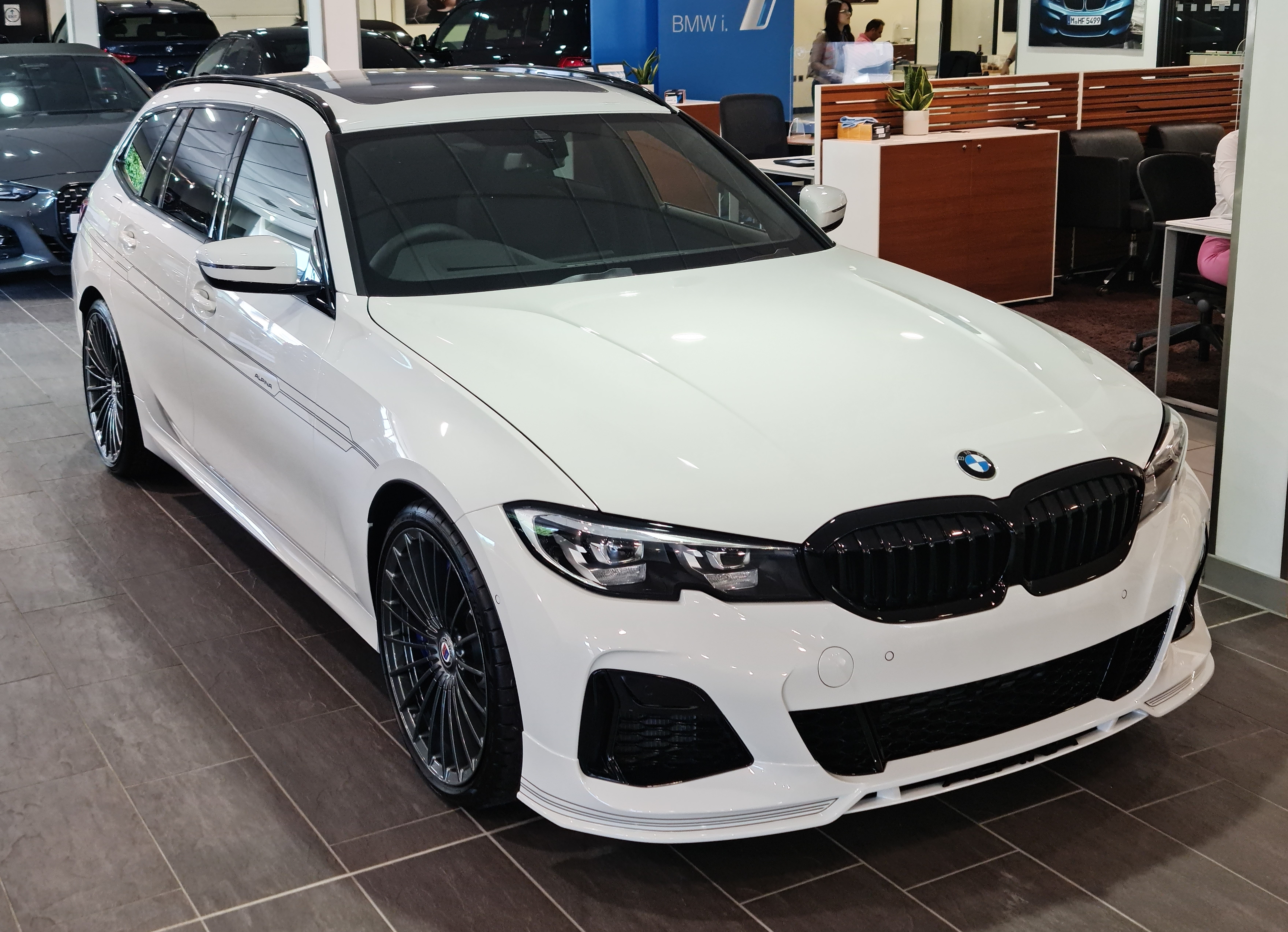
The F30 Alpina B3 Bi-Turbo was in production since March 2013. It is based on the BMW F30 335i with a bi-turbocharged 3.0 litre six cylinder. The 301 kW engine with 600 Nm of torque accelerates the B3 from 0–100 km/h in 4.0 seconds. The top speed is 305 km/h. The B3 Biturbo is available as a sedan or touring, both can be combined with xDrive four-wheel drive.
Alpina modified the exterior with front and rear spoilers and a quad-exit exhaust system.
In March 2017, Alpina revised the engine of the B3. It now produces 324 kW.
A new model based on the G20 3 Series replaced the F30 model, it uses the S58 3.0 litre bi-turbo inline six engine producing 340 kW and 700 Nm of torque, which is 150 Nm more than the BMW M3, and 50 Nm more than the BMW M3 Competition.
Alpina D3 Bi-Turbo
Main article: BMW 3 Series (G20)
The Alpina D3 Bi-Turbo was presented at IAA 2013. It is based on the BMW F30. It is available as a Saloon or Touring version with a 3.0-litre straight-six, bi-turbocharged diesel engine with 257 kW of Power and 700 Nm of torque. The Touring is also available with all-wheel drive, based on BMW xDrive.
Alpina B4 Bi-Turbo
Main article: Alpina B4
Launched in 2014, the B4 is based on the 435i. The N55 straight-six engine is modified by using twin-turbochargers, a sixty-one percent larger intercooler and a new crankshaft. The engine also utilises new pistons, all of these modifications allow the engine to generate 408 PS between 5,550 and 6,250 RPM and 443 lbft between 3,000 and 4,000 RPM.
Alpina B5 Bi-Turbo
Main article: Alpina B5 (G30)

The Alpina B5 was introduced at the 2017 Geneva Motor Show in all-wheel drive Saloon or Touring versions. The B5 features a 4.4-litre N63M30 V8 engine that generates a maximum power output of 447 kW and 800 Nm of torque. Based on the N63B44O2 V8, it has uprated pistons, new twin-scroll Garrett turbochargers and new spark plugs by NGK. The B5 can accelerate from 0-100 kph in 3.5 seconds with a top speed of 330 km/h for the Saloon, and 202 mph for the Touring, making it the fastest production estate car in production at that time.
Alpina D5 S
Main article: Alpina B5 (G30)


The Alpina D5 S debuted at the 2017 Frankfurt Motor Show in all-wheel drive only sedan and Touring variants. The D5 S uses a modified 3.0-liter B57D30 diesel inline-six engine. The engine has three turbochargers and produces 285 kW and 800 Nm of torque in left-hand drive markets, whereas it has two turbochargers and produces 240 kW and 700 Nm of torque in right-hand drive markets. The left-hand drive D5 S saloon has a top speed of 286 km/h and a 0–100 km/h acceleration time of 4.4 seconds. Alpina claims it is the fastest diesel-powered production car in the world. The right-hand drive, saloon-only version has a 0–100 km/h acceleration time of 4.9 seconds and a top speed of 275 km/h.
Alpina B6 Gran Coupé
Main article: Alpina B6 (F12)
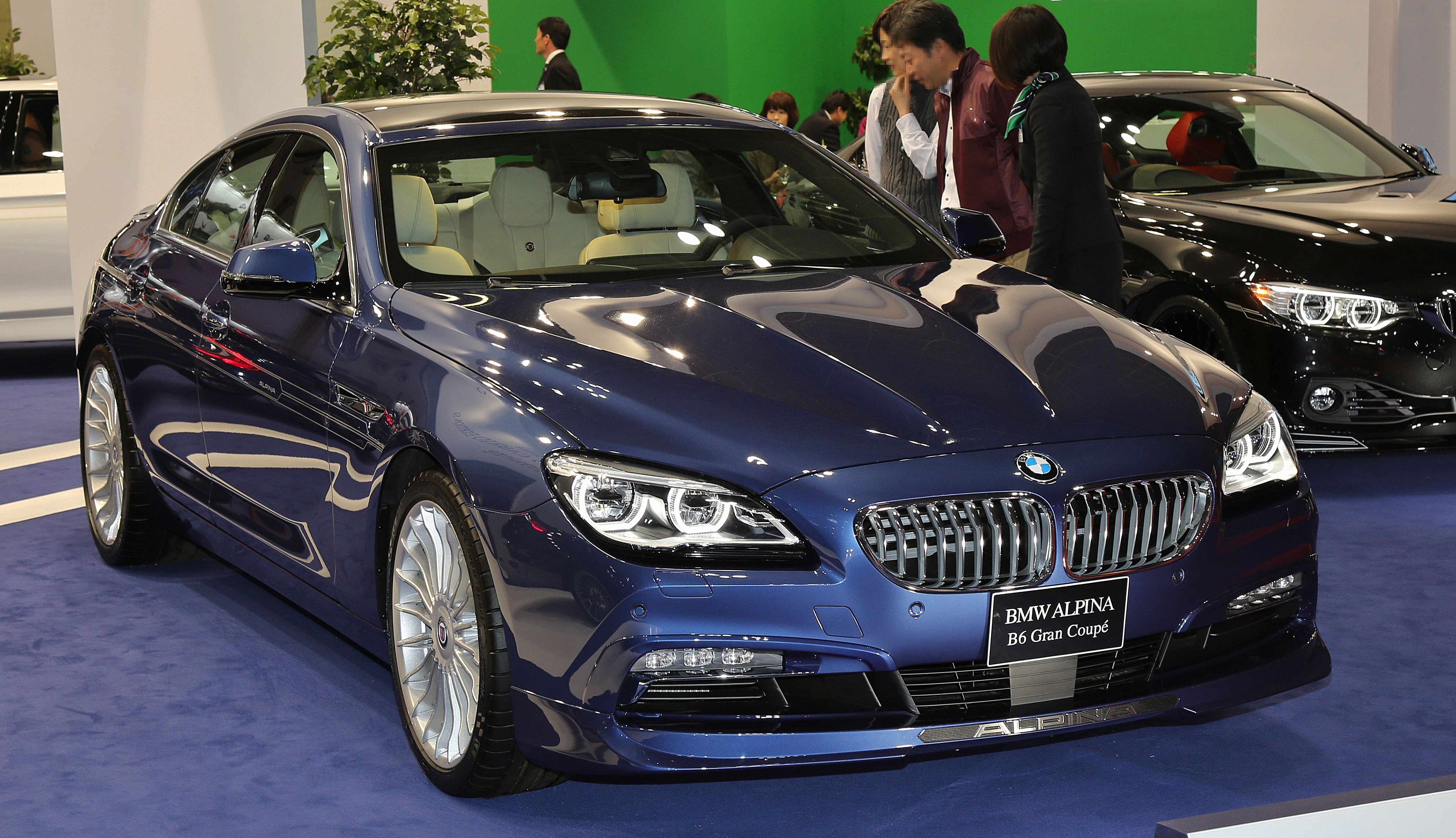
The Alpina B6 Gran Coupé xDrive was launched in 2014. This model is conceived by Alpina and based on the 650i. This model is sold by BMW only in the United States and in Canada (but Alpina also independently offers it in other countries). The Alpina B6 Gran Coupé 2015 model shares the 540 hp, 730 Nm 4.4-litre twin-turbo V8 of the Alpina B5 BiTurbo and B6 BiTurbo coupé which are not sold in North America. The 2016-2019 model produces 600 hp and 590 lbft of torque. Specification includes a more luxurious interior, 20-inch Alpina light-alloy wheels, aerodynamic elements and exclusive Alpina trims and paints. The Alpina B6 can go from 0–100 km/h in 3.9 (3.8 for the 2016-2019 model) seconds and has a top speed of 318 km/h. (324 km/h or 202 mph for the 2016-2019 model)
Alpina B7
Main article: Alpina B7 (G12)
The Alpina B7 is one of the two Alpina cars offered in the US and Canada, the other one being the Alpina B6. The B7 is produced at the same assembly line in Dingolfing, Germany, along with BMW's own 7 Series. It can be equipped identically to a normal M760Li. However, an exclusive Alpina Green finish is available.
BMW permitted Alpina to produce a high-performance version of its flagship 7 Series, however they did not want it to be a high-revving, BMW M version (which would have been known as a "BMW M7" under the current nomenclature). It has also been suggested that there was no market for an M7 that would have featured the BMW M's trademark high-rev engine and twin-clutch automated manual transmission, and most customers who desired a performance option in the 7 Series would have gone for the V12-engined BMW 760Li.
Competitors include the Mercedes-Benz S63 AMG and Audi S8.
;Alpina B7 xDrive


The Alpina B7 xDrive was announced by BMW North America on 8 February 2016 with sales starting in September 2016. With an electronically limited top speed of 310 km/h and a 0–100 km/h acceleration time of 3.7 seconds along with a sportier setup, it is the sportiest 7 Series but is sold by BMW only in the United States and Canada. The B7 is sold in other countries by Alpina as the B7 Bi-Turbo, with a delimited top speed of 330 km/h.
The Alpina B7 features a 447 kW 4.4 litre twin-turbocharged V8 engine delivering 800 Nm of torque and a more luxurious interior. It was unveiled at the 2016 Geneva Motor Show.
The face-lifted model, unveiled in February 2019, has an improved power band which allows better performance, with a 0–100 km/h acceleration time of 3.6 seconds. The top speed of 330 km/h is now delimited worldwide.
Previous models
Petrol-engine
| Alpina model | BMW donor model | Alpina Engine | Power at rpm | Torque at rpm | Production |
|---|---|---|---|---|---|
| A1/3 | E21 320 | A1/3 | 90 kW at 5,800 | 170 Nm at 4,000 | 1975–1977 |
| A2/3 | E21 320 | A2/3 | 112 kW at 6,900 | 173 Nm at 5,500 | 1975–1977 |
| A4/3 | E21 320i | A4/3 | 119 kW at 6,700 | 180 Nm at 5,500 | 1976–1977 |
| A4S/3 | E21 320i | A4S/3 | 125 kW at 6,700 | 180 Nm at 5,500 | 1976–1977 |
| C1 2.3 | E21 323i | C1 | 125 kW at 6,000 | 210 Nm at 4,500 | 1980–1983 |
| B6 2.8 | E21 323i | B6 | 147 kW at 6,200 | 248 Nm at 4,500 | 1978–1981 |
| B6 2.8 | E21 323i | B6 | 160 kW at 6,000 | 265 Nm at 5,000 | 1981–1983 |
| C1 2.3 / 1 | E30 323i | C1/1 | 125 kW at 6,000 | 225 Nm at 5,000 | 1983–1985 |
| C2 2.5 | E30 325i | C2 | 136 kW at 5,800 | 246 Nm at 4,800 | 1985-1986 |
| C1 2.5 | E30 325i | C2/3 | 140 kW at 5,800 | 235 Nm at 5,000 | 1986–1987 |
| C2 2.7 | E30 325i | C2/1 | 154 kW at 5,800 | 267 Nm at 4,500 | 1986–1987 |
| C2 2.7 | E30 325i | C2/2 | 149 kW at 6,000 | 265 Nm at 4,800 | 1987-1987 |
| B3 2.7 | E30 325i | C2/2 | 150 kW at 6,000 | 265 Nm at 4,800 | 1987–1992 |
| B6 2.8 / 1 | E30 323i/325i | B6/2 | 154 kW at 6,100 | 270 Nm at 5,000 | 1984–1986 |
| B6 3.5 | E30 323i/325i | B10/2 | 192 kW at 6,000 | 346 Nm at 4,000 | 1985–1987 |
| B6 3.5 | E30 325i | B10/3 | 187 kW at 5,900 | 320 Nm at 4,000 | 1986–1987 |
| B6 3.5 | E30 325i | B10/5 | 187 kW at 5,900 | 320 Nm at 4,000 | 1987–1990 |
| B6 3.5 S | E30 M3 | B10/5 | 187 kW at 5,900 | 320 Nm at 4,000 | 1987–1990 |
| B6 2.8 | E36 325i | E1 | 177 kW at 5,900 | 293 Nm at 4,700 | 1992–1993 |
| B3 3.0 | E36 325i | E3 | 184 kW at 5,700 | 320 Nm at 4,400 | 1993–1996 |
| B3 3.2 | E36 328i | E4 | 195 kW at 5,800 | 330 Nm at 4,400 | 1996–1999 |
| B8 4.6 | E36 328i | F2/1 | 245 kW at 5,700 | 470 Nm at 3,900 | 1995–1998 |
| B3 3.3 | E46 328i | E4/4 | 206 kW at 6,200 | 335 Nm at 4,500 | 1999–2002 |
| B3 3.3 ALLRAD | E46 330ix | E4/8 | 206 kW at 6,200 | 335 Nm at 4,500 | 2001–2005 |
| B3 S | E46 330i | E5/1 | 224 kW at 6,300 | 362 Nm at 4,800 | 2002–2006 |
| B3 Bi-Turbo | E90/E91/E92/E93 335i | K2 | 265 kW at 5,500 | 500 Nm at 3,800 | 2007–2010 |
| B3 Bi-Turbo Allrad | E90/E91/E92 335xi | K2 | 265 kW at 5,500 | 500 Nm at 3,800 | 2008–2010 |
| B7 Turbo | E12 528i | B7 | 221 kW at 6,000 | 462 Nm at 3,000 | 1978–1982 |
| B7 S Turbo | E12 528i | B7S | 243 kW at 5,800 | 500 Nm at 3,000 | 1981–1982 |
| B9 3.5 | E28 528i | B9 | 180 kW at 5,700 | 320 Nm at 4,000 | 1981–1983 |
| B9 3.5 / 1 | E28 528i | B9/1 | 180 kW at 5,700 | 320 Nm at 4,000 | 1983–1985 |
| B7 Turbo / 1 | E28 528i/535i | B7/1 | 221 kW at 5,800 | 501 Nm at 3,000 | 1984–1987 |
| B10 3.5 | E28 535i | B10 | 192 kW at 5,800 | 346 Nm at 4,000 | 1985–1987 |
| B7 Turbo / 1 | E28 535i | B7/3 | 235 kW at 5,700 | 520 Nm at 2,400 | 1986–1987 |
| B10 3.5 / 1 | E34 535i | B11/3 | 187 kW at 6,000 | 325 Nm at 4,000 | 1988–1992 |
| B10 Bi-Turbo | E34 535i | B7/5 | 265 kW at 6,000 | 520 Nm at 4,000 | 1989–1994 |
| B10 3.0 ALLRAD | E34 525ix | E3/1 | 170 kW at 5,800 | 312 Nm at 4,200 | 1993–1996 |
| B10 4.0 | E34 540i | F1 | 232 kW at 5,800 | 410 Nm at 4,600 | 1993–1996 |
| B10 4.6 | E34 540i | F2 | 250 kW at 5,700 | 480 Nm at 3,900 | 1994–1996 |
| B10 3.2 | E39 528i | E4/3 | 191 kW at 5,900 | 330 Nm at 4,300 | 1997–1998 |
| B10 3.3 | E39 528i | E4/5 | 206 kW at 6,200 | 335 Nm at 4,500 | 1999–2003 |
| B10 V8 | E39 540i | F3 | 250 kW at 5,700 | 470 Nm at 3,900 | 1997–1998 |
| B10 V8 | E39 540i | F4 | 255 kW at 5,700 | 480 Nm at 3,700 | 1998–2002 |
| B10 V8 S | E39 540i | F5 | 276 kW at 5,800 | 510 Nm at 3,800 | 2002–2004 |
| B5 | E60/E61 545i | H1 | 368 kW at 5,500 | 700 Nm at 4,250 | 2005–2007 |
| B5S | E60/E61 550i | H2 | 390 kW at 5,500 | 725 Nm at 4,750 | 2007–2010 |
| B7 Turbo Coupé | E24 630CSi | B7 | 221 kW at 6,000 | 462 Nm at 2,500 | 1978–1982 |
| B7 S Turbo Coupé | E24 635CSi | B7S | 243 kW at 5,800 | 500 Nm at 3,000 | 1982-1982 |
| B9 3.5 Coupé | E24 635CSi | B9 | 180 kW at 5,700 | 320 Nm at 4,000 | 1982-1982 |
| B9 3.5 Coupé / 1 | E24 635CSi | B9/1 | 180 kW at 5,700 | 320 Nm at 4,000 | 1982–1985 |
| B7 Turbo Coupé / 1 | E24 635CSi | B7/2 | 243 kW at 5,700 | 512 Nm at 2,400 | 1984–1987 |
| B10 3.5 Coupé | E24 635CSi | B10 | 192 kW at 6,000 | 346 Nm at 4,000 | 1985–1987 |
| B7 Turbo Coupé / 1 | E24 635CSi | B7/3 | 235 kW at 5,700 | 520 Nm at 2,400 | 1986–1988 |
| B6 | E63/E64 650i | H1 | 368 kW at 5,500 | 700 Nm at 4,250 | 2006–2008 |
| B11 3.5 | E32 735i | B11 | 184 kW at 5,700 | 330 Nm at 4,000 | 1987-1987 |
| B11 3.5 | E32 735i | B11/1 | 176 kW at 5,700 | 310 Nm at 4,500 | 1987-1987 |
| B11 3.5 | E32 735i | B11/3 | 187 kW at 6,000 | 325 Nm at 4,000 | 1987–1993 |
| B11 4.0 | E32 740i | F1 | 232 kW at 5,800 | 410 Nm at 4,600 | 1993–1994 |
| B12 5.0 | E32 750i | D1 | 350 PS at 5,300 | 470 Nm at 4,000 | 1988–1994 |
| B12 5.7 E-KAT | E38 750i | D3 | 285 kW at 5,200 | 560 Nm at 4,100 | 1995–1998 |
| B12 6.0 E-KAT | E38 750i | D3/2 | 316 kW at 5,400 | 600 Nm at 4,200 | 1999–2001 |
| B7 | E65/E66 745i | H1 | 368 kW at 5,500 | 700 Nm at 4,250 | 2003–2008 |
| B12 5.0 Coupé | E31 850i/850Ci | D1/1 | 350 PS at 5,300 | 470 Nm at 4,000 | 1990–1994 |
| B12 5.7 Coupé | E31 850CSi | D2 | 306 kW at 5,400 | 570 Nm at 4,000 | 1992–1996 |
| Roadster Limited Edition | Z1 | C2/6 | 200 PS at 6,000 | 261 Nm at 4,900 | 1990–1991 |
| Roadster V8 | E52 Z8 | F5 | 280 kW at 5,800 | 520 Nm at 3,800 | 2002–2003 |
| Roadster S | E85 Z4 | E5/2 | 221 kW at 6,300 | 362 Nm at 4,800 | 2003–2005 |
Diesel-engine
| Alpina model | BMW donor model | Alpina Engine | Power at rpm | Torque at rpm | Production |
|---|---|---|---|---|---|
| D10 BITURBO | E39 530d | G1 | 180 kW at 4,200 | 500 Nm at 3,500 | 2000–2003 |
| D3 | E90/E91 320d | M47 | 147 kW at 4,000 | 410 Nm at 2,000 | 2005–2008 |
| D3 Bi-Turbo | E90/E91/E92 3 series (engine from BMW 123d) | N1 | 157 kW at | 450 Nm at 2,000-2,500 | 2008-2013 |
Alpina XD3 Bi-Turbo: based on the BMW F25 X3 - featuring a 3 L straight-six bi-turbo Diesel engine, delivering 350 PS and 700 Nm.
3 Series based Alpinas
Alpina C1
.jpg)
The Alpina C1 was based on the E21 323i and was among their most popular early models, providing superior performance over the unmodified car. The C1 2.3 made 125 kW and 225 Nm of torque. 0–100 km/h is achieved in 7.8 seconds. Top speed was 213 km/h. The extra power is due to special Mahle pistons, and a special exhaust and ignition system. It also received dry-sump lubrication and a short-ratio five-speed gearbox. Only 35 C1 cars were built, making it one of the rarest Alpina models. As BMW released the 325i, Alpina responded with the C2 2.5, and later the 2.7 models, providing between 190-210 hp. The brakes and suspension were also upgraded.
The C1 2.5 and early C2 / 2.6* models used the M20B23 (2.3L) engine, but bore and stroke were increased to achieve a displacement of 2552 cm3. Alpina reworked the head which was ported and polished, installed harder valve springs and a hotter cam. The intake manifold was also reworked, and Alpina used a larger throttle body. It produced 136 kW, with 246 Nm of torque. Alpina claimed 0–100 km/h acceleration in 7.1 seconds. Top speed was 220 km/h. Production is unclear, with estimates ranging from 35 cars built to around 400 depending on the source.
Alpina C2

An interesting variant of the M20 engine was Alpina's C2. The first C2 combined the wider bore of the M20B25 with the slightly larger 76.8 mm crankshaft of an M20B23, to create a torquier engine of 2552 cc. This version put out 185 PS and 265 Nm, 74 units were built between 1985 and November 1986. After the C2 2.7 appeared in the spring of 1986, the 2.5 was slightly upgraded and gained 5 horsepower. However, to indicate its "little brother" position in the lineup, the name was changed to C1 2.5. When the September 1987 facelift model of the E30 was introduced, the 2.5 litre C1 was discontinued, although a few cars were finished into 1988.

The larger yet 2.7 litre unit was introduced in February 1986 in uncatalyzed C2/1 form. Originally installed in the E30-based Alpina C2 2.7, with available four-wheel drive, the catalyzed C2/2 appeared in the interim C2 2.7 Kat in March 1987. This was then renamed "B3 2.7" five months later, by which time the "C2" labelled cars were discontinued. The B3 2.7 continued to be available until June 1992, in all body variants and drivetrain configurations (excepting automatics) in which the E30 was offered.
Later C2 2.5 models (C2 /3 2.5) were based on the 325i. Alpina used the M20B25 engine with very few modifications compared to earlier models. Again the cylinder head was decked to increase compression ratio, and it was ported and polished. The ECU was also remapped. Max power is 140 kW, with 235 Nm of torque. 0–100 km/h was achieved in 7.2 seconds. Top speed is 220 km/h. Only 50 cars were built.
The C2 /1 2.7 used the 325e eta model engine block, crank and rods, but with custom flat head pistons provided by Mahle. Originally Alpina modified the "200" casting number cylinder head specific to the 325e with bigger intake valves, larger air intake ports, and redesigned the valve chamber for better flow. A more aggressive camshaft was used, with higher lift and duration, and harder valve springs were installed. Compression ratio was increased to 10.2:1. The C2/1 2.7 made 210 bhp with 267 Nm of torque and was the fastest E30 available at the time (227 km/h top speed). 108 cars were built.
Later C2 /2 2.7 (and early 1987 B3 2.7) used the M20B25 block with ETA (325e) crank and rods. The intake manifold was also redesigned for better flow. The head was decked to improve compression ratio (10.1:1 for models with the 731 head, 9.6:1 for later "885" head models with catalytic converter) and matched with custom pistons - flat Mahle pistons for engines equipped with the 731 head, and domed KS pistons for engines equipped with the 885 head. Larger throttle bodies were installed (the C2/2 version uses the same throttle body as the M20B25 325i). A total of 309 cars were built between 1986 and 1987. The C2/2 2.7 makes 204 bhp and 266 Nm of torque. Top speed is 224 km/h and 0–100 km/h is achieved in 7.5 seconds.
The B3 2.7 is similar to late C2/2 2.7 cars. It uses the M20B25 block with M20B27 crank and custom rods. The 885 head is exclusively used for the B3 model. The head is decked ~ 1 mm to improve CR to 9.6:1 and matched with custom domed KS or Mahle pistons. Intake and cylinder head are ported and polished. Custom ECU mapping is used. Engine management is Bosch Motronic 1.3. The B3 2.7 is equipped with a catalytic converter to conform to emission standard of the time. Performance numbers are similar to the later C2/2 2.7 cars. 254 cars were built from 1987 to 1992.
.jpg)
Alpina B6
.jpg)
The Alpina B6 2.8 is based on the 323i, but uses the same B6/2 engine used in the B6 E21. The car makes 210 bhp and 270 Nm of torque. Top speed is 230 km/h. 0–100 km/h is achieved in 7.2 seconds. 533 cars were made from 1983 to 1986.
The Alpina B6 3.5 is based on the 325i chassis, but uses the M30 "big six" 3430 cm3 engine, upgraded to 261 bhp and 346 Nm of torque. 0–100 km/h is achieved in 6.4 seconds. The engine uses custom Mahle pistons and rods. The cylinder head was ported and polished, and a hotter cam was used. Top speed is 250 km/h. Suspension and brakes were upgraded. Bigger ventilated disks and progressive springs were installed at the front. Only 210 cars were made from 1986 to 1990. The B6 3.5 was sold in Japan as the B6 2.7 and used the 2.7 L engine from the Alpina C2 as the larger 3.0 L engine was unable to pass emissions.
The Alpina B6 3.5 S uses the M3 chassis. The 3.5 S, like the 3.5, uses the B10/2 M30 "big six" which makes 261 bhp and 346 Nm of torque. Displacement is 3430 cm3. 0–100 km/h is achieved in 6.4 seconds. Top speed is 250 km/h. The gearbox used is the Getrag 260/6 sport, known as a dog-leg gearbox. Only 62 cars were made from 1987 to 1990.
The E30 BMW 333i was developed by Alpina for BMW South Africa. It was based on the 325i chassis and M30B32 engine, with numerous Alpina components common to the B6. Customers had to choose between power steering or air conditioning because of limited space in the engine bay.
Alpina B3 GT3
Main article: Alpina B3 (E90)
To celebrate Alpina's victory in the 2011 ADAC GT Masters with an Alpina B6 GT3, Alpina decided to produce a limited run of the Alpina B3 S Bi-Turbo, called the Alpina B3 GT3. The B3 GT3 features a new exhaust system developed in collaboration with Akrapovič which is 11 kg lighter than the standard exhaust and increases power to 300 kW and 398 lbft of torque. It features upgraded brakes with 380 mm discs, a Drexler limited slip differential and fully adjustable coilovers by KW at all four corners.
.jpg)
The most noticeable changes were on the exterior: The B3 GT3 sports a carbon fibre rear wing, a special front splitter and 19" lightweight Alpina GT3 Classic wheels, painted in Himalaya Grey. The B3 GT3 was available in Black Sapphire metallic, Mineral White metallic, Alpina Blue metallic or with a full body vinyl wrap in the official GT3 design. The car could be ordered with an extra set of lightweight wheels (also 19" Alpina GT3 Classic, but equipped with Michelin Pilot Sport Cup+ tires) for use on the track.
Only 99 units were produced.
5 Series based Alpinas
E12 B2
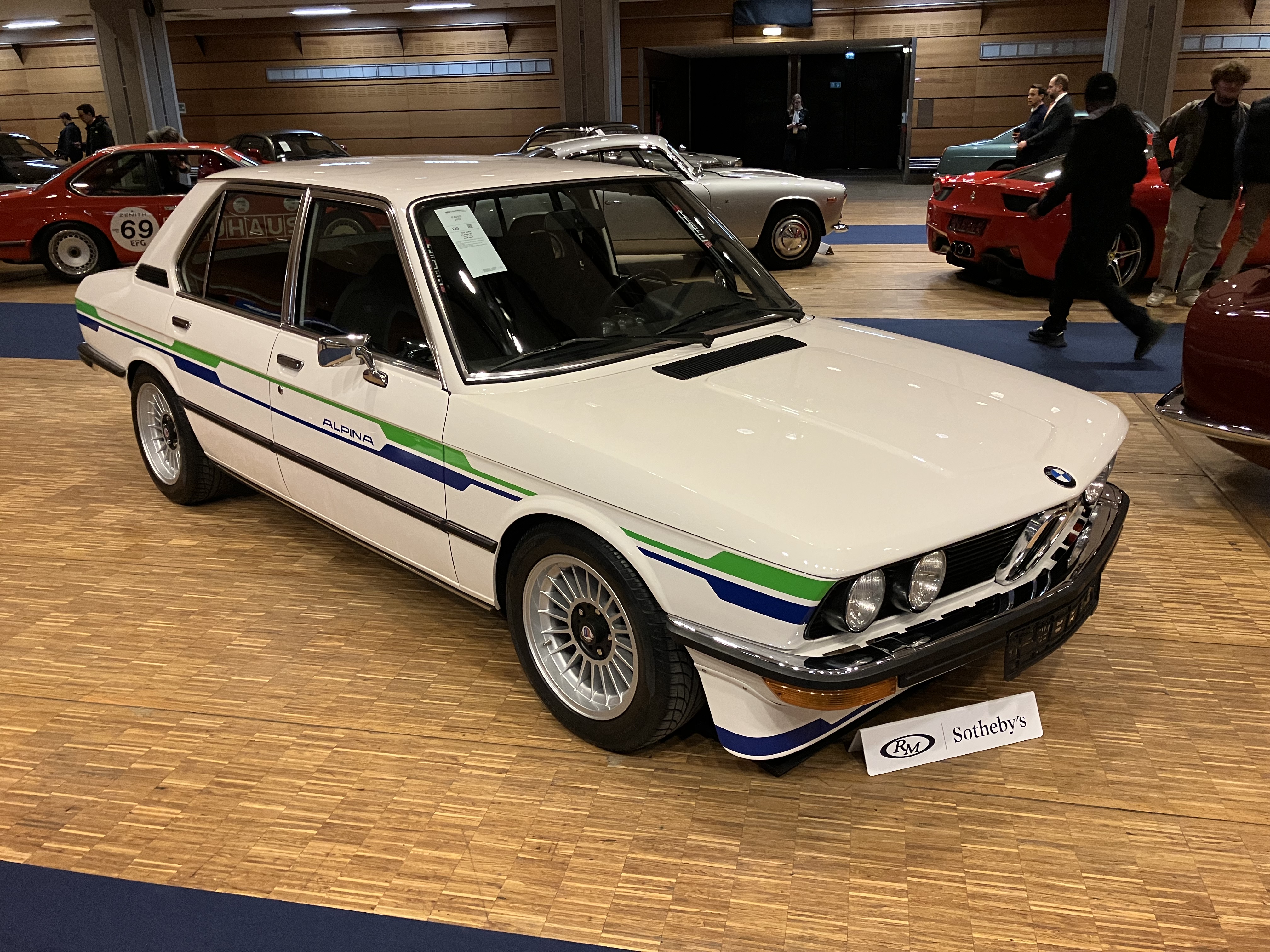
The Alpina B2 is based on the 1976 BMW 5 Series (E12) 528i. The car featured a bored-out 230 hp 3.0-liter straight-six fitted with three double barrel carburetors. Only eleven B2 were built before the introduction of the B7.
E12 B7 Turbo / B7 S Turbo

The Alpina B7 Turbo is based on the BMW 5 Series (E12) 528i like its predecessor the B2. From 1978 to 1982 it featured a B7 engine with 221 kW at 6,000 rpm and 462 Nm at 3,000 rpm. In 1981, Alpina introduced the B7 S Turbo with 243 kW at 5,800 rpm and 500 Nm at 3,000 rpm. Only sixty B7 S Turbos were produced.
E28 B9

The Alpina B9 was built in a small series from November 1981 to December 1985 on the basis of the BMW E28. About 500 examples were produced.
Changes
The B9 is based on the 528i, whose M30-2.8-litre BMW engine was replaced by a 3.45-litre. Alpina tuned engine. The motor is based on the 3.5-liter version of the M30, but has been extensively modified. Alpina replaced the cylinder head, pistons, camshaft and modified the Bosch Motronic ECU. The engine transmits its power to the rear wheels via a 5-speed gearbox, an automatic transmission was also available. The suspension of the E28 has been modified with Bilstein gas dampers, as standard the B9 was delivered with 16-inch wheels (see picture). Alpina also modified the interior with among other things, Recaro seats, a new shifter and a modified instrument cluster.
Technical specifications
| B9 3.5 | B9 3.5 / 1 | Production period | Motor type | Design | Displacement | Power | Torque | Acceleration 0–100 km/h | Top speed |
|---|---|---|---|---|---|---|---|---|---|
| 11/1981 – 08/1983 | 01/1983 – 12/1985 | ||||||||
| B9 | |||||||||
| Inline-six | |||||||||
| 3453 cm3 | 3430 cm3 | ||||||||
| 180 kW at 5,700 rpm | |||||||||
| 320 Nm at 4,500 rpm | |||||||||
| 6.7 s | |||||||||
| 240 km/h | |||||||||
| Source |
E28 B10
In 1985, Alpina launched the B10 3.5, based on the BMW 535i (E28).
The 3.5 liter six-cylinder engine from the B6 3.5 was fitted to replace the B9's 3.45 liter. The output was 192 kW. Only 77 examples of the B10 3.5 were produced.
Technical specifications
| Model | B10 3,5 | Platform | Production period | Displacement | Engine architecture | Power | Torque | Transmission | Acceleration, | ||
|---|---|---|---|---|---|---|---|---|---|---|---|
| 0–100 km/h | Top speed | Production | |||||||||
| BMW 535i E28 | |||||||||||
| 7/1985–12/1987 | |||||||||||
| 3430 cm3 | |||||||||||
| Inline-six | |||||||||||
| 192 kW at 5,700 rpm | |||||||||||
| 346 Nm at 4,000 rpm | |||||||||||
| 5-speed manual transmission, or a 4-speed automatic transmission (optional) | |||||||||||
| 6.4 s | |||||||||||
| 250 km/h (automatic: 245 km/h) | |||||||||||
| 77 |
E34 B10
.jpg)
B10 3.5
The B10 3.5 was the first Alpina based on the BMW E34, With production beginning in April 1988 at launch it was the only available B10. The 3.5-liter BMW M30 inline-six cylinder engine of the BMW 535i was reworked with Mahle pistons, a modified cylinder-head, and a new camshaft increasing power from 155 kW to 187 kW. In 1992 production was stopped after 572 cars were made.
B10 4.0
In 1993 the BMW M30 ended production forcing Alpina to discontinue the B10 3.5 and B10 BiTurbo. In April 1993 Alpina launched their replacement, the first B10 with an eight-cylinder engine. The BMW M60 engine of the BMW 540i was modified with higher-compression Mahle pistons and a modified air intake. Power was increased from 210 kW to 232 kW. 49 examples were built.
B10 3.0 Allrad
The B10 3.0 Allrad was based on the all-wheel drive BMW 525ix, launched in October 1993. The displacement of the six-cylinder single-VANOS and four-valve engine was increased from 2.5 liters to 3.0 liters and the performance was increased from 141 kW to 170 kW. 64 sedans and 70 tourings were produced.
B10 4.6
The B10 4.6 replaced the B10 biturbo from March 1994 onwards. The engine was a re-designed and enlarged V8 with a displacement of 4.6 liters, which was also used in the E36 Alpina B8 4.6 With 250 kW, the power was only just below the B10 Bi-Turbo. 27 saloon cars were produced, and 19 Tourings - all were left hand drive except one right hand drive Touring.
Technical specifications
| Model | B10 3.5 | B10 Biturbo | B10 3.0 Allrad / Touring | B10 4.0 / Touring | B10 4.6 / Touring | Platform | Production period | Displacement | Engine architecture | Power | Torque | Acceleration, | ||||
|---|---|---|---|---|---|---|---|---|---|---|---|---|---|---|---|---|
| 0–100 km/h | Top speed | |||||||||||||||
| BMW 535i E34 | BMW 525ix E34 | BMW 540i E34 | ||||||||||||||
| 4/1988 – 12/1992 | 8/1989 – 3/1994 | 10/1993 – 5/1996 | 4/1993 – 8/1995 | 3/1994 – 4/1996 | ||||||||||||
| 3430 cm3 | 2997 cm3 | 3982 cm3 | 4619 cm3 | |||||||||||||
| Inline six | V8 | |||||||||||||||
| 187 kW | 265 kW | 170 kW | 232 kW | 250 kW | ||||||||||||
| 325 Nm | 520 Nm | 312 Nm | 410 Nm | 480 Nm | ||||||||||||
| 6.4 s | 5.6 s | 7.9 / 8.4 s | 6.5 / 6.7 s | 6.1 / 6.2 s | ||||||||||||
| 250 km/h | over 290 km/h | 235 / | 268 / | over 275 / |
E34 B10 BiTurbo
_(cropped).jpg)
Main article: Alpina B10 Bi-Turbo
The B10 BiTurbo is a high performance version of the BMW 5 Series E34. Beginning production in 1989, the B10 BiTurbo was based on the 535i and received several upgrades by Alpina, being the fastest production saloon in the world at the time of its introduction, as tested by Road & Track. Production ended in 1994 with 507 examples produced, almost as many as the B10 3.5.
E39 B10
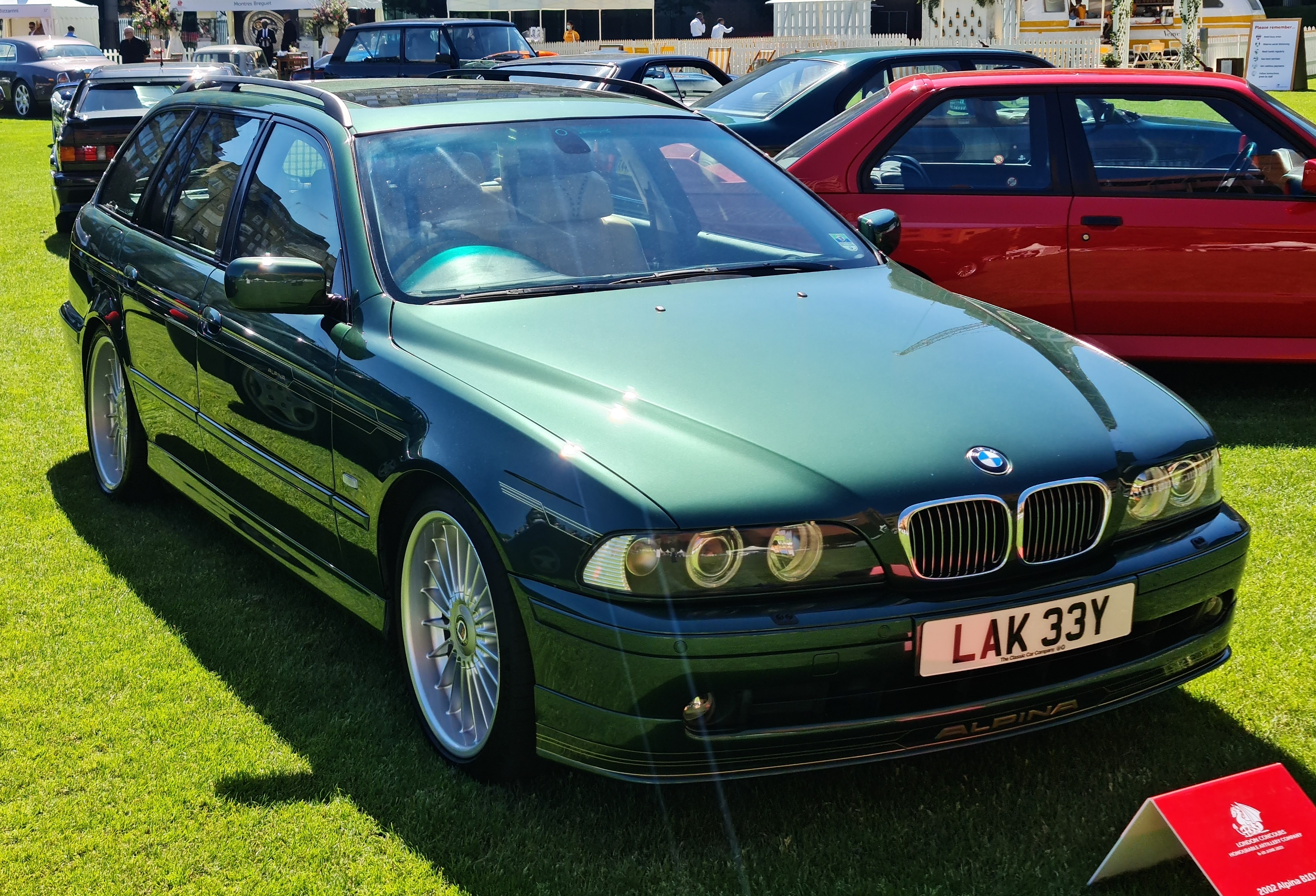
The B10 was built as a sedan and touring based on the BMW E39 from January 1997 to May 2004.
In February 2000, Alpina introduced the Alpina D10 Biturbo, the first six-cylinder diesel model produced by Alpina. The engine, a 3.0 litre twin turbocharged unit with 182 kW and 500 Nm of torque, was based on the engine of the BMW 530d. It was at the time the most powerful diesel saloon in the world. High-pressure common-rail injection technology (the famous Bosch CP3 high-pressure pump) has revolutionized the diesel industry.
Engines
The third generation of the B10 was built with both six-cylinder and V8 engines.
The six-cylinder engines with 3.2 and 3.3 liters displacement were based on the 528i and the 530i. For the 3.3 liter engine the engine block was bored to increase displacement to 3298 cubic centimeters. The cylinder head was machined and a modified crankshaft was added, different pistons and camshafts were also used. A modified intake system enabled a higher rate of air flow, as well as a stainless steel exhaust system (Alpina-Bosal) with metal catalytic converters. The engine control unit was also completely revised, which increased the power to 206 kW.
The two V8 engines with 4.6 (B10 V8) and 4.8 liters (B10 V8S) come from the BMW 540i. Again, a larger displacement was achieved by boring the engine block, which, together with other modifications, increased the power to 250 kW, then to 255 kW for the 4.6 liter engine, and 276 kW through an increased stroke with the 4.8 liter engine.
Suspension
The original suspension from the BMW E39 has been reworked for the B10. Changes include modified springs and tuned shock absorbers from Sachs that help lower the car.
Technical data
| Model | Engine | Power | Torque | Years |
|---|---|---|---|---|
| B10 3.2 | BMW M52 | |||
| I6 | 191 kW | |||
| at 5,900 rpm | 330 Nm | |||
| at 4,300 rpm | 8/1997–12/1998 | |||
| B10 3.3 | BMW M52 | |||
| I6 | 206 kW | |||
| at 6,200 rpm | 335 Nm | |||
| at 4,500 rpm | 2/1999–10/2003 | |||
| B10 V8 | M62B46 | |||
| V8 | 250 kW | 470 Nm | 1/1997–10/1998 | |
| B10 V8 | M62TUB46 | |||
| V8 | 255 kW | 480 Nm | 10/1998–9/2002 | |
| B10 V8S | Alpina F5 | |||
| V8 | 280 kW | 519 Nm | 1/2002–5/2004 | |
| D10 Biturbo | M57D30 | |||
| I6 | 180 kW | 500 Nm | 4/2000–10/2003 |
E60 B5
Main article: Alpina B5 (E60)
The BMW E60 and the 4.4-liter BMW N62 engine from the 545i serve as the basis for the Alpina B5, which uses the same H1 supercharged engine as the E65 B7. Compared to the E60, the B5 has larger brakes, a new suspension with Electronic Damper Control, a stainless steel silencing system with polished double tailpipes and the typical Alpina changes to the interior and exterior.
The B5 was made from February 2005 to September 2007 and the B5 S was made from September 2007 to May 2010.
Drivetrain
The N62B44's output is increased by means of a centrifugal supercharger. The supercharger is made by the company ASA, and is also called "Turbessor" because it is able to combine the advantages of turbocharger and supercharger. At low speeds, it spontaneously responds as a conventional displacement compressor, but it can also immediately provide the thrust of a turbo. It also reaches speeds of more than 100,000 revolutions per minute. As compared to the 545i performance has increased from 245 kW to 368 kW, torque was increased from 450 Nm to 700 Nm. The power is transmitted to the rear wheels by means of a six-speed automatic transmission (6HP 26). As usual with Alpina, this was refined and has "Switch-Tronic".
Technical data
| Alpina B5 | Sedan | Touring | |
|---|---|---|---|
| Displacement | 4398 cm3 | ||
| Compression ratio | 9,0:1 | ||
| Horsepower | 368 kW at 5500–6000 rpm | ||
| Torque | 700 Nm at 4250–4850 rpm | ||
| Transmission | 6-speed automatic "Switch-Tronic" | ||
| Top speed | 314 km/h | ||
| Acceleration 0–100 km/h | 4.7 s | ||
| Empty weight | 1720 kg |
Note
In 2005, an Alpina B5 Touring was tested by Auto, Motor und Sport on the Nardò Ring. The B5 reached a top speed of 319 km/h.
Alpina B5 S
At the 2007 Frankfurt Motor Show (IIA), Alpina presented the revised B5 S.

Engine
The motor's combustion process was optimized by changing the camshaft. This resulted in a significantly lower exhaust gas temperature, which is the basis for the performance increase. The power of the 4.4-liter V8 was thus increased by 22 kW to 390 kW. The torque increased by 25 Nm to 725 Nm. The B5 S completes the sprint to 100 km/h in 4.6 seconds; The top speed increases to 317 km/h.
Transmission
One innovation is the ZF six-speed Sport-Switch-Tronic transmission. The switching time was reduced by 50% compared to the predecessor. The reaction time is 1/10 s. In manual mode, the driving feeling is similar to the shift dynamics of a dual clutch transmission.
Chassis
A further feature is the EDC suspension tuning with the company Sachs Race Engineering.
Technical data
| Alpina B5S | Sedan | Touring | |
|---|---|---|---|
| Displacement | 4398 cm3 | ||
| Compression ratio | 9,0:1 | ||
| Horsepower | 390 kW at 5500 rpm | ||
| Torque | 725 Nm at 4750 rpm | ||
| Transmission | 6-Speed Automatic "Switch-Tronic" | ||
| Top speed | 317 km/h | ||
| Acceleration 0–100 km/h (62 mph) | 4.6 s | ||
| Empty weight | 1720 kg |
F10 B5
Main article: Alpina B5 (F10)
Alpina produced two variants based on the BMW 5 Series (F10), the petrol-engined B5 and diesel-engined D5.
B5 Bi-Turbo

The B5 is based on the 550i and is powered by an Alpina-modified version of the BMW N63 twin-turbo V8 engine. The original B5, which was unveiled at the 2010 Goodwood Festival of Speed, produced 373 kW and 700 Nm. The transmission is an 8-speed automatic.
Alpina unveiled an updated B5 at the 2012 Geneva Motor Show. Power had been uprated to 397 kW and torque to 730 Nm. During 2015, Alpina sold the B5 Bi-Turbo Edition 50, which marked the company's 50th year in operation. The Edition 50 uses an upgraded engine which produces 441 kW and 800 Nm. The standard B5 received this same engine for the B5's last year of production, 2016.
D5 Bi-Turbo
The D5 Bi-Turbo is based on the 535d. It is powered by Alpina-modified version of the BMW N57 turbo straight-6 engine, which produces 257 kW and 700 Nm of torque.
G30 B5
Main article: Alpina B5 (G30)
The third generation B5 is based on the BMW 5 Series (G30), and is available in both saloon and wagon body styles.
7 Series based Alpinas
E32 B11
E32 B12
E38 B12
Main article: Alpina B12
_(16531947875)_(cropped).jpg)
Based on the BMW 750i and 750iL, Alpina released the B12 5.7 in 1995 and the B12 6.0 in 1999. In contrast to the cars they are based on, these models are not electronically limited to a top speed of 250 km/h, but are able to reach top speeds of more than 280 km/h and 291 km/h, respectively. According to Alpina, the B12 5.7 was the world's first vehicle with an electrically heated metal catalyst as standard. The B12 5.7 has a 5.7 litre V12 and the B12 6.0 has a 6.0 litre V12.
| Model | Engine | title=ALPINA Automobile auf Basis der BMW 7er – E38 - | publisher=ALPINA Burkard Bovensiepen GmbH + Co. KG | url=https://www.alpina-automobiles.com/de/produktwelt/modellhistorie/bmw-7er/bmw-7er-e38/ | access-date=2 April 2016 | language=de}} | Torque | Years | Production |
|---|---|---|---|---|---|---|---|---|---|
| B12 5.7 | V12 | 285 kW | 560 Nm | 12/1995–08/1998 | 202 | ||||
| B12 6.0 | V12 | 316 kW | 600 Nm | 07/1999–07/2001 | 94 |
E65 B7
Main article: Alpina B7 (E65)

For the E65 7 Series generation, the Alpina B7 was widely credited with being able to hold its own against top performing offerings from Mercedes (including AMG) such as the S600 and S63 AMG, Audi (particularly quattro's Audi S8), the Bentley Flying Spur, and Jaguar XJ Supercharged, while BMW's own top-of-the-line V12 760Li was considered uncompetitive.
The E65 B7 uses a supercharged version of the 4.4-litre V8 found in the BMW 745i as the 750i and its 4.8-litre engine were not around when development began. The 760Li's naturally aspirated 6.0-litre V12 was deemed too heavy to have a sporty offshoot.
BMW of North America, LLC offered 800 Alpina B7s as limited edition models for 2007 and 2008, all of which quickly sold out.
{{anchor|F01|F02}} F01/F02 B7
Main article: Alpina B7 (F01)
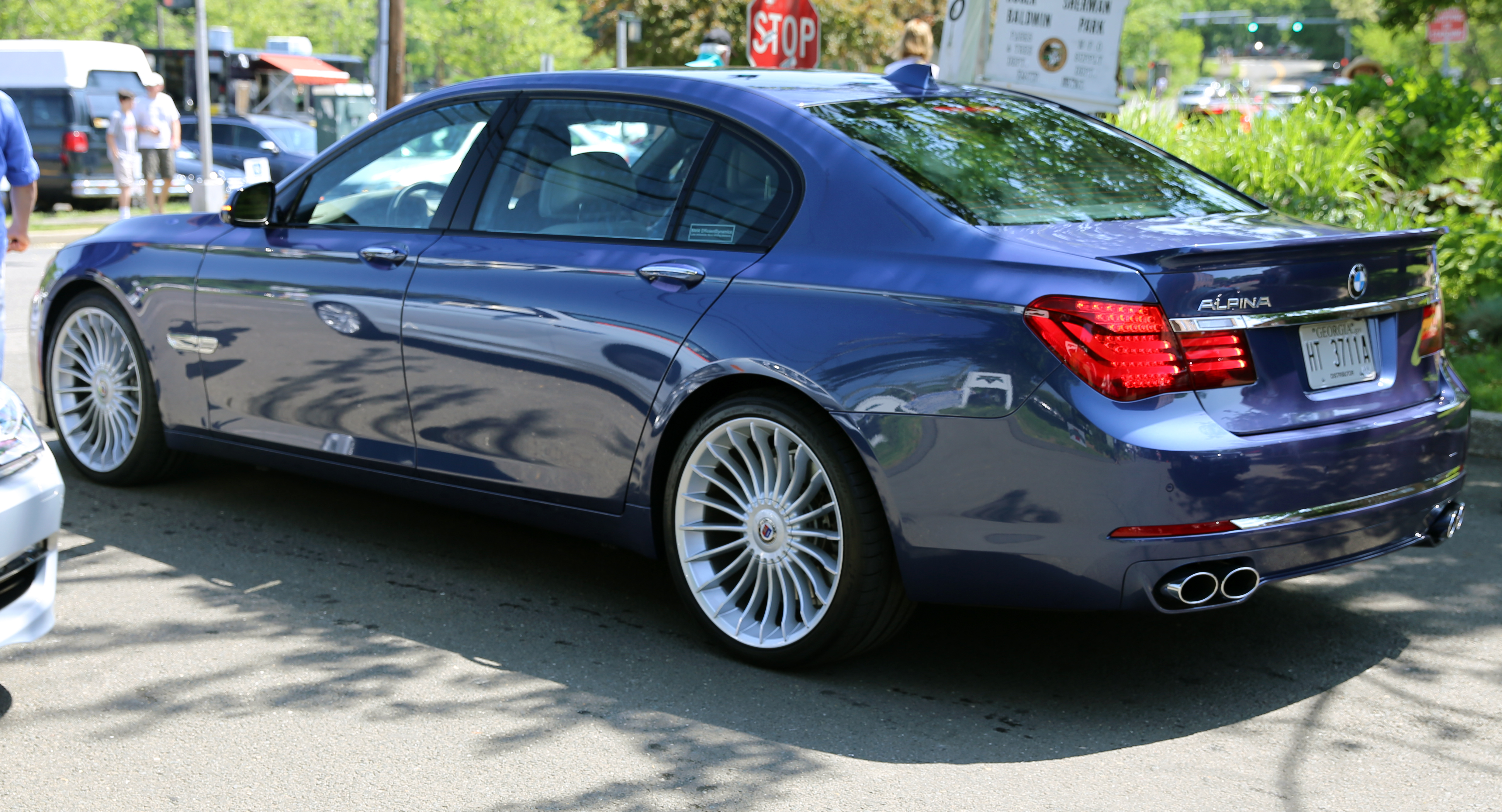
The F01 B7 will be offered again for the 2011 model year in the US, with approximately 500 vehicles (half of the annual production of the B7) with a choice of rear-wheel drive or all-wheel drive and/or a standard or long wheelbase (the B7, B7 L (long wheelbase), B7 xDrive (all-wheel drive), and B7 L xDrive), otherwise all configurations have the same equipment. Roughly 80 models will be sold in Canada, all of the xDrive variety due to that country's winter weather.
The B7's twin-turbo 4.4-litre V8 is assembled by hand at Alpina's facility in Buchloe, Germany, before being shipped to BMW for installation, and the assembled vehicle is then sent back to Alpina for finishing touches. It is based upon BMW's N63 twin-turbo V8 but produces considerable more torque and horsepower, albeit with some turbo lag due to the larger turbos, yet more measured throttle mapping makes the B7 smoother than a stock BMW 750i. The 2011 Alpina B7, with its twin-turbo 4.4-litre V8 engine and 6-speed automatic transmission, is less expensive and yet faster than its F01 stablemate, the 2010 BMW 760Li powered by a twin-turbo 6.0-litre V12 mated to an 8-speed automatic transmission. The B7's engine, derived from the BMW N63 that is found in the standard BMW lineup, matches the BMW 750i in fuel economy despite increased performance, plus its lighter weight than the 760Li's V12 engine gives the B7 considerably better weight distribution and handling than the 760Li.
While BMW uses run-flat tires for its 7 Series, the B7 comes with non-reinforced tires with a tire repair kit for emergencies. By using conventional, softer-sidewalled tires, compared to the reinforced sidewalls of run-flats, Alpina engineers were able to stiffen the B7's suspension for better handling and still improve the ride quality over that of a stock BMW 750i.
For the 2013 model year, the Alpina B7 received similar updates to the rest of the 7 Series lineup, including an 8-speed automatic transmission, while its engine adds Valvetronic and now produces 540 hp and 538 lbft, which is good for a 0–100 km/h time of 4.3 seconds and a top speed of 300 km/h. Compared to BMW M's version of the 4.4L twin-turbo engine (such as found in the F10 M5), Alpina's engine has 20 hp less but more maximum torque which is also available at a lower rpm.
In a comparison of the 2013 BMW 7 series and the Alpina B7, Motor Trend stated the B7 handled better than the BMW 760iL, but not as well as the 750iL.
G12 B7
Main article: Alpina B7 (G12)
Alpina introduced the next generation of the B7, based on the G11/G12 BMW 7 Series, in 2016. It features a 4.4L twin-turbocharged V8, designated the N63M30, producing 608 hp and 590 lbft of torque. The B7 can accelerate from 0-60 mph in 3.6 seconds and reach a top speed of 205 mph.
8 Series based Alpinas
E31 B12
B12 5.0
.jpg)
The B12 5.0 was built from 1990 to 1994 and is based on the BMW E31 850i. It is powered by an Alpina modified BMW M70 V12 (shared with the E32 B12 5.0) producing 257 kW and mated to an automatic transmission.
B12 5.7

The B12 5.7 was available from 1992 and is based on the 850CSi. It is powered by an increased displacement version of the BMW S70 V12 with a modified intake, crankshaft. camshafts and a stainless steel exhaust system as well as a six speed manual gearbox with an optional system called Shift-Tronic that automatically actuates the clutch when shifting and allows the vehicle to creep in traffic, 32 B12 5.7s were equipped with Shift-Tronic. it produced 306 kW. The carbon-fibre hood has cooling vents and a NACA duct.
G16 B8
B8 Gran Coupé

The Alpina B8 Gran Coupé was available in 2021 and is based on the BMW M850i and M8 Gran Coupé's respectively. Powered by an Alpina tuned version of BMW's N63 4.4L V8 Bi-Turbo, the B8 produces 630 PS and 800 Nm of torque. Alpina tuned suspension and handling provided drivers with a Comfort+ and Sport+ mode for ideal ride comfort and performance. The exterior sports Alpina Classic 21 inch wheels featuring 20 spokes per wheel, Alpina designed front and rear bumpers, and a choice of Alpina blue or green metallic paint. The interior features Alpina trim appointments, custom Alpina leather upholstery, and or BMW Individual trims and upholstery.
Technical data
| Model | Engine | Power | Torque | Years | Production |
|---|---|---|---|---|---|
| B12 5.0 | V12 | 257 kW | 470 Nm | 6/1990-5/1994 | 97 |
| B12 5.7 | V12 | 306 kW | 570 Nm | 11/1992-11/1996 | 57 |
Alpina Roadster V8

With production of the BMW Z8 completed by November 2002, for 2003 the Z8 production was replaced by the Alpina Roadster V8. The Alpina was a departure from the hard-edged sporting focus of the original car, and elements of the new grand touring intent were evident throughout this final edition.
Instead of the original six-speed manual and 4.9 L (S62) engine featured in Z8's, the Alpina came only as an automatic, using a five-speed BMW Steptronic transmission mated to a 4.8 L Alpina-tuned V8 motor from the Alpina E39 B10 V8 S (Alpina F5). In order to complete the car's transition from sports car to Alpina, relaxed suspension tuning was used. The standard Z8's run-flat tires on 18 in wheels were discarded in favor of conventional tires with softer sidewalls, on 20 in wheels.
A new, softer grade of Nappa leather replaced the Z8's less supple specification, and special Alpina gauges were featured on the dash cluster. An Alpina steering wheel with three solid spokes replaced the original, which could not be retrofitted with shift paddles for the automatic. Gear selection was displayed in an Alpina-specific display mounted in front of the wheel.
Performance of the Alpina V8 differed from that of the standard car in that peak power was reduced to 381 PS while peak torque was raised to 520 Nm; this torque was available at significantly lower rpm than the original in order to enable more relaxed cruising. Curiously, the electronically limited top speed was officially raised to 260 km/h, rather than the 250 km/h that most cars are limited to.
Only 555 of these Alpinas were built, 450 of which were exported to the U.S. market and only eight to the UK. In the United States, this special edition of the Z8 was sold directly through BMW dealerships, marking a first for Alpina, whose cars had never been sold through retail channels in the U.S.
Gallery
File:CS-Alpina.JPG|1974 BMW 3.0 CS 'Alpina' profile view File:CS-Interior.jpg|1974 BMW 3.0 CS 'Alpina' interior File:BMW ALPINA B7 Turbo Coupé 1.jpg|1984 BMW Alpina B7 Turbo Coupé / 1 File:AlPINA C2 27 iX b.jpg|Alpina C2 2.7 Allrad File:ALPINA C2 27 iX.jpg|Alpina C2 2.7 Allrad File:Alpina B10 BiTurbo rear.jpg|1992 Alpina B10 BiTurbo File:Alpina Deco stripe.jpg|Alpina Deco stripe File:Alpina rim.jpg|Alpina wheel
File:BMW Alpina B5 E60 (2005) engine bay.jpg|Alpina B5 (2005) engine bay File:2007 Alpina B6 S.JPG|Alpina B6 S File:Alpina (4075372782).jpg|Alpina D3 Bi-Turbo
References
References
- Elsinore, Bradford. (20 May 2010). "2011 BMW 750Li Alpina B7 First Drive". Insideline.com.
- (22 August 2024). "2011 BMW ALPINA B7". Autoblog.com.
- (2023-10-19). "Alpina founder Burkard Bovensiepen has died aged 87".
- Petroni, Giulia. (2022-03-10). "BMW to Acquire Alpina Brand".
- "Expanding the Portfolio: BMW Group Acquires the Alpina Brand".
- (17 May 2014). "Alpinas Long Enduring Successes". Max Rodgers.
- "ALPINA SWITCH-TRONIC".
- Vanderwerp, Dave. (July 2007). "2007 BMW Alpina B7 - Road Test - Car Reviews". Car and Driver.
- "Technische Daten: ALPINA Automobiles".
- "Technische Daten: ALPINA Automobiles".
- "Technische Daten: ALPINA Automobiles".
- "Technische Daten: ALPINA Automobiles".
- "Technische Daten: ALPINA Automobiles".
- "Technische Daten: ALPINA Automobiles".
- (7 July 2014). "To The Max". [[Autoweek]].
- "Technische Daten: ALPINA Automobiles".
- "Highlights: ALPINA Automobiles".
- Panait, Mircea. (9 March 2018). "Alpina Brings XD3 And XD4 In Geneva, Both Are Quad-Turbocharged". autoevolution.
- (9 March 2018). "2018 Geneva: BMW ALPINA D5 S in Alpina Green looks stunning". BMW BLOG.
- "Alpina revs up BMW SUVs with new XD3 and XD4". CAR Magazine.
- Rae, Alex. (6 March 2018). "Alpina reveals world's fastest diesel SUV - The world's fastest diesel SUV". Drive.
- "Alpina XD3 coming next year, XD4 not for Australia {{!}} CarAdvice". CarAdvice.com.
- (11 September 2013). "Alpina D3 Biturbo auf der IAA: 278 km/h im 3er-Selbstzünder".
- Sheehan, Sam. (7 March 2017). "Hot Alpina B5 gets 600bhp BMW V8; Alpina's hot B5 will be joined by a 400bhp D5 version based on BMW's 550d".
- "Road Vehicle Descriptor (RVD1)".
- "All-new Alpina B5 Bi-Turbo on sale in the UK – Alpina's £89k, 200mph saloon and estate". Evo.
- Mahoney, John. (24 January 2018). "BMW Alpina B5 Biturbo 2018 Review".
- (5 July 2017). "Wie dynamisch ist Alpinas Allrad-Mittelklasse?".
- Baumann, Uli. "Neuer Alpina B5 Biturbo (2017): Power-5er mit M-Ambitionen". auto motor und sport.
- "New 322bhp BMW Alpina D5 S debuts at the Frankfurt Motor Show". Auto Express.
- "Alpina D5 S Review (2018) {{!}} Autocar".
- "New Alpina D5 S revealed in saloon and estate forms in Frankfurt". Evo.
- (12 September 2017). "Alpina D5 S: Der schnellste Seriendiesel der Welt". Süddeutsche Zeitung.
- (19 April 2018). "Alpina D5 S review: tuned twin-turbo 5 Series tested". Top Gear.
- (8 April 2014). "Alpina B6 xDrive Gran Coupe Available on the BMW USA Website".
- Meiners, Jens. (April 2014). "2015 BMW Alpina B6 xDrive Gran Coupe". [[Car and Driver]].
- Lingeman, Jake. (18 December 2019). "Full Gallery: 2020 BMW Alpina B7".
- "Preview: 2013 Alpina B7 offers outrageous performance | Driving | National Post". Life.nationalpost.com.
- (19 May 2010). "2011 BMW Alpina B7 First Drive". Motor Trend.
- (8 August 2016). "2016 Alpina B7 Biturbo review {{!}} Autocar".
- Ingram, Antony. (9 February 2016). "Alpina B7 – 600bhp luxury car revealed ahead of Geneva".
- "The new 2020 ALPINA B7 xDrive Sedan - Power, Dynamics and Luxury in a new contemporary Design.".
- "Alpina Typentabelle". Allegos.com.
- (7 September 2011). "Alpina Modellhistorie". Alpina-automobiles.com.
- "BMW 3er E90/91/92/93: ALPINA Automobiles: ALPINA Automobiles".
- "Technische Daten: ALPINA Automobiles".
- ter Kuile, Caju. (24 December 1983). "Rijden met: BMW Alpina C1-2.3". Folio Groep B.V..
- "This Alpina C1 is a Rare Bit of BMW 3 Series History". Motor1.com.
- "1985 Alpina C2 2.5 (model since July 1985 for Europe ) specifications & performance data review". Pawel Zal.
- Ritter, Marc. "Alpina Typentabelle". alpinacars.
- (1 August 1986). "Auto Katalog 1987". [[:de:Motor Presse Stuttgart.
- "Be Different: Drive This Rare Alpina B6 2.8". Motor1.com.
- (16 November 2017). "RM Sotheby's - 1986 BMW Alpina B6 2.7 {{!}} Arizona 2017". RM Sotheby's.
- (18 October 2016). "Alpina B6 3.5S". Mint Classics.
- (6 March 2012). "Official Alpina Website, February 2012". Alpina-automobiles.com.
- "2012 Alpina B3 GT3 review and pictures".
- "KW History {{!}} KW suspensions".
- "1976 BMW Alpina B2 {{!}} Paris 2023".
- "Was the Alpina B2 the original German super-saloon?".
- "1982 BMW Alpina B7 S Turbo {{!}} Paris 2020".
- "1982 BMW Alpina B7 S Turbo {{!}} Paris 2019".
- "This 1983 Alpina B9 is aRare Alternative to the BMW M5".
- Alpina: [https://www.alpina-automobiles.com/de/produktwelt/modellhistorie/bmw-5er/bmw-5er-e28/ ALPINA Automobile auf Basis der BMW 5er]
- [https://www.alpina-automobiles.com/de/produktwelt/modellhistorie/bmw-5er/bmw-5er-e28/ B10 E28 technische Daten]
- [http://www.alpina-archive.com/?page_id=176&nmt=B10-3.5 B10-3.5]
- "B10 3.5/1".
- "B10 4.0".
- [https://www.alpina-automobiles.com/de/produktwelt/modellhistorie/bmw-5er/bmw-5er-e34/ B10 E34 technische Daten]
- (1 September 2017). "Driving the Alpina B10 BiTurbo, The World's Fastest Four-Door in 1991". Road & Track.
- "ALPINA Automobiles based on BMW 5 Series E39". www.alpina-automobiles.com.
- "E39 B10 3.2".
- "E39 B10 V8".
- "E39 B10 V8S".
- "ALPINA Automobiles based on BMW 5 Series E60 / E61".
- (4 October 2005). "Alpina B5 gegen Mercedes-Benz E 55 AMG".
- "Nardo High-Speed: Wem die Stunde schlägt".
- "ALPINA B5 S S macht schneller".
- (February 2022). "F10 ALPINA B5 BiTurbo Unveiled".
- "BMW 5 Series F10/F11".
- "Alpina B5 Bi-Turbo Edition 50 review - the fastest 5-series money can buy".
- (21 June 2010). "Alpina B5". Top Gear.
- "BMW Alpina B5 Biturbo Revised: The Other Hot 5-series [Geneva Auto Show] | Car and Driver Blog".
- "BMW 5 Series F10/11: ALPINA Automobiles".
- "ALPINA Meilensteine". ALPINA Burkard Bovensiepen GmbH + Co. KG.
- "ALPINA Automobile auf Basis der BMW 7er – E38 -". ALPINA Burkard Bovensiepen GmbH + Co. KG.
- "BMW 7er E38: ALPINA Automobiles".
- "Alpina-Archive The Unofficial BMW Alpina homepage – since 1998".
- (2 May 2007). "2007 BMW ALPINA B7 Review by Cars.com Staff". Cars.com.
- (11 February 2010). "Chicago 2010: BMW Alpina B7 Sedan Making a Comeback". Nitrobahn.com.
- (2 May 2007). "2007 BMW ALPINA B7 Review by Cars.com Staff". Cars.com.
- "7-series [E6x]". Alpina-Archive.
- (22 August 2024). "2011 BMW ALPINA B7". Autoblog.com.
- "Handler". Bmwusa.com.
- Lorio, Joe. (28 August 2012). "First Drive: 2013 BMW 7-series".
- (28 August 2012). "2013 BMW 750Li, 760Li, and Alpina B7 First Drive". Motor Trend.
- "Highlights: ALPINA Automobiles".
- "The Automated Clutch - The New LuK ECM".
- (March 2023). "Rare 1994 Alpina B12 5.7 Coupe is up for sale".
- "Chassis: ALPINA Automobiles".
- Hutton, Ray. (February 2003). "BMW Alpina Roadster V-8". Car and Driver.
- Buckley, Martin. (January 2003). "BMW Aplina Roadster V8". Evo.
This article was imported from Wikipedia and is available under the Creative Commons Attribution-ShareAlike 4.0 License. Content has been adapted to SurfDoc format. Original contributors can be found on the article history page.
Ask Mako anything about Alpina — get instant answers, deeper analysis, and related topics.
Research with MakoFree with your Surf account
Create a free account to save articles, ask Mako questions, and organize your research.
Sign up freeThis content may have been generated or modified by AI. CloudSurf Software LLC is not responsible for the accuracy, completeness, or reliability of AI-generated content. Always verify important information from primary sources.
Report