From Surf Wiki (app.surf) — the open knowledge base
Alpha solenoid

An alpha solenoid (sometimes also known as an alpha horseshoe or as stacked pairs of alpha helices, abbreviated SPAH) is a protein fold composed of repeating alpha helix subunits, commonly helix-turn-helix motifs, arranged in antiparallel fashion to form a superhelix. Alpha solenoids are known for their flexibility and plasticity. Like beta propellers, alpha solenoids are a form of solenoid protein domain commonly found in the proteins comprising the nuclear pore complex. They are also common in membrane coat proteins known as coatomers, such as clathrin, and in regulatory proteins that form extensive protein-protein interactions with their binding partners. Examples of alpha solenoid structures binding RNA and lipids have also been described.
Terminology and classification
The term "alpha solenoid" has been used somewhat inconsistently in the literature. However, protein structural classification systems have used varying terminology; the Structural Classification of Proteins (SCOP) database describes these proteins using the term "alpha alpha superhelix". The CATH database uses the term "alpha horseshoe" for these proteins, and uses "alpha solenoid" for a somewhat different and more compact structure exemplified by the peridinin-chlorophyll binding protein.
Structure
Alpha solenoid proteins are composed of repeating structural units containing at least two alpha helices arranged in an antiparallel orientation. Often the repeating unit is a helix-turn-helix motif, but it can be more elaborate, as in variants with an additional helix in the turn segment. Alpha solenoids can be formed by several different types of helical tandem repeats, including HEAT repeats, Armadillo repeats, tetratricopeptide (TPR) repeats, leucine-rich repeats, and ankyrin repeats.
Alpha solenoids have unusual elasticity and flexibility relative to globular proteins. They are sometimes considered to occupy an intermediate position between globular proteins and fibrous structural proteins, distinct from the latter in part due to the alpha solenoids' lack of need for intermolecular interactions to maintain their structure. The extent of the curvature of an alpha solenoid superhelix varies considerably among the class, resulting in the ability of these proteins to form large, extended protein-protein interaction surfaces or to form deep concave areas for binding globular proteins.
Because they are composed of repeating relatively short subunits, alpha solenoids can acquire additional subunits relatively easily, resulting in new interaction surface properties. As a result, known alpha solenoid proteins vary substantially in length.
Function
Nuclear pore complex components
Alpha solenoids feature prominently in the proteins making up the nuclear pore complex (NPC); alpha solenoid and beta propeller domains together account for up to half of the core NPC scaffold by mass. This latter domain architecture also occurs in clathrin and Sec31, and was thought to be unique to eukaryotes, though a few examples have been reported in planctomycetes.
Vesicle coat proteins
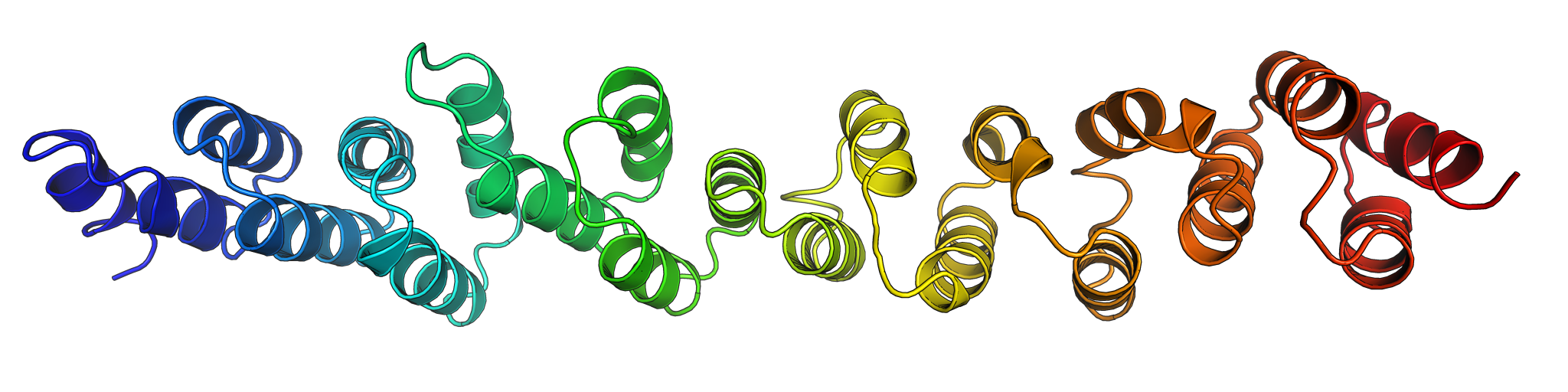
Vesicle coat proteins frequently contain alpha solenoids and share common domain architecture with some NPC proteins.
Transport proteins
Due to their propensity for forming large interaction surfaces well-suited to protein-protein interactions, and their flexible surfaces permitting binding of various cargo molecules, alpha solenoid proteins commonly function as transport proteins, particularly in transport between the nucleus and the cytoplasm. Transporters of other molecules, such as RNA, can also be of alpha solenoid architecture, as in exportin-5 or pentatricopeptide-repeat-containing RNA-binding proteins, which are particularly common in plants.
Regulatory proteins

The protein-protein interaction capacity of alpha solenoid proteins also makes them well suited to function as regulatory proteins. For example, regulatory subunit A (also known as PR65) of protein phosphatase 2A is a HEAT-repeat alpha solenoid whose conformational flexibility regulates access to the enzyme binding site.
Taxonomic distribution
Alpha solenoid proteins are found in all domains of life; however, their frequencies in different proteomes vary significantly. They are rare in viruses and bacteria, somewhat more common in archaea, and quite common in eukaryotes. Many of the eukaryotic alpha solenoid proteins have detectable homologs only in other eukaryotes and are often restricted even further, to the chordates. Prokaryotic alpha solenoid proteins are concentrated in particular taxa, notably the cyanobacteria and planctomycetes, which have unusually complex intracellular compartmentalization relative to most prokaryotes.
Evolution
Evolutionary relationships between different alpha solenoid proteins are difficult to trace due to the low sequence homology of the repeats. Convergent evolution of similar protein structures from ancestrally unrelated proteins is thought to be significant in the evolutionary history of this fold class.
Nuclear pore complexes and vesicle transport
The nuclear pore complex is an extremely large protein complex that mediates transit into and out of the cell nucleus. Homologous structures from which the NPC might have evolved have not been detected in prokaryotic transmembrane transport proteins; however, it has been suggested that the NPC components show distinct homology to vesicle coat proteins found in clathrin/adaptin, COPI, and COPII complexes. Most distinctively, a shared domain architecture consisting of an N-terminal beta propeller and a C-terminal alpha solenoid has been detected in both NPC and coat proteins, suggesting a possible common origin.
Examination of the genome of Lokiarchaeum, thought to be among the closest archaeal relatives to eukaryotes, did not reveal any examples of the beta propeller/alpha solenoid domain architecture, although homologs of other proteins involved in eukaryotic membrane trafficking were identified. However, it is unclear whether this observation means that the propeller/solenoid architecture evolved later or was lost from modern lokiarchaea.
Membrane coat proteins in prokaryotes
A survey of the sequenced genomes of complex prokaryotes from the PVC superphylum (Planctomycetota-Verrucomicrobiota-Chlamydiota) identified examples of proteins with homology to eukaryotic membrane trafficking proteins, including examples of the distinctive beta-propeller/alpha-solenoid domain architecture previously believed to be unique to eukaryotes. The identification of proteins with sequence similarities to HEAT repeats in the G. obscuriglobus proteome has been interpreted as support for the membrane-bound nucleoid hypothesis; however, this has been disputed.
Bioinformatics
Low sequence similarity among alpha solenoid proteins of similar structure has impeded their identification using bioinformatics methods, since the repeats are often not well defined in sequence. A large number of different computational methods have been developed to identify candidate alpha solenoid proteins based on their amino acid sequence.
References
References
- (1 November 2006). "Crystal structure of a protein phosphatase 2A heterotrimeric holoenzyme". Nature.
- (21 November 2013). "Functional and Genomic Analyses of Alpha-Solenoid Proteins". PLOS ONE.
- (September 2010). "An Unusual Hydrophobic Core Confers Extreme Flexibility to HEAT Repeat Proteins". Biophysical Journal.
- (13 June 2011). "On a bender—BARs, ESCRTs, COPs, and finally getting your coat". The Journal of Cell Biology.
- (October 2000). "When protein folding is simplified to protein coiling: the continuum of solenoid protein structures". Trends in Biochemical Sciences.
- "CATH Topology "Alpha Horseshoe"".
- (2 November 2004). "Components of Coated Vesicles and Nuclear Pore Complexes Share a Common Molecular Architecture". PLOS Biology.
- (January 2005). "Nuclear pore complexes: Round the bend?". Nature Cell Biology.
- (19 January 2010). "The Compartmentalized Bacteria of the Planctomycetes-Verrucomicrobia-Chlamydiae Superphylum Have Membrane Coat-Like Proteins". PLOS Biology.
- (27 May 1999). "Clathrin self-assembly is mediated by a tandemly repeated superhelix". Nature.
- (September 2010). "Quantitative Structural Analysis of Importin-β Flexibility: Paradigm for Solenoid Protein Structures". Structure.
- (November 2011). "Nucleocytoplasmic Transport of MicroRNAs and Related Small RNAs". Traffic.
- (16 August 2012). "A Combinatorial Amino Acid Code for RNA Recognition by Pentatricopeptide Repeat Proteins". PLOS Genetics.
- (29 April 2014). "Pentatricopeptide Repeat Proteins in Plants". Annual Review of Plant Biology.
- (January 1999). "The Structure of the Protein Phosphatase 2A PR65/A Subunit Reveals the Conformation of Its 15 Tandemly Repeated HEAT Motifs". Cell.
- (25 January 2010). "PR65, the HEAT-repeat scaffold of phosphatase PP2A, is an elastic connector that links force and catalysis". Proceedings of the National Academy of Sciences.
- (26 September 2016). "The changing view of eukaryogenesis – fossils, cells, lineages and how they all come together". Journal of Cell Science.
- (2 March 2016). "Sequence evidence for common ancestry of eukaryotic endomembrane coatomers". Scientific Reports.
- (June 2016). "Tracing the Archaeal Origins of Eukaryotic Membrane-Trafficking System Building Blocks". Molecular Biology and Evolution.
- (2010). "Beyond Prokaryotes and Eukaryotes: Planctomycetes and Cell Organization". Nature Education.
- (November 2011). "Planctomycetes and eukaryotes: a case of analogy not homology.". BioEssays.
- (October 2013). "The PVC superphylum: exceptions to the bacterial definition?". Antonie van Leeuwenhoek.
- (September 2013). "Gemmata obscuriglobus". Current Biology.
- (February 2014). "Re-interpretation of the evidence for the PVC cell plan supports a Gram-negative origin.". Antonie van Leeuwenhoek.
- (January 2014). "PVC bacteria: variation of, but not exception to, the Gram-negative cell plan". Trends in Microbiology.
- (August 2014). "Towards understanding the molecular mechanism of the endocytosis-like process in the bacterium Gemmata obscuriglobus". Biochimica et Biophysica Acta (BBA) - Molecular Cell Research.
- (24 September 2015). "Tandem Repeats in Proteins: Prediction Algorithms and Biological Role". Frontiers in Bioengineering and Biotechnology.
This article was imported from Wikipedia and is available under the Creative Commons Attribution-ShareAlike 4.0 License. Content has been adapted to SurfDoc format. Original contributors can be found on the article history page.
Ask Mako anything about Alpha solenoid — get instant answers, deeper analysis, and related topics.
Research with MakoFree with your Surf account
Create a free account to save articles, ask Mako questions, and organize your research.
Sign up freeThis content may have been generated or modified by AI. CloudSurf Software LLC is not responsible for the accuracy, completeness, or reliability of AI-generated content. Always verify important information from primary sources.
Report