From Surf Wiki (app.surf) — the open knowledge base
Alpha Kappa Alpha
International historically African American collegiate sorority

International historically African American collegiate sorority
| Field | Value |
|---|---|
| letters | ΑΚΑ |
| name | Alpha Kappa Alpha |
| motto | "By Culture and By Merit" |
| crest | Alpha Kappa Alpha shield.svg |
| image_size | 180px |
| alt | The official crest of Alpha Kappa Alpha |
| founded | |
| scope | International |
| affiliation | NPHC |
| address | 5656 S. Stony Island Avenue |
| status | Active |
| type | Social sorority |
| emphasis | African-American |
| city | Chicago |
| state | Illinois |
| country | United States |
| ZIP code | 60637 |
| members | 90,000 |
| lifetime | 365,000+ |
| nicknames | AKAs, Alpha Women, Ivies |
| chapters | 1,085 |
| colors | Salmon Pink |
| Apple Green | |
| homepage | |
| birthplace | Howard University |
| flower | Pink Tea Rose |
| publication | Ivy Leaf |
| symbol | Ivy leaf |
Apple Green
Alpha Kappa Alpha Sorority, Inc. (ΑΚΑ) is a historically African-American sorority. The sorority was founded in 1908 at Howard University in Washington, D.C. Alpha Kappa Alpha was incorporated in 1913. It is a member of the National Pan-Hellenic Council (NPHC), a group of historically Black fraternities and sororities often called the Divine Nine.
In 2025, Alpha Kappa Alpha had more than 365,000 members in 1,085 chapters in the United States and eleven other countries. Women may join through undergraduate chapters at a college or university, or graduate chapters after acquiring an undergraduate or advanced college degree.
History
Beginnings: 1907–1912
In the spring of 1907, student Ethel Hedgemon Lyle led efforts to create a sorority at Howard University in Washington, D.C. Forming a sorority broke barriers for African-American women in areas where they had little power or authority due to a lack of opportunities for Black Americans in the early 20th century. Faculty member Ethel T. Robinson encouraged Hedgemon by relating her observations of sorority life at the Women's College at Brown University. Hedgemon began recruiting interested classmates; the group used the summer of 1907 to research and explore options for their new organization.
In November 1907, Hedgemon and Marie Woolfolk Taylor gave a presentation to the university's administration to secure approval for a sorority, which was granted immediately. Thus, Alpha Kappa Alpha became the first sorority member of the Divine Nine to be created at a historically black college or university. Nellie Quander was selected as the sorority's first president.
On January 15, 1908, the nine founders held the first official meeting of Alpha Kappa Alpha in Miner Hall. On February 21, 1908, the seven sophomores were admitted to the sorority without initiation and were also given a status as founders. In its first few months, Alpha Kappa Alpha created its rituals, held social events, and made presentations for the general public. On May 1, 1908, members planted ivy and a tree on the Howard campus; this practice was later adopted by the university and continued for decades."HU Journal, Volume 9 Issue 29" (1912). Volume 09. 29. https://dh.howard.edu/huj_v9/29
The sorority's first initiation was held in a wing of Miner Hall at Howard University on February 11, 1909. On May 25, 1909, Alpha Kappa Alpha held its first Ivy Day, a celebration that included planting ivy at Miner Hall. The sorority established many service efforts, including helping to create the NAACP and the YWCA D.C. chapter, feeding the hungry, tutoring, and clothing people experiencing poverty.
Incorporation: 1912–1913
By the end of the 1911–12 school year, Alpha Kappa Alpha had more than forty members at Howard. In October, former president Nellie Quander was invited to attend a sorority meeting. In this meeting, the active members proposed changing the sorority's name, colors, and symbols. Quander opposed the changes, advising the students that they had no right, legally or ethically, to make such changes. Quander advised them to hold a poll of the entirety of the sorority. That poll found that the vast majority did not favor the change.
Some of the undergraduate members who favored the changes held a meeting the next month with other collegiate women and voted to established a new group that incorporated the changes, forming what became Delta Sigma Theta. Quander set up a committee that worked to incorporate Alpha Kappa Alpha to ensure its continuation. Alpha Kappa Alpha Sorority became the first African-American sorority to incorporate nationally on January 29, 1913.
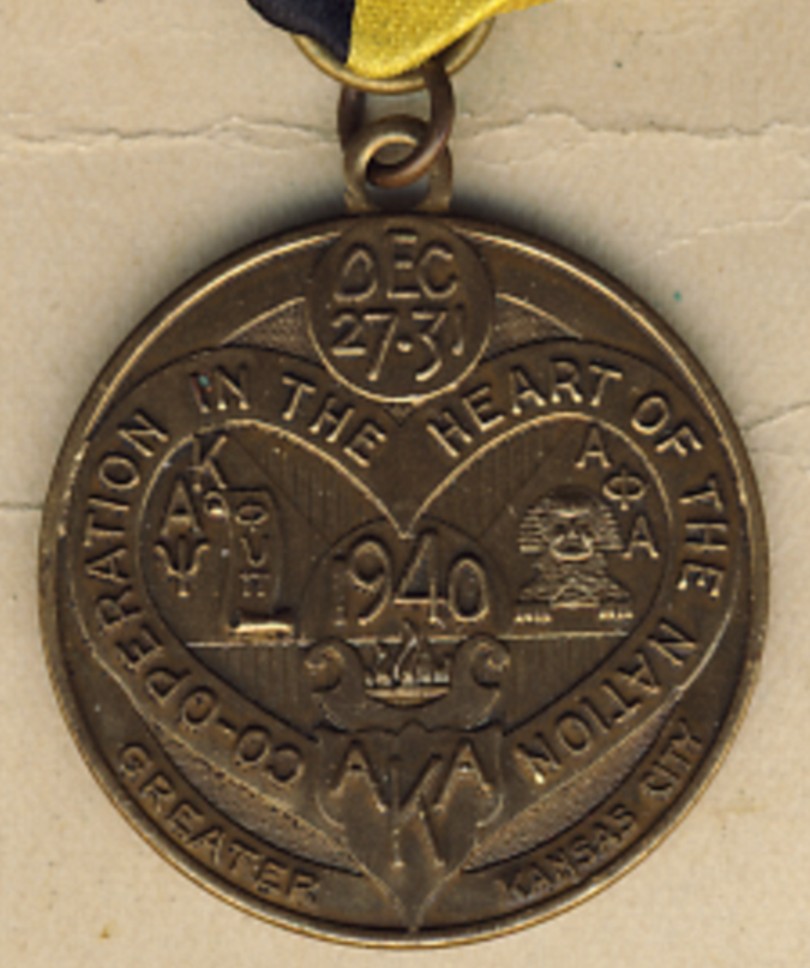
Expansion and implementation of programs: 1913–1940
Alpha Kappa Alpha helped to support members by providing scholarship funds for school and foreign studies and by raising money for Howard University's Miner Hall. It was the first of the historically Black fraternities and sororities at Howard University to offer a scholarship program.
A second chapter of Alpha Kappa Alpha was chartered at the University of Chicago in the fall of 1913. This sorority held its first annual Boulé, a meeting of the sorority's governing body, at Howard University in December 1918. The sorority's pledge was written by Grace Edwards and was adopted by the 1920 Boulé. In addition, the sorority's crest was designed by Phyllis Wheatley Waters and accepted in the same Boulé.
At the 1921 Boulé, the Ivy Leaf was designated as the sorority's publication, and Founders' Week, paying honor to ΆKΆ's founders, was established. Pearls were first introduced to the sorority in the same year. The sorority membership pin was approved in the following Boulé in Kansas City, Missouri. At the 1947, Boulé, pins for honorary members were designed and approved.
By 1920, the sorority created a national service plan catered to the surrounding communities of each chapter. By May 1924, Alpha Kappa Alpha opened its vocational guidance program. Throughout the Great Migration, members assisted the Travelers Aid Society to help thousands of Southern Blacks adjust to Northern society, find housing, and navigate around the city. Members also volunteered at the Freedman's Hospital.
In 1921, the sorority sent telegrams to seven other historically Black fraternities and sororities, suggesting that they form a panhellenic. On May 10, 1930, Alpha Kappa Alpha, along with the fraternities Kappa Alpha Psi and Omega Psi Phi and sororities Delta Sigma Theta and Zeta Phi Beta, formed the National Pan-Hellenic Council (NPHC) at Howard University.
In April 1933, the sorority's international president Ida Louise Jackson visited All Saints Industrial School in Lexington, Mississippi, learning of the difficult conditions in the Mississippi Delta during the Great Depression. Some of the school's teachers did not have an education past the seventh grade. African Americans were trying to make a living sharecropping on plantation land as agricultural prices continued to fall.{{cite web |last=Smith |first=Susan L. |title=Arenia Mallory |publisher=The University of Mississippi |date=June 2003 |url=http://www.olemiss.edu/depts/south/ms_encyclopedia/areniamallorysample.htm |access-date=2007-10-20 |url-status=dead |archive-url=https://web.archive.org/web/20120205182053/http://www.olemiss.edu/depts/south/ms_encyclopedia/areniamallorysample.htm |archive-date=2012-02-05 }}
In the summer of 1934, Jackson initiated the Summer School for Rural Teachers to train future teachers. She worked with a total of 22 student teachers and 243 school children. In addition, she held night classes for 48 adults. By obtaining 2,600 books for the school's library, Jackson made it "the largest library owned by white or colored in all Holmes County."
The December 1935 Boulé approved $1,000 for Jackson to forma a regional health clinic in Mississippi. The clinic opened in the summer of 1938 and evolved into the Mississippi Health Project, with Alpha Kappa Alpha Dorothy Boulding Ferebee serving as its director. The Mississippi Health Project brought primary medical care to the rural Black population across the state for six summers.{{cite web|date=2007-02-19|url=https://www.nlm.nih.gov/changingthefaceofmedicine/physicians/biography_109.html |archive-url=https://web.archive.org/web/20031017025830/http://www.nlm.nih.gov/changingthefaceofmedicine/physicians/biography_109.html |url-status=dead |archive-date=October 17, 2003
Norma Elizabeth Boyd led the sorority to create the National Non-Partisan Lobby on Civil and Democratic Rights (NPC) in 1938, later renamed the National Non-Partisan Council on Public Affairs. It was the first full-time congressional lobby for minority group civil rights. Throughout the organization's life, the Non-Partisan Council worked with the NAACP, National Urban League, the United Office and Professional Workers of America, the National Association of Graduate Nurses, the American Federation of Churches, the Colored Women's Club, the Brotherhood of Sleeping Car Porters and Auxiliary, and the New York Voter's League. The NPC was dissolved on July 15, 1948, by twelfth Supreme Basileus Edna Over Gray-Campbell.
In August 1945, Alpha Kappa Alpha established the American Council on Human Rights (ACHR) to replace the NPC. The council made recommendations to the government concerning civil rights legislation. The ACHR was proposed at the 1946 Boulé. In October 1946, Alpha Kappa Alpha was the first sorority to obtain observer status at the United Nations. On January 25, 1948, Delta Sigma Theta, Zeta Phi Beta, Sigma Gamma Rho sororities, and Alpha Phi Alpha and Phi Beta Sigma fraternities were charter members of the ACHR. Kappa Alpha Psi was later included in March 1949.
On September 1, 1945, Alpha Kappa Alpha established The National Health Office in New York City. The National Health Office coordinated activities with local chapters and worked with the ACHC to promote health initiatives before the United States Congress, increase the number of student nurses, and improve the state of health programs at historically black colleges and universities. The National Health Office was dissolved in 1951, as its goals were incorporated into the sorority's international program.
Civil rights and educational training: 1950–1970
Throughout the 1950s, 1960s, and 1970s, Alpha Kappa Alpha members helped to sponsor job training, reading enrichment, heritage, and youth programs. By encouraging youth to improve math, science, and reading skills, the sorority continued its commitment to community service and enriching the lives of others. Financially, Alpha Kappa Alpha expanded funding for projects in 1953 through the creation and trademark of a fashion show called Fashionetta. Politically, ACHR continued lobbying for equality concerning civil rights during the 1950s and 1960s. According to Collier-Thomas, the ACHR drew attention to legislation concerning education, transportation, employment, and improving equality in the armed forces and public places. The ACHR participated in filing civil rights cases in amicus curiae with Bolling v. Sharpe and 1954's Brown v. Board of Education. However, ACHR voted to dissolve operations in 1963.
Alpha Kappa Alpha contributed programs for inner-city youth by capitalizing on political gains in the White House. On August 20, 1964, President Lyndon B. Johnson signed the Economic Opportunity Act, which allowed the creation of the Job Corps. The sorority wanted to operate a student job training center. Led by president Julia Purnell, the sorority negotiated with the Office of Economic Opportunity to operate a women's center from October 1964 to January 1965. Alpha Kappa Alpha was awarded a $4 million grant (equivalent to $ million in ) to operate the Cleveland Job Corps in Cleveland, Ohio on February 12, 1965, becoming the first sorority to operate a federal job training center.
The sorority published The Heritage Series between 1968 and 1972. Alpha Kappa Alpha also donated $20,000 for preserving Martin Luther King Jr.'s birthplace in Atlanta, Georgia, in the early 1970s. In 1978, during the sorority's seventieth anniversary, the Memorial Window at Howard University was dedicated to the founders of Alpha Kappa Alpha. Surviving founders Lavinia Norman and Norma Elizabeth Boyd attended the celebration of unveiling the Memorial Window, designed by Lois Mailou Jones.
Bridging toward the twenty-first century: 1980–2007
Soon after the sorority's 75th anniversary, Alpha Kappa Alpha contributed funds to decrease Africa's poverty with the establishment of the African Village Development Program (AVDP). As a conjoint program with Africare, it sought to decrease poverty in African villages. In collaboration with the International Foundation for Education and Self-Help (IFESH), the sorority built ten schools in South Africa after apartheid ended, and it donated computer technology to the region.
The sorority continued to provide after-school mentoring programs, such as ON TRACK. ON TRACK, an acronym for "Organizing, Nurturing, Team building, Respecting, Achieving, Counseling and Knowing", was designed to help 20,000 at-risk third graders who were failing their education. In addition, programs such as the Ivy Reading AKAdemy and Young Authors Program improved elementary reading comprehension skills, while PIMS highlighted programs in math and science.
After Hurricane Katrina in 2005, the sorority raised money for a disaster relief fund. In July 2007, through Habitat for Humanity, the sorority helped build a house in New Orleans for a family that survived Hurricane Katrina.
Other Alpha Kappa Alpha initiatives increased awareness of health-related issues, such as AIDS, sickle cell anemia, breast cancer, and the importance of staying in shape. The sorority supported the efforts of justice for the Jena Six. It also partnered with African Ancestry, allowing members to use DNA testing to find genealogical data for themselves and their families.
Centennial celebration: 2008
Alpha Kappa Alpha celebrated its centenary with a year-long commemoration in 2008. The celebration coincided with the sorority's biennial Boulé.{{cite web |url=http://www.aka1908.com/news/alphachapter/ |title=AKA Returns to Its Roots |publisher=aka1908.com |access-date=2007-08-31 |archive-url=https://web.archive.org/web/20070930013028/http://www.aka1908.com/news/alphachapter/ |archive-date=September 30, 2007 |url-status=dead
From July 11 to July 18, 2008, Alpha Kappa Alpha held their 63rd Boulé which included a town hall meeting with the public, a unity march in conjunction with other NPHC members, and a concert featuring honorary member Patti LaBelle. On July 17, 2008, Alpha Kappa Alpha Sorority set a Guinness World Record when 16,206 members participated in the largest-ever silver service sit-down dinner in a convention.
Alpha Kappa Alpha's accomplishments were heralded by the United States Congress, with U.S. Senator Hillary Clinton and sorority member U.S. Representative Sheila Jackson-Lee introducing legislation in both houses of the United States Congress to commemorate the sorority's founding. In addition, the toy company Mattel designed a Barbie collectible doll fashioned with a pink and green evening gown.

Symbols
The sorority's motto is "By Culture and By Merit". Its colors are salmon pink and apple green. Its symbol is the Ivy leaf and its flower is the pink tea rose. Its publication is the Ivy Leaf magazine.
The term soror, derived from the Latin for "sister", is used between members of the sorority. Deceased members are referred to as "Ivies Beyond the Wall".
Membership
Women may join Alpha Kappa Alpha through undergraduate chapters at a college or university, or they may be invited to join by a graduate chapter after acquiring an undergraduate or advanced college degree. Honorary membership is Alpha Kappa Alpha's highest honor.
Membership interest is processed by an interest meeting called a "rush". After the candidate receives an official letter from the sorority, she can participate in the membership intake process. Prospective members must have a C+ or a 2.5 GPA average or better before their membership submission and a record of community service. If a prospective member has graduated, she could be invited to join the sorority at the discretion of the graduate chapter.[[File:Ivyleafclub.jpg|200px|thumb|Ivy Leaf Pledge Club, [[Wilberforce University]], 1922]]
Ivy Leaf Pledge Club
Historically, potential candidates for Alpha Kappa Alpha membership would join the Ivy Leaf Pledge Club before being inducted into the sorority.{{cite web |date = 2007-02-19
According to Graham, the sorority would have "Pledge Week", a period where chapter members reviewed a candidate's grades and behavior. Candidates who withstood this period were initiated into the sorority.

Governance
The leadership of the sorority in the early years was derived from three separate groups—the original group, the sophomores, and the incorporators, who together are known as "The Twenty Pearls". Twelve members have held the executive director position since the office's creation on October 9, 1949.
Twenty Pearls
Original group of 1908:
- Anna Easter Brown
- Beulah Elizabeth Burke
- Lillie Burke
- Marjorie Hill
- Margaret Flagg Holmes
- Ethel Hedgemon Lyle
- Lavinia Norman
- Lucy Diggs Slowe
- Marie Woolfolk Taylor
Sophomores of 1910:
- Norma Elizabeth Boyd
- Ethel Jones Mowbray
- Alice P. Murray
- Sarah Meriweather Nutter
- Joanna Berry Shields
- Carrie Snowden
- Harriet Josephine Terry
Incorporators of 1913:
- Nellie Quander
- Julia Evangeline Brooks
- Nellie Pratt Russell
- Minnie B. Smith
International Presidents
Listed below are the thirty International Presidents since the 1913 institution of the office. "Supreme" is added to the title of an international officeholder, such as Supreme Basileus.
- Nellie Quander (1913)
- Lorraine Richardson Green (1919)
- Lottie Pearl Mitchell (1923)
- Pauline S. Puryear (1925)
- B. Beatrix Scott (1927)
- Maudelle Brown Bousfield (1929)
- Maude B. Porter (1931)
- Ida L. Jackson (1933)
- Margaret D. Bowen (1936)
- Dorothy B. Ferebee (1939)
- Beulah T. Whitby (1941)
- Edna O. Campbell (1946)
- Laura Lovelace (1949)
- Arnetta G. Wallace (1953)
- Marjorie H. Parker (1958)
- Julia B. Purnell (1962)
- Larzette Hale (1966)
- Mattelia B. Grays (1970)
- Bernice I. Sumlin (1974)
- Barbara K. Phillips (1978)
- Faye B. Bryant (1982)
- Janet Jones Ballard (1986)
- Mary Shy Scott (1990)
- Eva L. Evans (1994)
- Norma S. White (1998)
- Linda White (2002)
- Barbara A. McKinzie (2006)
- Carolyn House Stewart (2010)
- Dorothy Buckhanan Wilson (2014)
- Glenda Glover (2018)
- Danette Anthony Reed (2022Present)
Boulé
The Boulé is the regulating institution of the sorority and meets every two years. The first Boulé was held at Howard University in December 1918. Meetings were held annually in December. No Boulé occurred in 1942 due to World War II. The 41st Boulé in 1964 was the last annual meeting scheduled around the Christmas holiday. After the 41st Boulé, Boulé meetings were held every two years. The 69th Annual Boule scheduled for July 15–19, 2020, in Philadelphia, was canceled because of concerns about COVID-19.
Notable speakers at Boulé conventions include civil rights activists Martin Luther King Jr. and Roy Wilkins.
Chapters

Main article: List of Alpha Kappa Alpha chapters
After establishing 32 graduate and undergraduate chapters in 1924, Alpha Kappa Alpha Sorority organized chapters according to their regions in the United States and abroad. The Boulé determines the boundaries of the regions. The ten regions are each led by a regional director, who serves a member of the sorority's board of directors. As of 2025, Alpha Kappa Alpha has 1,085 chapters in the United States and eleven other countries. For graduate chapters, "Omega" is added to distinguish those that consist of college graduates from undergraduate chapters.
Philanthropy
Ivy Acres
Senior Residences, Incorporated, a subsidiary of Alpha Kappa Alpha, is currently developing Ivy Acres, a retirement center in Winston-Salem, North Carolina. Ivy Acres will be one of the first retirement centers founded by African Americans and minorities in the United States. According to Business Wire, Ivy Acres will include 188 independent, 40 assisted-living apartments, 20 units for skilled nursing care." Residents are expected to pay $1,890 to $2,890 monthly for services. The planning for Ivy Acres cost approximately US$32 million.

Ivy Reading AKAdemy
The sorority's Ivy Reading AKAdemy is a reading initiative that focuses on early learning and mastery of basic reading skills by the end of third grade.
Leadership Fellows Program
The Leadership Fellows Program trains thirty Alpha Kappa Alpha Sorority sophomore and junior undergraduate members for professional leadership roles. In addition, the fellows contribute to community service for one week. In the past, Alpha Kappa Alpha has sponsored the event through the Educational Advancement Foundation. Also, the program has been financed by Pillsbury, Tyson Foods, Johnson & Johnson, and most recently General Electric.
Partnerships in Mathematics and Science
The sorority started Partnerships in Mathematics and Science (PIMS) in 1994 to encourage Black girls to pursue math, science, and technology careers. The National Science Foundation and historically black colleges nationwide sponsored campaigns to highlight the program's importance. Several chapters provided two-week math and science summer camps on college and day school campuses.
Young Authors Program
The Young Authors Program aims to encourage and raise reading and writing involvement in kindergarten through third-grade children. Each of the ten regions in the sorority selected a child's story to be published in a two-volume anthology entitled The Spirit Within: Voices of Young Authors.
Foundation
Alpha Kappa Alpha's Educational Advancement Foundation (EAF) is a separate and tax-exempt branch of the sorority, which "provide[s] financial support to individuals and organizations engaged in lifelong learning." The foundation awards academic scholarships (for undergraduate members of the sorority, as well as non-members), fellowships, and grants for community service.

At the organization's twentieth anniversary in 2000, EAF published Perpetuating Our Posterity: A Blueprint for Excellence. The book served as a comprehensive history of the organization and a source of advice for other beginning philanthropies.
For the sorority's centennial, the foundation created the Alpha Kappa Alpha Exhibit to travel to several U.S. cities from 2006 to 2008. The foundation also celebrated the centennial by donating $2 million to Howard University. Half of the gift supported the Moorland-Spingarn Research Center, which houses the historical artifacts, photographs, documents, and recordings of Alpha Kappa Alpha. The other half of the gift went to the Nellie M. Quander Scholarship Fund for partial or full scholarships junior and senior female students at Howard.
Notable members
Member and chapter misconduct
Embezzlement
On June 20, 2009, eight Alpha Kappa Alpha Sorority members filed a complaint in the Superior Court for the District of Columbia demanding that international president Barbara McKinzie be fired for improper use of sorority funds and the money be returned to the sorority. The lawsuit claimed that the sorority's executive board approved the spending of substantial amounts on McKinzie's costs of living, including the commissioning an expensive wax model of McKinzie that cost $900,000. McKinzie denied the allegations, describing them as "without merit". The sorority revoked the memberships of the eight members who filed the complaint in retaliation for the lawsuit, but a judge later required reinstatement. In February 2010, the Superior Court dismissed the lawsuit. On August 18, 2011, the District of Columbia Court of Appeals reversed that decision.
On March 22, 2012, a forensic audit of Alpha Kappa Alpha's 2010 financial records revealed concerns with past president McKinzie's development and access to a "secret" bank account. The findings of the audit supported the claims in the previous lawsuit. The audit also found that two former officials continued using sorority credit cards after their service ended, failing to document charges appropriately. Another lawsuit against the organization, McKinzie, and other officials contained similar allegations. The audit found that McKinzie and the other officials secretly created a second set of financial books to get around the sorority's accounting policies. According to the audit, "(n)early $1.7 million in payments were made to the former president, Barbara McKinzie, without authorization. Approximately $282,000 in credit card charges on a second set of books appear to be fraudulent, including personal charges the sorority wasn't reimbursed for." The sorority later expelled McKinzie and won an arbitration award of $1.6 million against her. McKinzie challenged the award, but the appeals court affirmed the award in favor of the sorority.
Hazing
In 2018, the University of Pittsburgh suspended the Iota chapter because of hazing—a mother reported bruises on her daughter's arm. The daughter, along with eleven other students, admitted to having been involved in hazing practices at the sorority.
In a 2019 lawsuit filed in the U.S. District Court of Illinois, the family of Jordan Hankins blamed Alpha Kappa Alpha, Inc. for her 2017 suicide. Hankins, a sophomore basketball player at Northwestern University, pledged to the sorority after receiving official membership. While backward pledging to gain respect from chapter members who went through a similar process, Hankins "was subjected to physical abuse including paddling, verbal abuse, mental abuse, financial exploitation, sleep deprivation, items being thrown and dumped on her, and other forms of hazing intended to humiliate and demean her," according to the lawsuit. An official statement from Alpha Kappa Alpha, Inc. says the sorority is "deeply saddened" by Hankins' death and declined to comment on the details of the complaint and her suicide due to the "sensitive nature" of the incident and "the ongoing grief her family is experiencing".
On September 9, 2002, Kristin High (age 22) and Kenitha Saafir (age 24) from California State University, Los Angeles died following a hazing activity. Members of Alpha Kappa Alpha instructed the women to perform a series of activities blindfolded on Dockweiler State Beach when a high tide came, and eventually drowned both of them. The next day, when the woman brought Kristin's car and cell phone to her mother, she noticed her pledge journal missing from the car and numbers deleted from her cell phone. Before Kristin's death, Kristin's mother encouraged her to fully disassociate herself from the sorority after Kristin discussed inappropriate behavior by members of the sorority. A year after the incident, the families of the deceased settled with Alpha Kappa Alpha Sorority Inc. after filing a $100 million civil wrongful death lawsuit. The sorority denied having an active chapter at CSULA, but the court rejected that assertion and found the sorority accountable for the deaths. No criminal charges were filed. The CSULA chapter had previously been sanctioned for hazing, and the sorority permanently expelled all members involved with the death.
Prostitution
In May 2018, the Alpha Beta chapter at Fort Valley State University (FVSU) was placed under investigation by the University System of Georgia and the Georgia Bureau of Investigations due to allegations that the executive assistant to FVSU's president and graduate advisor of the chapter, Alecia Johnson, suggested low-income prospective members have sex with affluent men in Georgia to cover approximately $1,500 in required membership intake fees. Johnson resigned from her position at the university and hired legal representation to contest the allegations. In June 2019, Johnson pled guilty to prostituting herself and one FVSU student. Also, as part of her plea deal, she testified against the men charged in the prostitution ring. Her plea deal resulted in her getting five years of probation, 180 days of house arrest, and a $1,000 fine. GBI investigations led to indictments that included no members of the Alpha Kappa Alpha chapter. The sorority completed an internal investigation into the matter, and allowed the chapter to remain in good standing with the sorority's highest leadership.
Notes
References
Inline citations
Sources referenced
- 206 pages; sociological study which combines ethnographic, archival, oral-historical, and other approaches
References
- (August 1999). "Gallery – Part II: The Progressive Era, 1890–1910". Moreland-Spingarn Research Center at Howard University.
- (2005-04-21). "Alpha Kappa Alpha Important Facts". Lambda Eta chapter of Alpha Kappa Alpha sorority.
- Gilmore, Matthew. (May 2003). "Capitol Losses, Second Edition". H-Net, Humanities & Social Sciences OnLine.
- Brown, Tamara L., Gregory Parks, Clarenda M. Phillips (2005), ''African American Fraternities and Sororities: The Legacy and the Vision''. Lexington: University Press of Kentucky, p. 342.
- McNealey, E., ''Pearls of Service'', p. 19.
- Brown, Anna. (1908). "A Brief History of the Founding of Alpha Kappa Alpha.".
- Josephs, Ruth. (1952). "The History of Alpha Kappa Alpha in the North Atlantic Region".
- McNealy, Earnestine. (2006). "Pearls of Service".
- Parker, Marjorie. (1958). "Alpha Kappa Alpha 1908 - 1958, Alpha Kappa Alpha Sorority, Incorporated".
- (2005-04-21). "History of AKA". Lambda Eta chapter of Alpha Kappa Alpha Sorority, Incorporated.
- "Alpha Kappa Alpha Timeline". Alpha Kappa Alpha Sorority, Incorporated.
- "Ethel Jones Mowbray". Theta Rho chapter of Alpha Kappa Alpha Sorority, Incorporated.
- Parker, Marjorie. (1978). "Alpha Kappa Alpha: In the Eye of the Beholder".
- McNealey, E., ''Pearls of Service''.
- Quander, Nellie M. "Soror Nellie Quander reviews period of storm & stress." Ivy Leaf, vol. 26, no. 4, December 1948,32.
- McNealey, Earnestine Green. Priceless Pearls: Dimensions of Sisterhood and Service in Alpha Kappa Alpha. United States, Alpha Kappa Alpha, 2017.
- Johnson-Morris, Edna J.. (1941). "Queen Delta's Violets".
- Giddings, Paula In Search of Sisterhood: Delta Sigma Theta and the Challenges of the Black Sorority Movement (New York: William Morrow and Company, 1988)
- Evening star, Fri, Jan 31, 1913 ·Page 7
- "Centennial Celebration Quick Facts".
- Parker, M., ''Alpha Kappa Alpha Through the Years'', p. 140.
- Jones-Wilson, Faustine Childress. ''Encyclopedia of African-American Education''. Westport, CT: [[Greenwood Press]], 1996. p. 196. {{ISBN. 0-313-28931-X.
- "Alpha Kappa Alpha Sorority Prize".
- "Beta Chapter History".
- Ross, Jr., ''The Divine Nine'', p. 167.
- McNealey, E., ''Pearls of Service'', p. 329.
- "Regional Tributes: Midwestern Region". Alpha Kappa Alpha Sorority, Incorporated.
- McNealey, E., ''Pearls of Service'', p. 327.
- (May 31, 1924). "Woman's Page". New Pittsburgh Courier.
- Waters, Phyllis. (1922). "Boule Notes". The Ivy Leaf.
- "National Pan-Hellenic Council: About". NPHC.
- McNealey E., ''Pearls of Service'', p. 150.
- McNealey, E., ''Pearls of Service'', p. 151.
- McNealey, E., ''Pearls of Service'', p. 181.
- "Alpha Kappa Alpha National Programs". Alpha Kappa Alpha Sorority, Incorporated.
- More, Ellen S.. (2001). "Restoring the Balance: Women Physicians and the Profession of Medicine, 1850–1995". [[Harvard University Press]].
- Collier-Thomas, Bettye. (2001). "Sisters in the Struggle: African American Women in the Civil Rights-Black Power Movement". [[New York University Press]] Press.
- Parker, M., ''Past is Prologue'', p. 195.
- McNealey, E., ''Pearls of Service'', p. 157.
- McNealey, E., ''Pearls of Service'', p. 158.
- McNealey, E., ''Pearls of Service'', p. 126.
- McNealey, E., ''Pearls of Service'', p. 159.
- McNealey, E., ''Pearls of Service'', p. 160.
- Parker, M., ''In the Eye of the Beholder'', p. 101.
- Parker, M., ''In the Eye of the Beholder'', p. 87.
- Parker, M., ''In the Eye of the Beholder'', p. 88.
- Parker, M., ''In the Eye of the Beholder'', p. 89.
- "Delta Beta Omega Chapter's Programs". Alpha Kappa Alpha's Delta Beta Omega Chapter.
- [http://academic.lexisnexis.com/documents/upa_cis/1336_TheIvyLeaf.pdf ''Ivy Leaf'': 1921–1998 Microfiche Guide] {{Webarchive. link. (2008-02-29 p. 15 (xv). Published by the United Publications of America, 2000.)
- McNealey, E., ''Pearls of Service'', p. 132.
- "Encyclopedia of Cleveland History: Cleveland Job Corps". [[Case Western Reserve University]].
- Parker, M., ''In the Eye of the Beholder'', p. 107.
- McNealey, E., ''Pearls of Service'', p. 330.
- McNealey, E., ''Pearls of Service'', p. 185.
- McNealey, E., ''Pearls of Service'', p. 186.
- McNealey, E., ''Pearls of Service'', p. 153.
- Alpha Kappa Alpha — Iota Gamma Chapter. (2000-11-22). "History". Alpha Kappa Alpha — Iota Gamma Chapter.
- (2007-07-18). "New Orleanian Credits Alpha Kappa Alpha's Kindness for New Hope and New Home". Alpha Kappa Alpha Sorority, Incorporated.
- "International President Supports Weight-Loss Initiative". aka1908.com.
- "AKA Centennial Welcome". aka1908.com.
- (2007-09-19). "Sorority Demands Justice for Jena 6". Alpha Kappa Alpha Sorority, Incorporated.
- "Sorority Partners with African Ancestry to Trace Ancestral Roots". aka1908.org.
- "Celebrating 100 Years of Service". aka1908.com.
- [http://www.blacknews.com/pr/akasorority701.html Alpha Kappa Alpha Donates $1 Million to Howard University: Contribution Caps Emotional Day of Tributes During ΑΚΑ's Centennial Celebration]. Black News Press Release. Retrieved January 18, 2008. {{webarchive. link. (January 22, 2008 .)
- [http://www.blacknews.com/pr/akasorority601.html "Alpha Kappa Alpha Ushers in Centennial Year"] {{webarchive. link. (January 10, 2008 . BlackNews.com. Retrieved January 8, 2008.)
- "Centennial Boulé 2008: A Once-in-a-Century Celebration". Alpha Kappa Alpha Sorority.
- [https://archive.today/20120714060404/http://site.aka1908cms.com/news/guinnessrecord/ Alpha Kappa Alpha's Dinner Sets Guinness World Record]. Alpha Kappa Alpha Sorority, Incorporated. Retrieved on 2009-04-22.
- (2008-01-15). "Centennial Anniversary of Alpha Kappa Alpha". The Hudson Valley Press.
- link. (October 19, 2007 . ''Broward Times'', 2008-01-18. Retrieved on 2008-01-21.)
- [http://site.aka1908cms.com/news/barbie/ "Barbie Doll Unveiled at International Convention"]. Alpha Kappa Alpha Sorority, Incorporated. July 14, 2008. {{webarchive. link. (January 18, 2013 .)
- "AKA Quick Facts". Alpha Kappa Alpha Sorority, Incorporated.
- "Alpha Kappa Alpha Sorority, Inc. - History".
- Simpson, D. P.. (1979). "Cassell's Latin Dictionary". Cassell Ltd..
- (2006). "Historical Overview". Alpha Kappa Alpha Sorority, Incorporated. – International Region.
- "AKA Membership Profile". aka1908.org.
- "Honorary members".
- (2006). "Alpha Kappa Alpha — Prospective Members". Alpha Kappa Alpha Sorority, Incorporated.
- Parker, M., ''In the Eye of the Beholder'', p. 2.
- Graham, Lawrence Otis. (1999). "Our Kind of People: Inside America's Black Upper Class". [[HarperCollins]] Publishers.
- "AKA Leadership". aka1908.com.
- McNealey E., ''Pearls of Service'', p. 257.
- Parker, M., ''Past is Prologue'', p. 12.
- "AKA Centennial Regions: North Atlantic Region". Alpha Kappa Alpha Sorority, Incorporated.
- "Alpha Kappa Alpha Sorority, Inc. - Service to All Mankind Since 1908".
- "Chapter Locator". Alpha Kappa Alpha Sorority, Incorporated.
- "Regional Tributes". Alpha Kappa Alpha Sorority, Incorporated.
- "Alpha Kappa Alpha Sorority, Inc. - Homepage".
- Barnes, Marc. (October 4, 2002). "Long-planned continuing care complex draws closer to reality". American City Business Journals.
- (2007). "AKA Centennial Regions: Mid-Atlantic". Alpha Kappa Alpha Sorority, Incorporated.
- "2007 Leadership Fellows Program Application". Alpha Kappa Alpha Sorority, Incorporated.
- "Leadership Fellows Program Adds GE as Partner". Alpha Kappa Alpha Sorority, Incorporated.
- "Alpha Kappa Alpha Leadership Fellows Program". Alpha Kappa Alpha Sorority, Incorporated.
- McNealey, E., ''Pearls of Service'', p. 152.
- "About Educational Advancement Foundation". Alpha Kappa Alpha Sorority, Incorporated — Educational Advancement Foundation.
- "AKA Educational Advancement Foundation Programs". Alpha Kappa Alpha Sorority, Incorporated — Educational Advancement Foundation.
- "Travelling Exhibit". Alpha Kappa Alpha Sorority, Incorporated — Educational Advancement Foundation.
- "New Initiatives". Alpha Kappa Alpha Sorority, Incorporated — Educational Advancement Foundation.
- Kaur, Harmeet. (2024-07-25). "A look at Alpha Kappa Alpha, the legendary sorority repped by Kamala Harris".
- Wright, James. (2009-08-13). "AKA Battles Internal Discord". New Journal and Guide.
- "Members sue AKA president, cite $900K wax statue", ''Chicago Sun-Times'', July 29, 2009.
- [http://www.friendsoftheweepingivy.com/PDF/PinkGreenVsBAM.pdf Joy Elaine Dailey et. al. v. Barbara Anne McKinzie]. {{Webarchive. link. (2013-09-03 Superior Court of The District of Columbia Civil Division. Friends of the Weeping Ivy. Accessed on July 12. 2018.)
- [http://www.friendsoftheweepingivy.com/PDF/Shackelford_Letter.pdf Shackleford Letter]. {{Webarchive. link. (2009-12-22. Friends of the Weeping Ivy. Accessed on July 12, 2018.)
- (2013-05-21). "Judge Orders Alpha Kappa Alpha To Reinstate 8 Suspended Members". Welcome To KollegeKidd.com.
- "Judge dismisses suit against oldest black sorority". [[The Seattle Times]].
- Castro, Melissa. (2010-02-10). "Alpha Kappa Alpha lawsuit dismissed".
- [http://www.friendsoftheweepingivy.com/PDF/Appeal%20Decision%2010-CV-220_MTD%5B1%5D.pdf%208%2018%202011.pdf Joy E. Daley et. al. v. Alpha Kappa Alpha Sorority, Incorporated]. Friends of the Weeping Ivy. Retrieved on July 12, 2018. {{Webarchive. link. (2014-04-07.)
- [http://www.fileden.com/files/2007/7/31/1311456/Audit.pdf Alpha Kappa Alpha Sorority, Inc., Consolidated Financial Statements and Supplemental Information, Year Ended December 31, 2010]. {{webarchive. link. (December 25, 2014)
- "Expelled and Revoked Members as of July 2016 (PDF)".
- "Ex-sorority president seeks to overturn $1.6M arbitration award over embezzlement claims {{!}} Cook County Record".
- (2023-09-23). "McKinzie v. Alpha Kappa Alpha Sorority, Inc., 2018 Ill. App. 172337 {{!}} Casetext Search + Citator".
- Dzhanova, Yelena. (March 1, 2018). "Alpha Kappa Alpha sorority suspended at Pitt after 12 claims of hazing". NBC News.
- Kim, Catherine. (11 January 2019). "Alpha Kappa Alpha ends silence on Jordan Hankins lawsuit". The Daily Northwestern.
- Andone, Dakin. (10 January 2019). "Sorority hazing led to Northwestern student's suicide, lawsuit claims".
- Kim, Catherine. (9 January 2019). "Mother of Jordan Hankins claims Alpha Kappa Alpha Sorority responsible for daughter's death".
- Pelisek, Christine. (September 23, 2004). "Drowning deaths remembered". LA Weekly.
- (September 24, 2002). "Sorority accused of hazing in $100 million suit". CNN.
- (December 16, 2009). "Pledging Gone Wrong". Essence.
- (September 15, 2007). "Five years later, still haunted by drowning". Los Angeles Times.
- (January 14, 2019). "A Northwestern Student Took Her Own Life. Is a Sorority to Blame?". The Atlantic.
- McNamara, Brittney. (May 1, 2018). "A Sorority in Georgia Is Being Investigated for Sexual Misconduct". Teen Vogue.
- Brown, Elisha. (2018-05-01). "AKA Sorority in Georgia Under Investigation for Sexual Misconduct". The Daily Beast.
- Report, Electronic Urban. (2018-05-05). "AKA Chapter at Fort State Valley State Under Investigation for Running a Sex Ring". EURweb.
- (19 June 2019). "Ex-Fort Valley State employee pleads guilty to leading prostitution ring".
- Roberson, Vanessa. (April 25, 2019). "Alpha Kappa Alpha Sorority, Inc. Clears Fort Valley State Chapter".
This article was imported from Wikipedia and is available under the Creative Commons Attribution-ShareAlike 4.0 License. Content has been adapted to SurfDoc format. Original contributors can be found on the article history page.
Ask Mako anything about Alpha Kappa Alpha — get instant answers, deeper analysis, and related topics.
Research with MakoFree with your Surf account
Create a free account to save articles, ask Mako questions, and organize your research.
Sign up freeThis content may have been generated or modified by AI. CloudSurf Software LLC is not responsible for the accuracy, completeness, or reliability of AI-generated content. Always verify important information from primary sources.
Report